
This wouldn’t have been possible without our amazing collaborators and support (Emory HERCULES, @emorygenetics.bsky.social) and the bold and fearless ambition of @maureenbiologies.bsky.social
21.08.2025 20:10 — 👍 1 🔁 1 💬 0 📌 0This wouldn’t have been possible without our amazing collaborators and support (Emory HERCULES, @emorygenetics.bsky.social) and the bold and fearless ambition of @maureenbiologies.bsky.social
21.08.2025 20:10 — 👍 1 🔁 1 💬 0 📌 0There is so much more packed into the pre-print, including some evidence on how this is all working via PRC2 disruption, so please take a look!
21.08.2025 20:10 — 👍 2 🔁 0 💬 1 📌 0
Then came one of our most astonishing observations. We exposed human progenitors to a 10-day pulse of Pb before xenografting. We left the cells for 7 weeks (!) without any more Pb in the mouse at all. THEN, we isolated these human cells and saw robust evidence of metal response genes STILL active!!
21.08.2025 20:10 — 👍 0 🔁 0 💬 1 📌 0
But maybe again this is an artifact of in vitro culture conditions? So, we worked closely with our amazing collaborators Ye Zhang and @bhadurilab.bsky.social to perform xenograft experiments into the mouse cortex. Human progenitors exposed to Pb engrafted readily throughout the mouse brain.
21.08.2025 20:10 — 👍 2 🔁 0 💬 1 📌 0
When we look at the composition of clone families, we again saw an increase in neuronal progenitor populations at the expense of glial progenitors.
21.08.2025 20:10 — 👍 0 🔁 0 💬 1 📌 0
But we wanted a more sophisticated approach for verifying this cell fate change. We used genetic lineage tracing approaches in cultured human progenitors where we could identify individual clone families as they differentiate in the presence or absence of Pb.
21.08.2025 20:10 — 👍 0 🔁 0 💬 1 📌 0
Turns out, we saw the same striking shift of cell fate away from astrocyte lineages. Sometimes by as much as a 50% decrease!
21.08.2025 20:10 — 👍 0 🔁 0 💬 1 📌 0
Maybe this was some artifact of working with organoids? We optimized protocols for isolating primary human neural progenitors so we could find out.
21.08.2025 20:10 — 👍 0 🔁 0 💬 1 📌 0
Once we knew Pb was getting into cells, we next wanted to know how it affected neural differentiation. One of the most striking observations we saw across multiple hiPSC lines was a shift in cell fate away from astrocytes and towards excitatory neurons.
21.08.2025 20:10 — 👍 0 🔁 0 💬 1 📌 0
Could we then observe Pb being actively taken up by human neural cells? Yes! A human Pb sensor (leadmium) let us literally watch Pb uptake over the course of several hours into human neurons and astrocytes.
21.08.2025 20:10 — 👍 0 🔁 1 💬 1 📌 0
One of the first challenges we had was figuring out how much Pb to give to human cells to reflect true exposure levels. We dug through the literature for relevant Pb levels in brain and then empirically correlated this with exposure paradigms that resulted in similar tissue levels in human organoids
21.08.2025 20:10 — 👍 0 🔁 1 💬 1 📌 0We decided to investigate one of the most infamous and widely prevalent neurotoxicants—Lead (Pb). In the US, approximately 2.5% of pregnant women exhibit high blood Pb levels (!!!) What is the consequence of this on the developing human brain?
21.08.2025 20:10 — 👍 0 🔁 1 💬 1 📌 0
Excited to share an important new pre-print from the lab led by incredibly talented postdoc @maureenbiologies.bsky.social, a neurotoxicologist who came to the lab with an ambitious goal of understanding the consequences of toxicant exposure in human neurodevelopment. www.biorxiv.org/content/10.1...
21.08.2025 20:10 — 👍 13 🔁 4 💬 3 📌 2There is so much more packed into the pre-print, including some evidence on how this is all working via PRC2 disruption, so please take a look!
21.08.2025 19:02 — 👍 0 🔁 0 💬 0 📌 0
But we wanted a more sophisticated approach for verifying this cell fate change. We used genetic lineage tracing approaches in cultured human progenitors where we could identify individual clone families as they differentiate in the presence or absence of Pb.
21.08.2025 19:02 — 👍 0 🔁 0 💬 0 📌 0
Turns out, we saw the same striking shift of cell fate away from astrocyte lineages. Sometimes by as much as a 50% decrease!
21.08.2025 19:02 — 👍 0 🔁 0 💬 1 📌 0
Maybe this was some artifact of working with organoids? We optimized protocols for isolating primary human neural progenitors so we could find out.
21.08.2025 19:02 — 👍 0 🔁 0 💬 1 📌 0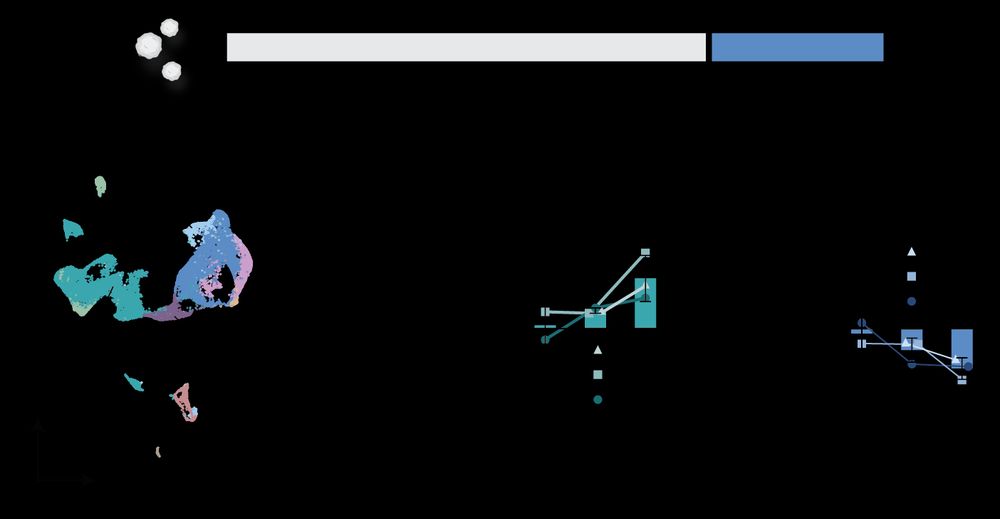
Once we knew Pb was getting into cells, we next wanted to know how it affected neural differentiation. One of the most striking observations we saw across multiple hiPSC lines was a shift in cell fate away from astrocytes and towards excitatory neurons.
21.08.2025 19:02 — 👍 0 🔁 0 💬 1 📌 0
Could we then observe Pb being actively taken up by human neural cells? Yes! A human Pb sensor (leadmium) let us literally watch Pb uptake over the course of several hours into human neurons and astrocytes.
21.08.2025 19:02 — 👍 0 🔁 0 💬 1 📌 0
One of the first challenges we had was figuring out how much Pb to give to human cells to reflect true exposure levels. We dug through the literature for relevant Pb levels in brain and then empirically correlated this with exposure paradigms that resulted in similar tissue levels in human organoids
21.08.2025 19:02 — 👍 0 🔁 0 💬 1 📌 0We decided to investigate one of the most infamous and widely prevalent neurotoxicants—Lead (Pb). In the US, approximately 2.5% of pregnant women exhibit high blood Pb levels (!!!) What is the consequence of this on the developing human brain?
21.08.2025 19:02 — 👍 0 🔁 0 💬 1 📌 0There's so much more packed into this pre-print, so please check it out as we continue to work on these questions!!!
30.06.2025 18:25 — 👍 1 🔁 0 💬 1 📌 0We think there are important implications here. Can astrocyte reactivity be reversed in the setting of neurologic disease? Why do astrocytes present peptides via MHCII? Why is there a delay before this starts? Is this pro- or anti-inflammatory for T-cells???
30.06.2025 18:25 — 👍 2 🔁 0 💬 1 📌 0
Then we tried something fancier. We isolated peptides from human neurons and co-cultured with astrocytes in the presence of cytokines. After MHCII pulldown and MS we found lots of neuronal peptides associated with MHCII (and not cleaved by trypsin, so probably processed by cellular machinery)!
30.06.2025 18:25 — 👍 0 🔁 0 💬 1 📌 0
What could astrocytes be presenting? This is really hard to figure out in human models, but we took a stab at it. We pulled down MHCII proteins in astrocytes and performed mass spec to see what peptide fragments came with it. We found lots of expected proteins related to MHCII processing (phew).
30.06.2025 18:25 — 👍 0 🔁 0 💬 1 📌 0
I know what you're thinking. It's some artifact related to organoids. But no! We see the same thing in primary human cortical slices. We see MHCII at the cell surface AND we see CD74 loaded onto MHCII only in the presence of inflammatory cytokines.
30.06.2025 18:25 — 👍 1 🔁 0 💬 1 📌 0
ok, but surprise! Remember those time-dependent genes that only turn on with prolonged inflammatory exposure? Almost all were related to MHCII presentation. We thought this must be a mistake. Astrocytes are not canonical antigen presenting cells! But we see this also by protein staining.
30.06.2025 18:25 — 👍 2 🔁 0 💬 1 📌 0
More to come on that in a sec. But FIRST! We had another question. If you make the astrocytes "reactive", can they reverse back to a "normal" state if you remove the inflammatory cue? Does it matter how long the initial inflammatory signal lasts before withdrawing it? The answer is generally, YES!
30.06.2025 18:25 — 👍 0 🔁 0 💬 1 📌 0
At both transcriptomic and chromatin accessibility levels we found evidence of genes/loci that respond IMMEDIATELY to cytokine exposure (time-independent), but also a group of genes/loci who expression/accessibility was dependent on the duration of exposure (time-DEPENDENT)
30.06.2025 18:25 — 👍 0 🔁 0 💬 1 📌 0
So then we wondered whether it mattered how long astrocytes see an inflammatory environment. After all, some neurological injuries are very short-lasting, and others chronic. So, we exposed organoids (already aged to have astrocytes) to very short (1 day) or long (3 months) inflammatory periods.
30.06.2025 18:25 — 👍 1 🔁 0 💬 1 📌 0