
MindAI?
20.01.2026 09:44 — 👍 2 🔁 0 💬 1 📌 0MindAI?
20.01.2026 09:44 — 👍 2 🔁 0 💬 1 📌 0
Our group has been looking at beta bursts for the last 5 years, but we do it a little differently than most - we group into types them based on their waveforms. In this open access article we lay out why and what we think this might mean
journals.sagepub.com/doi/10.1177/...
#neuroskyence
New preprint w/ Malin Styrnal & @martinhebart.bsky.social
Have you ever computed noise ceilings to understand how well a model performs? We wrote a clarifying note on a subtle and common misapplication that can make models appear quite a lot better than they are.
osf.io/preprints/ps...

1/7 New preprint on the role of insular traveling waves in memory and behavior, using depth recordings from neurosurgical patients, with @chenwumd.bsky.social, Sameer Sheth, and Josh Jacobs.
www.biorxiv.org/content/10.1...
Phase-locking as a complementary code to rate code in the human hippocampus.
Happening today (13:00-17:00) at poster TT11.
#sfn25
Good question! I'll reach out to the surgeons.
18.11.2025 19:35 — 👍 1 🔁 0 💬 0 📌 0Happening today! #HSN25
14.11.2025 15:23 — 👍 0 🔁 0 💬 0 📌 0
#SfN Poster ⬇️
We report rate-independent, location-specific phase locking in human hippocampus, and episode-specific phase coding during memory.
Bring your critique - any feedback welcome! Poster attached.
#SfN25 | PSTR362.24 (Human Navigation) — Tue Nov 18, 1–5 pm, SDCC Halls B–H.

Come and visit my poster at HSN (Poster B12; Fri Nov 14, 12:45–2:30)!
Neuropixels in human hippocampus (anesthesia). Neurons show strong tracking of the auditory envelope of sound cues. No evidence for sound-evoked spatial reactivation. Come and have a look! Poster attached.
#HSN25
Read Quirogas Letter here: tinyurl.com/2zffa3dd
Read our original Opinion piece here: tinyurl.com/wm8m52pn


Despite recent criticism from Quiroga to our claim that Concept Neurons emerge from Conjunctive Coding Neurons we claim: “And yet, the hippocampus codes conjunctively!”.
We hope it sparks a smile (and maybe a few debates).
Read here: tinyurl.com/3ycv3vj2
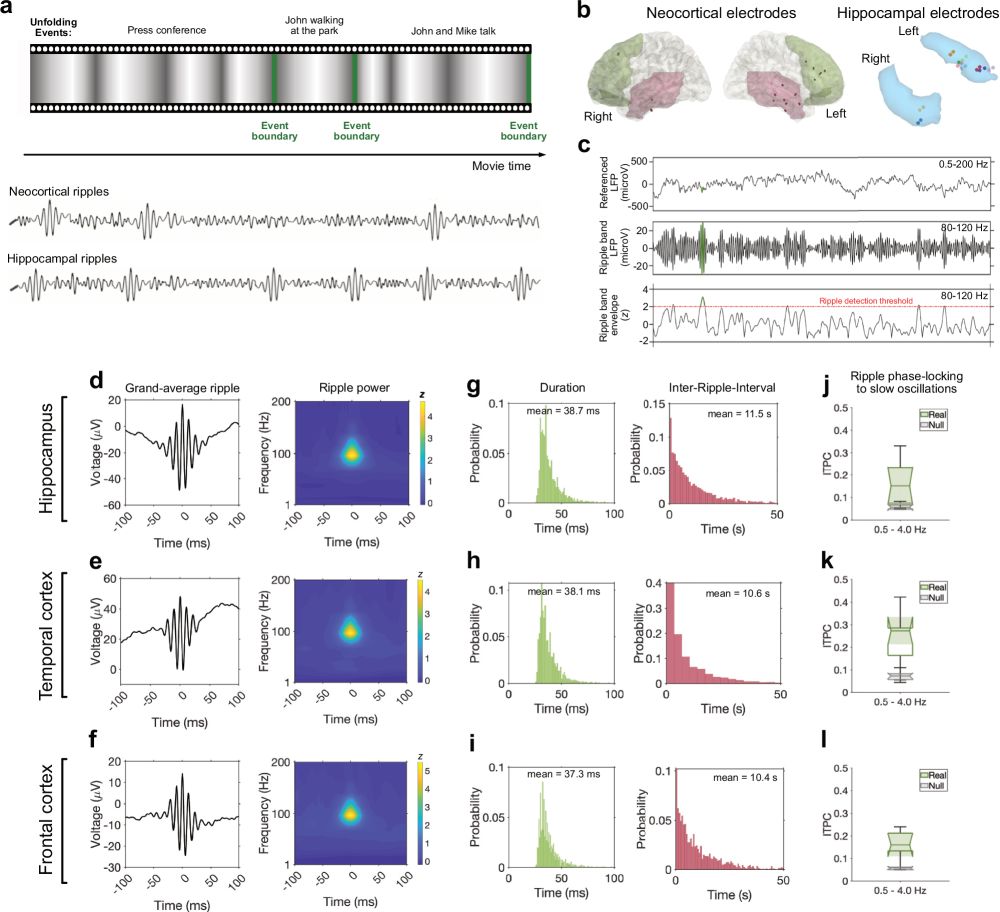
🧠 Paper out!
We investigated how hippocampal and cortical ripples support memory during movie watching. We found that:
🎬 Hippocampal ripples mark event boundaries
🧩 Cortical ripples predict later recall
Ripples may help transform real-life experiences into lasting memories!
rdcu.be/eui9l
New preprint from the team at BCM Neurosurgery, led by superstar neuroscientist / neurosurgeon Vigi Katlowitz! “Attention is all you need (in the brain): semantic contextualization in human hippocampus” 🧵
www.biorxiv.org/content/10.1...

Hi Bluesky! First post here. Kicking things off with a new preprint.
🧠 Using human iEEG + pharmacology, we asked: is hippocampal theta required for retrieval?
Turns out it’s not. Instead, it may reflect a reinstated encoding mode.
Thread below.
www.biorxiv.org/content/10.1...
Cool finding!
As a side question, do you know if aphantasics dream visually? I.e., is the lack of visual imagery tied to being awake or is it a general experience?

We are recruiting for 5 permanent staff positions (Prof, Senior-, Lecturer) including for 7T-MRI. Please have a look and share widely.
(Closing date: May 12)
www.nature.com/naturecareer...
Did you give Fiverr a go? I have had good experience with them for illustrations.
03.04.2025 19:09 — 👍 1 🔁 0 💬 0 📌 0Congratulations of the new position!!
03.04.2025 19:06 — 👍 0 🔁 0 💬 1 📌 0Thank you, Sarah!
08.03.2025 18:31 — 👍 0 🔁 0 💬 0 📌 0Thank you to my fantastic co-authors on this project: Sheena Josselyn and Simon Hanslmayr who have been an absolute joy to work with. 15/15
05.03.2025 17:43 — 👍 3 🔁 0 💬 0 📌 0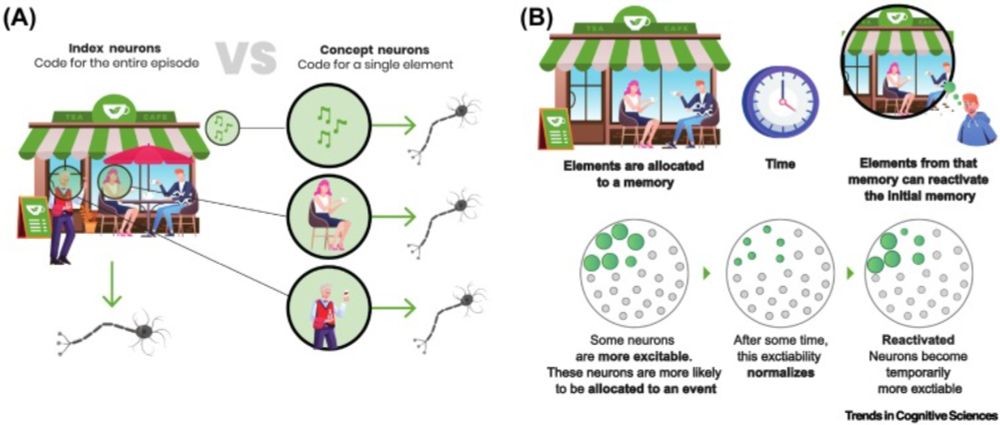
Check out our opinion paper for more on engrams, and the role of hippocampal subfields, inherent connectivity, inhibitory neurons, and schemas in the hippocampus: www.cell.com/trends/cogni... 14/15
05.03.2025 17:43 — 👍 4 🔁 0 💬 1 📌 0We believe that focusing on computational principles allows a more fruitful discourse between researchers studying different species. 13/15
05.03.2025 17:43 — 👍 1 🔁 0 💬 1 📌 0This process shows how index neurons, initially coding for specific episodes, may semanticize over repeated experiences into concept neurons linked to the shared element across all episodes: the friend. 12/15
05.03.2025 17:43 — 👍 1 🔁 0 💬 2 📌 0Meeting the same friend at the movies repeats this process, a subset of neurons now codes for all three episodes. 11/15
05.03.2025 17:43 — 👍 1 🔁 0 💬 1 📌 0
Meeting a friend in a cafe is allocated to more excitable green neurons.
Later seeing the same friend in the park reactivates the cafe memory, increasing the excitability of the initially allocated neurons. A subset of these neurons are also allocated to the park episode. 10/15
Overlapping memories transform a subset of index neurons into concept neurons. Keep in mind according engram research, more excitable neurons are more likely to be allocated to an episodic memory and recently active neurons become more excitable. 9/15
05.03.2025 17:43 — 👍 1 🔁 0 💬 1 📌 0Center: Over time, excitability normalizes (smaller green circles). Right: Reactivation (e.g., seeing the café again) boosts excitability allowing linking of memories. 8/15
05.03.2025 17:43 — 👍 1 🔁 0 💬 1 📌 0
Left: When an episodic memory (e.g., meeting a friend at a café) is formed, certain neurons in a heightened excitability state form an engram (larger green circles). 7/15
05.03.2025 17:43 — 👍 1 🔁 0 💬 1 📌 0Right panel: Under the concept neuron framework, each neuron codes a distinct element, and their concurrent activity represents the entire event. 6/15
05.03.2025 17:43 — 👍 2 🔁 0 💬 1 📌 0
Left panel: According to the Indexing Theory, index neurons in the hippocampus conjunctively link various elements of an episode (e.g., loungy jazz music, your friend, the waiter). 5/15
05.03.2025 17:43 — 👍 1 🔁 0 💬 1 📌 0