De novo emergence of metabolically active protocells
A continuous route from a disordered soup of simple chemical feedstocks to a functional protocell -- a compartment that metabolizes, grows, and propagates -- remains elusive. Here, we show that a homo...
Protocells from three inorganic salts, some formaldehyde and water?
They grow? They synthesise organic molecules of core biomolecular classes: amino acids, sugars, lipid-like motifs?
And, there are similar structures in today's oceans?
Yes! Read on.
arxiv.org/abs/2601.11013
13.02.2026 19:05 —
👍 12
🔁 7
💬 2
📌 4
YouTube video by Prof Mahesh Panchagnula
CRISPR, Vaccines & Biotech: Exploring Life Sciences with Prof. Mukund Thattai | Episode 22
It was a pleasure talking to Prof. Mahesh Panchagnula of IITM for his podcast.
Our conversation went far beyond career advice, covering how living systems work, the role of math in the life sciences, and where groundbreaking discoveries in biology come from.
youtu.be/wZeUX3G13pk?...
01.10.2025 05:46 —
👍 6
🔁 1
💬 0
📌 0

Representation of spherical harmonics as lobed objects, indexed by l, m.
Clearly these are spherical harmonics...
26.08.2025 05:08 —
👍 8
🔁 1
💬 1
📌 0
Gutting the humanities will not save the sciences. This piece is worth reflecting on: "The broad liberal arts education Carl Sagan received at the University of Chicago played an important role in his development as a scientist and intellectual."
www.loc.gov/collections/...
24.08.2025 12:26 —
👍 4
🔁 1
💬 0
📌 0
It's a great time to be studying eukaryogenesis, with so much new experimental data from diverse species. I want to thank several folks with whom I've been discussing these ideas for many years, especially @buzzbaum.bsky.social, @gautamdey.bsky.social, @ishier.bsky.social, @dackslabecb.bsky.social.
04.08.2025 20:40 —
👍 6
🔁 0
💬 0
📌 0
A Tubules-First Model for the Origin of Eukaryotic Membrane Traffic
Open questions remain. Intracellular membranes have not so far been confirmed in Asgard archaea. And what of the origin of other eukaryotic organelles? Could they be stabilised versions of ancient tubular carriers? I'd love to hear your thoughts!
New preprint: ecoevorxiv.org/repository/v...
04.08.2025 20:34 —
👍 6
🔁 2
💬 1
📌 0

Diagram showing Asgard ESP homologs involved in the generation of tubular membrane carriers in modern eukaryotes. The left panel lists sequential stages of carrier generation: initiation, cargo loading, tubulation, scission, tethering, and fusion, with associated protein complexes such as Arf GTPases, BAR domain proteins, ESCRTs, and SNAREs. The right panel shows a stylized eukaryotic cell, indicating sites where tubular carriers are found in present-day eukaryotes (ER exit site, endosome/TGN, plasma membrane).
A closer look shows that in present-day eukaryotes these Asgard ESPs are involved in the generation of tubular carriers at the ER, endosomes/TGN, and at the plasma membrane. In the review I discuss several new studies showing that Asgard versions of these proteins can indeed generate tubules!
04.08.2025 20:34 —
👍 5
🔁 0
💬 1
📌 0

AlphaFold-based structural alignments of Asgard archaeal (red) and eukaryotic (blue) homologs of membrane trafficking proteins. Shown are COPII component Sec24, TRAPP subunit TRAPPC3, AP2 μ and σ subunits, ESCRTIII protein CHMP1B, retromer component VPS29, BAR domain protein Arfaptin, and CORVET/HOPS subunit VPS16. Each pair except CORVET/HOPS show strong structural similarity despite the evolutionary distance.
Asgard archaeal genomes encode many eukaryotic signature proteins, previously thought to be restricted to eukaryotes. In modern eukaryotes several of these ESPs are involved in membrane traffic. But Asgard archaea lack canonical vesicle coats. So what were these proteins doing in FECA?
04.08.2025 20:34 —
👍 5
🔁 0
💬 1
📌 0

A simplified evolutionary tree showing how eukaryotes arose from a merger between Asgard archaea (green) and α-proteobacteria (brown). Key nodes include LUCA (last universal common ancestor), FECA (archaeal first eukaryotic common ancestor), FMCA (first mitochondrial common ancestor) and LECA (last eukaryotic common ancestor). The mitochondrial endosymbiosis event is highlighted.
Eukaryotes arose via a merger between archaea and bacteria, with eukaryotic traits emerging gradually on the path from FECA (the archaeal first eukaryotic common ancestor) to LECA (last eukaryotic common ancestor). What if FECA was already an atypical archaeon with rudimentary eukaryote-like traits?
04.08.2025 20:34 —
👍 2
🔁 0
💬 1
📌 0
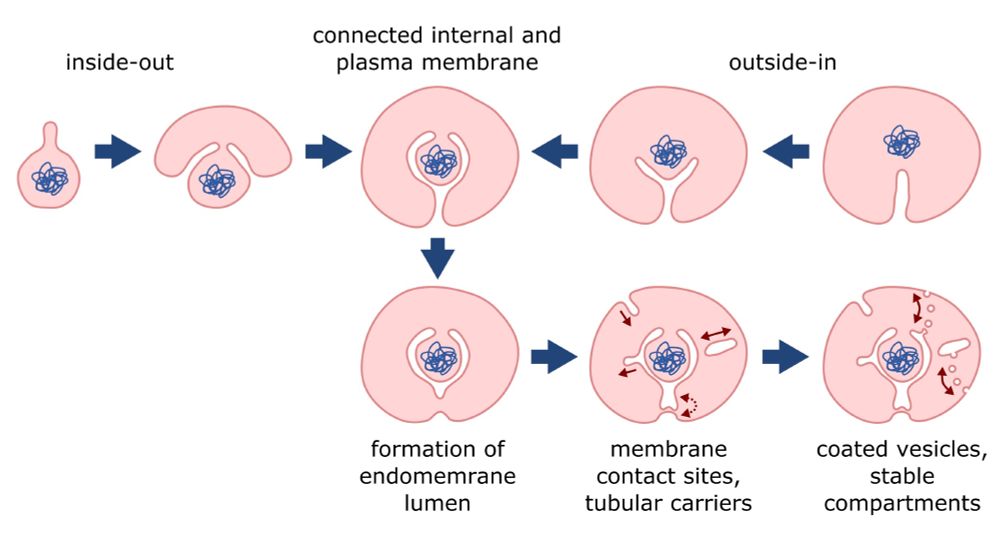
A schematic showing two models for the evolution of the eukaryotic cell plan starting from an archaeal ancestor. The "inside-out" and "outside-in" models both lead to an intermediate stage with internal and plasma membranes connected by tubules. The sequence continues through the formation of an endomembrane lumen, followed by the emergence of membrane contact sites and tubular carriers, and finally coated vesicles and stable compartments.
I set out to review the evolution of eukaryotic intracellular traffic, but along the way a new hypothesis came into focus: maybe the earliest membrane carriers were tubules, not coated vesicles!
New preprint: ecoevorxiv.org/repository/v...
Here’s the idea. 🧵
04.08.2025 20:34 —
👍 42
🔁 15
💬 4
📌 1
The week after that, I'll be at Statphys29 in Florence.
At both meetings I'll speak about new work on the evolution of complex vesicle traffic networks in proto-eukaryotes.
Looking forward to catching up with many old friends on this trip!
statphys29.org/plenary-and-...
06.07.2025 16:54 —
👍 0
🔁 0
💬 0
📌 0
I'll be in Kyoto all week, at the joint meeting of the Asian International Conference on Mathematical Biology & Japanese Society for Mathematical Biology.
It features a broad lineup of topics and interesting talks, with speakers from across Asia and the world. pub.confit.atlas.jp/en/event/acm...
06.07.2025 16:15 —
👍 0
🔁 0
💬 1
📌 0

Snakebite capital | What India must get right
Discover how experts in India are revolutionizing snakebite treatment and research to save lives and protect communities.
New efforts in conservation and venom research are helping humans and snakes co-exist. So many interesting facts I did not know, in this great piece by Indulekha Aravind.
www.thehindu.com/society/indi...
06.07.2025 04:34 —
👍 2
🔁 0
💬 0
📌 0
A truly unexpected discovery, and an important insight into how "life finds a way"!
21.06.2025 05:41 —
👍 6
🔁 0
💬 0
📌 0

The solution to the puzzle involves modifying paths in an Nx3 array of squares. First, replace each diagonal step with a special point to its top left. Then associate a minus sign with every edge below that point. The first three columns correspond to X, Y, Z. The image shows examples of this transformation, with the original path on the left and the modified path on the right. Below the modified path is the coordinate of a specific cube in the octahedron, e.g. X-2Z is one positive step in the X direction and two negative steps in the Z direction. The path endpoints correspond to the specific "layer" of each cube in the octahedron (0 is the central cube, and 1, 2, 3 are successive layers). This construction clearly generalises to more dimensions (more columns to the right) and more layers (more rows on top).
Great puzzle @nedbat.com @wang.social. The trick was to find enough minus signs! Here's the answer: Replace each diagonal with a special point to its top left, and associate ALL edges below with a minus sign. The first three columns are X,Y,Z. This gives coordinates of each cube in the octahedron.
17.06.2025 12:17 —
👍 2
🔁 0
💬 0
📌 0
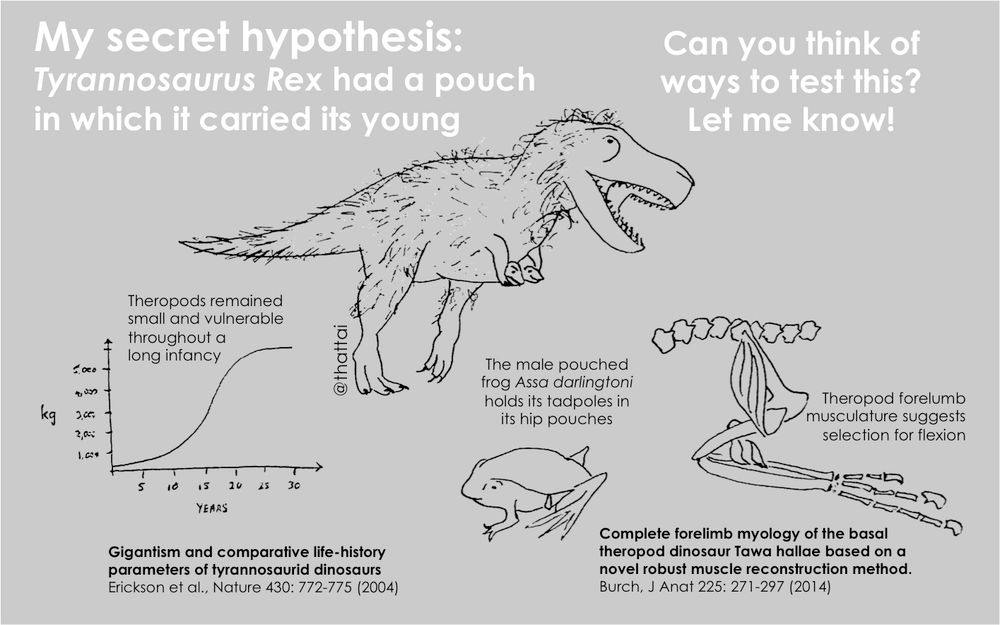
Sketch of T. Rex and references to papers regarding possible use of forelimbs. Caption: "My secret hypothesis: Tyrannosaurus Rex had a pouch in which it carried its young. Can you think of ways to test this? Let me know!"
My secret hypothesis
24.01.2025 14:38 —
👍 5
🔁 0
💬 0
📌 0
YouTube video by Bangalore Literature Festival (blrlitfest)
Light Years in Lines: How Science Speaks
Video of our #blrlitfest panel discussion "Light Year in Lines: How Science Speaks" is now online!
As I started by saying: only in Bangalore would the science session draw a bigger crowd than any other session at a litfest!
www.youtube.com/watch?v=5Oq0...
24.01.2025 04:14 —
👍 4
🔁 1
💬 0
📌 0

Photo of Jawaharlal Nehru and MIT President James Killian, 1949. Courtesy of the MIT Museum.

Cover of "The Technological Indian" by Ross Bassett.
Bal Gangadhar Tilak looked to MIT as a model for India to emulate. Many MIT students interacted with Gandhi. MIT helped establish IITs in post-independence India.
These and other chapters in the long engagement between MIT and India are chronicled in Ross Bassett's book "The Technological Indian".
21.01.2025 05:38 —
👍 0
🔁 0
💬 0
📌 0

Ranu Boppana and Mukund Thattai, with other visitors at the exhibit.

Photograph of Almitra Patel from MIT yearbook, 1958. Image courtesy of Almitra H (Sidhwa) Patel.
This is the first time the exhibit has been shown outside MIT. It grew out of a collaboration between MIT history professor Sana Aiyar, Ranu Boppana and Nureen Das.
Here's a sample from the exhibit: the 1958 yearbook photo of Almitra Patel, the first South Asian woman to receive a degree at MIT.
21.01.2025 05:37 —
👍 0
🔁 0
💬 1
📌 0

Photo of Jawaharlal Nehru and MIT President James Killian, 1949. Courtesy of the MIT Museum.

Cover of "The Technological Indian" by Ross Bassett.
Bal Gangadhar Tilak looked to MIT as a model for India to emulate. Many MIT students interacted with Gandhi. MIT helped establish IITs in post-independence India.
These and other chapters in the long engagement between MIT and India are chronicled in Ross Bassett's book "The Technological Indian".
19.01.2025 16:19 —
👍 2
🔁 0
💬 1
📌 0

Timeline
It was great to see the exhibit "South Asia and the Institute" at Science Gallery Bengaluru.
MIT played an outsized role in pre- and post-independence India, beginning with the first Indian student in 1882 (when MIT was barely two decades old!) digital-exhibits.libraries.mit.edu/s/south-asia...
19.01.2025 16:19 —
👍 6
🔁 1
💬 1
📌 0

Raj Rewal, Untitled Work, circa 1965, coloured ink on paper.
Raj Rewal, whose iconic brutalist Hall of Nations in New Delhi was demolished by the government in 2017, is also the architect of the National Centre for Biological Sciences campus. The nonagenarian recently shared his striking sketches from the 1960s: www.architecturaldigest.in/story/master....
02.01.2025 06:37 —
👍 7
🔁 2
💬 0
📌 0
Quintumble - Dec 26, 2024
🎯 100 🟪 0 ⌛ 00:24
26.12.2024 07:00 —
👍 1
🔁 0
💬 1
📌 0

Clam shell with a pattern that resembles a map of continents around the Indian ocean.
Map of Asia, Africa and Europe, in the little-known Mollusc projection.
24.12.2024 14:00 —
👍 6
🔁 1
💬 0
📌 0

Session information text - Light Years in Lines: How Science Speaks. Annapurni Subramaniam, Anil Ananthaswamy, Simon Singh, Venki Ramakrishnan, with Mukund Thattai. Sunday 15 December 4:45 PM. Waterfront, Lalit Ashok. Free Entry. blrlitfest.org.
Technology shouts for itself; science is more abstract and subtle. We cannot assume that the value of science is self-evident to the public.
In "How Science Speaks", we will hear how scientists and science writers communicate complex ideas about the history and practice of science to non-experts.
12.12.2024 05:57 —
👍 6
🔁 2
💬 1
📌 1
Lots of excitement at the #MCBM workshop as participants image #UExM gels! NCBS pond is packed with biodiversity! Thanks @thattai.bsky.social, Sonia Sen & Anshika Singh for putting together a fantastic workshop. It has been a blast interacting with all the fantastic participants & TAs!
09.12.2024 13:11 —
👍 12
🔁 3
💬 0
📌 2
Not live streamed, but the sessions will be recorded and posted on YouTube later.
08.12.2024 01:24 —
👍 1
🔁 0
💬 0
📌 0

Schedule 2024 - Bangalore Literature Festival 2024
Schedule for Bangalore Literature Festival 2024.
#blrlitfest on Dec 15th: I'll anchor a panel on
"How Science Speaks" with science writers @anilananth.bsky.social and @simonsinghnerd.bsky.social, astrophysicist Annapurni Subramaniam, and structural biologist Venki Ramakrishnan.
It's free, do attend!
bangaloreliteraturefestival.org/year-2024/sc...
07.12.2024 04:10 —
👍 4
🔁 2
💬 2
📌 0

Participants listen to a lecture on expansion microscopy

Teaching lab set up for hands-on sessions
Our workshop has kicked off! Amazing instructors Aditya Nayak, @hiralshah.bsky.social and @stpalli.bsky.social will teach participants from all over India how to use expansion microscopy, holography and a flatbed scanner to study the shapes and structures of protists! www.ncbs.res.in/events/marin...
04.12.2024 00:21 —
👍 7
🔁 2
💬 0
📌 1
Nov 20
🎯 76 🟪 0 ⌛ 24:41
Nov 21
🎯 99 🟪 0 ⌛ 01:11
Nov 22
🎯 97 🟪 0 ⌛ 03:25
Nov 23
🎯 99 🟪 0 ⌛ 01:47
Nov 24
🎯 93 🟪 0 ⌛ 07:05
Nov 25
🎯 98 🟪 0 ⌛ 02:04
Nov 26
🎯 98 🟪 0 ⌛ 02:09
Nov 27
🎯 99 🟪 0 ⌛ 01:18
Nov 28
🎯 99 🟪 0 ⌛ 01:35
Nov 29
🎯 96 🟪 0 ⌛ 04:14
29.11.2024 03:57 —
👍 1
🔁 0
💬 1
📌 0