Submit a Science Spotlight Proposal by 25 February.
Learn more.
Submit a science spotlight proposal to contribute to the scientific programming at #ISSCR2026! Organized by @ISSCR.org student & postdoc members, these sessions provide a fresh perspective on emerging scientific topics. Proposals are due 25 February invt.io/1bxblv0w3zj
19.01.2026 17:01 —
👍 1
🔁 1
💬 0
📌 0

Join me at the ISSCR 2026 Annual Meeting!
Register now
There are many ways to make your voice heard and participate in all that #ISSCR2026 has to offer! Discover how to get involved, including submitting an abstract, proposing a science spotlight, hosting a meet-up hub, and more! invt.io/1bxbhh15upf @ISSCR.org
05.11.2025 16:02 —
👍 3
🔁 1
💬 0
📌 0

I'm an ISSCR 2026 Ambassador, join me!
Register now
Thrilled to be selected as an #ISSCR2026 Ambassador! The @isscr.org 2026 Annual Meeting will take place in Montréal, Canada on 8-11 July 2026 & features 4 days of scientific sessions with talks from global researchers! Explore the scientific program and the ways to participate. invt.io/1bxb53avp9c
20.10.2025 21:06 —
👍 4
🔁 1
💬 0
📌 0

Our next #DevPres webinar focusses on gut development with talks from Surojit Sural @surojitsural.bsky.social, Swarnabh Bhattacharya @iamzico.bsky.social and Brittany Edens, chaired by Alex Eve @amjeve.bsky.social.
📆 17 September, 15:00 BST (UTC+1)
Register here: us02web.zoom.us/webinar/regi...
04.09.2025 10:37 —
👍 6
🔁 4
💬 0
📌 1
Thanks to @rkzwick.bsky.social for writing this excellent preview and thoughtful discussion on our recent article @cp-cellstemcell.bsky.social (t.co/TkDxt1b3DH)
27.06.2025 21:30 —
👍 2
🔁 1
💬 0
📌 0
Honored to receive a Pilot & Feasibility grant (P30 DK034854) from the Harvard Digestive Disease Center to explore cellular plasticity and the epigenetic drivers of inflammatory bowel disease. Excited to uncover new insights into IBD pathogenesis!
09.06.2025 01:08 —
👍 0
🔁 0
💬 0
📌 0

To play Paneth or goblet: Shapeshifting secretory cells read the room
The intestinal secretory lineage is thought to comprise four distinct cell types derived
from one Atoh1+ progenitor, but the mechanisms that distinguish Paneth and goblet
cells are unclear. Bhattachar...
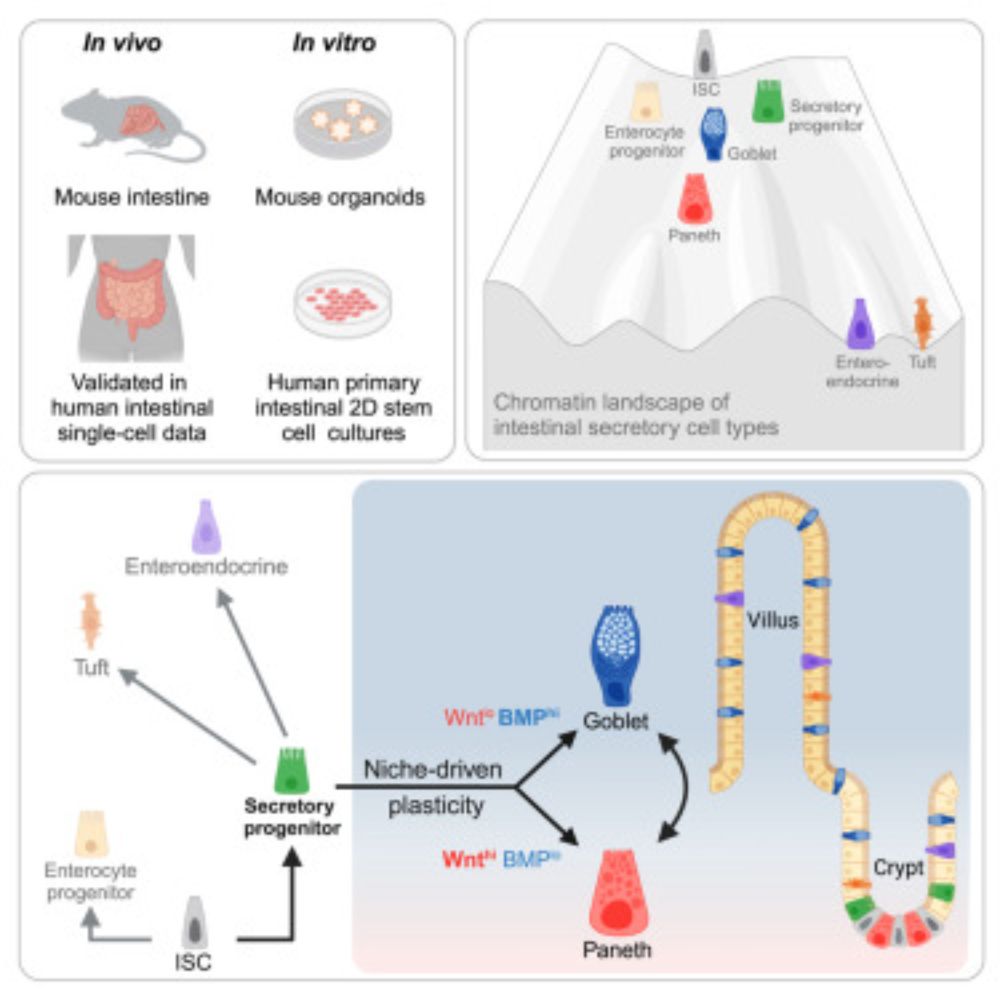
I’m thrilled to have our work—“Intestinal secretory differentiation reflects niche-driven phenotypic plasticity of a common signal-responsive terminal cell” (dlvr.it/TK2Fzl) featured in the Preview of this issue of @cp-cellstemcell.bsky.social!
07.06.2025 01:33 —
👍 5
🔁 1
💬 0
📌 0
Check out this exciting preprint from @aznarbenitahlab.bsky.social discovering a new mode of crosstalk between YAP and the circadian regulator BMAL1. Congrats @juliabonjoch.bsky.social and @guiomarsolanas.bsky.social for fantastic work and thank you for the fun collaboration!
23.04.2025 19:32 —
👍 9
🔁 3
💬 2
📌 0
I want to give a big shoutout to my mentor Ramesh Shivdasani, my fellow lab members, and all the fantastic collaborators. It was an excellent team effort.
Here is a link to the full text: authors.elsevier.com/c/1kusf6tu0C...
#PanethCell #GobletCell #Epigenetics #IntestinalBiology
08.04.2025 16:43 —
👍 1
🔁 0
💬 0
📌 0
A minority of enhancers are uniquely activated in Paneth cells under Wnt-favored conditions, shedding light on how epigenetic priming directs cell function along the crypt–villus axis.
08.04.2025 16:43 —
👍 0
🔁 0
💬 1
📌 0
Beyond phenotypic plasticity, our study maps cis-regulatory dynamics of intestinal secretory differentiation: Tuft and EE cells display thousands of unique enhancers, while many goblet and Paneth enhancers are shared with intestinal stem cells.
08.04.2025 16:43 —
👍 0
🔁 0
💬 1
📌 0
These insights redefine how we think about cell fate in the intestinal epithelium. Instead of being fixed identities, goblet and Paneth cells may be viewed as flexible, context-dependent states—a paradigm shift with potential implications for understanding intestinal diseases.
08.04.2025 16:43 —
👍 0
🔁 0
💬 1
📌 0

a cartoon penguin is holding a red uno card with two arrows pointing in opposite directions
ALT: a cartoon penguin is holding a red uno card with two arrows pointing in opposite directions
A striking aspect of our findings is the reversible nature of this phenotypic switch. Even post-mitotic cells can rapidly convert their secretory identity in response to local niche signals—a process underpinned by dynamic chromatin changes.
08.04.2025 16:43 —
👍 0
🔁 0
💬 1
📌 0
Under forced Wnt and especially low BMP conditions, goblet cells gain Paneth features; conversely, BMP exposure potently suppresses Paneth markers and enhances goblet gene expression both in mouse and primary human 2D culture cells.
08.04.2025 16:43 —
👍 0
🔁 0
💬 1
📌 0
Experimentally, we demonstrated this plasticity by altering Wnt/BMP levels in vivo (e.g., via Apc deletion and RSPO modulation) and in organoid cultures.
08.04.2025 16:43 —
👍 0
🔁 0
💬 1
📌 0
Niche signals play a pivotal role! High Wnt and low BMP signaling, characteristic of the crypt base, push ATOH1+ cells to adopt a Paneth profile, while increased BMP (and lower Wnt) as cells move up the crypt drive a goblet cell phenotype.
08.04.2025 16:43 —
👍 0
🔁 0
💬 1
📌 0

a man in a suit and tie is smiling in front of a crowd while wearing sunglasses .
ALT: a man in a suit and tie is smiling in front of a crowd while wearing sunglasses .
Our data show that both cell types originate from a common ATOH1+ secretory progenitor. Rather than being independently specified, goblet and Paneth cells share most mRNAs and many regulatory elements—only a few key antimicrobial genes differentiate them.
08.04.2025 16:43 —
👍 0
🔁 0
💬 1
📌 0

a cartoon of two spidermans standing in front of a nypd van
ALT: a cartoon of two spidermans standing in front of a nypd van
Using lineage tracing with Atoh1Cre-ER mice, along with single-cell RNA and chromatin accessibility (snATAC-seq) analyses, we found an unexpectedly high overlap in the transcriptomes and epigenetic landscapes of goblet and Paneth cells.
08.04.2025 16:43 —
👍 0
🔁 0
💬 1
📌 0
The intestinal epithelium renews rapidly from stem cells, generating absorptive enterocytes and secretory cells. While enteroendocrine and tuft cells follow distinct trajectories, goblet and Paneth cells have long been thought of as separate terminal fates—until now.
08.04.2025 16:43 —
👍 0
🔁 0
💬 1
📌 0

Different fibroblast subtypes propel spatially defined ileal inflammation through TNFR1 signaling in murine ileitis @naturecomms.bsky.social
www.nature.com/articles/s41...
28.03.2025 19:19 —
👍 2
🔁 1
💬 0
📌 0

Multiple layers of γδ IEL dysregulation and loss of their immunosuppressive capacity occur before the onset of chronic ileitis
www.science.org/doi/10.1126/...
@nbgolovchenko.bsky.social @sciimmunology.bsky.social @edelblumlab.bsky.social
21.03.2025 18:31 —
👍 8
🔁 4
💬 0
📌 0

Vagal pathway activation links chronic stress to decline in intestinal stem cell function @cp-cellstemcell.bsky.social
www.cell.com/cell-stem-ce...
21.03.2025 19:08 —
👍 9
🔁 2
💬 0
📌 0

🔦Spotlight of Peter Dempsey, @brumbaugh-lab.bsky.social et al paper: Epigenetic fluidity meets phenotypic malleability in intestinal epithelial cells by @iamzico.bsky.social and Ramesh Shivdasani at @danafarber.bsky.social http://dlvr.it/TJfVRZ
20.03.2025 21:01 —
👍 5
🔁 1
💬 0
📌 1

It was fun to write this Spotlight article @cp-cellchembiol.bsky.social on the recent NCB paper (rdcu.be/eayN3) by @brumbaugh-lab.bsky.social & Dempsey labs, revealing how epigenetic fluidity drives phenotypic malleability in the intestinal epithelium. www.sciencedirect.com/science/arti...
20.03.2025 15:30 —
👍 2
🔁 0
💬 0
📌 0