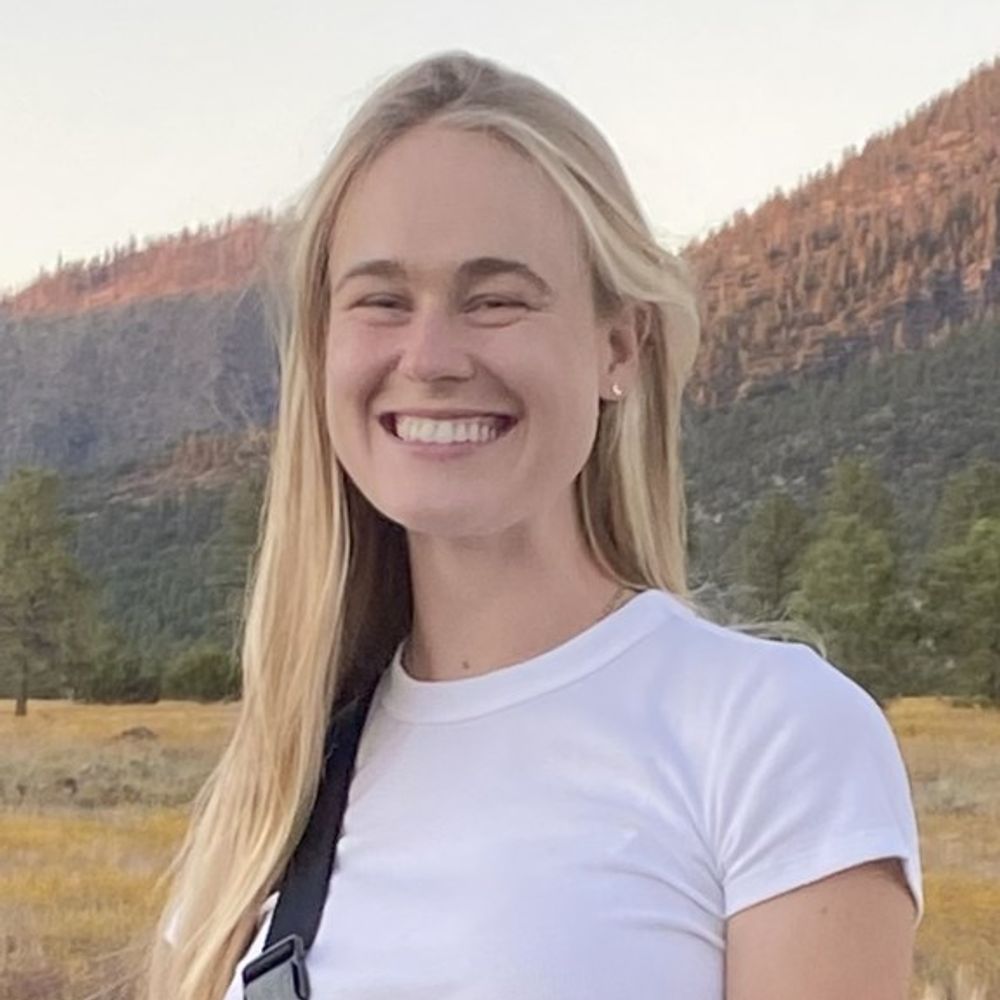
Very excited to share that I am heading to CU Boulder this May for the 2026 ESIIL Innovation Summit! 🏔️💻
We will be spending the week focused on AI for Sustainability, Earth embeddings, and open environmental data. Can't wait to collaborate with this community.
26.02.2026 14:15 —
👍 0
🔁 0
💬 0
📌 0

Home | Bea Bock - Studying Plant-Fungal Associations
Researching how plants and fungi associate. Currently searching for Postdoc opportunities. Beatrice Bock (included for searchability).
Finally gave my digital home a renovation! 🛠️
I moved away from just listing dissertation chapters to sharing actual resources. You can now find my open-source R packages (nanodRop), wet lab protocols, and NLP workflows all in one place.
Open science or bust! 🧬💻
beabockm.wixsite.com/bea-bock
24.02.2026 14:54 —
👍 0
🔁 1
💬 14
📌 0

People often assume Arizona is just saguaros and heat. Meanwhile, Flagstaff is doing this. ❄️
The roads are messy, but the coding productivity is high today. Hunkering down with data pipelines now (and dreaming of thawing out in there later). Stay warm, friends!
19.02.2026 14:54 —
👍 2
🔁 1
💬 0
📌 0

Beyond ’survival’ of the fittest: Evolution works in teams - Binghamton News
Review of scientific studies shows that natural selection operates on multiple levels
Press release by @binghamtonu.bsky.social about our @frontiersin.bsky.social in #Ecology & #Evolution rev: “Abundant empirical evidence of multilevel selection revealed by a bibliometric review”.
Natural selection operates from molecules to ecosystems.
#MLS
www.binghamton.edu/news/story/6...
17.02.2026 14:32 —
👍 5
🔁 3
💬 0
📌 0
Predicting forest decline requires us to bridge this gap between above- and belowground biodiversity. As I look at my own cottonwood data, this paper remains a vital benchmark for what’s happening at scale. 🧪📈 #ScienceSky #Mycorrhiza #Populus
17.02.2026 15:14 —
👍 0
🔁 0
💬 0
📌 0
My favorite findings: AMF become more common with increased temperature, while EMF (diversity and presence) drops off. For trees that rely on EMF, the available and ideal fungal partners might be diminishing.
17.02.2026 15:14 —
👍 0
🔁 0
💬 1
📌 0
So kind - best of luck to you too :)
16.02.2026 20:28 —
👍 1
🔁 0
💬 0
📌 0

📢 A new publication from our team is now out in the
@ecologicalsociety.bsky.social BULLETIN!
👉 doi.org/10.1002/bes2...
It shows how community, collaboration, & multilingual science are not extras—they are essential for equity in ecology. 🌎
📢Please share to amplify Latin American voices!
30.01.2026 19:42 —
👍 21
🔁 10
💬 0
📌 0
Thank you :)
13.02.2026 20:28 —
👍 1
🔁 0
💬 1
📌 0

The Changing Chemistry of Invasive Death Cap Mushrooms
University of Wisconsin–Madison researchers just released a groundbreaking study on the same mushrooms behind an uptick in poisonings in California.
UW–Madison scientists have published new research about the makeup of death cap mushrooms (Amanita phalloides) after learning that its spread across continents has changed the chemistry of the species. 🍄🟫
12.02.2026 22:32 —
👍 452
🔁 115
💬 14
📌 4
Dissertation: SUBMITTED to my committee! 🥂🧬
It’s a strange feeling to finally hand over the document I’ve been living with for so long. Huge thanks to everyone who helped me get to this point. Next stop: PhD Defense! 🦋
#ScienceSky #PhDLife #BiologicalSciences #GradSchool
13.02.2026 18:43 —
👍 5
🔁 0
💬 1
📌 0
Grateful to the New Phytologist Foundation for making this possible. Can’t wait for some great science down under!
10.02.2026 16:03 —
👍 0
🔁 0
💬 0
📌 0
So excited to announce I've received the ECR Award from the International Mycorrhiza Society! I’ll be heading to Cairns, Australia this summer for ICOM as the North American travel award recipient.
10.02.2026 16:03 —
👍 3
🔁 0
💬 1
📌 0
YouTube video by Mycorrhizas
Pedro M. Antunes on fluid mechanics within mycorrhizal networks
I loved hosting this interview with Dr. Pedro M. Antunes for the South American Mycorrhizal Research Network!
We dove into the fluid mechanics of mycorrhizal networks and why biological sciences need more interdisciplinary physics thinking.
Watch here: youtu.be/zqaS6ZBimYA
09.02.2026 14:43 —
👍 3
🔁 0
💬 1
📌 0
So glad to finally be doing @carpentries.org Instructor Training! The focus on mental models and live coding feedback is a total game changer for how I approach technical workshops in the biosciences. Highly recommend for any researcher! 🧪✨
#Carpentries #ScienceSky #OpenScience
06.02.2026 18:05 —
👍 2
🔁 0
💬 0
📌 0

Using AI to Uncover the Secret Lives of Fungi | Blog
AI holds the potential to automatically identify fungal versatility from the available scientific literature.
A new study led by Northern Arizona University's @beabock.bsky.social demonstrates how a specialised language model called 𝐁𝐢𝐨𝐁𝐄𝐑𝐓 can scan decades of research in minutes to identify fungi, with almost 90% accuracy.
Read more about it on our blog: blog.pensoft.net/2026/02/05/u...
05.02.2026 08:19 —
👍 2
🔁 1
💬 1
📌 0
So grateful :)
04.02.2026 18:14 —
👍 1
🔁 0
💬 0
📌 0

🌱 IMS Early Career Researcher Travel Award 🍄
Congrats to Beatrice M. Bock USA
🏆 North America awardee
Supported by The New Phytologist Foundation @newphyt.bsky.social
This award supports her participation with oral presentation at #ICOM2026
#Mycorrhiza
04.02.2026 15:38 —
👍 4
🔁 7
💬 2
📌 0