Where Did Humans Evolve?
Gazing at the Changing Nature of the Garden of Eden
Where did humans evolve? What was the scenery like? And what should we make of the "savanna hypothesis"?
What a pleasure to find so much clarity on these questions!
My brilliant guest was Denise Su at ASU's Institute of Human
Origins! @asuiho.bsky.social.
🎧 Enjoy!
09.03.2026 07:06 —
👍 9
🔁 2
💬 0
📌 0
Priceless interview for all anthropologists and fieldworkers. Thank you, @ilarimakela.bsky.social & RB Lee!!
Lee’s discussions on establishing new field sites closely parallel my experiences in the Omo in Ethiopia with the @omovalleyresearchproject.org
07.03.2026 15:35 —
👍 13
🔁 4
💬 0
📌 0

The Original Affluent Society? Lessons from 60-Years of "Man the Hunter" Research
To mark the 60th anniversary of the 1966 'Man the Hunter' symposium, On Humans is proud to publish the first-ever podcast interview with Richard B. Lee.
It's out: the first ever podcast interview with Richard B. Lee! 🥁
We discuss the 60 year legacy of Man the Hunter conference, including:
The Original Affluent Society
The Dawn of Everything
The choice of the term "Man" in the conference name.
Enjoy!
10.02.2026 09:43 —
👍 14
🔁 5
💬 0
📌 3

What Can Shamans Teach Us About Religion? | Many Minds with Manvir Singh
Podcast Episode · On Humans · 01/21/2026 · Bonus · 1h 20m
What can shamanism teach us about religion -- and the human mind?
What a pleasure to share this excellent conversation to the listeners of On Humans! The hard work was done by @manymindspod.bsky.social and @manvir.bsky.social 🙏
Spotify: open.spotify.com/show/4nhm3fG...
Apple 👇
21.01.2026 03:28 —
👍 14
🔁 5
💬 0
📌 1
What a pleasure to do this swap with one of my favourite shows, Many Minds! Do check their work out if you haven't already.
And stay tuned for my turn in an hour or so ;)
21.01.2026 02:15 —
👍 6
🔁 1
💬 0
📌 0
The talk was superb, do check it ou!
11.12.2025 14:46 —
👍 6
🔁 0
💬 0
📌 0

"Rather than framing cooperation as a moral innovation or a product of stable communal life, [the] researchers propose that cooperation may actually flourish when the world is unstable."
www.anthropology.net/p/when-the-w...
by @anthropology.net
10.12.2025 11:36 —
👍 2
🔁 0
💬 0
📌 0
😂
05.12.2025 17:11 —
👍 0
🔁 0
💬 0
📌 0
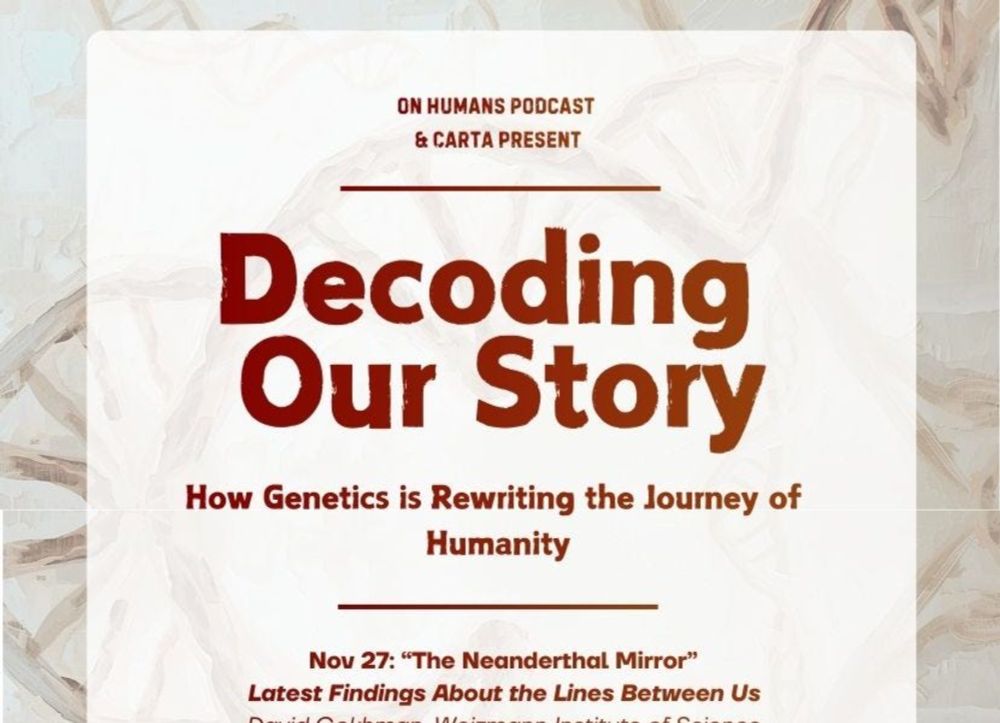
Decoding Our Story
What happens when you marry the art of archaeology with the science of genetics?
The trilogy ends!
The final episodes of Decoding Our Story traces the last miles in the human journey out of Africa: South America in the west, Polynesia in the east, and ....
Can you guess?
🙏 @morestrada.bsky.social & @anthropogeny.org
Listen >> open.spotify.com/episode/16l1...
05.12.2025 17:11 —
👍 4
🔁 0
💬 0
📌 0

How cool!
"The long coexistence of humans and leopard cats is one of the most overlooked relationships in East Asian zooarchaeology. Yet it represents a case where a wild species began down a pathway toward domestication but never reached the final steps."
www.anthropology.net/p/strangers-...
05.12.2025 16:31 —
👍 2
🔁 0
💬 0
📌 2

The top artists amongst On Humans listeners in 2025 -- a surprising mix 😂 I guess this speaks about a diverse crowd. Glad if so 👏
Thanks to everyone who've been listening!
04.12.2025 17:47 —
👍 1
🔁 0
💬 0
📌 0
Decoding Our Story
What happens when you marry the art of archaeology with the science of genetics?
2/ This is episode two of Decoding Our Story -- a series of short live-episodes, recorded at the Salk Institute's CARTA symposium on ancient DNA.
onhumans.substack.com/p/dna
02.12.2025 10:26 —
👍 1
🔁 0
💬 0
📌 0

Beyond Race: A New Outlook on the Shape of Humanity ~ Diyendo Massilani
Yes, there are genetic differences between human populations. But how big are they?
Diyendo Massilani's lab has produced a fascinating analysis on this.
What a pleasure to have him on!
open.spotify.com/episode/043H...
02.12.2025 10:26 —
👍 6
🔁 1
💬 1
📌 0
The Neanderthal Mirror: Latest Findings About the Lines Between Us ~ David Gokhman
2/ The first episode explores the differences between us and the Neanderthals.
For centuries, we could only understand Neanderthals through stones and bones. Now, genetics is offering a new tool.
David Gokhman's lab is decoding Neanderthal traits from their genetic echoes.
What have they found?
28.11.2025 17:50 —
👍 2
🔁 0
💬 0
📌 0
Decoding Our Story
What happens when you marry the art of archaeology with the science of genetics?
It’s live! 👏
Decoding Our Story is a three-part series on how genetics is rewriting the human story🏺
Recorded at the @salkinstitute.bsky.social's CARTA symposium on ancient DNA, these episodes take you behind the scenes of one of the most exciting frontiers in modern science.
Enjoy!
28.11.2025 17:50 —
👍 10
🔁 5
💬 1
📌 0

If David is right, you should check this out too 😉
onhumans.substack.com/p/can-we-tel...
27.11.2025 21:47 —
👍 2
🔁 0
💬 1
📌 0

A telling graph about climate change and human origins.
onhumans.substack.com/p/can-we-tel...
#PaleoSky
27.11.2025 16:17 —
👍 2
🔁 0
💬 0
📌 0
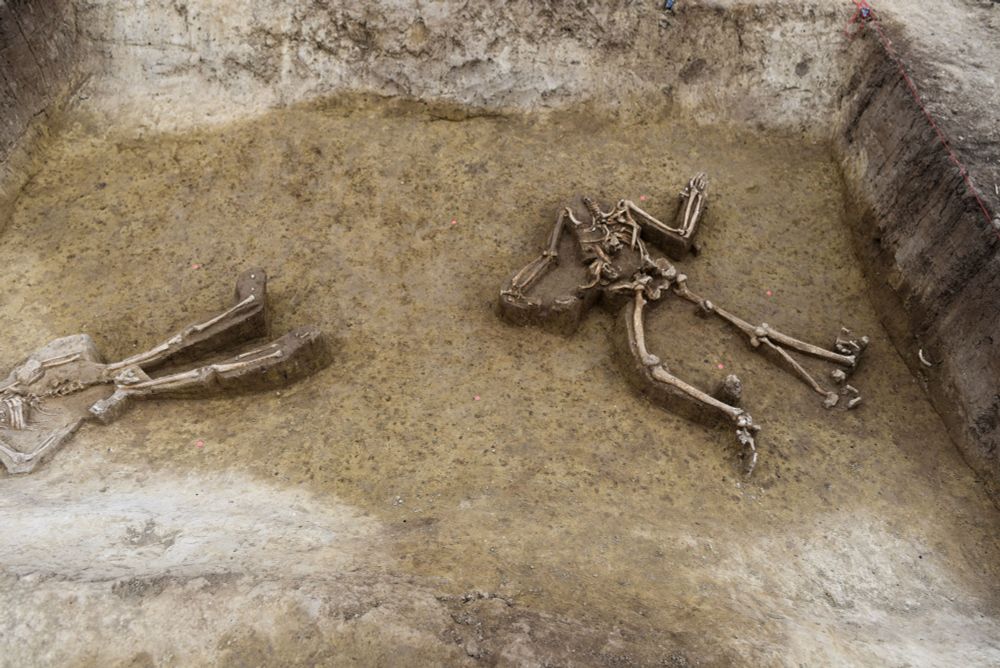
Headless bodies hint at why Europe’s first farmers vanished
Wave of mass brutality accompanied the collapse of the first pan-European culture
"Why did violence break out all across the LBK at the same time, and with such lasting consequences?"
Very interesting reminder of how early European farming was quite peaceful -- until it wasn't.
www.science.org/content/arti...
27.11.2025 15:43 —
👍 8
🔁 2
💬 0
📌 1
And many thanks to @dremmabird.bsky.social for help with this!
19.11.2025 15:20 —
👍 14
🔁 5
💬 0
📌 0

The Origins of Humankind
Where do we really come from?
2/2 This grew out of years of conversations I've had with some of the most thoughtful scholars on the matter, including @chrisbstringer.bsky.social , @cecileduflot.bsky.social , @vivek123.bsky.social , @lukegldng.bsky.social + the Origins of Humankind with @anthropogeny.org
Grateful to all !🙏
26.11.2025 15:37 —
👍 16
🔁 3
💬 0
📌 0

Can We Tell a (True) Story of Human Origins?
The science of human origins keeps producing new theories. But are we any closer to telling a true story of human origins? I think so. Here is the story.
Why do we exist?
The science of human origins keeps producing new theories. But are we any closer to telling a true story of human origins? Or are we simply drowning in data?
I think we have a story--a story centered on calories, childhoods, cooperation, and climate.
Here is the story.
26.11.2025 15:37 —
👍 8
🔁 2
💬 1
📌 0
Is the Brain Free to Choose?
You decided to read this. But could you have chosen otherwise? Tim Coulson thinks so.
You decided to read this. But could you have chosen otherwise? Are we ever free to choose?
🧠 A short episode on a big topic!
Read or listen at onhumans.substack.com/p/is-the-bra....
🙏 Thanks to @timcoulson.bsky.social from @biology.ox.ac.uk!
20.11.2025 18:49 —
👍 4
🔁 1
💬 0
📌 0

"New research at Semiyarka is challenging long-held ideas about mobility, metallurgy, and the unexpected shape of early cities in Eurasia."
www.anthropology.net/p/city-of-th...
@anthropology.net
20.11.2025 16:49 —
👍 2
🔁 0
💬 0
📌 0
I guess I was thinking about the ease with which folks like me might use this to inflate the gap between us and Neanderthals. You have quite a thoughtful approach to this, hence thought of you.
20.11.2025 11:24 —
👍 0
🔁 0
💬 0
📌 0
Curious to hear if you think this work is illuminating or misleading? @lemoustier.bsky.social
19.11.2025 16:59 —
👍 0
🔁 0
💬 1
📌 0
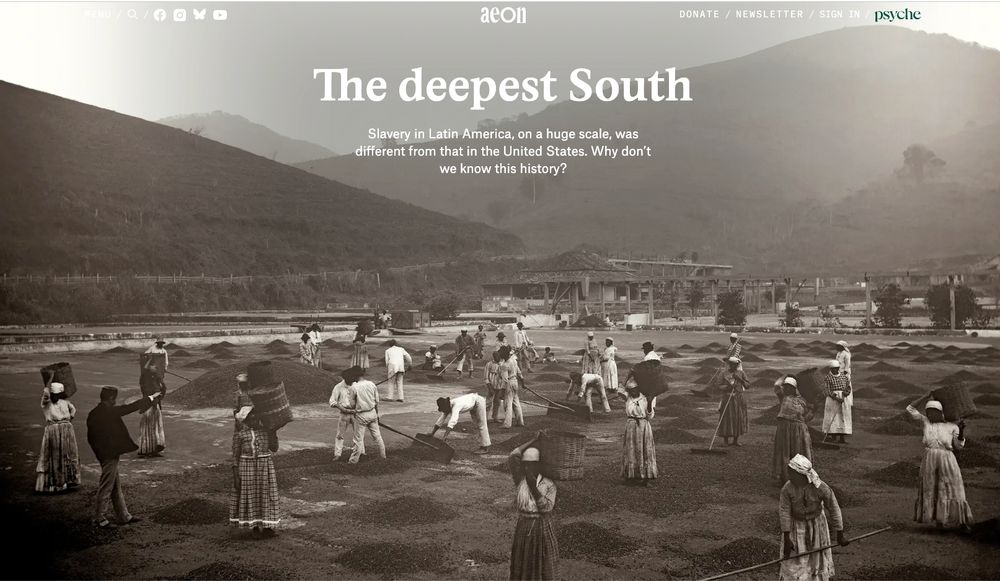
"How is it that Brazil imported so many more enslaved people than the US, yet by the mid-19th century the US had 2.5 times more?"
aeon.co/essays/way-d...
19.11.2025 13:53 —
👍 2
🔁 0
💬 0
📌 0
A classic challenge: human brain is only ~2% of our body mass but takes about ~20% of our base metabolism.
A bigger challenge: during early childhood, the number climbs over 50%!
How to afford that?
So much of human evolution wrapped in one puzzle
www.nature.com/articles/npr...
🏺 #paleosky
19.11.2025 13:46 —
👍 4
🔁 0
💬 0
📌 0
Diving with Sea Lions in San Diego 🦭
Turn on the sound to hear their vocalisations!
Not a bad start to a Wednesday. I could get used to this...
#animal
12.11.2025 22:21 —
👍 5
🔁 0
💬 0
📌 0

Did Neanderthals speak? We don't know. But DNA evidence shows our ancestors experienced speedier evolution in the vocal tract.
This is highly suggestive of a more important role for speech amongst Homo sapiens.
By the way, the methods are insane 🤯 pubmed.ncbi.nlm.nih.gov/32132541/
🏺 #paleosky
12.11.2025 21:50 —
👍 13
🔁 0
💬 1
📌 0