
Thanks Adrien!
09.12.2025 18:07 — 👍 0 🔁 0 💬 0 📌 0Thanks Adrien!
09.12.2025 18:07 — 👍 0 🔁 0 💬 0 📌 0Thank YOU David! For everything you brought to the lab!
08.12.2025 22:20 — 👍 1 🔁 0 💬 0 📌 0Thanks so much!
08.12.2025 22:20 — 👍 1 🔁 0 💬 0 📌 0No you! Thanks andy! Hope to see you again soon!
08.12.2025 22:19 — 👍 1 🔁 0 💬 0 📌 0Shout-out to the reviewers whose criticism was instrumental in improving this work over its initial submission. I think this work has some exciting implications for future directions in the lab, and I'm very excited for this to mark the first peer-reviewed mouse work from the lab.
08.12.2025 21:36 — 👍 1 🔁 0 💬 0 📌 0Finally, we show that a model which encodes predictive structure over geometrically-tuned inputs (a la de Cothi et al., 2020) can reproduce many of our key results. Importantly, models with random spatial inputs and models with geometric inputs but no predictive encoding failed.
08.12.2025 21:34 — 👍 1 🔁 0 💬 1 📌 0Next we show that changing the behavior of each mouse induces a change in representational structure that specifically resembles their new navigational patterns on the relevant spatiotemporal scale. I think this is especially neat!
08.12.2025 21:30 — 👍 1 🔁 0 💬 1 📌 0By leveraging weeks of data in each mouse, we show that early session behavior appears to have an outsized impact on representational structure. This data-driven approach also suggests that the critical timescale for integrating navigational history is on the order of 5 seconds (BTSP?).
08.12.2025 21:28 — 👍 0 🔁 0 💬 1 📌 0Imaging CA1 in mice freely navigating a multicompartment environment, we show that different mice instantiate reliably different patterns of remapping between compartments. Next, we show that these idiosyncratic patterns can be predicted from the navigational history of the mouse.
08.12.2025 21:25 — 👍 0 🔁 0 💬 1 📌 0
Another new paper from the lab: Predictive theories like the SR imply that navigators who navigate differently should have cognitive maps which differ in predictable ways. Here we show that this holds in mouse hippocampal CA1.
www.sciencedirect.com/science/arti...
Very related to work by the Knierim on distance integration with The Dome. Maybe humans also exhibit behavioral biases consistent with recalibrated distance integration as well??
08.12.2025 21:20 — 👍 1 🔁 0 💬 0 📌 0Ajabi et al. demonstrated that the integration of head movements in the rodent neural compass is inherently plastic, and can be recalibrated in rotating visual spaces. Here we show that humans exhibit behavioral biases consistent with recalibrated heading integration under similar circumstances.
08.12.2025 21:19 — 👍 2 🔁 0 💬 1 📌 0
Excited to share the first peer-reviewed work from the lab (what a moment)! We have two papers to share. First, some work on heading integration in humans.
www.cell.com/iscience/ful...
We'll be missing you too, David!
15.07.2025 20:05 — 👍 1 🔁 0 💬 0 📌 0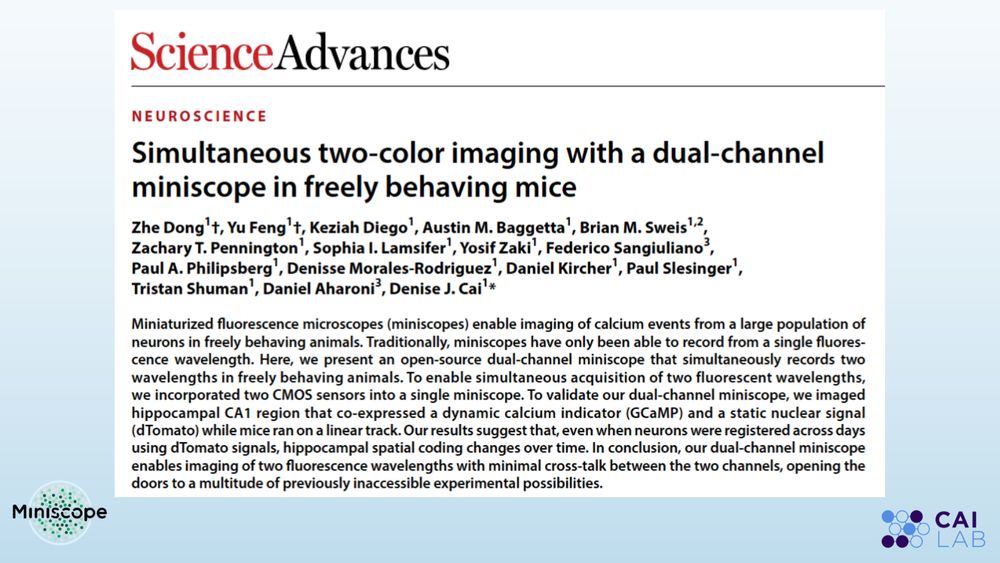
Screenshot of the top of the article, including the title, authors, and abstract.
What’s better than a one-channel #Miniscope? 🥁 A TWO-CHANNEL Miniscope!
Our new Miniscope2C is a dual-channel, open-source Miniscope that lets you record 2 fluorescent signals simultaneously in freely moving animals.
Read the paper here: www.science.org/doi/10.1126/...
(1/10)
6\. Really excited about these results and about how this approach can be used in the future! Lots more to do, but I think these comparisons of rep geometry across assays can really help us add more nuance to our understanding of similarities and differences between species (and other comparisons).
15.07.2025 17:23 — 👍 1 🔁 0 💬 0 📌 05\. Does the difference between these assays depend on the human visual advantage? In another cohort of participants, we demonstrate that masking the visual world with dense fog during retrieval does NOT impact representational geometry or cross-species resemblance. So it’s not just about vision!
15.07.2025 17:21 — 👍 0 🔁 0 💬 1 📌 04\. Does this depend on the scale of the environment? We repeated our experiment in a room double the size (5x5 vs. 10x10 m). Here, the local impact of deformations scaled up, in turn preserving the rep geometry and cross-species resemblance. So it's not just about scale (at least for the humans)!
15.07.2025 17:21 — 👍 0 🔁 0 💬 1 📌 03\. The geometry of human memory is similar but not the same as mouse CA1. Instead, it resembles a change-resistant version. CA1 subpopulations with higher firing rates, stability, and spatial specificity look more human-like. Low precision (but not low accuracy) memories look more mouse-like.
15.07.2025 17:16 — 👍 0 🔁 0 💬 1 📌 02\. We then compare the geometry of these reps to those of mouse CA1 recorded during analogous deformations, leveraging a dataset that @markbrandonlab.bsky.social, @jquinnlee.bsky.social, and I published recently. (Check out that work if you haven’t already! www.cell.com/neuron/fullt....
15.07.2025 17:14 — 👍 1 🔁 0 💬 1 📌 01\. We use immersive VR to characterize the impact of a diverse deformations on human spatial memory. Across 3 experiments of 100+ participants each, we find that deformations induce compounding local distortions in memory.
15.07.2025 17:13 — 👍 1 🔁 0 💬 1 📌 0
Trans rights are human rights.
Fresh work incoming: Here we quantitatively compare the representational geometry of mouse CA1 and human spatial memory during environmental deformations. Briefest TLDR: Human memory looks like a change-resistant version of mouse CA1.
www.biorxiv.org/cgi/content/...
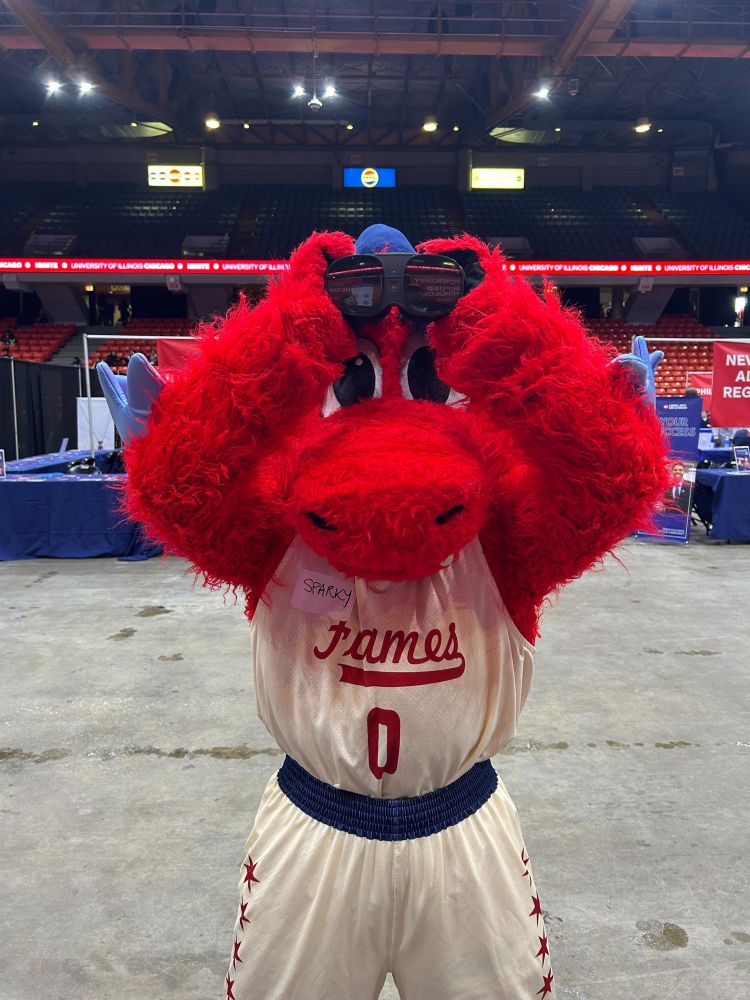
Gotta make sure your results generalize to mascots! #uic
03.05.2025 20:34 — 👍 2 🔁 1 💬 0 📌 0Super excited to share that one of our outstanding founding undergrad RAs @dahery.bsky.social will be headed to the Kempner postbac program at Harvard to work with @gershbrain.bsky.social after graduation! Congratulations David! You cannot be replaced, and I’m so proud and excited for you!
14.04.2025 14:51 — 👍 5 🔁 1 💬 1 📌 1
The dataset and code for our recent paper in Neuron (tinyurl.com/yc48d6vr) is online now!
The data is available on Zenodo (zenodo.org/records/1486...) and code on Github (github.com/jquinnlee/ge...). Big thanks to @markbrandonlab.bsky.social and @atkeinath.bsky.social on this effort! #neuroskyence 🧠
How good is your place cell model?
Come benchmark yours against real data - nearly 70K CA1 rate maps in various geometric shapes across weeks - collected and curated in my lab by the great @jquinnlee.bsky.social and @atkeinath.bsky.social
If you’ve been wondering what Elon Musk and his lackeys are up to since taking control of the US government, look no further. Our latest story names six 19- to 24-year-olds working with his DOGE organization, which now has access to sensitive federal systems. wrd.cm/4jzpiSN
02.02.2025 22:43 — 👍 4350 🔁 2083 💬 252 📌 300Shoutout to all the millennial junior faculty who finally got their dream jobs right as the scientific enterprise in the states is functionally dismantled.
02.02.2025 03:57 — 👍 49 🔁 6 💬 1 📌 1i think an important thing for people outside the US to understand is that elon musk seized control of the government today and most americans don’t even realize it happened.
01.02.2025 05:43 — 👍 19940 🔁 5868 💬 424 📌 265
The campaign against trans rights is also about stripping away everyone’s protections against discrimination, reviving, as Douglass put it “the moral blindness” of those who “persuade themselves that they are safe, though the rights of others may be struck down.”
www.theatlantic.com/ideas/archiv...