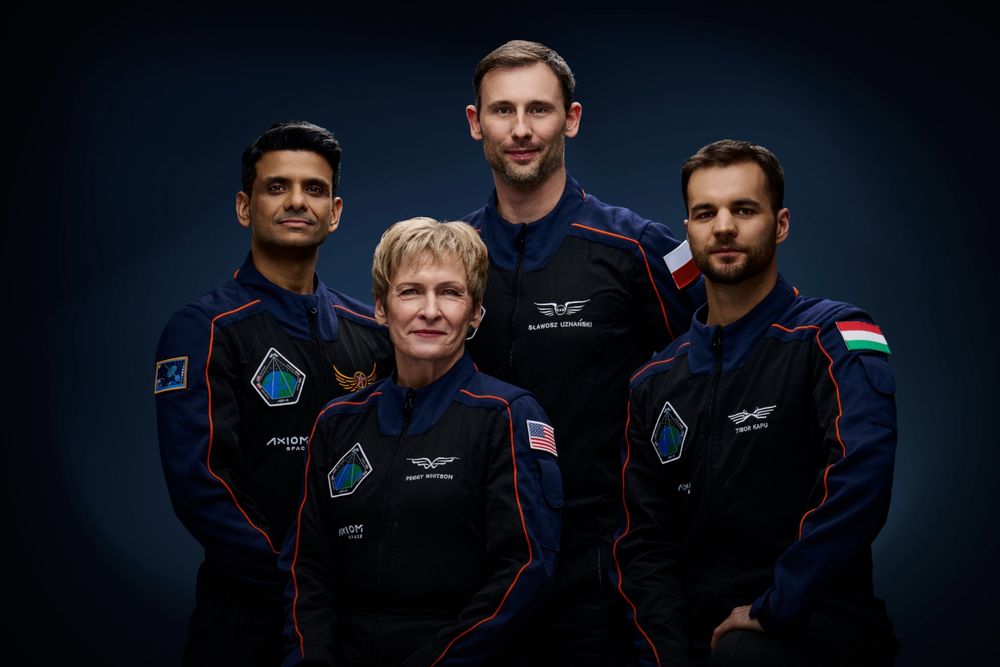
NASA and Axiom Space delay Axiom Mission 4 launch to the International Space Station.
@exploration.esa.int
NASA and Axiom Space delay Axiom Mission 4 launch to the International Space Station.
@exploration.esa.int

This radar image is from 31 March 2025, it is in false-colour and in ‘dual polarisation’ horizontal and vertical radar pulses. Compared to a single acquisition, this dual mode provides more detailed and complementary information about Earth’s surface. Different colours represent different types of land cover, such as yellow for dense vegetation and forests and dark blue for water. Here, the land is dominated by forests, dotted with numerous small lakes appearing as dark blue spots. Brighter zones suggest built-up areas, mainly located along the course of the Mahakam River, which runs across the image. The capital of the province, Samarinda, can be seen on the northern bank of the river. Radar reflections from the ships stand out like shining jewels in the dark water of the river, as well as the sea. The Mahakam River fans out into a labyrinth of distributaries before emptying into the Makassar Strait through a large and complex delta. The area alternates between agriculture and aquaculture, particularly shrimp farming, and extensive wetlands dominated by mangrove ecosystems. Zooming in, aquaculture structures can be seen in dark blue. Varying colours of the seawater are caused by different atmospheric fronts and wind conditions, with stronger winds on the left in the lighter zone, and calmer conditions on the right. Distinct greenish patches visible on the ocean surface, especially within the lighter blue area, are ‘rain cells’ – distinct areas of rainfall within a larger precipitation system. As we can see in the image, these cells can range in size, from small, localised showers to larger, more extensive rainfall events. As rain cells are easy to spot using satellite radar, scientists also exploit these images to monitor the weather.
Captured by Copernicus EU Sentinel-1, this radar image shows the Mahakam River delta with the city of Samarinda located in the river’s northern bank.
Can you spot the many ships? They look like scattered bright spots.🚢
Access the image at its full resolution: www.esa.int/ESA_Multimed...

A picture of a mostly white orb is shown that has many craters and crevasses. Please see the explanation for more detailed information.
🔭 Enceladus in True Color
Image Credit: NASA, ESA, JPL, SSI, Cassini Imaging Team
apod.nasa.gov/apod/ap25061...
It will be a fully virtual event!
The Shaw-IAU workshops focus on astronomy education for primary and secondary school students, as well as teacher training in universities. This year's Education focus session on Teaching with authentic data and the Science focus is on Galaxies.

Check out the information for the 7th Annual SHAW-IAU workshop on astronomy education November 2025
astro4edu.org/shaw-iau/

3D image shows a group of prominent ridges, all very close to one another, in Granicus Valles on Mars. (NASA/JPL-Caltech/University of Arizona)
HiRISE 3D: Groups of Ridges in Granicus Valles
The objective of this observation is to determine the nature of groups of ridges. There are groups that appear to have different directions. There also seems to be old ring-mold craters in the image field.
www.uahirise.org/anaglyph/ESP...
#Mars

Like images of broken light, Webb captured these carbon-rich dust shells around a binary star system. Drifting swiftly outwards, they are seeding their surroundings with carbon - one way elements spread across the universe. https://t.co/gjfLhdaP1x https://t.co/rbFjcpKjgm
13.01.2025 20:20 — 👍 270 🔁 58 💬 5 📌 3
If you’re a STEM professional (broadly defined!) looking for a cool outreach opportunity, check out prescientist.org! Pen pal registration for the upcoming school year closes in less than 48 hours. I’ve participated twice as a STEM pen pal and just signed up for another year - highly recommended!
02.08.2024 05:47 — 👍 1 🔁 2 💬 0 📌 0🎉 #50YearsOfESA: for half a century, we've been serving Europe as its space agency and inspiring its citizens. Join us this anniversary year to reflect not only on our past achievements, but also on our future perspectives!
30.05.2025 14:33 — 👍 382 🔁 69 💬 8 📌 19
One of our fabulous members also creates free and wonderful YouTube content on their channel by inviting lecturers, like the NASA Solar System Ambassadors! Here’s a video on Weird Moon facts:
youtu.be/tms3SatdlPc?...

STEM doesn’t have to be complicated or costly to inspire students.
Discover how small classroom adjustments can make a significant impact.
📚 Read →https://www.nms.org/Resources/Newsroom/News/How-Teachers-Can-Incorporate-STEM%E2%80%94Without-Making-I.aspx
#STEMeducation #schoolleaders #EduSky

Banner for the astroEDU educational activity "The Brown Dwarf builder's guide" for May 2025 with a background photo of four styrofoam models in different colours
Brown dwarfs are celestial objects that are too massive to be considered planets but not massive enough to become true stars. They are also very different one from the other: Let’s learn how they are classified, making models with this activity coming from Brazil
astroedu.iau.org/en/activitie...

This composite of images spaced a weather-permitting 5 to 9 days apart, from 2024 September 19 (top right) through 2025 May 18 (bottom left), faithfully traces ruddy-colored Mars as it makes a clockwise loop through the constellations Gemini and Cancer in planet Earth's night sky. You can connect the dots and dates with your cursor over the image, but be sure to check out this animation of the Red Planet's 2024/25 retrograde motion. Of course Mars didn't actually reverse the direction of its orbit. Instead, the apparent backwards motion with respect to the background stars is a reflection of the orbital motion of Earth itself. Retrograde motion can be seen each time Earth overtakes and laps planets orbiting farther from the Sun, the Earth moving more rapidly through its own relatively close-in orbit. In this case Mars' apparent eastward motion began to reverse around December 8, when it seemed to linger near open star cluster M44 in Cancer. After wandering back to the west, under Gemini's bright stars Castor and Pollux, Mars returned to pose near M44 by early May. At its brightest near opposition on 2025 January 16, Mars was a mere 96 million kilometers away.
🔭 Mars in the Loop
Image Credit & Copyright: Tunc Tezel (TWAN)
apod.nasa.gov/apod/ap25053...

A new study of the motion of Jupiter’s moons has revealed that the king of planets, when it was young, was at least twice as large and 50 times more magnetically potent than it is today.
buff.ly/SxiV9UN
.
.
#astronomy #jupiter #cosmology #planetformation

Pluto never gave up:)
01.06.2025 20:07 — 👍 11726 🔁 1712 💬 274 📌 91
How do students reason about astronomy? Chad Leukes explored student reasoning on astronomy topics such as 'Why do stars twinkle?' at the 6th Shaw-IAU workshop, revealing that their answers, although incorrect at times, show that coherent reasoning
www.youtube.com/watch?v=xIa-...

6/3/25 Online Workshop: America 250 - How Can Children's Museums and Science Centers Celebrate the United States Semiquincentennial? Register now!
#onlineworkshop #America250 #Semiquincentennial #nisenet #nisenetwork #museums #planetarium #InformalScience #sciencecenters #childrensmuseum

Rubin Observatory First Look Watch Parties will be held around the world in June or July 2025. Learn how you can participate!
#rubinobservatory #nisenet #nisenetwork #museums #planetarium #InformalScience #sciencecenters #childrensmuseum
Hello! 👋 Thanks for the follow! We hope to have some neat ideas to share 😊
02.06.2025 03:00 — 👍 1 🔁 0 💬 0 📌 0
Each National Astronomy Education Coordinator (NAEC) team is tasked with helping the OAE document how astronomy is used in teaching and organizing professional development for teachers and developing readily accessible and high-quality educational material!
astro4edu.org/naec-network/

Here’s a little snippet about what we do, by our fearless leader, Dr. Christine Bernhardt! #scicomm #STEM #STEMeducation
youtu.be/syjE_ppW9zE?...
Hello world!
We are Team USA for the International Astronomical Union Office of Astronomy for Education! 👋
We would love to share and interact and support educators and STEM groups with our space resources! 🔭 ✨
