A yellow historic tram travels along a narrow cobblestone street lined with bright-colored buildings in Lisbon, Portugal. The 10kLepGenomes and LepEU logos are overlaid in the bottom corner.
(1/4) 📢 Applications are open for the #LepEU Workshop 2026: a joint training + hackathon event focused on the analysis of #Lepidoptera genomic data.
🗓️ 26–29 May 2026
📍 Faculty of Sciences, University of Lisbon (Portugal)
Save the date! ⬇️
04.03.2026 11:07 —
👍 11
🔁 6
💬 1
📌 0
Did you know that the bees that need saving are NOT honeybees?
Honeybees are the dairy cows of bees. People brought them over from Europe to make us honey.
The problem with honeybees, esp in resource-limited ecosystems (like hey! cities!) is that they compete with our native bees for food.
01.03.2026 16:21 —
👍 2070
🔁 671
💬 76
📌 56

A phylogeny of Afrotheria, showing stellar's sea cow, rock hyrax, african elephant, manatee, mastodon
What I love about molecular phylogeny: it's so counter-intuitive.
What's the closest living relative of elephants?
Is it rhinos?
Nope, it's a hyrax, or a manatee.
They're all in super-order Afrotheria.
18.02.2026 16:43 —
👍 129
🔁 33
💬 10
📌 6

Decline in body mass in adult (left) and nestling great tits. In the nestling plot, the purple line represents all nestling and the green line those that recruited to the population as breeders. Their different slope suggest an increase in the strength of selection on nestling mass something confirmed in the MS by analysing the temporal trends in selection differentials (see link for further information)
We have published a new pre-print showing a decline in great tit adult and nestling mass of around 1 gram in 47 y. [rate of approx. -0.040 Hadanes] With @ellafcole.bsky.social, @devisatarkar.bsky.social, Sam. Crofts, @mcmahok.bsky.social & @sheldonbirds.bsky.social www.biorxiv.org/content/10.6...
15.02.2026 17:07 —
👍 61
🔁 31
💬 1
📌 3
This strange little bird is an 'oystercatcher', one of 12 species in family Haematopodidae, Latin for "blood foot" because of dark red coloration on the legs of some.
A group of them is called a "stew".😀
Let's talk about the utter weirdness of their eyes & beaks.
13.02.2026 14:48 —
👍 69
🔁 11
💬 7
📌 1
reading about organisms that aren’t your specialty is like
margins of the quorbus eplungulate, ploobular processes bent posteriorly towards the foobulum
define term “eplungulate”
- lacking plungae. synonym: thubulous
02.02.2026 22:14 —
👍 908
🔁 233
💬 29
📌 18

Four-panel image-led graphic. Left panels show David Attenborough wearing a beige jacket, seated outdoors beside reeds and water, smiling and gesturing behind him. Right panels show close-up photos of a beaver swimming and standing upright among tall reeds. Bold yellow caption text across the panels reads: “If someone had told me when I first moved here that one day I would be watching wild beavers in London, I would have thought they were mad. But there they are, right behind me. Happily going about their own business.”
Beavers are back in London 🦫
Here's how (and why) we did it ⬇️
21.01.2026 07:18 —
👍 1166
🔁 273
💬 19
📌 57

A male Common Blue butterfly (Polyommatus icarus) rests on a flower.
Every year I try to repurpose #BlueMonday (which we all know is a load of 💩) and advocate for #insects by showcasing some beautiful BLUE BUGS!
Please join me by sharing your photos or artwork with the hashtag #BlueBugs 🦋🩵
📷 Common Blue (Polyommatus icarus)
19.01.2026 08:51 —
👍 81
🔁 15
💬 3
📌 5
Helpful listing of things academics can do now. www.abiperrin.com/p/scientists...
08.01.2026 12:20 —
👍 27
🔁 13
💬 3
📌 1

New work from @miyapan.bsky.social and our team, bringing ant, bee, and wasp labs together. @chuanxinyu.bsky.social shows that the ANTSR locus we discovered in ants has determined sex for 150+ My across bees and stinging wasps 🐜🐝, despite virtually no sequence conservation 😮 doi.org/10.1073/pnas...
06.01.2026 03:01 —
👍 89
🔁 37
💬 2
📌 6

A conceptual diagram illustrating the two approaches used to
assess the IUCN Red List status of specialist oil-collecting bees. The
starting point for both approaches is the compilation of georeferenced
occurrence data for the species. Here, we use Rediviva vogeli as an
example. IUCN-based approach (top sequence, left to right): To
estimate the Extent of Occurrence (EOO), a minimum convex hull
polygon is plotted around the occurrence records. The resulting EOO
map is then intersected with national spatial datasets to evaluate the
decline in the “area, extent, and/or quality of habitat,” corresponding
to Subcriterion b(iii) of IUCN Criterion B. First, the EOO is reduced
to 59.4% of its initial area as a consequence of habitat loss. Overlaying threatened habitats on what remains reveals that 29.1% of remaining habitat is threatened, suggesting a high risk of further habitat loss.
Finally, we overlay the EOO with the current protected area network
and find that only 5.6% of the EOO is currently protected. SDM-based
approach (bottom sequence, left to right): Occurrence data and environmental variables are used to generate species distribution models
(SDMs), from which the Area of Occupancy (AOO) is estimated. The
resulting AOO map is also intersected with national spatial datasets to
assess habitat condition under Subcriterion b(iii) of Criterion B. First,
the AOO is reduced to 67.4% of its initial area as a consequence of
habitat loss. Overlaying threatened habitats on what remains reveals
that 22.1% of remaining habitat is threatened, suggesting a high risk
of further habitat loss. Finally, we overlay the AOO with the current
protected area network and find that only 22.1% of the AOO is currently protected. The two approaches, combined with expert knowledge where available, informs the assessment of species status under
IUCN Criterion B: Endangered (EN) using the IUCN-approach; and
Vulnerable (VU) using the SDM-approach

Picture of Rediviva steineri, one of the bee species identifying key features to look for. She's a cure fluffy bee with longsh front legs.
Starting the week with a 1st new paper of the year! Led by Annalie Melin, this is a red-list assessment for her newly described oil-collecting bee species. Red Listing invertebrates is notoroisly hard, as data on distribution & longevity are sparse. 🧪🌏1/3 links.springernature.com/f/a/Ih58aJfK...
05.01.2026 11:48 —
👍 10
🔁 5
💬 1
📌 0

This handsome beast is the larva of the spurge hawkmoth (Hyles euphorbiae) of Europe, Asia & N. America. It feeds on Ephorbia spp., sequestering toxic diterpenes from its host. 📷: Wolfgang Ahlmer CCBY4. #Euphorbiaceae #Aposematism #TeamMoth #Botany 🌾🧪🌱
17.12.2025 16:32 —
👍 647
🔁 84
💬 18
📌 3

Unveiling - Home
Our friends at the University of Florence have been looking into the aesthetic appeal of European butterflies and does this bias the species we choose to protect. You can help their research by completing a simple online survey. Many thanks in advance www.unveiling.eu?fbclid=IwZXh...
17.12.2025 17:58 —
👍 296
🔁 49
💬 4
📌 0
Grading and googling hallucinated citations, as one does nowadays, and now that LLMs have been around for a while, I've discovered new horrors: hallucinated journals are now appearing in Google Scholar with dozens of citations bc so many people are citing these fake things
15.12.2025 20:41 —
👍 3989
🔁 1275
💬 132
📌 276

Cladogram showing Jaffa Cakes as pseudobiscuits.
For reasons that are too complicated to explain, I am reminded of Adam Stuart Smith’s 2005 paper “Are Jaffa Cakes Really Biscuits?”. Here’s his cladogram (it says they aren’t): Full paper here: plesiosauria.com/pdf/smith_20...
10.12.2025 22:14 —
👍 47
🔁 15
💬 6
📌 3

1,000 butterfly and moth genomes to investigate evolution, climate change resilience, and tackle food security issues
These freely available genomes can be used to answer evolutionary questions, inform conservation and improve food security around the world.
The DNA of butterflies & moths is supporting conservation, shedding light on evolution, and could find new ways to stop pests 🦋
1,000 genomes have been released, and @projectpsyche.bsky.social aims to continue until all 11,665 European species have been sequenced🧬
www.sanger.ac.uk/news_item/10...
28.11.2025 10:24 —
👍 20
🔁 7
💬 1
📌 0

Project Psyche: reference genomes for all Lepidoptera in Europe
Project Psyche is a transnational initiative to generate and study chromosome-level
reference genomes of all ~11 000 species of Lepidoptera (butterflies and moths) found
in Europe. Here, we describe t...
One of the most exciting projects I have ever been involved in: Project Psyche! Read all about our ambitions and aims. It's ground breaking stuff, just mind blowing and even surreal (27 years ago we did single genes for lep phylogenetics)! @projectpsyche.bsky.social
www.cell.com/trends/ecolo...
27.11.2025 08:46 —
👍 48
🔁 17
💬 0
📌 1

🚨 PNAS Special Feature 🐕
We analysed genomes of historical German Shepherds to reveal how bottlenecks linked to WWII and the use of popular sires led to significant declines in genomic health. We also found an early 20th century wolf-dog hybrid!
🔗 Full paper here: www.pnas.org/doi/10.1073/...
24.11.2025 21:10 —
👍 25
🔁 7
💬 1
📌 0

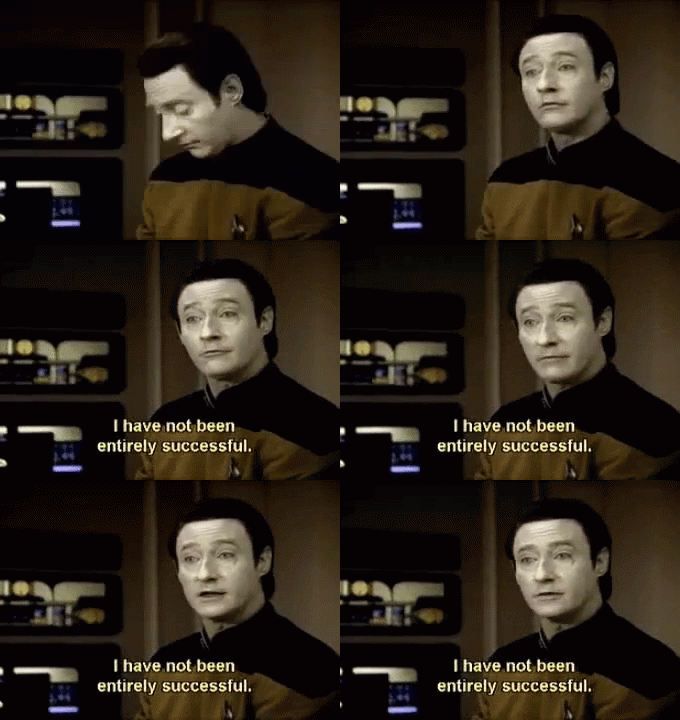
a man is talking about being entirely successful .
Alt: a robot is is talking about not being entirely successful .
It's funny to have to make this case but tbqh we don't make it enough: human efforts to counter fossil fuel use have had *at least some* effect on total greenhouse gas emissions since the signing of the Paris Agreement in 2015, and there's some evidence to back up this position
A lil thread 🧵
24.11.2025 09:18 —
👍 221
🔁 70
💬 4
📌 8

And we warned them with our new 2025 State of the Climate Report which you can check out here: doi.org/10.1093/bios...
14.11.2025 07:31 —
👍 739
🔁 180
💬 8
📌 10
𝗦𝗰𝗶𝗲𝗻𝘁𝗶𝘀𝘁𝘀! Want to join @chrisgpackham.bsky.social in supporting the National Emergency Briefing on Climate & Nature?
🖋️ 𝙋𝙡𝙚𝙖𝙨𝙚 𝙨𝙞𝙜𝙣 𝙩𝙝𝙞𝙨 𝙤𝙥𝙚𝙣 𝙡𝙚𝙩𝙩𝙚𝙧 urging MPs to attend: lnkd.in/ecGDM3Ry
10.11.2025 11:17 —
👍 24
🔁 13
💬 2
📌 0

Screenshot of a Tweet pointing out that academic spam is actually in its own way kind of encouraging.
I think about this post every day 🧪
07.11.2025 12:15 —
👍 637
🔁 111
💬 3
📌 1

This is figure 5, which shows global hotspots and coldspots of non-native mosquito introduction and establishment, and their socio-economic and environmental drivers.
Globalization has accelerated the spread of mosquito species that transmit human diseases. An analysis in Nature Communications shows that 45 disease-vector mosquito species have been introduced to non-native regions worldwide. go.nature.com/4hn6ogW 🧪
31.10.2025 01:51 —
👍 41
🔁 27
💬 0
📌 1

Check out our new insect decline paper. By analysing 36 yrs of German ground beetle distribution data, we show:
- ~80% of species have declined, with significant declines for >50%.
- The decline was similar across species traits and threatened status.
doi.org/10.1111/ddi.... @consbiog.bsky.social
03.11.2025 01:37 —
👍 76
🔁 44
💬 2
📌 5