Budget live updates: Packaged milkshakes and lattes to be included in sugar tax for first time in UK
Health Secretary Wes Streeting announces the changes ahead of tomorrow's Budget.
🧋 A NEW sugar tax on milkshakes and lattes has just been announced. Our work found the #sugartax has been beneficial for children's health (obesity, dental & asthma) & has reduced sugar intake. This is evidence-informed public health policy in action www.bbc.co.uk/news/live/cg...
25.11.2025 13:13 — 👍 3 🔁 0 💬 0 📌 0

· 🔽sugar consumption from soft drinks in adults and children jech.bmj.com/content/jech...
25.11.2025 12:21 — 👍 2 🔁 0 💬 0 📌 0
· 🔽rates of childhood hospital admissions for asthma
25.11.2025 12:21 — 👍 0 🔁 0 💬 1 📌 0

· 🔽hospital tooth extractions among infants and primary school children pubmed.ncbi.nlm.nih.gov/38264366
25.11.2025 12:21 — 👍 0 🔁 0 💬 1 📌 0

Using multiple datasets, I’m proud to have led work triangulating evidence on health/dietary impacts of UK SDIL
Our findings indicate:
· 🔽 obesity prevalence among Year 6 girls, with particularly strong effects for children living in more deprived areas
journals.plos.org/plosmedicine...
25.11.2025 12:21 — 👍 0 🔁 0 💬 1 📌 0

(1/4)
19 months after the introduction of the UK’s Sugar Drinks Industry Levy, households with children bought fewer sugary drinks!
But researchers also found that sugary drink purchases went up by 14% in households WITHOUT children.
Read - buff.ly/kgiuoAs
17.07.2025 18:31 — 👍 2 🔁 3 💬 1 📌 0
(1/6)
Takeaways can negatively impact the diet and diet-related health outcomes of local residents
Local authority urban planners can deny planning for new takeaways in management zones around schools
But what are the long term impacts of these exclusion zones?
Read - buff.ly/S04RDSP
16.07.2025 13:03 — 👍 4 🔁 4 💬 1 📌 0
Strong words from Ursula von der Leyen today:
“Science belongs to humanity. We must protect it, prioritize it, and give it the freedom it needs to flourish.”
At the launch of the EU’s “Choose Science - Choose Europe” initiative, she announced four key actions.
🧵1/3
05.05.2025 12:47 — 👍 386 🔁 126 💬 11 📌 19
Our research shows substantial sugar purchased from the category "milk & milk-based drinks" (although we didn't look at these separately). Plain milk is nutritious and not part of the consultation. Other exempt groups (eg: powders) could be considered bmjopen.bmj.com/content/bmjo...
29.04.2025 11:40 — 👍 0 🔁 0 💬 0 📌 0

A lower tax threshold (4g/100 ml) should reduce sugar intake given manufacturers reformulated drinks to just below the 5g /100ml. A step-wise graded system to incentivise lower sugar levels should be considered plus a higher tax on drinks with very high sugar (>10g sugar/100ml)
29.04.2025 11:40 — 👍 0 🔁 0 💬 1 📌 0

In conclusion, our comprehensive analysis of the UK SDIL, using multiple data sources to understand the health impacts of the sugar tax, suggests large population-wide benefits across the life-course starting with infants and children.
29.04.2025 11:40 — 👍 0 🔁 0 💬 1 📌 0

Inside Health - Can supervised toothbrushing fix the children's dental crisis? - BBC Sounds
Around a third of British children have tooth decay. Is supervised toothbrushing the fix?
~ 2 years post-SDIL we find a 12% relative reduction in NHS hospital admissions for tooth extraction in children aged 0-18 years. ⬇️⬇️ greatest in infants/young children & regardless of deprivation. Hear me talking to
@BBCRadio4 www.bbc.co.uk/sounds/play/...
29.04.2025 11:40 — 👍 1 🔁 0 💬 1 📌 0

I led research on the health/dietary impacts of the UK SDIL and used different data to examine the impact of SDIL on: 1)purchasing of sugar from drinks, 2)sugar consumption in adults/children 3)obesity (primary school) 4) dental extractions 5) asthma. Here is what we found:
29.04.2025 11:40 — 👍 0 🔁 0 💬 1 📌 0
The Uk government are consulting on extending the UK sugar tax by 1) including milk-based drinks (previously exempt) and 2) Lowering the threshold of the tax to cover drinks with >4g sugar/100ml (previously 5g/100 ml). www.bbc.co.uk/news/article...
29.04.2025 11:40 — 👍 2 🔁 1 💬 2 📌 0

🆕"How can we make food that is good for health, societies, the planet and the economy?"
Richard Westcott talks to experts Jonathan Stieglitz, IAST, & @martinwhite33.bsky.social, @mrcepid.bsky.social, in this month's #CrossingChannels #Podcast
Listen: pod.fo/e/2c3eac
07.04.2025 13:06 — 👍 11 🔁 4 💬 0 📌 1

We were pleased to organise a Parliamentary discussion on sugar with the APPG for Dentistry and Oral Health and @oha-updates.bsky.social
Our Mick Armstrong spoke movingly about the shame and trauma of the families whose children need to have decayed teeth extracted in hospital.
26.03.2025 17:52 — 👍 11 🔁 5 💬 1 📌 1
I think I spot some figures from @ninarogers.bsky.social paper where we reported a 12% reduction in admissions for severe dental caries in children following introduction of the levy (and maybe even Nina herself in the foreground there!).
nutrition.bmj.com/content/bmjn...
26.03.2025 17:57 — 👍 4 🔁 1 💬 1 📌 0
Thanks Jean, great to see our findings highlighted in parliament, as the principal piece of evidence for the success of SDIL on preventing tooth extraction in children. If only dental data from community settings was available to evaluate further!
26.03.2025 18:12 — 👍 1 🔁 0 💬 0 📌 0


ASO attended a Parliamentary roundtable yesterday on the Soft Drinks Industry Levy (SDIL), discussing its role in improving public health through sugar reduction.
Great to see @katfoodjenner.bsky.social from @oha-updates.bsky.social on the panel, sharing evidence of its impact and future potential.
26.03.2025 16:48 — 👍 3 🔁 2 💬 1 📌 1
Impacts were greatest in the lowest income households (14% reduction) and those with children (13.7% reduction. These households also had the highest pre-intervention purchasing. So the levy may help reduce inequalities in diet and health.
06.02.2025 18:17 — 👍 4 🔁 2 💬 1 📌 0
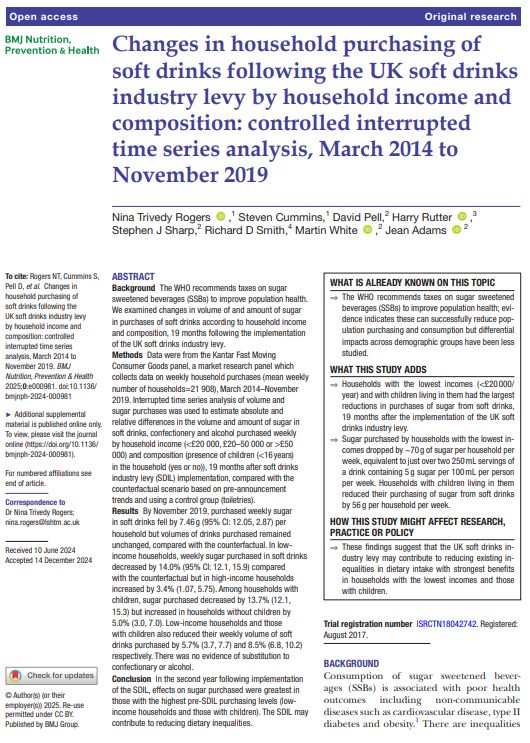
Background The WHO recommends taxes on sugar sweetened beverages (SSBs) to improve population health. We examined changes in volume of and amount of sugar in purchases of soft drinks according to household income and composition, 19 months following the implementation of the UK soft drinks industry levy.
Methods Data were from the Kantar Fast Moving Consumer Goods panel, a market research panel which collects data on weekly household purchases (mean weekly number of households=21 908), March 2014–November 2019. Interrupted time series analysis of volume and sugar purchases was used to estimate absolute and relative differences in the volume and amount of sugar in soft drinks, confectionery and alcohol purchased weekly by household income (<£20 000, £20–50 000 or >£50 000) and composition (presence of children (<16 years) in the household (yes or no)), 19 months after soft drinks industry levy (SDIL) implementation, compared with the counterfactual scenario based on pre-announcement trends and using a control group (toiletries).
Results By November 2019, purchased weekly sugar in soft drinks fell by 7.46 g (95% CI: 12.05, 2.87) per household but volumes of drinks purchased remained unchanged, compared with the counterfactual. In low-income households, weekly sugar purchased in soft drinks decreased by 14.0% (95% CI: 12.1, 15.9) compared with the counterfactual but in high-income households increased by 3.4% (1.07, 5.75). Among households with children, sugar purchased decreased by 13.7% (12.1, 15.3) but increased in households without children by 5.0% (3.0, 7.0). Low-income households and those with children also reduced their weekly volume of soft drinks purchased by 5.7% (3.7, 7.7) and 8.5% (6.8, 10.2) respectively. There was no evidence of substitution to confectionary or alcohol.
Conclusion In the second year following implementation of the SDIL, effects on sugar purchased were greatest in those with the highest pre-SDIL purchasing levels (low-income household…
ICYMI: Our new paper on the impact of the UK Soft Drinks Industry Levy is out. 19 months after implementation, we found that households purchased 7.5g less sugar from soft drinks compared to expected - equivalent to a 2.6% reduction. nutrition.bmj.com/content/earl...
06.02.2025 18:17 — 👍 38 🔁 15 💬 2 📌 1
Social psychologist, studying boredom, interest, and thinking (...and why it's so hard for so many of us!). Assistant Professor @ University of Florida 🐊
🌐 erinwestgate.com
📸 https://instagram.com/erin.corwin.westgate
The Association for the Study of Obesity (ASO) is the UK’s foremost charitable organisation dedicated to the understanding, prevention and treatment of obesity.
The UK's professional membership body for #publichealth. We work with our members to protect and improve health for all. www.fph.org.uk
The Obesity Health Alliance is a coalition of 60 health organisations who have joined together to advocate for policies to improve population health and address obesity.
Microbiologist, amateur long covid specialist, mask-wearer, europhile, thalassophile, biophile, grecophile 🇬🇷.
One of #MillionsMissing - LC, ME/CFS, POTS, MCAS
Award-winning Nutritionist (MSc, RNutr) | Workplace Wellbeing Consultant | Founder @Rocket Fuel Wellbeing | I help organisations and individuals make sense of nutrition to nurture their health and wellbeing.
Senior Implementation Science Methodologist in the Methodological and Implementation Research Program, Ottawa Hospital Research Institute, Canada. 🇦🇺 in 🇨🇦 #behaviouralscience #healthpsychology #impsci
Associate Prof #UFRGS, PQ-1D #Cnpq
Guest Researcher #Karolinska Institutet 🇧🇷🇸🇪
Epidemiologist and Associate Editor #CDOE, #BMC-OH and #RBE
Stockholm, SE
Researcher @ University of Glasgow, UK. Epidemiologist interested in mental-health and wellbeing, health inequalities, administrative data, education.
Trying to learn Italian and Spanish.
The UCL Dental Public Health Group has an outstanding national and international reputation for high quality dental and public health research, teaching and policy.
www.ucl.ac.uk/epidemiology-health-care/research/eph/research/dental-public-health
Professor of Epidemiology & Medical Statistics at the University of Bristol. Researching the health consequences of childhood adversity. Life course and causal inference methods.
Public health researcher, mother of 3, surviving stillbirth
She/her. Philosopher; postdoc (FEAST; FOODPATH) on food policy, obesity, equality & commercial determinants of health at School of Public Health, University College Cork, Ireland. Free Palestine. I stand with Kneecap&Mo Chara.
Professor of Place-Based Health and Care | Lincoln Institute for Rural and Coastal Health | Health Psychologist | Editor, Community Dentistry and Oral Epidemiology | #psychology #dentistry #oralhealth #oralepi #publichealth #academia #sciencificpublishing
Public Health Medicine registrar (resident doctor), epidemiologist, migrant, geek in disguise.📍 London | 🗣️ an-DREH-ah | 👤 he/him
Sociologist: philosophy, theory, politics, health & sport. #sociology #health
Emeritus Professor of Sociology, UCL
Fellow, Academy of Social Sciences, UK
New: ‘The Sociological Theory of Margaret Archer’ (Routledge, 2026)
www.grahamscambler.com
I lead adult education programmes to support food policy change. I research how to teach food policy & food systems literacy. Centre for Food Policy, City St George’s Uni of London. Programme Director MSc Food Policy www.citystgeorges.ac.uk/mscfoodpolicy