Handwritten note saying: "But I am very poorly today & very stupid & hate everybody & everything."
Let's celebrate #DarwinDay by reminding ourselves that everyone has moments when they feel worse for wear.
Darwin wrote to Charles Lyell in 1861:
"But I am very poorly today & very stupid & hate everybody & everything."
www.darwinproject.ac.uk/letter/DCP-L...
So, hang in there, #academicsky!
🧪🌏🐵
12.02.2026 09:48 —
👍 109
🔁 45
💬 1
📌 6
When insomnia hits, it’s not just “having trouble sleeping.”
For many people with MS, it’s a brain that won’t slow down, a body that feels wired and exhausted at the same time, and nights that don’t offer real rest.
08.02.2026 17:30 —
👍 5
🔁 2
💬 2
📌 0

Sign up now for the EMBO Workshop "#RNA metabolism: Perspective from physiology to brain disorder" in Darjeeling, India, 25–28 October 2026.
Deadline: 15 May 2026
https://meetings.embo.org/event/26-rna-metabolism
#EMBOrnaMetabolism #RNAsky #LifeSciences #research #conference #EMBOevents 🧪
27.01.2026 13:13 —
👍 7
🔁 2
💬 0
📌 1

New year and new opportunities! There is an open call for a PhD student to join our lab.
#RNA biology #circRNAs #miRNAs #neuroscience #neuroedocrinology
Please share with potential candidates 🙏🫶.
A link to the call & more details here: www.phdscanner.com/opportunitie...
06.01.2026 15:58 —
👍 4
🔁 3
💬 1
📌 0

Young PI Symposium 2026
Visit the post for more.
yo 🦋 NEURO SKY 📣 the website is live and registration open for the Young PI Symposium 2026 - the day prior to FENS Barcelona! @young-pi-neuro26.bsky.social
navigate challenges, sharpen leadership skills, make a roadmap together for generations of neuroscientists!
youngpisymposium2026.com
15.01.2026 17:04 —
👍 6
🔁 5
💬 0
📌 1
New year and new opportunities! There is an open call for a PhD student to join our lab.
#RNA biology #circRNAs #miRNAs #neuroscience #neuroedocrinology
Please share with potential candidates 🙏🫶.
A link to the call & more details here: www.phdscanner.com/opportunitie...
06.01.2026 15:58 —
👍 4
🔁 3
💬 1
📌 0
When RNA Degradation 🤝 meets 🤝 Protein Degradation! tinyurl.com/E3TDMD In a collaboration of @bartellab.bsky.social and Schulman lab, we show that, in target-directed microRNA degradation (TDMD), 2-RNA-factors recruit an E3 ligase and induce the degradation of not only a protein but also RNA (1/5).
06.01.2026 08:04 —
👍 117
🔁 50
💬 1
📌 4
LinkedIn
This link will take you to a page that’s not on LinkedIn
Exciting opportunity to learn about #humanbrainmodels and #singlecelltechnology! July 13-17 2026 we for the first time will offer the Utrecht Summer School titled "Advanced human brain models in the single-cell era" for master and PhD students. Apply now: utrechtsummerschool.nl/courses/life...
13.12.2025 09:37 —
👍 6
🔁 3
💬 0
📌 0
All travelers from ESTA countries (yes the ones on visa waiver programs) will have to disclose 5 years of social media + huge amounts of personal data to enter the US now. All US academic associations should now meet outside the US if we want to meet our international colleagues.
10.12.2025 04:27 —
👍 439
🔁 234
💬 17
📌 21

Announcing the 2026 edition of the EMBO workshop on RNA localization and local translation! This meeting will be held June 30 - July 4 near Porto, Portugal. Come for exciting updates in the field from both established investigators and trainees. See the link below for details!
08.12.2025 16:40 —
👍 37
🔁 19
💬 1
📌 3
Join us in Porto for the forefront of RNA localization & local translation research! Registration is live!
08.12.2025 21:46 —
👍 1
🔁 2
💬 1
📌 0

A graphic including a QR code that describes the RNA Society's Infographic contest.
Hey everyone, the RNA Society is running an RNA Infographic Contest! Get your team together and create! There are prizes!
09.12.2025 02:14 —
👍 2
🔁 2
💬 1
📌 0

Figure 1. Mechanisms of biogenesis of circular RNA (circRNA) subclasses and the biomedical relevance of the RNA-binding proteins (RBPs) involved.
"Features and biomedical relevance of circular RNA biogenesis"
by Xiaolin Wang & Ge Shan
"Recently, modulation of circRNA biogenesis to generate tissue-specific expression patterns is coming into focus. We summarize various mechanisms involved..."
authors.elsevier.com/sd/article/S...
05.12.2025 21:53 —
👍 3
🔁 2
💬 0
📌 0
Still a couple of weeks to apply for a fully funded PhD position in #AI and #RNA biology!!!
04.12.2025 08:17 —
👍 4
🔁 3
💬 0
📌 0
Wow
21.11.2025 17:31 —
👍 15
🔁 6
💬 1
📌 0
Join our upcoming course on cutting-edge evolutionary & genomic methods for Evo-Devo studies!
We'll cover: comparative & single-cell transcriptomics,ATAC-seq, phylogenomics, comparative genomics, gene regulation, and much more
Spots still available: sites.google.com/view/evodevo...
14.11.2025 13:48 —
👍 12
🔁 10
💬 0
📌 0

Flu vaccine providing important protection despite new subclade
UKHSA’s early season data shows vaccination remains best defence alongside good respiratory hygiene as flu activity rises.
Some good news
New data published by the UK Health Security Agency (UKHSA) shows the 2025/26 vaccine is currently 70 to 75% effective at preventing hospital attendance in children aged 2 to 17 years and 30 to 40% effective in adults.
www.gov.uk/government/n...
15.11.2025 10:27 —
👍 13
🔁 5
💬 0
📌 0
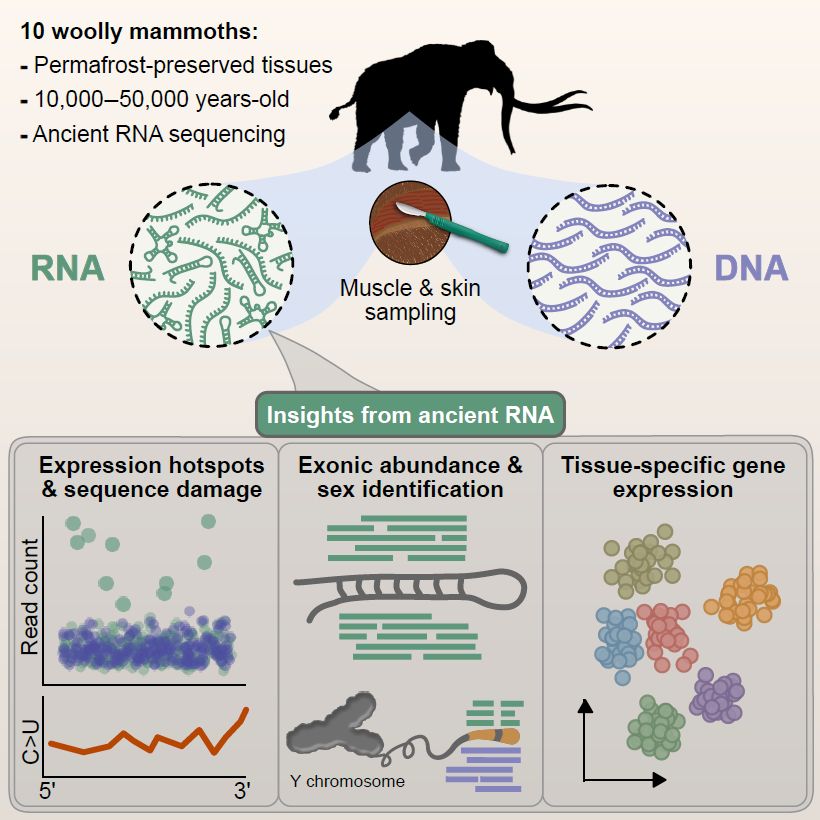
🦣🧬🦣🤯💥We are pleased to share our new paper about ancient RNA expression profiles from the Woolly Mammoth, now published in Cell @cellpress.bsky.social
www.cell.com/cell/fulltex...
If you want to know more, read the 🧵 below:
14.11.2025 16:08 —
👍 111
🔁 41
💬 1
📌 6

A table showing profit margins of major publishers. A snippet of text related to this table is below.
1. The four-fold drain
1.1 Money
Currently, academic publishing is dominated by profit-oriented, multinational companies for
whom scientific knowledge is a commodity to be sold back to the academic community who
created it. The dominant four are Elsevier, Springer Nature, Wiley and Taylor & Francis,
which collectively generated over US$7.1 billion in revenue from journal publishing in 2024
alone, and over US$12 billion in profits between 2019 and 2024 (Table 1A). Their profit
margins have always been over 30% in the last five years, and for the largest publisher
(Elsevier) always over 37%.
Against many comparators, across many sectors, scientific publishing is one of the most
consistently profitable industries (Table S1). These financial arrangements make a substantial
difference to science budgets. In 2024, 46% of Elsevier revenues and 53% of Taylor &
Francis revenues were generated in North America, meaning that North American
researchers were charged over US$2.27 billion by just two for-profit publishers. The
Canadian research councils and the US National Science Foundation were allocated US$9.3
billion in that year.

A figure detailing the drain on researcher time.
1. The four-fold drain
1.2 Time
The number of papers published each year is growing faster than the scientific workforce,
with the number of papers per researcher almost doubling between 1996 and 2022 (Figure
1A). This reflects the fact that publishers’ commercial desire to publish (sell) more material
has aligned well with the competitive prestige culture in which publications help secure jobs,
grants, promotions, and awards. To the extent that this growth is driven by a pressure for
profit, rather than scholarly imperatives, it distorts the way researchers spend their time.
The publishing system depends on unpaid reviewer labour, estimated to be over 130 million
unpaid hours annually in 2020 alone (9). Researchers have complained about the demands of
peer-review for decades, but the scale of the problem is now worse, with editors reporting
widespread difficulties recruiting reviewers. The growth in publications involves not only the
authors’ time, but that of academic editors and reviewers who are dealing with so many
review demands.
Even more seriously, the imperative to produce ever more articles reshapes the nature of
scientific inquiry. Evidence across multiple fields shows that more papers result in
‘ossification’, not new ideas (10). It may seem paradoxical that more papers can slow
progress until one considers how it affects researchers’ time. While rewards remain tied to
volume, prestige, and impact of publications, researchers will be nudged away from riskier,
local, interdisciplinary, and long-term work. The result is a treadmill of constant activity with
limited progress whereas core scholarly practices – such as reading, reflecting and engaging
with others’ contributions – is de-prioritized. What looks like productivity often masks
intellectual exhaustion built on a demoralizing, narrowing scientific vision.

A table of profit margins across industries. The section of text related to this table is below:
1. The four-fold drain
1.1 Money
Currently, academic publishing is dominated by profit-oriented, multinational companies for
whom scientific knowledge is a commodity to be sold back to the academic community who
created it. The dominant four are Elsevier, Springer Nature, Wiley and Taylor & Francis,
which collectively generated over US$7.1 billion in revenue from journal publishing in 2024
alone, and over US$12 billion in profits between 2019 and 2024 (Table 1A). Their profit
margins have always been over 30% in the last five years, and for the largest publisher
(Elsevier) always over 37%.
Against many comparators, across many sectors, scientific publishing is one of the most
consistently profitable industries (Table S1). These financial arrangements make a substantial
difference to science budgets. In 2024, 46% of Elsevier revenues and 53% of Taylor &
Francis revenues were generated in North America, meaning that North American
researchers were charged over US$2.27 billion by just two for-profit publishers. The
Canadian research councils and the US National Science Foundation were allocated US$9.3
billion in that year.

The costs of inaction are plain: wasted public funds, lost researcher time, compromised
scientific integrity and eroded public trust. Today, the system rewards commercial publishers
first, and science second. Without bold action from the funders we risk continuing to pour
resources into a system that prioritizes profit over the advancement of scientific knowledge.
We wrote the Strain on scientific publishing to highlight the problems of time & trust. With a fantastic group of co-authors, we present The Drain of Scientific Publishing:
a 🧵 1/n
Drain: arxiv.org/abs/2511.04820
Strain: direct.mit.edu/qss/article/...
Oligopoly: direct.mit.edu/qss/article/...
11.11.2025 11:52 —
👍 641
🔁 453
💬 8
📌 66

How to tackle emerging questions in cellular organisation, adaptation, and robustness? Join #EESPhaseSeparation! 🧬🦠
Bringing together scientists from diverse fields to foster new discoveries in condensate biology.
Submit your abstract by 10 Feb: s.embl.org/ees26-08-bl
📅 19 – 22 May 2026
13.11.2025 10:05 —
👍 13
🔁 9
💬 1
📌 1

Our RNA condensate work is finally out! Using simulations, we uncover the origin of the lower critical solution temperature (LCST) behaviour underlying thermo, iono-sensing functions in pure RNA condensates. www.pnas.org/doi/10.1073/...
04.11.2025 19:09 —
👍 9
🔁 2
💬 0
📌 0

Unlocking the regulatory code of RNA: launching the Human RNome Project - Genome Biology
The human RNome, the complete set of RNA molecules in human cells, arises through complex processing and includes diverse molecular species. While research traditionally focuses on four canonical nucl...
Exciting news for the RNA research community!
The Human RNome Project has been launched: a global effort to map all human RNAs and their chemical modifications. Proud to support it and contribute to the article in Genome Biology doi.org/10.1186/s130...
#RNA #bioinformatics #RNAstructure #modomics
25.10.2025 22:27 —
👍 48
🔁 16
💬 0
📌 3

The evolutionary origins of synaptic proteins and their changing roles in different organisms across evolution
Nature Reviews Neuroscience - Recent studies have shed further light on the evolutionary origins of chemical synapses, In this Review, Colgren and Burkhardt explore how ancient proteins were...
First neurons didn’t appear overnight. We trace their roots to ancient secretory cells - showing how lifestyle & behavior shaped the evolution of first synapses.🧠🌊 #Evolution #Neuroscience
Our latest in @natrevneuro.nature.com
Link: rdcu.be/eMX3E
@jeffcolgren.bsky.social @msarscentre.bsky.social
27.10.2025 18:48 —
👍 352
🔁 139
💬 4
📌 8
⏰ Last week to apply!
Don’t miss the chance to join our lab and explore the fascinating world of meiotic recombination 🌿
👉 Deadline: Nov 1, 2025
25.10.2025 05:48 —
👍 6
🔁 6
💬 0
📌 0
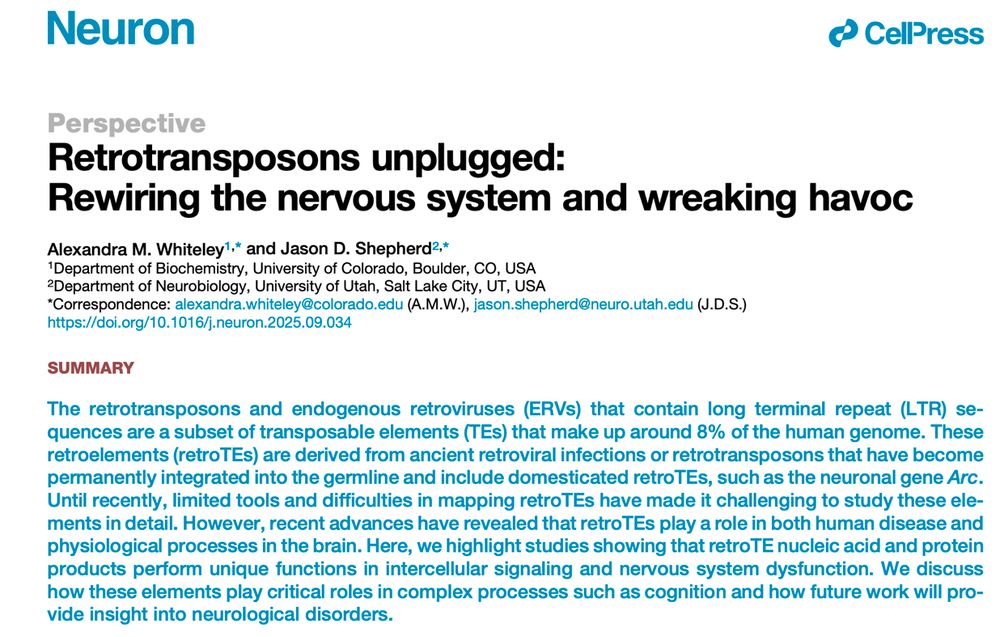
For obvious reasons, I've become fascinated with retrotransposons. So we ( @alexwhiteley.bsky.social and I) wrote an article now out in Neuron @cellpress.bsky.social on how we think retrotransposons influence brain function and health! kwnsfk27.r.eu-west-1.awstrack.me/L0/https:%2F...
20.10.2025 20:00 —
👍 65
🔁 15
💬 2
📌 2