UAB is recruiting neuroscience faculty at two different levels - come join our vibrant neuroscience community!
03.03.2026 15:14 — 👍 43 🔁 40 💬 0 📌 1UAB is recruiting neuroscience faculty at two different levels - come join our vibrant neuroscience community!
03.03.2026 15:14 — 👍 43 🔁 40 💬 0 📌 1Cholesterol and lipids are critical to spine formation, particularly during periods of active remodeling, such as adolescence. Multiple CNVs, GWAS loci, and SCHEMA mutations indicate that altered metabolism or trafficking could be a primary pathogenic mechanism in schizophrenia.
18.02.2026 15:24 — 👍 0 🔁 0 💬 0 📌 0Using zebrafish, we discovered a shared phenotype of cholesterol metabolism dysregulation. The mechanism has been suggested by prior work and human genetics. Here, we provide direct in vivo evidence of increased free cholesterol in two mutants.
18.02.2026 15:24 — 👍 2 🔁 0 💬 1 📌 0
Juvenile zebrafish brain stained with filipin to measure free cholesterol.
I'm pleased to share our newest preprint, which was actually the very first project started in my lab. It took a long time to come together! We address the challenge of translating complex psychiatric genetics into biological mechanism. tinyurl.com/4w7hv8d8
18.02.2026 15:24 — 👍 13 🔁 4 💬 1 📌 1New Python-based, modular animal tracking software from @sthyme.bsky.social 🐟 🖥️
03.02.2026 21:12 — 👍 2 🔁 1 💬 0 📌 0

We're hiring! The Hoffman lab at Yale is recruiting for Post-Doctoral Associate and Post-Graduate Associate positions available immediately. Join us! www.hoffmanlab.net/jobs #zebrafish #zebrafishjobs
01.02.2026 17:19 — 👍 7 🔁 9 💬 0 📌 2Grad student Ari Ginsparg co-led interns Ishaan, Laura, & Raheel, and grad student Jackie assisted with zebrafish work. We thank collaborators Angelique & Stephanie and Rocco for Rosetta support. Ari will be looking for industry or postdoc positions in the coming year. Reach out if you have leads!
21.01.2026 14:47 — 👍 1 🔁 0 💬 0 📌 0
Histogram bar graph showing identity and similarity of residues in the binding pocket of GPCRs. 211 total proteins were aligned. More than 130 show similarity in the 95-100% bin and about 50 are in this bin for identity. Almost 50 are in the 90-95% bin for both identity and similarity. The lowest X-axis bin is 60-65%.
The putative orthosteric binding pockets of dozens of GPCRs are conserved, and zebrafish share >70% of their genes with humans.
21.01.2026 14:47 — 👍 1 🔁 0 💬 1 📌 0
Example zebrafish locomotion trace over a three-day time period. The Y-axis is number of bouts / hour and X-axis is time, going from 0-60 hours. The motion cycles, with lower activity in the nighttime periods and higher in the daytime. The drug represses the activity of the zebrafish compared to the DMSO control animals.
We investigated 7 antagonists in zebrafish for repression of hyperactivity induced by a temporal expression of orexin (hcrt). We also confirmed off-target effects in receptor knockouts and discovered that pre-existing/FDA-approved drugs reduce zebrafish locomotion not through the intended receptor.
21.01.2026 14:47 — 👍 2 🔁 0 💬 1 📌 0
Histogram bar graph. The X-axis shows %RLU 1e-7M OxA and Y-axis shows frequency. The frequency centered at 0 X is around 6 for new hits, around 14 centered at 20 and 3 pre-existing antagonists are also in that same bin. There are around 8 in the bin at 40, 1 at 60 and 1 at 100.
REAL-M performs very well compared to virtual docking programs and AF3. Using REAL-M, we screened for antagonists of a conserved sleep receptor (GPCR HCRTR2). It is functionally conserved - ideal for a test case. HCRTR2 is activated by orexin A (OxA). Molecules were first tested using PRESTO-Tango.
21.01.2026 14:47 — 👍 2 🔁 0 💬 1 📌 0
Three panels. The one on the left shows a small molecule ligand and an amino acid residue on a protein, with three motif atoms on each side shown as spheres. The middle panel shows a small molecule in a protein binding cavity covered with many small spheres. This represents the grid we use to determine if a ligand clashes with the protein backbone and fills the binding pocket. The third panel on the right shows a ligand surrounded by a protein with two colors and slight shifts between the two colors. This represents subtle energy minimization of the ligand and protein to refine the placement.
We use motifs to guide the placement of drugs against a target protein. New ultra-fast filtering algorithms remove poses with unrecoverable backbone clashes or miss the binding pocket, saving precious runtime. We combine this with Rosetta's powerful score functions to evaluate and optimize poses.
21.01.2026 14:47 — 👍 1 🔁 0 💬 1 📌 0
An amino acid interacting with a small molecule. Three atoms on the amino acid that contact the ligand are colored purple and shown as spheres. Three atoms on the ligand that contact the amino acid are also colored purple and shown as spheres.
We introduce the Rosetta Engine for Anchoring Ligands with a Motif (REAL-M). What is a motif? The spatial orientation of 6 atoms in a protein-ligand interaction. We collected >1.6 million unique motifs.
21.01.2026 14:47 — 👍 3 🔁 0 💬 1 📌 0
Cartoon zebrafish with green lit-up brain, in well of plate responding to hit molecule.
Drug discovery for nervous system disorders is really challenging. We think early/rapid in vivo testing with zebrafish will accelerate the drug development cycle for conserved targets. Check out our proof-of-principle pilot study and virtual drug discovery pipeline (tinyurl.com/3whr23hs). #Skytorial
21.01.2026 14:47 — 👍 14 🔁 8 💬 1 📌 1Pls Repost: I am putting together an edition of “Methods in Molecular Biology” focused on early development, encompassing gastrulation. I am making a list of potential authors for chapters. If interested, please contact me - An excellent opportunity for trainees to co-author with their advisors.
03.12.2025 12:43 — 👍 7 🔁 9 💬 2 📌 0
IMPORTANT IMPORTANT IMPORTANT IMPORTANT
Please watch the workshop video and COMMENT by 5:00 Monday 7/14
This is the source of the "no more model organism only grants in NIH-funded research" decree.

Public comments have been opened back up!
Research with animals is critical for providing evidence-based knowledge in the pursuit of human health. Broadly reducing research projects with animals threatens public health and will greatly stall the development of new therapeutics for diseases!
"There have been many funding cuts to cancer research, and it's playing out many ways. Here are a few stories from people I know. I spend time in cancer circles. I am an recliner advocate nowadays.
Brooke is 24 years old, has a baby and a toddler, and has stage 4 B-cell lymphoma..."
UAB Neurobiology is hiring up to 4 new tenure-track faculty as part of 3 new open-rank searches. Come join our vibrant, supportive, and growing neuroscience community!
uab.peopleadmin.com/postings/23916
uab.peopleadmin.com/postings/23944
uab.peopleadmin.com/postings/24010
We get news of an apparent breakthrough in pancreatic cancer — usually a death sentence, one of the cancers with the worst outcomes — and Trump and Musk are blowing up NIH and with it future cancer cures.
The American people didn’t vote for this.
Not even close to 49.8% did.
THIS IS HUGE! A cancer vaccine developed by Yale University and DFCI shows MAJOR promise. Results of an early-phase trial reveal ALL patients with ADVANCED stage kidney cancer had successful anti-cancer immune responses AND have remained CANCER-FREE approximately THREE years after treatment. 🧪🧵⬇️
26.02.2025 17:00 — 👍 11279 🔁 3378 💬 218 📌 236One of the remarkable things about #NIH is how rigorously its grants, research, and employees are reviewed. NIH science and scientists are held to a high standard by external reviewers — via study sections and councils, or BSC/site visit reviewers. And the reviews have teeth. 🧪
25.02.2025 12:26 — 👍 403 🔁 74 💬 7 📌 8
Guardian story about Federal Register issue is up.
www.theguardian.com/us-news/2025...

New York Times article now up on Federal Register stuff.
www.nytimes.com/2025/02/21/s...
1/n
COALITION OF MAYORS ACROSS U.S. FILE AMICUS BRIEF IN OPPOSITION TO TRUMP ADMINISTRATION’S DRASTIC CUTS TO FEDERAL RESEARCH FUNDING Led by the City of Boston, MA, City of Cleveland, OH, the Metropolitan Government of Nashville and Davidson County, TN, the Mayor of Gainesville, FL, and the Mayor of Salt Lake City, UT, over 40 mayors, cities, and counties argue that NIH cuts will cause job losses, economic disruption, and undermine U.S. competitiveness BOSTON - Thursday, February 20, 2025 - Late yesterday, Mayor Michelle Wu co-led a coalition of Mayors from across the United States in writing and filing an amicus brief in federal district court in Boston to stop the Trump Administration's drastic and illegal cuts to federal research funding and immediate job losses in cities nationwide. Over 40 mayors, cities, and counties from across the country joined the brief. These cities are home to universities and hospitals that employ hundreds of thousands of Americans in cutting edge medical and scientific research, and the federally-funded research in these communities has made the United States the global leader in scientific discovery. The brief seeks a temporary restraining order against the Trump Administration, alongside the research universities, medical schools, hospitals, and 22 states that are plaintiffs in the three cases filed last week in federal district court. “For decades, Congress has made a clear choice to use federally-funded research to invest in cities, build a broadly-distributed infrastructure for scientific discovery, create jobs, and drive economic growth in communities across the United States,” said Mayor Michelle Wu. “We join with cities across the country – in red states, purple states, and blue states – to stop this illegal action that will cause layoffs, lab closures, and undermine scientific progress in American cities. I thank Massachusetts Attorney General Andrea Campbell for her leadership on behalf of the research institutions of Boston.”
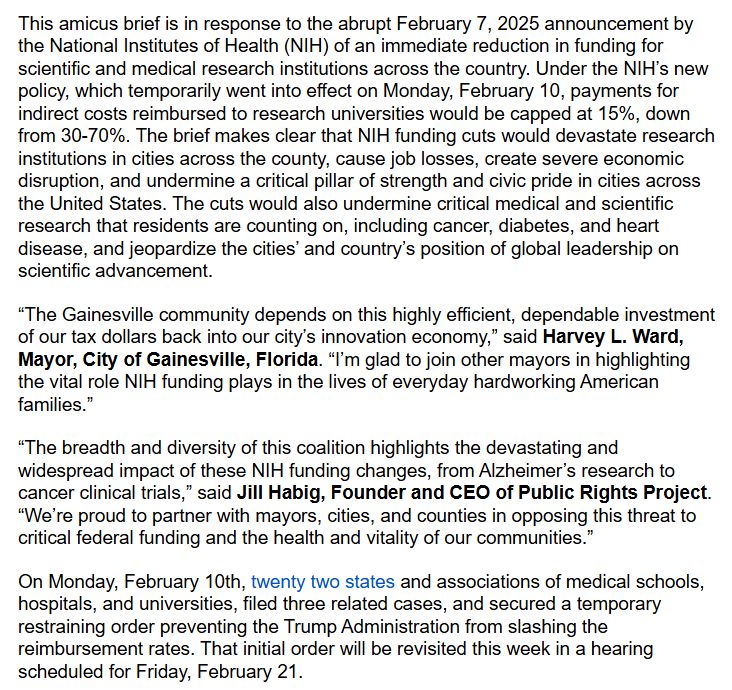
This amicus brief is in response to the abrupt February 7, 2025 announcement by the National Institutes of Health (NIH) of an immediate reduction in funding for scientific and medical research institutions across the country. Under the NIH’s new policy, which temporarily went into effect on Monday, February 10, payments for indirect costs reimbursed to research universities would be capped at 15%, down from 30-70%. The brief makes clear that NIH funding cuts would devastate research institutions in cities across the county, cause job losses, create severe economic disruption, and undermine a critical pillar of strength and civic pride in cities across the United States. The cuts would also undermine critical medical and scientific research that residents are counting on, including cancer, diabetes, and heart disease, and jeopardize the cities’ and country’s position of global leadership on scientific advancement. “The Gainesville community depends on this highly efficient, dependable investment of our tax dollars back into our city’s innovation economy,” said Harvey L. Ward, Mayor, City of Gainesville, Florida. “I’m glad to join other mayors in highlighting the vital role NIH funding plays in the lives of everyday hardworking American families.” “The breadth and diversity of this coalition highlights the devastating and widespread impact of these NIH funding changes, from Alzheimer’s research to cancer clinical trials,” said Jill Habig, Founder and CEO of Public Rights Project. “We’re proud to partner with mayors, cities, and counties in opposing this threat to critical federal funding and the health and vitality of our communities.” On Monday, February 10th, twenty two states and associations of medical schools, hospitals, and universities, filed three related cases, and secured a temporary restraining order preventing the Trump Administration from slashing the reimbursement rates. That initial order will be revisited this week in a hearing scheduled for Feb. 21.
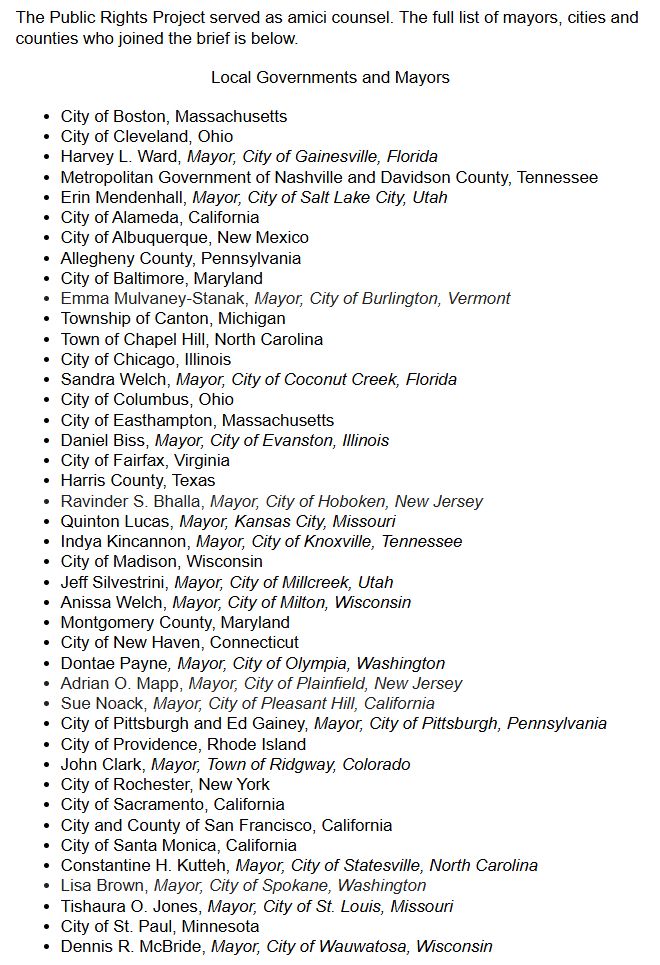
The Public Rights Project served as amici counsel. The full list of mayors, cities and counties who joined the brief is below. Local Governments and Mayors City of Boston, Massachusetts City of Cleveland, Ohio Harvey L. Ward, Mayor, City of Gainesville, Florida Metropolitan Government of Nashville and Davidson County, Tennessee Erin Mendenhall, Mayor, City of Salt Lake City, Utah City of Alameda, California City of Albuquerque, New Mexico Allegheny County, Pennsylvania City of Baltimore, Maryland Emma Mulvaney-Stanak, Mayor, City of Burlington, Vermont Township of Canton, Michigan Town of Chapel Hill, North Carolina City of Chicago, Illinois Sandra Welch, Mayor, City of Coconut Creek, Florida City of Columbus, Ohio City of Easthampton, Massachusetts Daniel Biss, Mayor, City of Evanston, Illinois City of Fairfax, Virginia Harris County, Texas Ravinder S. Bhalla, Mayor, City of Hoboken, New Jersey Quinton Lucas, Mayor, Kansas City, Missouri Indya Kincannon, Mayor, City of Knoxville, Tennessee City of Madison, Wisconsin Jeff Silvestrini, Mayor, City of Millcreek, Utah Anissa Welch, Mayor, City of Milton, Wisconsin Montgomery County, Maryland City of New Haven, Connecticut Dontae Payne, Mayor, City of Olympia, Washington Adrian O. Mapp, Mayor, City of Plainfield, New Jersey Sue Noack, Mayor, City of Pleasant Hill, California City of Pittsburgh and Ed Gainey, Mayor, City of Pittsburgh, Pennsylvania City of Providence, Rhode Island John Clark, Mayor, Town of Ridgway, Colorado City of Rochester, New York City of Sacramento, California City and County of San Francisco, California City of Santa Monica, California Constantine H. Kutteh, Mayor, City of Statesville, North Carolina Lisa Brown, Mayor, City of Spokane, Washington Tishaura O. Jones, Mayor, City of St. Louis, Missouri City of St. Paul, Minnesota Dennis R. McBride, Mayor, City of Wauwatosa, Wisconsin
The City of Boston is leading 40+ mayors, cities, and counties in an amicus brief against the Trump Administration's drastic and illegal cuts to federal research funding—cuts that will lead to immediate job losses nationwide.
20.02.2025 22:16 — 👍 1481 🔁 428 💬 34 📌 80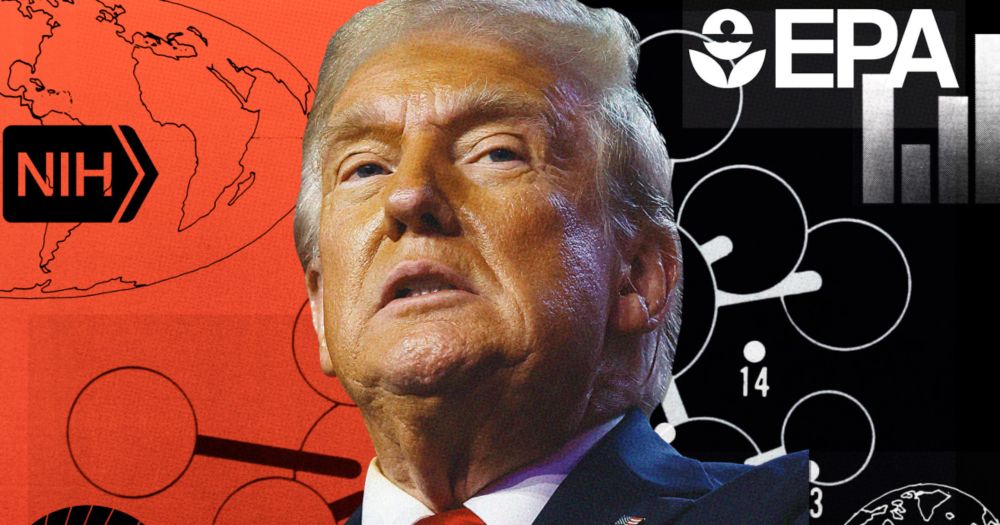
Reaching out to all Americans through the media to explain how decreasing funding of the NIH will have irreversible harm for developing therapies for all diseases. Please spread the word to your families and friends and contact your congressional representatives.
www.nbcnews.com/science/scie...
This is incredibly stressful to our Alzheimer's community (families and researchers). There are Alzheimer Disease Research Centers that are in limbo now - no council meetings means no notice of awards, means all the research we are doing to slow or prevent this disease is paused indefinitely.
18.02.2025 00:55 — 👍 91 🔁 37 💬 0 📌 4The court ordered that NIH grant funding be unfrozen, so The Regime found a way around it. For NIH grants to be funded, a review panel must rank them. In order for a review panel to meet, they must post it on the Federal Register. Submissions to the Federal Register are now on hold “indefinitely”.
20.02.2025 02:32 — 👍 834 🔁 508 💬 30 📌 37
Important article. This center was taking new approaches to studying Alzheimer’s and other dementias.
Everyone who knows someone with dementia is being hurt by Trump’s cuts to medical research. 🧪

Scientists studying neuroscience, diabetes, autism and bird flu became emotional as they spoke to the Guardian about the possibility of losing their life’s work.
19.02.2025 15:01 — 👍 122 🔁 56 💬 7 📌 7
The MMR vaccine is 97% effective at preventing measles infection.
But infants under 12 months old are not eligible for the vaccine, leaving them vulnerable.
When measles spreads due to low vaccination rates, it puts our youngest—and most defenseless—children at the greatest risk.