
Happy to see our paper Uniqueness of Purifications Is Equivalent to Haag Duality with @arrr.de and @stotti-alex.bsky.social published in PRL! 🥳
doi.org/10.1103/d7nm...
Happy to see our paper Uniqueness of Purifications Is Equivalent to Haag Duality with @arrr.de and @stotti-alex.bsky.social published in PRL! 🥳
doi.org/10.1103/d7nm...

I strongly recommend Tobias Osborne's lectures on general relativity. They are full of insight and lots of fun to watch.
www.youtube.com/playlist?lis...
We're a group of fun, loving, and fun-loving people welcoming more :)
07.11.2025 15:45 — 👍 5 🔁 2 💬 0 📌 0If you are interested in doing a postdoc with me, please apply to the IQC postdoctoral fellowship here: iqc-uwaterloo.slideroom.com#/login/progr...
06.11.2025 19:12 — 👍 18 🔁 12 💬 1 📌 1
Happy to see that our paper on pure state entanglement and von Neumann algebras with @lvanluijk.bsky.social, @stotti-alex.bsky.social and Reinhard Werner is finally out in CMP 🥳
link.springer.com/article/10.1...
Here's a picture of the four of us at my defense some weeks ago.
13.10.2025 19:44 — 👍 13 🔁 0 💬 1 📌 0The thesis is based on a series of works with my wonderful collaborators @stotti-alex.bsky.social, Reinhard Werner, and @arrr.de. I'm grateful for the wonderful time I had as a PhD student in Hanover!
13.10.2025 09:01 — 👍 3 🔁 0 💬 0 📌 1
Interested in entanglement theory for systems with infinitely many degrees of freedom? Take a look at my PhD thesis, now available on the arXiv 🥳 arxiv.org/abs/2510.07563
13.10.2025 09:01 — 👍 19 🔁 3 💬 1 📌 2
Inclined to send around a mail to everyone:
Dear colleagues, friends and family, due to the consequences of QIP's post-submission-arXiv-posting-deadline you won't see or hear from me in the next two weeks while I try to catch up with the literature. Thanks for your understanding.
With Simon Becker, Niklas Galke and Robert Salzmann.
The paper is inspired by doi.org/10.1103/Phys..., where Burgarth et al show unexpectedly slow Trotter convergence rates of N^{-¼} for the Coulomb dynamics of certain states. We quantitatively link such slow rates to certain regularity properties.

The Trotter product formula has countless applications from quantum simulation to numerical analysis—but sharp error bounds, especially for unbounded Hamiltonians, are often hard.
We prove new state-dependent bounds and apply them to Schrödinger, Dirac and Coulomb dynamics: doi.org/10.1007/s102...

Like embezzlement of entanglement but not von Neumann algebras?
Check out
arxiv.org/abs/2509.15749
where we show explicitly that generic Gaussian fermionic states provide universal embezzling families.
Plus: A novel bound relating trace distance of Gaussian states to their covariance matrices.
Main takeaway:
Haag duality and the uniqueness of purifications are equivalent, but not automatic in bipartite systems with infinitely many DoF. E.g., they can fail in certain bipartitions of topologically ordered systems.
By our result, the Uhlmann property must also fail. But can we understand this explicitly?
Yes: Creating a pair of anyons in the two cones leaves the B-marginal unchanged. With unitaries in A, the anyons can't be removed. The resulting states remain perfectly distinguishable from the ground state.

Example: The ground state sector of the surface code on an infinite square lattice. Let A be two disjoint cones, and let B be the complement (see below). Then tomography holds, but it was shown by P. Naaijkens in doi.org/10.1063/1.48... that Haag duality fails.
17.09.2025 10:22 — 👍 1 🔁 0 💬 1 📌 0
For systems with finitely many DoF, all three are equivalent. In the general case, where subsystems are modeled by von Neumann factors on the full system’s Hilbert space, we prove:
Haag duality ⇔ Uhlmann property ⇒ tomography.
The converse to the second implication does not hold.
Uhlmann property: Pure states with equal A-marginals are connected by unitaries of Bob, up to arbitrarily small error. In other words: Purifications of A-states are unique, modulo their obvious symmetries.
17.09.2025 10:22 — 👍 0 🔁 0 💬 1 📌 0
A bipartite system is a system composed of two subsystems. We investigate three formalizations of what "composed of" means:
Tomography: States are uniquely determined by correlation experiments.
Haag duality: Observables belong to Alice if and only if they commute with all of Bob’s observables.
New paper on entanglement in infinite quantum systems with @stotti-alex.bsky.social @arrr.de 🎉:
arxiv.org/abs/2509.12911
The paper investigates bipartitions of quantum systems with infinitely many degrees of freedom. Small thread below 👇
🥳I am very happy to have been awarded an ERC Starting Grant that I will use to start my own group and explore the large-scale entanglement properties of complex quantum systems.
This would not have been possible without my fantastic collaborators and supervisors. A big "thank you" to all of you! 🙏

Glad someone took the time to debunk the (obviously nonsensical) claim that Bell inequalities could be violated w/o entanglement. It is astonishing (to say the least) that this claim was made by experienced authors & that it passed peer review in the first place, does not reflect well on the journal
20.08.2025 09:22 — 👍 45 🔁 7 💬 2 📌 1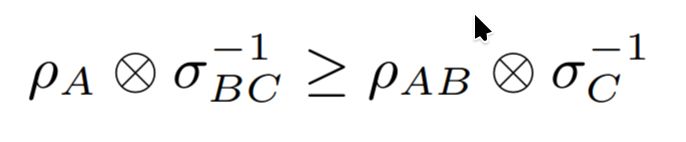
An inequality between density operators: \rho_A \otimes \sigma_{BC}^{-1} \geq \rho_{AB} \otimes \sigma_C^{-1}
Small paper w/ @lvanluijk.bsky.social and @stotti-alex.bsky.social: We revisit the amazing operator inequality by Lin et al. (arXiv:2211.13372), which implies strong sub-additivity of entropy and find that it's a special case of Connes' theory of spatial derivatives:
arxiv.org/abs/2508.03731
For the math folks on here: NSF has suspended Terry Tao's grant. www.nsf.gov/awardsearch/...
31.07.2025 22:44 — 👍 277 🔁 122 💬 9 📌 38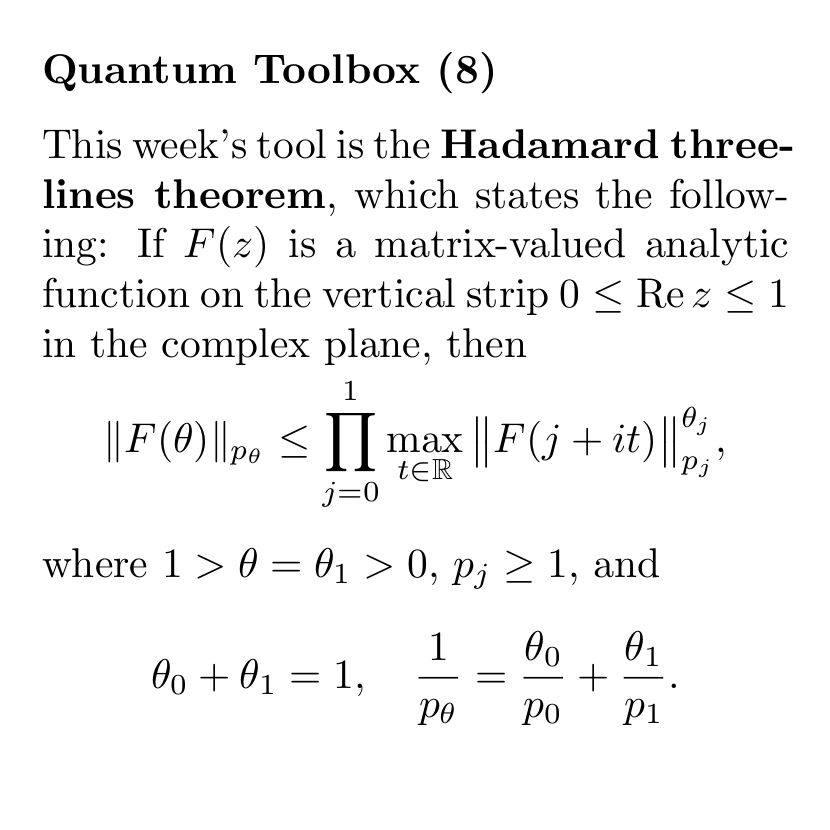
Quantum Toolbox (8): Hadamard's Three-Lines Theorem (1/6)
01.08.2025 10:35 — 👍 11 🔁 4 💬 1 📌 1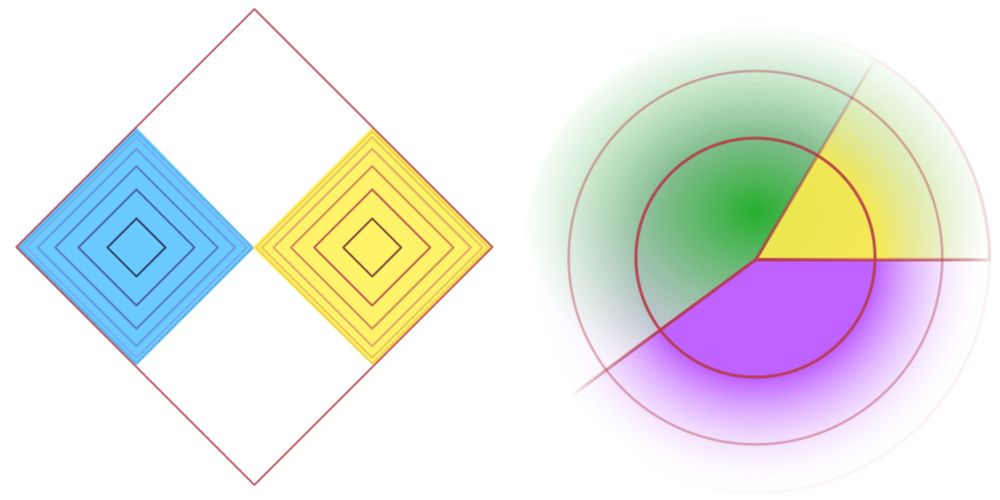
Happy to see that our paper on multipartite embezzlement with @lvanluijk.bsky.social and @stotti-alex.bsky.social is finally out in @quantum-journal.bsky.social
quantum-journal.org/papers/q-202...
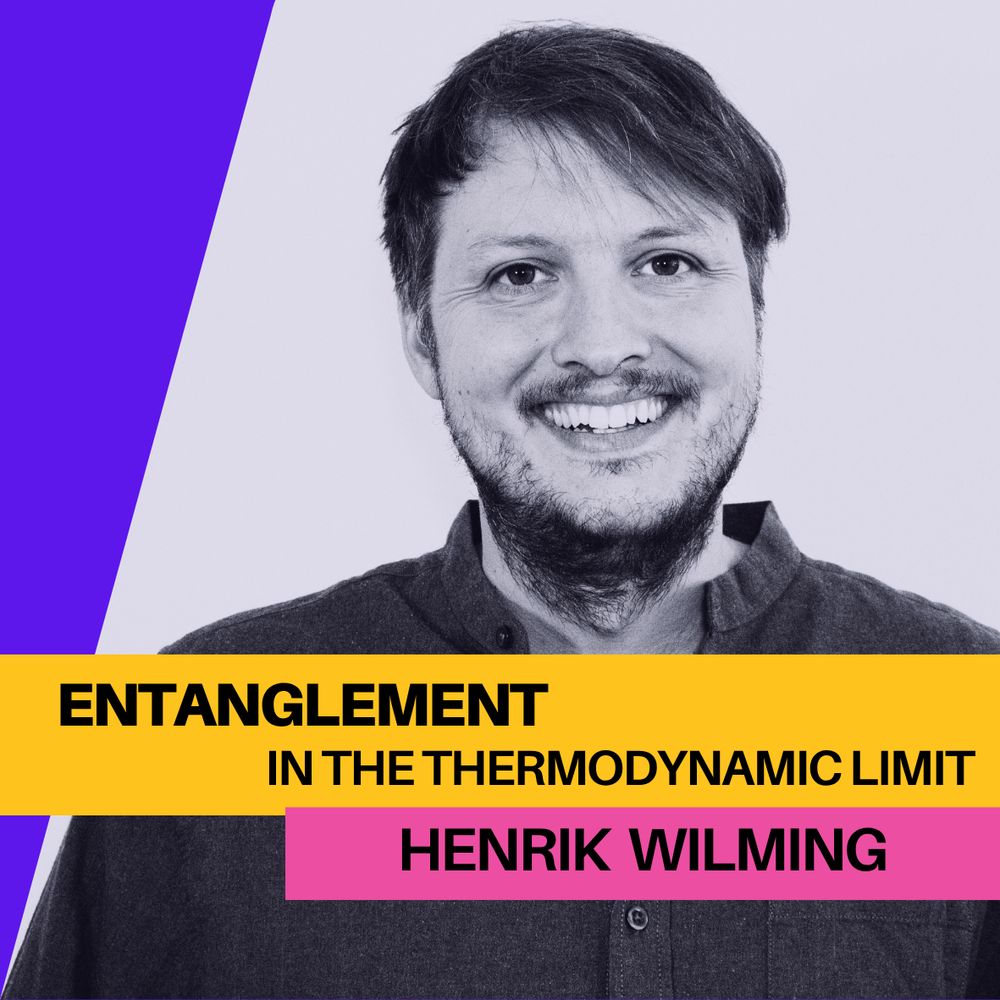
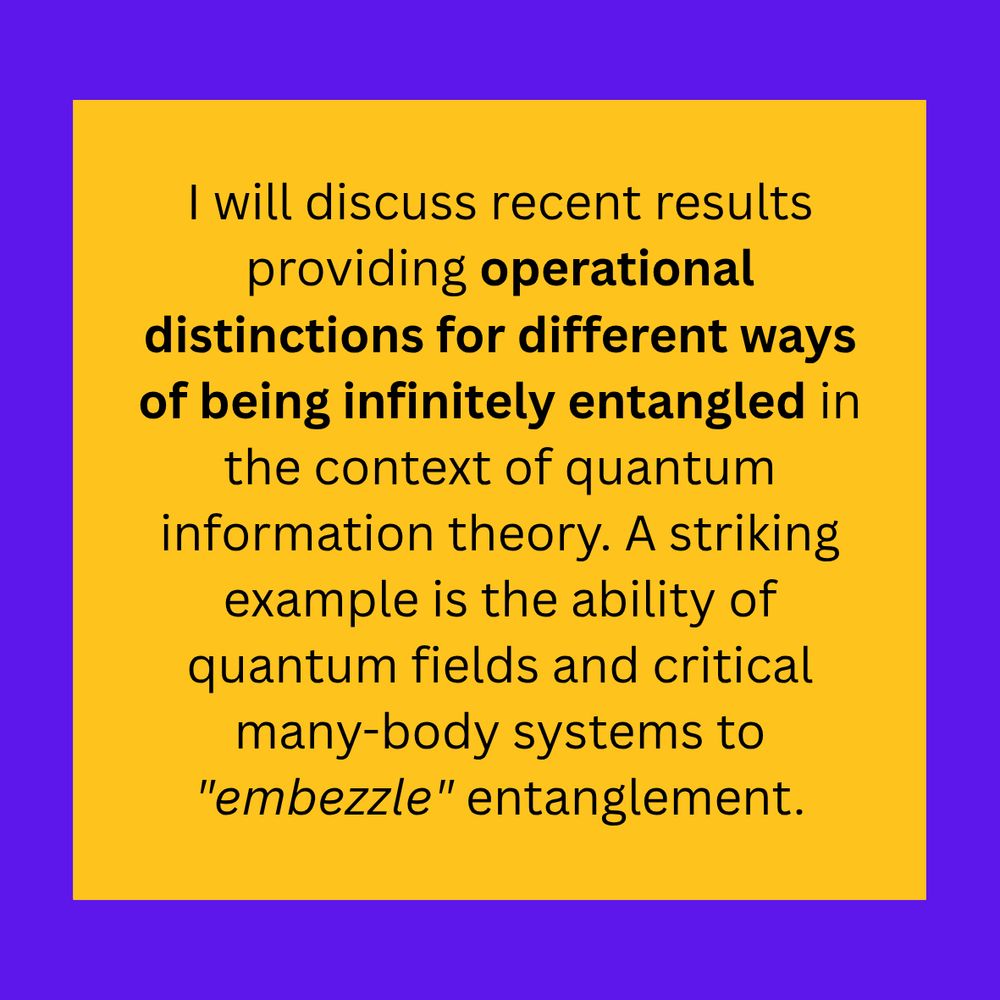
Henrik will soon talk about entanglement in the thermodynamic limit at LUH :).
21.07.2025 09:50 — 👍 7 🔁 3 💬 0 📌 0
Thanks to @phys.org.web.brid.gy for covering our recent work with @stotti-alex.bsky.social and @lvanluijk.bsky.social on embezzlement of entanglement in critical systems:
phys.org/news/2025-06...
Paper: www.nature.com/articles/s41...
I am currently looking for a PhD student who would like to work on position-based cryptography. Details can be found here: andreasbluhm.eu/wp-content/u...
Please spread the word!
Today our paper on universal embezzlement of entanglement in critical fermion systems has been published in Nature Physics:
www.nature.com/articless415...
Another intense collaboration with the great Lauritz (@lvanluijk.bsky.social) & Henrik (@arrr.de).
Below is the former Twitter thread.