Margarita Lopez-Uribe's Avatar

Margarita Lopez-Uribe

@mmlopezu.bsky.social

1,871 Followers  |  1,105 Following  |  126 Posts  |  Joined: 23.09.2023  |  2.0595

Latest posts by mmlopezu.bsky.social on Bluesky

Looking forward to your comments!

22.11.2025 01:03 β€” πŸ‘ 0    πŸ” 0    πŸ’¬ 0    πŸ“Œ 0
Preview
Overcoming barriers that limit the impact of ecological research Ecology and conservation researchers have diverse goals that often include both personal career aspirations and desires to enhance the well-being of the natural world and its inhabitants. Perception ....

Why do so many ecologists share common feelings of disconnection between their research goals and real-world impact? 🌍

Our new article in #FE&E explores the constraints that limit ecological research and how we can mitigate them. πŸ‘‡

esajournals.onlinelibrary.wiley.com/doi/10.1002/...

20.11.2025 09:02 β€” πŸ‘ 34    πŸ” 19    πŸ’¬ 3    πŸ“Œ 3
The bee bread of honey bees is characterized by a core microbiota despite the application of miticide treatments and variation across space and time Background Bee bread is composed of a mixture of pollen and nectar used as the main source of proteins and lipids for the development of bee larvae. Despite its important role in honey bee food preser...

New study shows bee bread has a stable core microbiota 🐝🧬 Miticides had only weak effects, with slight drops in non-core diversity. Honey bee nutrition is more microbially resilient than we thought. πŸ’›
peerj.com/articles/203...

20.11.2025 13:21 β€” πŸ‘ 7    πŸ” 2    πŸ’¬ 1    πŸ“Œ 0
Preview
From the Lab to the Legislature and Living Room: Science Needs Storytellers Keynote speakers on the opening day of Entomology 2025 emphasized the importance of communication and collaboration in advancing both science and the public understanding of how science affects their…

Keynote speakers on the opening day of Entomology 2025 emphasized the importance of communication and collaboration in advancing both science and the public understanding of how science affects their lives and society at large. #EntSoc25

10.11.2025 22:02 β€” πŸ‘ 13    πŸ” 2    πŸ’¬ 0    πŸ“Œ 0

Tomorrow Tuesday at #EntSoc25 Portland Ballroom at 8am!

11.11.2025 00:15 β€” πŸ‘ 5    πŸ” 1    πŸ’¬ 0    πŸ“Œ 0

Hope to be able to catch up with you!

10.11.2025 07:16 β€” πŸ‘ 1    πŸ” 0    πŸ’¬ 0    πŸ“Œ 0
Post image

Hello Portland! Super excited for all the talks and networking at #EntSoc25!!!

09.11.2025 17:08 β€” πŸ‘ 11    πŸ” 1    πŸ’¬ 1    πŸ“Œ 0
Post image

Enjoying Portland’s fall moss before #EntSoc2025! Join me Sunday (8–8:20 AM, Room B114) for my talk on how space and species shape stingless bee colony microbiomes β€” part of the symposium 'Inside and Out: Roles of Environmental and Gut Symbioses' with lots of great talks!

07.11.2025 21:07 β€” πŸ‘ 10    πŸ” 3    πŸ’¬ 1    πŸ“Œ 0

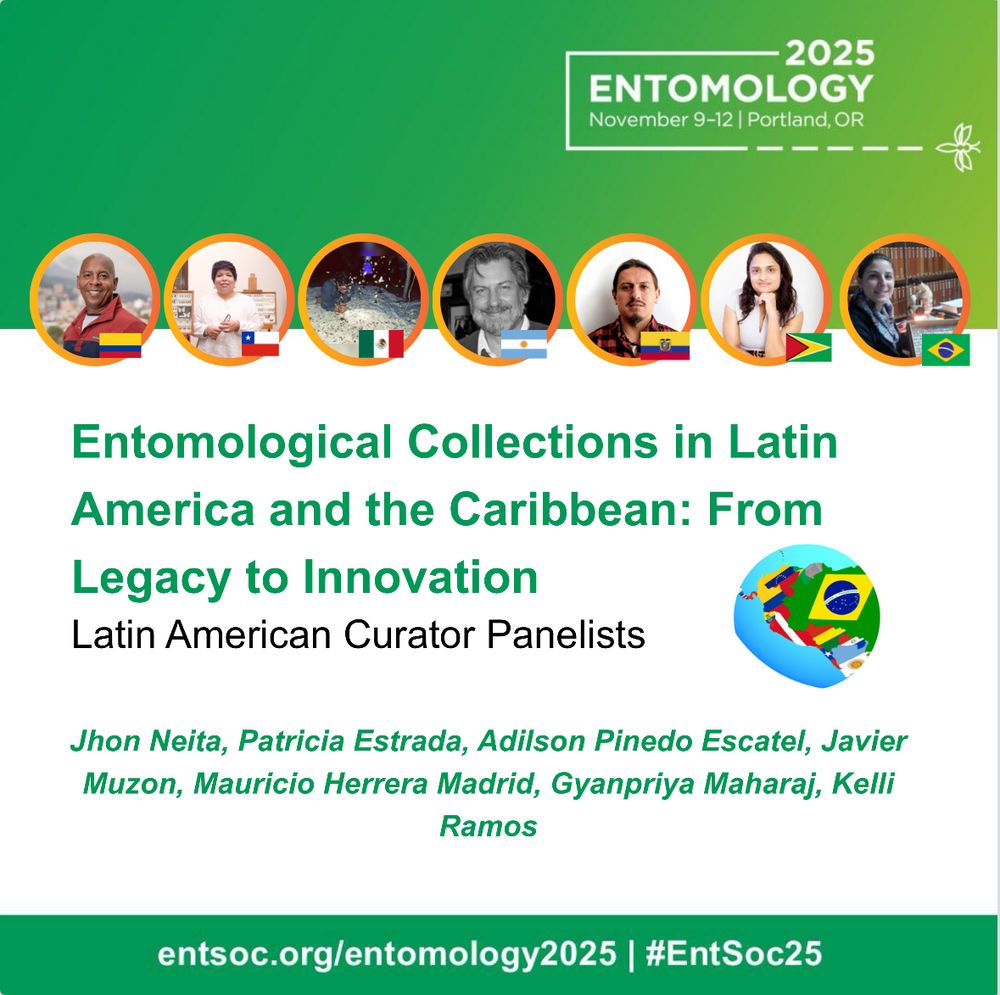
@mmlopezu.bsky.social and I bring β€œEntomological Collections in Latin America and the Caribbean” to #EntSoc25 β€” voices from the Americas on access, sustainability, and equity. #GlobalSouthScience
Check the Panelists! @entsocamerica.bsky.social @entcollnet.bsky.social

05.11.2025 07:14 β€” πŸ‘ 5    πŸ” 2    πŸ’¬ 0    πŸ“Œ 0

Innovation in insect collections starts here β€” meet our #EntSoc25 plenarists. #GlobalSouthScience @mmlopezu.bsky.social @entsocamerica.bsky.social

05.11.2025 07:16 β€” πŸ‘ 4    πŸ” 3    πŸ’¬ 0    πŸ“Œ 0
Post image

Entomology 2025 begins in five days! As you're exploring the program, what session are you most looking forward to? (Other than your own.πŸ˜‰) entomology2025.eventscribe.net Reply or quote to share. #EntSoc25

04.11.2025 18:20 β€” πŸ‘ 4    πŸ” 2    πŸ’¬ 0    πŸ“Œ 0
Post image

#EntSoc25

Tuesday Nov 11 at 8am in Portland Ballroom 256

Meet our Curator Panelists
Jhon Neita πŸ‡¨πŸ‡΄, Patricia Estrada πŸ‡¨πŸ‡±, Adilson Pinedo Escatel πŸ‡²πŸ‡½, Javier Muzon πŸ‡¦πŸ‡·,Mauricio Herrera Madrid πŸ‡ͺπŸ‡¨, Gyanpriya Maharaj πŸ‡¬πŸ‡Ύ, Kelli Ramos πŸ‡§πŸ‡·

04.11.2025 22:42 β€” πŸ‘ 9    πŸ” 2    πŸ’¬ 0    πŸ“Œ 1
Post image

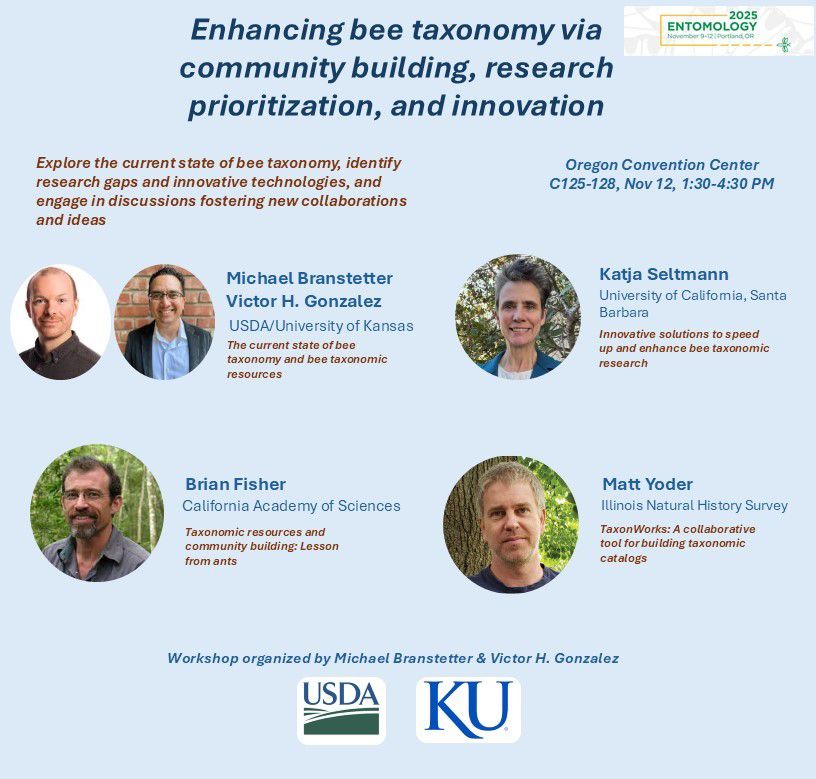
#EntSoc25 Curious about the future of bee taxonomy? Join our workshop to explore its current state, identify research gaps, and discover innovative solutions shaping the field. Wednesday at 1:30 PM in C25 @entsocamerica.bsky.social πŸπŸ§¬πŸ”¬ @isabellamanning.bsky.social @mmlopezu.bsky.social

04.11.2025 19:01 β€” πŸ‘ 8    πŸ” 3    πŸ’¬ 0    πŸ“Œ 0
Post image

#EntSoc2025 #LatinAmericanEntomology #InsectCollections #Biodiversity
Tuesday Nov 11 at 8am in Portland Ballroom 256
Plenarists β€” Katja Seltmann, Juanita Rodriguez, Robert P. Guralnick, and John Abbott will explore how entomological collections connect the past and future of biodiversity research.

04.11.2025 22:34 β€” πŸ‘ 6    πŸ” 0    πŸ’¬ 0    πŸ“Œ 2
Post image Post image

#EntSoc25 Join us for our symposium on Ecophysiology of Social Insects. Wednesday at 9:30 am in Portland Ballroom 251. @entsocamerica.bsky.social @jelenabujan.bsky.social @mmlopezu.bsky.social @isabellamanning.bsky.social

03.11.2025 22:14 β€” πŸ‘ 7    πŸ” 4    πŸ’¬ 0    πŸ“Œ 0
Preview
She Studied How Logging Affects Pollinators

An article about a former lab tech in my lab, Kim Ballare, in the new NYTimes "Lost Science" series about impacts of federal cuts. Thanks to @carlzimmer.com for doing this!
www.nytimes.com/2025/10/08/s...

13.10.2025 20:00 β€” πŸ‘ 35    πŸ” 12    πŸ’¬ 0    πŸ“Œ 0
Preview
Postdoctoral Fellowship - Ecology, Evolution, and Behavior

Apply to become the next MSU EEB Presidential Postdoctoral Fellow!

These are two year positions with research stipend, working with 2+ MSU EEB faculty. Applications due 10 November 2025. More here:

eeb.msu.edu/initiatives/...

07.10.2025 14:51 β€” πŸ‘ 38    πŸ” 46    πŸ’¬ 0    πŸ“Œ 1
Preview
The effects of floral microclimate on pollen viability and visitor behavior Flowers represent intricate microcosms shaped by their physical, chemical, and micrometeorological properties. Both thermogenic and non-thermogenic fl…

Here is the original paper by Dahake et al
www.sciencedirect.com/science/arti...

07.10.2025 15:28 β€” πŸ‘ 3    πŸ” 0    πŸ’¬ 0    πŸ“Œ 0
Photo by Nash Turley

Photo by Nash Turley

🌼 New paper showing that it's not just pollinators shaping flowersβ€”abiotic factors like humidity and temperature also influence floral form and function. Check out this new paper on a more complex picture of floral evolution. 🌬️🐝
www.sciencedirect.com/science/arti...

07.10.2025 15:28 β€” πŸ‘ 13    πŸ” 7    πŸ’¬ 1    πŸ“Œ 0

Sad about this news. What a great legacy she leaves behind.

01.10.2025 19:26 β€” πŸ‘ 3    πŸ” 0    πŸ’¬ 0    πŸ“Œ 0
Navigating A Government Shutdown: One-Stop Resource Page As of 12:01 AM on October 1, Donald Trump and Republicans in Congress have shut down the government.

NSF’s doors will be closed at 1:30 pm today. While you may be able to submit things, there will be no staff to process anything. In fact it is illegal for us to even open our work computers or email during a shutdown. A very few rotators may be able to communicate, so check out of office responses.

01.10.2025 05:56 β€” πŸ‘ 20    πŸ” 14    πŸ’¬ 2    πŸ“Œ 0
Preview
Modeling the effects of stress and premature hive exiting behavior on honey bee (Apis mellifera) colony survival - Apidologie Honey bees have a complex social structure, with many factors affecting colony survival. Mathematical models are therefore valuable for understanding how individual variables affect honey bee colony dynamics. Previous honey bee population models have shown that accelerated aging due to stress can lead to colony decline. Our previous work showed that general developmental stress causes a previously undocumented behavior whereby very young workers exit the colony before they can fly, leading them to die prematurely on the ground outside the hive. In this study, we modeled the effects of this premature hive exiting behavior on colony survival. We used parameters from previous studies to inform our model and incorporated empirical data regarding the rate of premature hive exiting behavior driven by various developmental stressors. An equation to link premature exit with accelerated aging was also introduced to mirror population dynamics across different worker age groups. We found that higher rates of premature hive exiting behavior can accelerate colony collapse. A feeding variable (provisioning colonies with extra sugar syrup) and a brood break variable (preventing the queen from laying eggs for a given time period to decrease Varroa mite levels) were added to the model to examine ways to counteract the negative effects of premature hive exiting behavior and to assess their effectiveness at regulating the progression of worker aging. Our results suggest that both supplemental feeding and implementing brood breaks can bring a colony back from the brink of collapse.

A new study finds that developmental stress is associated with young workers leaving hives too early and dying outside. Management tools like extra feeding + brood breaks can rescue stressed colonies
#HoneyBees #Pollinators #ColonyHealth
@julirangel.bsky.social
link.springer.com/article/10.1...

30.09.2025 12:39 β€” πŸ‘ 2    πŸ” 2    πŸ’¬ 0    πŸ“Œ 0
Preview
Past, present, and future of SSR molecular markers in bee studies - Apidologie Understanding bees, with their extensive morphological, phylogenetic, and behavioral diversity and their significant economic and ecological roles, requires integrating classical and modern scientific methods. Microsatellite (SSRβ€”Simple Sequence Repeat) markers are a low-cost tool useful for various investigations at individual, colony, population, and species levels. However, a comprehensive review on the applications, trends, and Limitations of molecular markers in bee studies is lacking. We aimed to systematize the knowledge about microsatellite markers in bee research, characterize research trends, discuss their applications, and present their advantages and Limitations to address major knowledge gaps across various research themes. Additionally, we aimed to establish a preliminary database of microsatellite primers and their transferability across related species. We conducted a systematic review of research articles on microsatellites and bees published until 2023. Our review included 576 articles from all biogeographical realms, which covered 173 species from 19 families. Apidae (94.1%) and Halictidae (3.4%) were the most frequent bee families in studies, with a strong dominance of Apis and Bombus species, followed by Meliponini species. Future research should include more solitary species and additional species from underrepresented tribes. The reviewed articles spanned 11 research themes, ranging from basic bee biology to applied and multi-disciplinary research, with reproduction, conservation, behavior, evolution, breeding, and beekeeping being the most frequent themes. Microsatellite markers are a suitable choice for most research themes and show a promising trend for continued use in future bee studies.

🐝 New review: Past, present, and future of SSR molecular markers in bee studies. The study is based on 576 papers from 173 species. Results find that most work has focused on Apis & Bombus 🐝 and that SSRs remain powerful + low-cost for bee research
#Bees #Genetics
link.springer.com/article/10.1...

30.09.2025 12:33 β€” πŸ‘ 2    πŸ” 1    πŸ’¬ 0    πŸ“Œ 0
Petition to NSF to Restore Eligibility for the 2026 Graduate Research Fellowship Program Competition

Consider signing - Petition to NSF to Restore Eligibility for the 2026 Graduate Research Fellowship Program Competition πŸ§ͺ🌐https://laurenkuehne.github.io/grfpChanges/

30.09.2025 12:06 β€” πŸ‘ 7    πŸ” 3    πŸ’¬ 0    πŸ“Œ 0
Preview
Assessing the status of sundial lupine (Lupinus perennis L.) genetic diversity and population structure throughout its distribution Habitat loss threatens plant genetic diversity, with consequences for species survival and ecosystem health. This study describes the genetic diversity, st

New study on the genetic diversity and population structure of the decline oak savanna plant Lupinus perennis
academic.oup.com/aobpla/artic...

23.09.2025 14:12 β€” πŸ‘ 3    πŸ” 0    πŸ’¬ 0    πŸ“Œ 0

Thank you Hannah! I hope you enjoy the book!

10.09.2025 20:30 β€” πŸ‘ 1    πŸ” 0    πŸ’¬ 0    πŸ“Œ 0
Post image

New study in #G3journal from @mmlopezu.bsky.social and the team reveals the importance of diet in #Bee sensory gene evolution, where generalists lose odorant receptors and gain gustatory receptors, while specialists diversify existing genes. buff.ly/1LSfQpl

05.09.2025 18:01 β€” πŸ‘ 5    πŸ” 1    πŸ’¬ 0    πŸ“Œ 0

1) Are you an Assistant Professor studying evolutionary biology?

2) Are you in the US?

3) Would you like to give a research seminar in Iowa?

4) Are you available to travel September 4-6?

If you can answer YES x4, please DM me ASAP, or comment below.
14.08.2025 20:09 β€” πŸ‘ 66    πŸ” 83    πŸ’¬ 8    πŸ“Œ 2
Post image

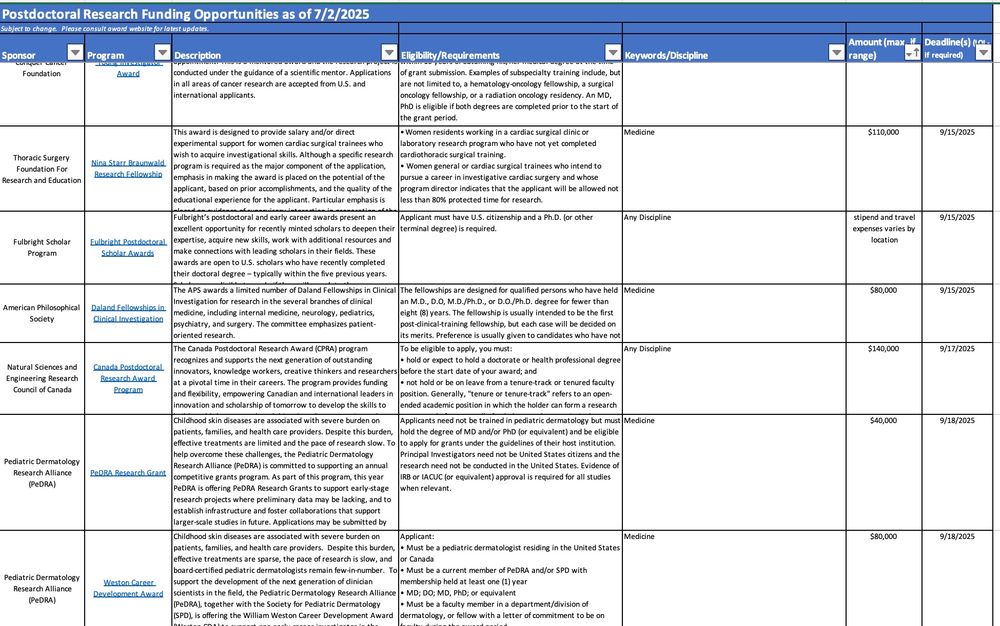
My team has updated our free database of POSTDOC fellowships.

This database contains 286 entries. For each entry, we provide a link, short description, deadline, amount, and eligibility criteria.

Download this updated and expanded database here: research.jhu.edu/rdt/funding-...
10.08.2025 19:50 β€” πŸ‘ 186    πŸ” 127    πŸ’¬ 4    πŸ“Œ 1
Post image

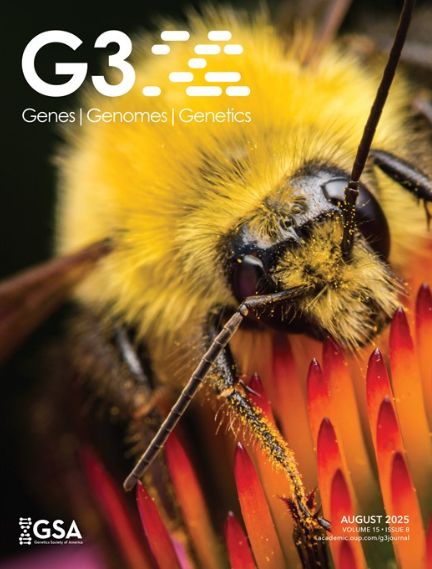
Cover image in #G3 highlighting our new paper in "Shifts in bee diet breadths are associated with gene gains and losses and positive selection across olfactory receptors"
academic.oup.com/g3journal/ar...
@genetics-gsa.bsky.social

07.08.2025 13:20 β€” πŸ‘ 13    πŸ” 2    πŸ’¬ 0    πŸ“Œ 0

@mmlopezu is following 20 prominent accounts