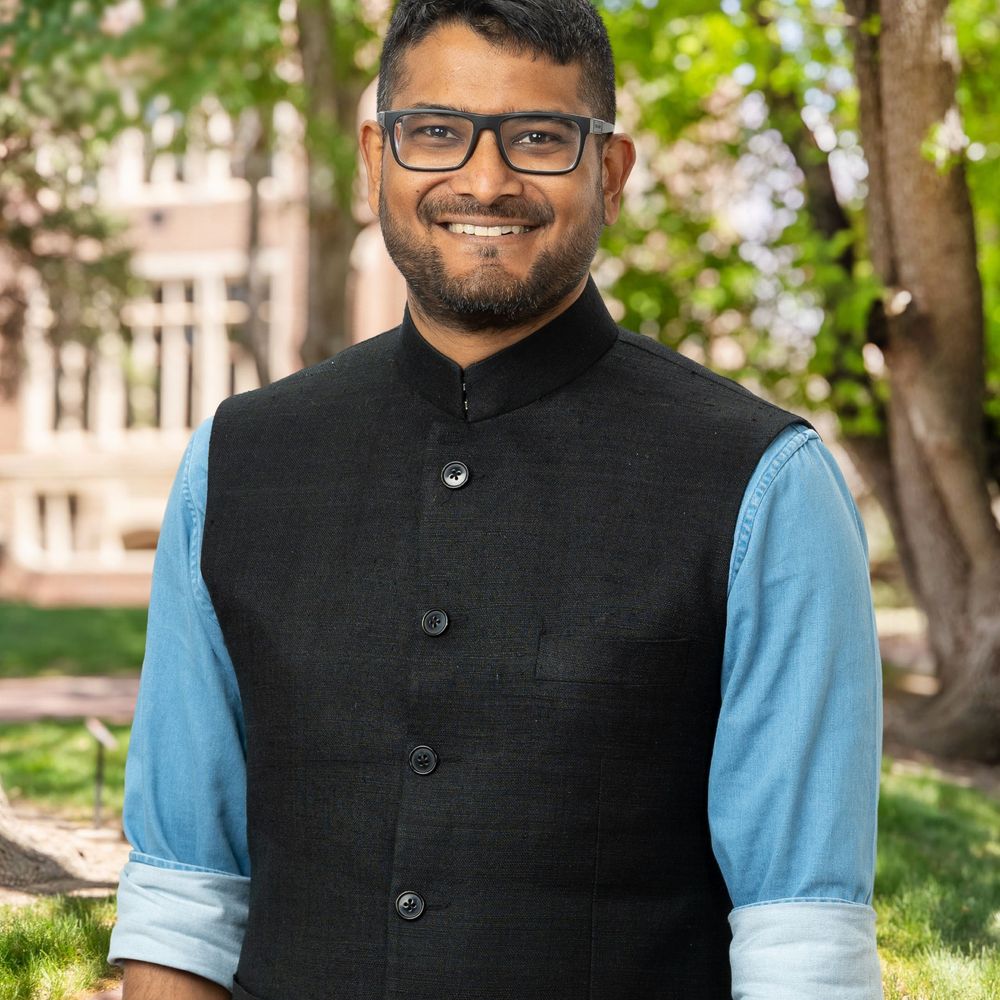
I'm looking forward to speaking at the Colorado Foothills World Affairs Council tomorrow on this new reality of a world without arms control treaties and how that might affect the future of nuclear proliferation.
If you're in the Denver area, do come by! #Nuclear #ArmsControl
26.02.2026 00:27 —
👍 3
🔁 0
💬 0
📌 0
What happens when the last remaining nuclear arms control treaty expires? On Feb 5, the New Strategic Arms Reduction Treaty will end & the first time since the Cold War that the US and Russia would have no legally binding limits on their nuclear arsenals. Learn more from Korbel's @debak.bsky.social:
30.01.2026 17:37 —
👍 1
🔁 1
💬 0
📌 0
YouTube video by India's World
Is the Nuclear Arms Race Back?
For the first time in 54 years, there won't be an arms control treaty between the U.S. & Russia next week.
It was pleasure to discuss the impeding expiration of the New START Treaty with India's World Magazine.
@josefkorbelschool.bsky.social @siecenter.bsky.social
www.youtube.com/watch?v=t5YB...
29.01.2026 17:19 —
👍 0
🔁 2
💬 0
📌 1
ISA-SAWP Colombo 2026: Call for Proposals
Happy to announce the 1st ever @isanet.bsky.social conference in South Asia in August 2026. Hosted in Colombo, Sri Lanka, we welcome proposals from scholars based in and/or studying South Asian politics & international relations, but also broader global themes ofc www.isanet.org/Conferences/...
21.01.2026 07:59 —
👍 53
🔁 52
💬 13
📌 3
Research from Korbel’s @debak.bsky.social expands how we think about today’s more complex security challenges.
05.01.2026 20:05 —
👍 1
🔁 1
💬 0
📌 0

Very pleased to see that my article "Explaining the Proliferation of Nuclear Delivery Vehicles" was the most read piece on Security Studies for 2025.
Check out the article here:
www.tandfonline.com/doi/full/10....
01.01.2026 10:04 —
👍 7
🔁 1
💬 1
📌 1
In the list: Korbel's @epsteinprof.bsky.social & @debak.bsky.social explain that without credible U.S. security guarantees, nuclear proliferation is likely to increase rapidly across Europe and Asia. Link to article: foreignpolicy.com/2025/03/14/t...
04.11.2025 17:25 —
👍 1
🔁 1
💬 0
📌 0

India fears its ballistic missiles are outmatched by China’s
The mismatch poses a dilemma in case of war: either endure Chinese missile strikes deep inside India without the ability to retaliate, or go nuclear.
In @defensenews.bsky.social about India's Rocket Forces.
So far, there has been no public discussion about the conventional deep strike capability against Chinese strategic infrastructure,” Das said. “The problem with adopting such a doctrine is that China could do the same.”
tinyurl.com/nzxzcv4y
21.10.2025 22:06 —
👍 3
🔁 0
💬 0
📌 0
Thank you!
21.10.2025 22:03 —
👍 1
🔁 0
💬 0
📌 0
Congrats to Korbel's @debak.bsky.social, named a DU Public Impact Fellow! 🎉 The program helps faculty share their research with broader audiences and highlight the impact of their work across the university.
21.10.2025 16:34 —
👍 4
🔁 1
💬 1
📌 0

India fears its ballistic missiles are outmatched by China’s
The mismatch poses a dilemma in case of war: either endure Chinese missile strikes deep inside India without the ability to retaliate, or go nuclear.
From Korbel Prof @debak.bsky.social in @defensenews.bsky.social: “So far, there has been no public discussion about the conventional deep strike capability against Chinese strategic infrastructure,” Das said. “The problem with adopting such a doctrine is that China could do the same against India.”
17.10.2025 16:22 —
👍 2
🔁 1
💬 0
📌 0
Korbel Faculty @hilarymatfess.bsky.social, @debak.bsky.social, @naazneenbarma.bsky.social, and Jonathan Moyer are among those who recently received grants recognizing and supporting their impactful research. Congrats! 🎉
09.10.2025 21:12 —
👍 6
🔁 1
💬 1
📌 0
A new roundtable by CISAC affiliate @laurensukin.bsky.social and Rohan Mukherjee examines the evolving global nuclear order, with several papers by former CISAC postdocs that show the interconnected nature of nuclear challenges and the vital role of domestic politics.
01.10.2025 20:56 —
👍 4
🔁 3
💬 0
📌 0
Within Southern Asia, states are seeking space to escalate at lower levels of conflict to address nuclear & military asymmetry. Pakistan is seeking to create space to escalate at lower levels of conflict against India, while India is doing the same against Pakistan on one side & China on the other.
06.10.2025 21:59 —
👍 1
🔁 0
💬 1
📌 0
While Washington & Beijing are responding to each other’s nuclear arsenals, India is responding to China’s arsenal, & Pakistan is responding to India’s nuclear modernization. The technology transfers and submarine proliferation in the Indo-Pacific precipitated by AUKUS are intensifying this dynamic.
06.10.2025 21:59 —
👍 1
🔁 0
💬 1
📌 0
There is a cascade of reactionary vertical proliferation that is occurring in the Indo-Pacific as a result of China-US strategic competition.
06.10.2025 21:59 —
👍 1
🔁 0
💬 1
📌 0

🚨 Where is nuclear competition in South Asia and the Indo-Pacific today? What impact does US-China competition have on nuclear proliferation in Southern Asia?
I answer these questions in my new Texas National Security Review piece: tnsr.org/wp-content/u...
06.10.2025 21:59 —
👍 6
🔁 2
💬 1
📌 0

It was a delight to discuss the Global Nuclear Order and the Proliferation of Nuclear Delivery Systems at the Athenaeum series at Claremont McKenna College earlier this week! @cmc.edu
01.10.2025 21:36 —
👍 0
🔁 0
💬 0
📌 0

"Cascades of Competition: Southern Asia, the Indo-Pacific, and AUKUS" by Debak Das
Nuclear stability in Southern Asia is being shaped by different layers of competition in the Indo-Pacific. This article highlights two dynamics that are shaping nuclear competition in the region. The first, within Southern Asia, is states finding space to escalate at lower levels of conflict to address nuclear and military asymmetry. Pakistan is seeking to create space to escalate at lower levels of conflict against India, while India is doing the same against Pakistan on one side and China on the other. The second dynamic is a cascade of reactionary vertical proliferation that is occurring in the Indo-Pacific as a result of China and the United States’ strategic competition. While Washington and Beijing are responding to each other’s nuclear arsenals, India is responding to China’s arsenal, and Pakistan is responding to India’s nuclear modernization. The technology transfers and submarine proliferation in the Indo-Pacific precipitated by AUKUS are intensifying this dynamic.
How is U.S.—China rivalry fueling a dangerous cascade of nuclear proliferation across Southern Asia? @debak.bsky.social explores the ripple effects of AUKUS and regional competition.
📖 Read here: tnsr.org/roundtable/n...
30.09.2025 16:49 —
👍 1
🔁 2
💬 1
📌 0

Putin says Russia will stick to nuclear arms limits for 1 more year
The Russian president said that the termination of the 2010 New START would have negative consequences for global stability.
One year unilateral adherence to New START treaty being proposed by Moscow is a positive sign that the last remaining arms control mechanism between the US and Russia does not need to disappear after February 2026. #ArmsControl #NukeSky
nbcnews.com/world/russia...
22.09.2025 19:19 —
👍 0
🔁 0
💬 0
📌 0
Congratulations, Chris!
18.09.2025 00:44 —
👍 1
🔁 0
💬 0
📌 0

This paper explores how democratization can reconstitute understandings of nationhood by empowering a new class of “storytelling elites”---those with the institutional and rhetorical resources to challenge the state’s narrative. In this critical juncture, storytelling elites may challenge (1) the bottom-line premise or (2) the sideline elements of the prevailing national narrative. Their narrative strategies, in turn, shape how the terms of the debates are redefined and structured under democracy. I develop this argument through a comparison of “One Korea” and “One China” narratives in postwar South Korea and Taiwan. Using interpretive process tracing of archival and other qualitative data, I find that democracy helped entrench “One Korea” narratives in South Korea but displace “One China” narratives in Taiwan, as new storytelling elites challenged dominant narratives of “oneness” to varying degrees. This resulted in increasingly divergent support for unification as a national objective, with enduring implications for peace.
I’m happy to share this paper in @cpsjournal.bsky.social on democracy and national narratives, with insights from South Korea and Taiwan. It is part of a special issue on postcolonial narratives with @paulschuler.bsky.social, @deandulay.bsky.social, + others.
journals.sagepub.com/doi/full/10....
15.09.2025 14:45 —
👍 24
🔁 7
💬 1
📌 2
Ultimately, the Space Launch Vehicle-3 was successfully launched in July 1980. A few years later, the first stage of the solid fuel SLV-3 became the first stage of the nuclear-capable Agni IRBM that is today in India's nuclear forces.
16.09.2025 17:48 —
👍 0
🔁 0
💬 0
📌 0
Confirming these assessments in 1979, Satish Dhawan, chairman of the Indian Space Research Organisation, told the Indian Parliament consultative committee that the Space Launch Vehicle, SLV-3, could, after some modifications, be used as an Intermediate Range Ballistic Missile (IRBM).
16.09.2025 17:48 —
👍 0
🔁 0
💬 1
📌 0
In 1978, France concluded that all indicators in India’s space program—building laboratories for solid and liquid fuels, acquiring the license for the Viking engine, and India’s cooperation in the Ariane program—could be interpreted as a strong signal to acquire nuclear weapons.
16.09.2025 17:48 —
👍 1
🔁 0
💬 1
📌 0
India collaborated with France on space technology through the 1970s. French MoD discussed France's space technology for a potential Indian nuclear delivery system in April 1976. It concluded that the bilateral cooperation in space concerned both civilian and military domains.
16.09.2025 17:48 —
👍 0
🔁 0
💬 1
📌 0
Meanwhile, even within the Indian government, it was suspected that INSAT (Satellite program) for TV was “the public rationale for the nation pursuing an ambitious space programme, particularly the development of very large rockets…broadly equivalent to inter-continental ballistic missiles (ICBM).”
16.09.2025 17:48 —
👍 1
🔁 0
💬 1
📌 0
The U.S. tried to stop India. Daniel Moynihan, US ambassador to India, said to Secretary of State Henry Kissinger that Washington should get India to privately agree “to go very slow in testing. Nothing more for a year or two. No weapons. Rocketry restraint. No missile system.”
16.09.2025 17:48 —
👍 1
🔁 0
💬 1
📌 0