Julia A. Rivera Drew's Avatar

Julia A. Rivera Drew

@juliariveradrew.bsky.social

Research Scientist @ IPUMS. Demographer studying disability, reproductive health, and injury.

357 Followers  |  1,149 Following  |  12 Posts  |  Joined: 13.11.2024
Posts Following

Posts by Julia A. Rivera Drew (@juliariveradrew.bsky.social)

NIH is reworking social and behavioral study sections including *eliminating SSPA and SSPB*. There will be one new study section Population Dynamics and Health.

Bad news since SSP originally received so many applications, they needed 2 difft study sections to process them.
:( #demography

03.03.2026 03:44 β€” πŸ‘ 7    πŸ” 3    πŸ’¬ 0    πŸ“Œ 0
Post image Post image

In β€œCohort Prevalence Estimates Are Sensitive to Prebaseline Mortality,” Molly Rosenberg et al. show that β€œprebaseline mortality patterns can meaningfully impact health outcome measures in cohort studies” & so represent a potential source of bias. read.dukeupress.edu/demography/a...

19.02.2026 18:46 β€” πŸ‘ 4    πŸ” 1    πŸ’¬ 0    πŸ“Œ 0
It must be very hard to publish null results
Publication practices in the social sciences act as a filter that favors statistically significant results over null findings. While the problem of selection on significance (SoS) is well-known in theory, it has been difficult to measure its scope empirically, and it has been challenging to determine how selection varies across contexts. In this article, we use large language models to extract granular and validated data on about 100,000 articles published in over 150 political science journals from 2010 to 2024. We show that fewer than 2% of articles that rely on statistical methods report null-only findings in their abstracts, while over 90% of papers highlight significant results. To put these findings in perspective, we develop and calibrate a simple model of publication bias. Across a range of plausible assumptions, we find that statistically significant results are estimated to be one to two orders of magnitude more likely to enter the published record than null results. Leveraging metadata extracted from individual articles, we show that the pattern of strong SoS holds across subfields, journals, methods, and time periods. However, a few factors such as pre-registration and randomized experiments correlate with greater acceptance of null results. We conclude by discussing implications for the field and the potential of our new dataset for investigating other questions about political science.

It must be very hard to publish null results Publication practices in the social sciences act as a filter that favors statistically significant results over null findings. While the problem of selection on significance (SoS) is well-known in theory, it has been difficult to measure its scope empirically, and it has been challenging to determine how selection varies across contexts. In this article, we use large language models to extract granular and validated data on about 100,000 articles published in over 150 political science journals from 2010 to 2024. We show that fewer than 2% of articles that rely on statistical methods report null-only findings in their abstracts, while over 90% of papers highlight significant results. To put these findings in perspective, we develop and calibrate a simple model of publication bias. Across a range of plausible assumptions, we find that statistically significant results are estimated to be one to two orders of magnitude more likely to enter the published record than null results. Leveraging metadata extracted from individual articles, we show that the pattern of strong SoS holds across subfields, journals, methods, and time periods. However, a few factors such as pre-registration and randomized experiments correlate with greater acceptance of null results. We conclude by discussing implications for the field and the potential of our new dataset for investigating other questions about political science.

I have a new paper. We look at ~all stats articles in political science post-2010 & show that 94% have abstracts that claim to reject a null. Only 2% present only null results. This is hard to explain unless the research process has a filter that only lets rejections through.

11.02.2026 17:00 β€” πŸ‘ 643    πŸ” 223    πŸ’¬ 30    πŸ“Œ 51
A Missing Piece: The 2025 U.S. Government Shutdown and the Current Population Survey – Use It for Good

The CPS 2025 November monthly data are now available on IPUMS CPS πŸŽ‰ CPS data collection and processing were among the many U.S. government programs and services interrupted by the October 1-November 12, 2025 U.S. government shutdown. Learn more: blog.popdata.org/2025-u-s-gov...

23.12.2025 13:14 β€” πŸ‘ 6    πŸ” 8    πŸ’¬ 0    πŸ“Œ 0
Preview
U.S. Bureau of Labor Statistics The Bureau of Labor Statistics is the principal fact-finding agency for the Federal Government in the broad field of labor economics and statistics.

1/ The BLS has published an FAQ about the November Current Population Survey (CPS data).

bls.gov/cps/methods/...

(Recall, in his press conference Powell mentioned "technical" issues with some November surveys.)

15.12.2025 16:55 β€” πŸ‘ 11    πŸ” 3    πŸ’¬ 1    πŸ“Œ 2
Post image NextGenPop scholars at Cornell in 2023

NextGenPop scholars at Cornell in 2023

NextGenPop scholars at the University of Wisconsin Madison in 2022

NextGenPop scholars at the University of Wisconsin Madison in 2022

NextGenPop is a 2-week, in-person, on-campus summer experience for undergrads aiming to increase the diversity of the population field and nurture the next generation of scholars. The summer 2026 session will be hosted by the University of Minnesota! Application deadline February 5. buff.ly/IO6P52W

24.11.2025 15:02 β€” πŸ‘ 10    πŸ” 3    πŸ’¬ 1    πŸ“Œ 0
Estimates | California Department of Finance

Sorry, one more follow up. My colleague recommended that you use the California county population estimates by race/ethnicity, which will include all California counties. dof.ca.gov/forecasting/...

07.11.2025 21:27 β€” πŸ‘ 2    πŸ” 0    πŸ’¬ 1    πŸ“Œ 0

There are a few more things you might try. Email us at ipums@umn.edu.

07.11.2025 20:55 β€” πŸ‘ 1    πŸ” 0    πŸ’¬ 1    πŸ“Œ 0
IPUMS NHGIS search result page for county geographic level + Hispanic Origin topics. A short list of search results for the 2023 ACS is shown.

IPUMS NHGIS search result page for county geographic level + Hispanic Origin topics. A short list of search results for the 2023 ACS is shown.

IPUMS NHGIS (www.nhgis.org) would get you this for 2023 and 2024 is coming soon.

07.11.2025 20:31 β€” πŸ‘ 2    πŸ” 0    πŸ’¬ 1    πŸ“Œ 0

The newest NHIS data are now available through IPUMS!

01.08.2025 20:50 β€” πŸ‘ 3    πŸ” 1    πŸ’¬ 0    πŸ“Œ 0
CDC issues 15 calls for comment | Federal Data Users Today's Federal Register includes many calls for comment on CDC data collections, including the following: - National Notifiable Diseases Surveillance System -

I should note that this is just one of several dozen calls for comment about health data that have come out over the past week. You can find a running list here:
federaldataforum.prb.org/discussion/c...

16.06.2025 16:25 β€” πŸ‘ 6    πŸ” 2    πŸ’¬ 1    πŸ“Œ 1

Check out this blog post describing our hands-on IAPHS workshop from fall 2024 featuring the NHIS LMF data harmonized by IPUMS. @ipums.bsky.social

04.06.2025 15:40 β€” πŸ‘ 8    πŸ” 1    πŸ’¬ 0    πŸ“Œ 0
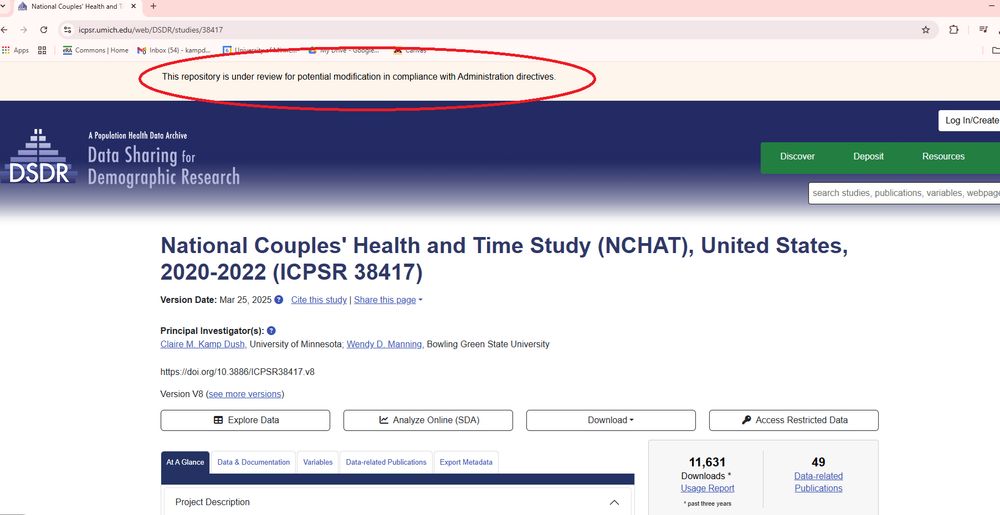
A screen shot of the National Couples' Health and Time Study webiste at DSDR, with the language "This repository is under review for potential modification in compliance with Administration directives." at the top circled in red.

A screen shot of the National Couples' Health and Time Study webiste at DSDR, with the language "This repository is under review for potential modification in compliance with Administration directives." at the top circled in red.

I just noticed that NCHAT's @icpsr.bsky.social website has a new disclaimer "This repository is under review for potential modification in compliance with Administration directives." I am not sure what this means, but I wanted to let everyone know.

07.04.2025 14:53 β€” πŸ‘ 11    πŸ” 7    πŸ’¬ 2    πŸ“Œ 0

That's amazing, what a great outcome!

24.03.2025 13:36 β€” πŸ‘ 6    πŸ” 0    πŸ’¬ 0    πŸ“Œ 0
Preview
The Contribution of Drug Overdose to Educational Gradients in Life Expectancy in the United States, 1992–2011 - Demography Since the mid-1990s, the United States has witnessed a dramatic rise in drug overdose mortality. Educational gradients in life expectancy widened over the same period, and drug overdose likely plays a...

I've always thought Jessica Ho's piece on the contribution of opioid overdoses to the education gradient in life expectancy was a clever way of getting around imperfect mortality data by combining data from two different sources. link.springer.com/article/10.1...

19.01.2025 20:58 β€” πŸ‘ 10    πŸ” 0    πŸ’¬ 2    πŸ“Œ 0
Post image

🌟Please share this great funding opportunity! 🌟Apply by 1/24/25 for IRP's National Dissertation Award For Research On Poverty And Economic Mobility 2025–2026. For more info on this $25,000 award & to view an informational webinar, visit: www.irp.wisc.edu/national-dis...

16.01.2025 15:20 β€” πŸ‘ 3    πŸ” 5    πŸ’¬ 0    πŸ“Œ 2
Preview
IPUMS DHS Climate Change and Health Research Hub Understand population health in its environmental context

...and the Climate Change and Health Hub using DHS data: tech.popdata.org/dhs-research...

19.12.2024 17:24 β€” πŸ‘ 1    πŸ” 0    πŸ’¬ 1    πŸ“Œ 0

Exercises using the IPUMS DHS data: www.idhsdata.org/idhs/exercis...

19.12.2024 17:24 β€” πŸ‘ 2    πŸ” 0    πŸ’¬ 1    πŸ“Œ 0
IPUMS Research Awards | IPUMS The IPUMS Research Awards honor outstanding research using IPUMS data to advance or deepen our understanding of social and demographic processes. We look for papers that use innovative approaches, com...

Check out the IPUMS Global Health annual research award winners for 2018-2023 www.ipums.org/impact/ipums...

19.12.2024 17:23 β€” πŸ‘ 2    πŸ” 0    πŸ’¬ 1    πŸ“Œ 0

Plans to link the 1950 full count to HRS, WLS, NSHAP, and Kaiser's ACT are documented here: assets.ipums.org/_files/ipums...

11.12.2024 03:08 β€” πŸ‘ 1    πŸ” 0    πŸ’¬ 2    πŸ“Œ 0
Preview
The Validity and Reliability of Retrospective Measures of Childhood Socioeconomic Status in the Health and Retirement Study: Evidence From the 1940 U.S. Census - PubMed Researchers who rely on retrospective indicators of childhood SES from the HRS should be aware of their measurement properties. They are measured with error, and that error modestly attenuates estimat...

You may want to check out the 1940 full count census data that has already been linked to records in the HRS.
pubmed.ncbi.nlm.nih.gov/35263760/
hrs.isr.umich.edu/sites/defaul...

11.12.2024 03:06 β€” πŸ‘ 5    πŸ” 1    πŸ’¬ 1    πŸ“Œ 0