
I’ll be taking part as a plenary speaker, presenting my work combining corpus and experimental methods to study how language shapes thought and behavior. Many thanks to the organizing team for the kind invitation!
13.01.2026 12:37 — 👍 1 🔁 0 💬 0 📌 0I’ll be taking part as a plenary speaker, presenting my work combining corpus and experimental methods to study how language shapes thought and behavior. Many thanks to the organizing team for the kind invitation!
13.01.2026 12:37 — 👍 1 🔁 0 💬 0 📌 0It’s always a lively and supportive event, great for networking, getting constructive feedback on your project, and meeting new people. And of course, Prague is beautiful and well worth a visit if you haven’t been yet.
13.01.2026 12:37 — 👍 1 🔁 0 💬 1 📌 0Linguistics Prague is designed specifically for early-career researchers (advanced MA students, PhD students, and post-docs) in linguistics and related fields, and has been running since 2013.
13.01.2026 12:37 — 👍 0 🔁 0 💬 1 📌 0
Early-career researchers: if you’d like to present your ongoing work and get helpful feedback from both peers and experienced scholars, the 2026 Linguistics Prague conference is for you!
👉 linguisticsprague.ff.cuni.cz/call-for-abs...
🗓 Abstract submission deadline: 1 February

The submission deadline for next year's #CADS conference has been extended to December 19th 2025! So, three more weeks to get abstracts in - nice!
wp.lancs.ac.uk/cad-2026/cal...
It was such a pleasure to take part in the legendary Language and Power podcast!
We had a very interesting chat about climate change discourses on the back of a lively panel at the last SFL Congress in Glasgow.
Thanks @michaelfarrelly.bsky.social and Tom Bartlett for hosting us!
Funding opportunity: PhD at Sussex
- Open to applicants on PhD Linguistics
- Scholarships cover tuition fees, a stipend at UK Research Council rates plus some research & training costs
- 5 interdisciplinary themes addressing major social sciences challenges
www.sussex.ac.uk/study/fees-f...

All scripts, prompts, and data for full replication are available on our companion GitHub repository: github.com/Weihang-Huan...
30.09.2025 08:49 — 👍 1 🔁 0 💬 0 📌 0
The paper is now on arXiv: arxiv.org/abs/2509.24866
Co-authored with Weihang Huang, Jeannette Littlemore, Sarah Turner, and Ellen Wilding.
Crucially, we don't just see LLMs as a scaling tool. By examining where model outputs diverge from human annotations, we can test and refine theoretical understandings of metaphor.
30.09.2025 08:49 — 👍 1 🔁 0 💬 1 📌 0
This will allow researchers to:
- Efficiently annotate large text corpora,
- Scale analyses and increase generalizability,
- Redirect human effort from tedious annotation toward higher-level interpretation and theory-building.
Based on these results, we propose that LLMs can be used to semi-automate metaphor identification and annotation.
30.09.2025 08:49 — 👍 1 🔁 0 💬 1 📌 0Interestingly, the "errors" made by the top-performing models weren't random. They were systematic and interpretable, offering new insights into both model behavior and metaphor theory.
30.09.2025 08:49 — 👍 1 🔁 0 💬 1 📌 0
These are solid results, especially considering:
1) Metaphor identification is complex - researchers have debated best practices for over 20 years.
2) Even humans don't fully agree on what counts as a metaphor, with inter-annotator reliability (Cohen's kappa) typically ranging from 0.56 to 0.88.


We find that state-of-the-art closed-source LLMs performed very well, with fine-tuned models reaching 79% accuracy. Even with just 8 annotated example sentences and a chain-of-thought prompt, we achieved 76% - remarkably close to the fine-tuned results.
30.09.2025 08:49 — 👍 1 🔁 0 💬 1 📌 0
We compared three approaches:
1) RAG: the model receives a codebook and is instructed to annotate texts based on it.
2) Prompt engineering: we designed task-specific instructions and tested zero-shot, few-shot, and chain-of-thought prompts.
3) Fine-tuning: the model is trained on hand-coded texts.
How good are LLMs at identifying and tagging metaphors in text? Turns out, pretty good!
In our new study, we ask 10 different open- and closed-source LLMs to label all metaphorical expressions in a dataset of film reviews using <Metaphor> and </Metaphor> XML tags.
arxiv.org/abs/2509.24866
The call for papers for the 2026 @corporadiscourse.bsky.social Conference is now out!
wp.lancs.ac.uk/cad-2026/cal...
Submission deadline is 16 November.
Really looking forward to it!

More and more companies have pledged to reach "net zero".
But how exactly are these pledges framed in corporate communications, and how credible are they?
These are the questions we explore in our new study, just published in Applied Corpus Linguistics: www.sciencedirect.com/science/arti...
What an absolute treat and honor to be invited to give a plenary at my favourite conference! 🤩 Thanks so much @gavinbrookes.bsky.social and all the #CADS2026 organizers for this invite. Can't wait!
22.07.2025 08:22 — 👍 30 🔁 4 💬 1 📌 0Try plopping your code into ChatGPT and asking it how you'd like the labels to change!
09.07.2025 13:49 — 👍 1 🔁 0 💬 1 📌 0p.s.: the production team (not me - I promise!) swapped the captions for figures 1 and 2 🥴
04.07.2025 08:53 — 👍 0 🔁 0 💬 0 📌 0It was super fun to work on this paper with brilliant Samantha Ford! Incidentally, this paper has been in the works for almost 10 years - I first presented it at RaAM back in 2016! It’s not procrastination, it’s letting the ideas *marinate* 😅
04.07.2025 08:53 — 👍 3 🔁 0 💬 1 📌 0Our paper connects with several areas of research in discourse studies and cognitive linguistics, including topics like "metaphor resistance", visual and multimodal metaphor, creativity, multimodal argumentation, blaming and protest discourses.
04.07.2025 08:53 — 👍 2 🔁 0 💬 1 📌 0With tools like image editing and generative AI, digital activism is rapidly evolving. Subverting visual and verbal texts is now more accessible than ever, offering new creative ways to expose injustice and advocate for change.
04.07.2025 08:53 — 👍 2 🔁 0 💬 1 📌 0We go beyond metaphors, examining how metonymy, irony, hyperbole, and more can be wielded as tools for resistance. These tropes, combined with visuals, create nuanced counterarguments that resonate emotionally.
04.07.2025 08:53 — 👍 0 🔁 0 💬 1 📌 0Our typology can be used to analyze other forms of figurative subversion, including political cartoons, street art (e.g. Banksy), contemporary conceptual art, memes, protest signs at political rallies, mockumentaries, and mash-up video clips circulated on social media.
04.07.2025 08:53 — 👍 0 🔁 0 💬 1 📌 0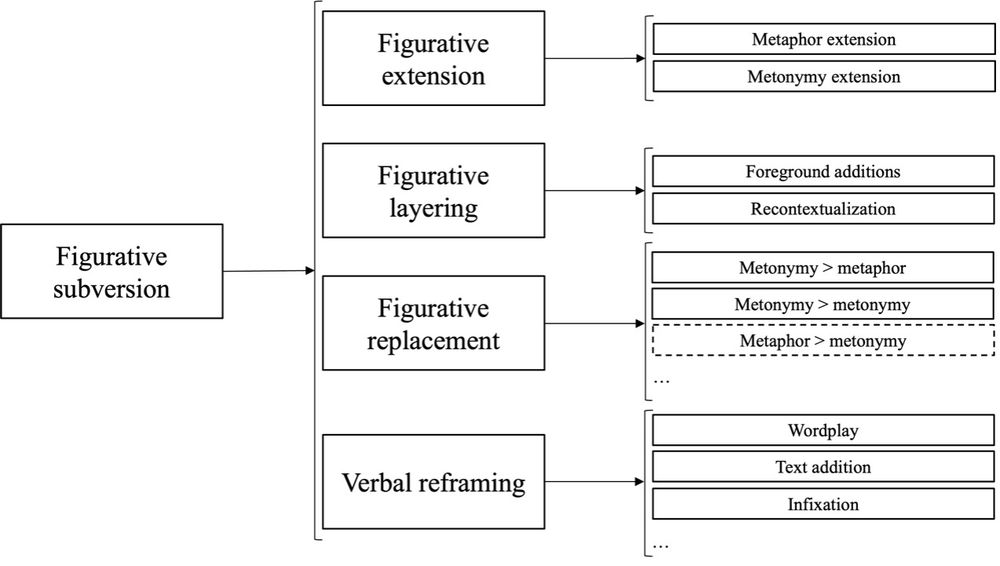
We identify four key figurative subversion strategies, which can be used individually or in combination to build a persuasive visual/multimodal argument.
Figurative extension
Figurative layering
Figurative replacement
Verbal reframing
We look at Greenpeace's 2010 "Behind the Logo" campaign, where activists cleverly reworked BP’s logo to call out its "green" branding, as a case study on how people can use figurative and visual strategies to subvert corporate messaging.
04.07.2025 08:53 — 👍 0 🔁 0 💬 1 📌 0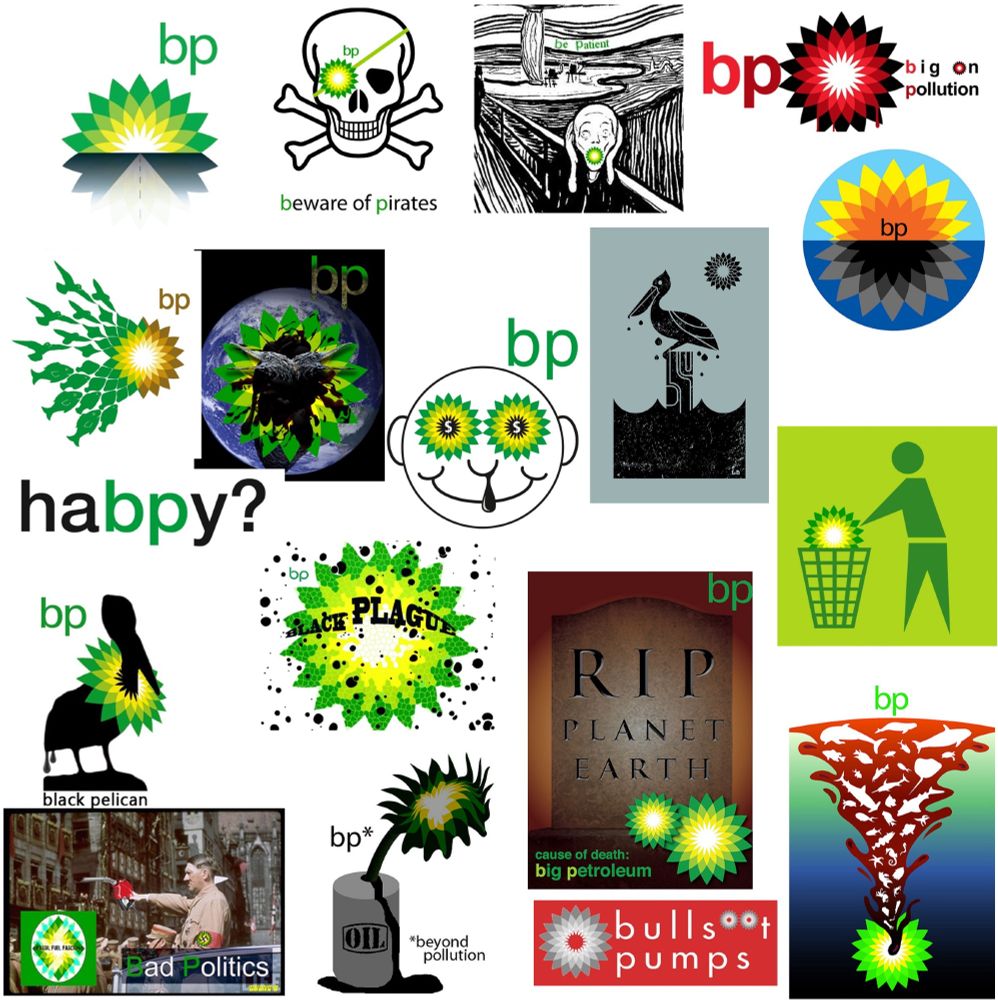
What happens when activists creatively reimagine corporate logos to resist branding narratives?
Our new paper explores the powerful multimodal practice of "figurative subversion" and its role in challenging corporate messages.
Read it here: bit.ly/3GrXAse