NOTE: I stand corrected here—John Glenn was NOT the first to take photos of Earth from space, that distinction belongs to cosmonaut Gherman Titov who took a 35mm movie camera on his Vostok 2 flight on August 6, 1961—6 1/2 months before Glenn's orbital flight.
Glenn is the first American.
20.02.2026 22:15 —
👍 12
🔁 0
💬 0
📌 0

The First Photographer in Space
Gherman Titov was the youngest person ever launched into space, the first to get space-sick, and the first to take along a camera.
Alan and Yuri did not take cameras. BUT—cosmonaut Gherman Titov *did* take a camera with him and shot 35mm movies of Earth during his Vostok 2 flight on August 6, 1961. So technically he's really the first space photographer. www.smithsonianmag.com/air-space-ma...
20.02.2026 21:52 —
👍 2
🔁 0
💬 1
📌 0
The image above has been adjusted for contrast and color and *a lot* of film dust and scratches have been cleaned out. Also rotated 180º (Glenn's modified Ansco Autoset 35mm camera had a grip mounted to the top so he was effectively shooting upside down!)
20.02.2026 18:09 —
👍 11
🔁 3
💬 0
📌 0

This is the first (correctly-exposed) photograph of Earth taken by a human from space, captured 64 years ago today by NASA astronaut John Glenn from inside his Friendship 7 capsule during the Mercury-Atlas 6 orbital mission on February 20, 1962.
20.02.2026 18:08 —
👍 59
🔁 11
💬 3
📌 0
Well duh
25.12.2025 02:01 —
👍 1
🔁 0
💬 0
📌 0

The detail of Earth 🌍 captured in Bill Anders’ first color photo taken from lunar orbit on #christmaseve in 1968 #OTD really is amazing. This is a crop of AS08-14-2383, in its original orientation, from a scanned 70mm @nasa film original 16-bit TIFF file by a project team at Arizona State University
25.12.2025 01:24 —
👍 58
🔁 24
💬 1
📌 0

This is the silhouette of 1,122-km-wide Dione in front of Saturn—a view captured with Cassini 15 years ago on December 20, 2010. Synthesized color from a single clear-filter greyscale image.
20.12.2025 18:56 —
👍 123
🔁 30
💬 4
📌 2

Space Shuttle Challenger in orbit during STS-7 in June 1983
28.11.2025 21:24 —
👍 46
🔁 7
💬 1
📌 2

45 years ago today we got our first closeup of the Solar System’s very own “Death Star!” Captured by Voyager 1 on November 12, 1980 as it passed Saturn, this image (PIA01968) shows the moon Mimas with its 139 km wide, 5 km deep Herschel crater making it resemble the Empire’s infamous space station.
12.11.2025 19:01 —
👍 146
🔁 26
💬 4
📌 0
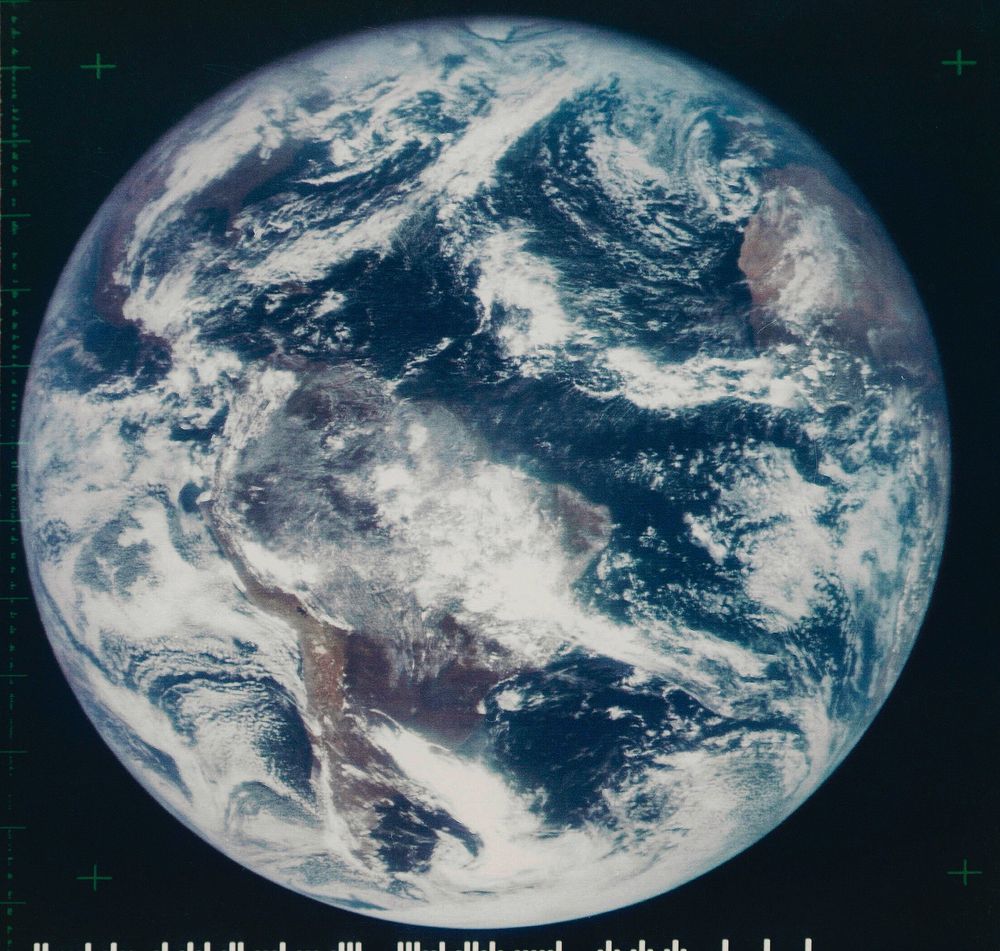
On November 10, 1967 #OTD NASA captured its first color picture of the entire daylit side of Earth from space using the Multicolor Spin-Scan Cloudcover Camera on the ATS-3 weather satellite from an altitude of about 22,000 miles. (More on the MSSCC here: journals.ametsoc.org/view/journal...)
10.11.2025 23:11 —
👍 42
🔁 13
💬 1
📌 1
So that light is actually the result of Earth's atmosphere; specifically, how sunlight reflected from the Moon is refracted when it passes through it. There's a brief point where green light is separated from other colors, and at that time we see a greenish boundary to the Moon's leading edge.
10.11.2025 20:03 —
👍 2
🔁 0
💬 0
📌 0

Astronomers from the International Centre of Radio Astronomy Research (ICRAR) have created one of the largest low-frequency radio colour images of the Milky Way ever assembled. This spectacular new image captures the Southern Hemisphere view of the Galactic Plane – the disk of our Galaxy, which appears to human eyes as the glowing band of the Milky Way – now revealed across a wide range of radio wavelengths, or ‘colours’ of radio light.
This is what the band of the Milky Way would look like at night if your eyes could see radio waves. A hidden beauty.
It's a new image created by the Murchison Widefield Array, which scanned the sky in 20 radio "colors" over frequencies from 72 to 231 megahertz. 🧪🔭
www.icrar.org/gleam-x-gala...
09.11.2025 18:18 —
👍 258
🔁 83
💬 8
📌 2


While shooting the moonrise last night (since the eastern horizon was relatively free of clouds) I did get to capture another nice green flash along the Moon's upper limb. (Really more of a wavering flicker than a flash, but it was visible through the viewfinder.) 📸🌖
07.11.2025 22:32 —
👍 58
🔁 11
💬 4
📌 1
This was a cool place to visit!
20.10.2025 01:40 —
👍 18
🔁 0
💬 1
📌 0

Jupiter's colorful, lava-coated moon Io imaged by NASA's Galileo spacecraft on October 16, 2001
16.10.2025 18:54 —
👍 31
🔁 4
💬 0
📌 0
Do it
13.10.2025 00:46 —
👍 2
🔁 0
💬 0
📌 0
Cassini was the goat
12.10.2025 03:10 —
👍 5
🔁 0
💬 1
📌 0

Dione in front of Saturn, captured by Cassini 20 years ago today on October 11, 2005 🌖🪐
11.10.2025 20:19 —
👍 447
🔁 97
💬 7
📌 3

A little bit of the "green flash" captured during Sunday night's sunset
08.10.2025 01:04 —
👍 102
🔁 10
💬 3
📌 0

The Moon and Earth together captured with a camera aboard the ESA European Service Module during NASA's Artemis I mission on November 28, 2022. The spacecraft was about 42,000 miles beyond the Moon when this picture was taken.🌖🌍
23.09.2025 00:25 —
👍 87
🔁 15
💬 0
📌 0

The Sun eclipsed by the Moon—a photo captured in the midst of the brief period of totality during the August 21, 2017 solar eclipse.
19.09.2025 00:08 —
👍 170
🔁 31
💬 5
📌 0

Cassini's final full view of Saturn 🪐 a mosaic comprising 11 color-composites captured by the spacecraft in visible light filters on September 13, 2017. The following day it dove into Saturn's atmosphere, ending its mission after 13 years in orbit.
14.09.2025 22:12 —
👍 314
🔁 67
💬 8
📌 6

Io in front of Jupiter. This is a color-composite made from images captured by NASA's Galileo spacecraft in red, green, and violet wavelengths on September 6, 1996. Io is the most volcanically-active world in our solar system.
06.09.2025 17:51 —
👍 242
🔁 39
💬 5
📌 2
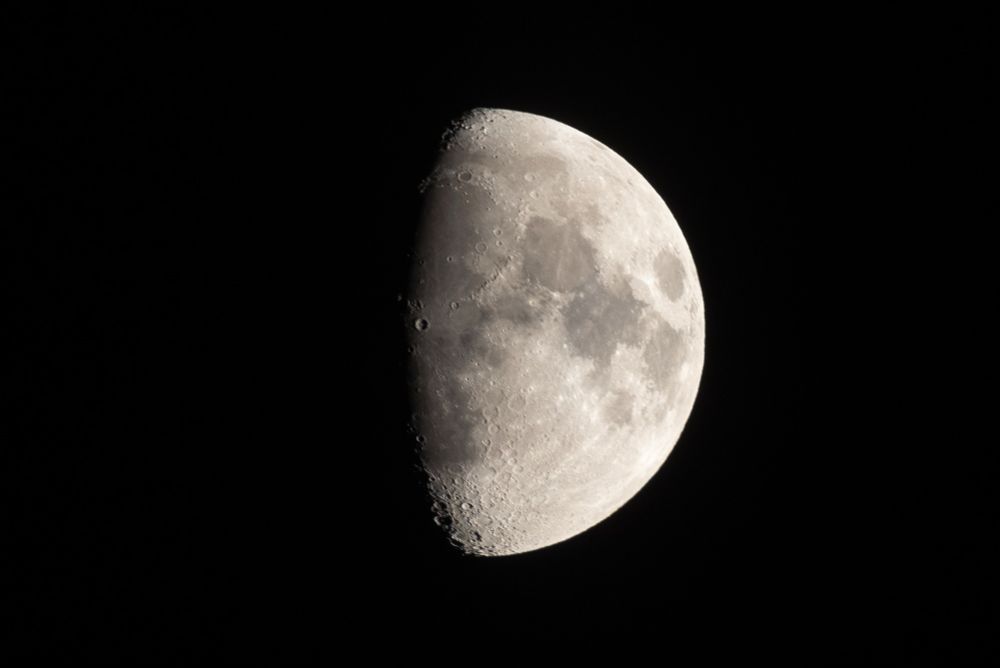
Tonight’s waxing gibbous Moon 🌔
02.09.2025 00:54 —
👍 90
🔁 10
💬 0
📌 0
Fair enough. Look baby turkeys (yesterday) !!
22.06.2025 19:37 —
👍 19
🔁 2
💬 0
📌 0
and this is just level 1 of The Total Perspective Vortex
30.04.2025 01:06 —
👍 5
🔁 1
💬 3
📌 0
Proxima Centauri is pretty small, only about twice the size of Jupiter. We can’t see it with the naked eye.
30.04.2025 15:29 —
👍 3
🔁 0
💬 0
📌 0
So much in that movie is a slow burn and endlessly rewatchable. 👍
I know it’s an oldie but I’m a fan of so many short lines from the original Ghostbusters. Classic irreverent comedy.
“I’ve worked in the private sector. They expect results.”
“I’ve quit better jobs than this!”
“Please come down.”
30.04.2025 15:24 —
👍 1
🔁 0
💬 1
📌 0
The next-closest star would be a sphere about 12 feet (3.6 m) wide...49.3 million miles (79.3 million km) away. ⭐️
Space is big.
29.04.2025 21:54 —
👍 24
🔁 1
💬 1
📌 0
If we equate Earth with the scale size of a basketball, the Moon would be about the size of a tennis ball, 24 feet (7.3 m) away. 🌎🌖
The Sun would be a sphere 86 feet (26 m) wide—about the height of an 8-story building—1.8 miles (2.9 km) away. 🌞
29.04.2025 21:53 —
👍 53
🔁 10
💬 3
📌 1