OSF
Do our social interactions influence what we become aware of?
In our❗new preprint❗@danieljamesyon.bsky.social and I delve into this question: asking whether joint decision making in a detection task can bias awareness reports.
osf.io/preprints/ps...
🧵
27.02.2026 10:39 —
👍 23
🔁 8
💬 1
📌 3

🚨new lab preprint; brain fingerprinting entirely revisited:
Can we differentiate individuals from just seconds of neurophysiological recordings with machine learning, without resorting to black-box approaches?
In this work, Maxence Lapatrie says 'yes'.
www.biorxiv.org/content/10.6...
17.02.2026 22:26 —
👍 21
🔁 6
💬 0
📌 0
Thank you so much to the brilliant @sylvainbaillet.bsky.social and @alexwiesman.bsky.social for all their support. And to our wonderful collaborators at @sickkidsto.bsky.social Margot Taylor! (6/6)🌈
15.12.2025 14:45 —
👍 2
🔁 0
💬 0
📌 0
Our findings suggest a growing influence of genetic factors on neurophysiological traits across the lifespan and advance our understanding of the evolving biological foundations of inter-individual differences. (5/6) 🧬🧬🧠🧠
15.12.2025 14:45 —
👍 0
🔁 0
💬 1
📌 0
The cortical regions most critical for determining individuality shift across the lifespan🧠, with sensorimotor cortices becoming increasingly prominent in adulthood. These changes closely align with the expression of cortical genetic systems involved in ion transport and neurotransmission. (4/6)
15.12.2025 14:45 —
👍 0
🔁 0
💬 1
📌 0
Children 👦👧 were more difficult to distinguish from one another based on their neurophysiology than adults. This is because children's neurophysiological traits are more similar to one another. Arrhythmic brain activity drives this effect—children are differentiable from rhythmic brain traits. (3/6)
15.12.2025 14:45 —
👍 0
🔁 0
💬 1
📌 0

People’s brain activity is much like a fingerprint and can distinguish individuals from one another. But all of this work has been done, for the most part, in adults. What about children and older adults? (2/6)
15.12.2025 14:42 —
👍 0
🔁 0
💬 1
📌 0
Redirecting
Very proud to announce that the final chapter of my thesis is now out in Cell Reports! How do neurophysiological traits that characterize individuals evolve across the lifespan? We combined data from over 1,000 individuals aged 4–89 to answer this question. (1/6) 🧠👶👦👧👱👩🦱🧔♂️🧓👴
doi.org/10.1016/j.ce...
15.12.2025 14:42 —
👍 15
🔁 8
💬 1
📌 2
It does not, however, speak to the origins of the 1/f. I agree that many mechanisms could produce the same spectrum. More work is needed to clarify these neural mechanisms.
25.09.2025 14:16 —
👍 1
🔁 0
💬 0
📌 0
This is a great question! Our paper is grounded in the 'specparam' framework and aims to test whether current approaches yield biased and/or correlated estimates of spectral parameters. I think this is an important question given the widespread use of these methods.
25.09.2025 14:15 —
👍 1
🔁 0
💬 1
📌 0
Using an empirical dataset, we show that analytical choice in quantifying brain rhythms impacts the interpretation of your results! 😰 Lastly, we find that resting state alpha power and arrhythmic slope are positively correlated at rest, which dovetails with the cortical inhibition account.
(4/4)
25.09.2025 11:22 —
👍 0
🔁 0
💬 1
📌 0
We show that spectral detrending methods produce biased estimates of rhythmic power that introduce spurious correlations between brain rhythms and arrhythmic brain activity. Modelled Gaussian power, on the other hand, does not. 🤯
(3/4)
25.09.2025 11:22 —
👍 0
🔁 0
💬 1
📌 0
Brain rhythms are important! 🚨Peristimulus alpha power predicts participants’ subjective experience. 👀 Arrhythmic brain activity is equally important! Both are theorized to be markers of cortical inhibition⚡️. But can we measure the two independently of one another with our current tools?
(2/4)
25.09.2025 11:21 —
👍 2
🔁 0
💬 1
📌 0

Quantifying Rhythmic and Arrhythmic Components of Brain Activity
Brain activity comprises both rhythmic (periodic) and arrhythmic (aperiodic) components. These signal elements vary across healthy aging, and disease, and may make distinct contributions to conscious ...
Quantifying rhythmic and arrhythmic brain activity is a hot 🥵 topic. But how independent are the two components from one another? 🤔 In my latest work with @smfleming.bsky.social & @matlandry.bsky.social, I explore the relationship between the two.
(1/4)
25.09.2025 11:21 —
👍 28
🔁 10
💬 1
📌 0

New study ✨!
⍺ regulates perceptual switches during binocular rivalry:
⍺↓ before dominant percepts, ↑ before mixed percepts + PO connectivity shifts from top-down to feedforward after perceptual alternations
Led by Janine Mendola @mcgill.ca, w/ E Mokri & @jasondasilvac.bsky.social
10.09.2025 16:50 —
👍 14
🔁 5
💬 1
📌 0
How attention simplifies mental representations for planning
🚨The first paper of my postdoc is out now in @elife.bsky.social! 🚨 We explored the role of attention in planning. Thank you 🙏 to the reviewers for their helpful comments & suggestions. Keep your 👀 peeled for additional analyses and our response. elifesciences.org/reviewed-pre...
10.09.2025 08:51 —
👍 9
🔁 3
💬 0
📌 0

🧠 New preprint: Why do deep neural networks predict brain responses so well?
We find a striking dissociation: it’s not shared object recognition. Alignment is driven by sensitivity to texture-like local statistics.
📊 Study: n=57, 624k trials, 5 models doi.org/10.1101/2025...
08.09.2025 18:32 —
👍 113
🔁 37
💬 5
📌 5
OSF
After five years of confused staring at Greek letters, it is my absolute pleasure to finally share our (with @smfleming.bsky.social) computational model of mental imagery and reality monitoring: Perceptual Reality Monitoring as Higher-Order inference on Sensory Precision ✨
osf.io/preprints/ps...
23.07.2025 14:18 —
👍 129
🔁 35
💬 4
📌 4
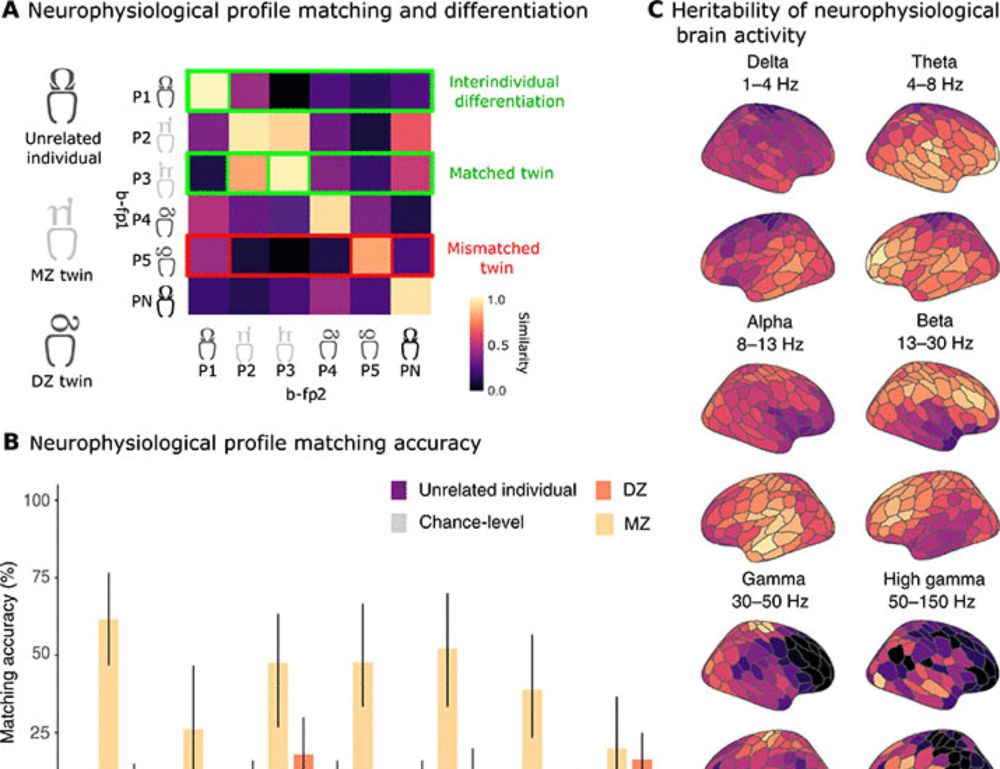
Genetic foundations of interindividual neurophysiological variability
Individual brain activity profiles are shaped by lifelong genetic influences.
Very proud to share this one🥹! We show that personalized signatures of brain activity are heritable and relate to the expression of specific genes. That means my brain-fingerprint is very similar to my twin brother's! #ResearchIsMeSearch🧠 🧬 ♊️
24.07.2025 08:20 —
👍 38
🔁 15
💬 1
📌 0

Genetic foundations of interindividual neurophysiological variability
Individual brain activity profiles are shaped by lifelong genetic influences.
🧬🧠 Our latest study shows that individual brain dynamics are partly written in our genes. We found that heritable neurophysiological traits align with adult cortical gene expression and psychological function.
www.science.org/doi/10.1126/...
@theneuro.bsky.social @mcgill.ca
23.07.2025 22:01 —
👍 54
🔁 13
💬 2
📌 0
OSF
🚨Excited to share my first preprint from my postdoc with @smfleming.bsky.social! 🚨 We explore how attention shapes simplified mental representations for planning. We show that inductive biases characteristic of attentional selection shape how we plan. Check it out: osf.io/preprints/ps... 🧠🔦🤖
22.05.2025 11:56 —
👍 27
🔁 7
💬 0
📌 3

Want to present at MEG-UKI but funding is a barrier?
We’re offering a limited amount of travel bursaries for presenters to help cover the cost of:
- Registration
- Accommodation
- Travel expenses
Click the link below to find out more:
meguk.ac.uk/apply-for-bu...
12.05.2025 13:03 —
👍 3
🔁 5
💬 0
📌 0

Deadline approaching, only 6 days left!
Follow the link below to submit your abstract:
meguk.ac.uk/abstract-sub...
19.05.2025 14:39 —
👍 5
🔁 5
💬 0
📌 1

Drumroll please... 🥁
Abstract submission for MEG-UKI 2025 is now open!!!
All the details can be found meguk.ac.uk/meg-uki-2025/
We are looking forward to welcoming you to London!
06.05.2025 14:17 —
👍 17
🔁 14
💬 1
📌 4
-Sensorimotor cortices 🏋️♀️🚴♀️ become increasingly prominent for differentiating individuals across neurodevelopment and aging.
-These changes become increasingly aligned with cortical gene expression🧬.
🧵 (3/3)
28.11.2024 09:43 —
👍 4
🔁 0
💬 0
📌 0
We analyzed resting-state MEG from over 1000 individuals between the ages of 4 and 89:
-children are harder to differentiate from one another 👯♂️ based on arrhythmic brain activity. 🧠
- rhythmic activity remains a reliable marker of individuality across all ages🌈.
🧵 (2/3)
28.11.2024 09:43 —
👍 4
🔁 0
💬 1
📌 0

Scientific figure demonstrating the spatial alignment between a normative atlas of norepinephrine transporter densities (x-axis; lower maps to the right) and the relationship between cortical alpha rhythms and locus coeruleus integrity (y-axis; higher maps to the right).
The association between locus coeruleus degeneration and pathological alpha-rhythmic increases was strongest in cortical regions sensitive to norepinephrine (r = -.65, pSPIN < .001).
New preprint! 📢
We combine MEG and neuromelanin-sensitive MRI of the locus coeruleus to show a noradrenergic basis for altered alpha rhythms in #Parkinson's disease
w/ Victoria Madge, Ted Fon, Alain Dagher, Louis Collins, and @sylvainbaillet.bsky.social
www.medrxiv.org/content/10.1...
21.02.2024 18:42 —
👍 17
🔁 8
💬 0
📌 1

