🌟Ready to apply?
16 fully funded PhD positions are open in ProtAIomics Doctoral Network!
Join 16 labs across Europe to advance AI-powered proteomics and drive discoveries in health & biotechnology.
👉 Apply here: www.protaiomics.eu
#Proteomics #ArtificialIntelligence #MSCA #PhDOpportunities
08.10.2025 09:15 —
👍 4
🔁 4
💬 0
📌 4

Researchers from any country🌍can apply to ProtAIomics->
No PhD yet
Mobility rule applies (≤12 months in host country in last 3 years)
Must meet host/project requirements
Details 👉 www.protaiomics.eu/call-for-app...
#Proteomics #ArtificialIntelligence #MSCA #PhDOpportunities #FullyFundedPhD
10.10.2025 08:53 —
👍 3
🔁 2
💬 0
📌 0
The proteasome-substrate-shuttle protein UBQLN2 contains—like other quality control system proteins—a long region devoid of lysine (a lysine desert)
Martin Grønbæk-Thygesen (from @rhp-lab.bsky.social) et al show that introducing K here causes ubiquitylation and degradation
doi.org/10.1101/2025...
07.10.2025 21:19 —
👍 32
🔁 11
💬 2
📌 1

The functional landscape of the human ubiquitinome
Protein ubiquitination regulates cell biology through diverse avenues, from quality control-linked protein degradation to signaling functions such as modulating protein-protein interactions and enzyme...
new preprint: Ubiquitin is a protein modification linked with degradation but known to regulate other functions. Over 100k ubiquitination sites have been discovered and here we (@julianvangerwen.bsky.social + others) try to prioritize those most critical to the cell www.biorxiv.org/content/10.1...
09.10.2025 07:07 —
👍 106
🔁 45
💬 2
📌 2
YouTube video by ProteinDesignStudio
Screen binders using ipSAE
pip install ipsae
from www.linkedin.com/in/ullah-sam...
www.youtube.com/watch?v=A5ph...
PyPI pypi.org/project/ipsae/
His github fork github.com/ullahsamee/I...
My github github.com/DunbrackLab/...
Paper www.biorxiv.org/content/10.1...
For designed protein binders www.biorxiv.org/content/10.1...
16.09.2025 19:21 —
👍 20
🔁 6
💬 1
📌 2


Our IPP Winter Call is now open! 📢 Are you looking for a fully funded PhD project in an international environment, doing cutting-edge research, and developing your career with advanced training? Join the #IPPMainz!
Learn more via www.imb.de/phd & apply by 16 October
#IMBMainz @unimainz.bsky.social
10.09.2025 09:08 —
👍 2
🔁 2
💬 0
📌 0
Open PhD position in the Luck lab at IMB in Mainz, Germany, in the field of AI and computational structural biology. Check out project description here: www.imb.de/students-pos...
Funded as part of the European Training Network ProAIomics cordis.europa.eu/project/id/1...
10.09.2025 07:01 —
👍 2
🔁 4
💬 1
📌 0
New IDPSeminars season on deck 🤩
We hope you can join us to learn about some exciting science!
More info in the post below👇
27.08.2025 14:23 —
👍 8
🔁 4
💬 0
📌 0
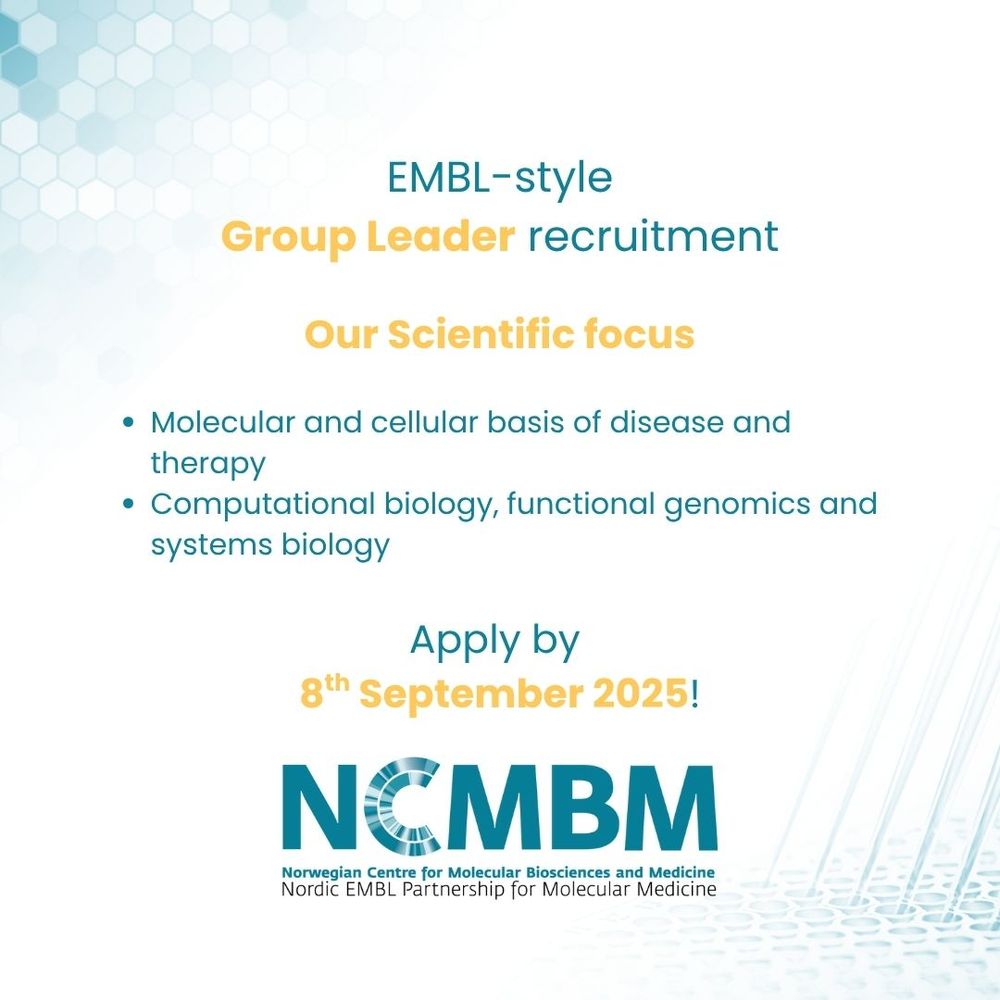
📣 We’re recruiting 1-2 Group Leaders! NCMBM is looking for early-career researchers ready to establish their independent research groups!
🧬 With an attractive start-up package, help us shape the future of molecular biosciences and medicine in 🇳🇴 and be part of the @nordicembl.bsky.social!
30.06.2025 07:09 —
👍 19
🔁 25
💬 1
📌 3
Are you @ the late stages of your postdoc ? Want to pursue a PI career ?
Then this 👇👇 is for you ! Apply for a spot @ our Talent Forum
www.helmholtz-munich.de/en/stem-cell...
Peer-networking / Career orientation and more !!!
Please distribute :) 🙂
12.06.2025 12:58 —
👍 23
🔁 28
💬 0
📌 1
We've updated our AFESM website to now include biome filtering, allowing exploration of protein structures adapted to specific environments.
🌐 afesm.foldseek.com
Read more about the work in the skeetorial
🦋 bsky.app/profile/mart...
or our preprint
📄 www.biorxiv.org/content/10.1...
15.05.2025 14:03 —
👍 60
🔁 22
💬 2
📌 0
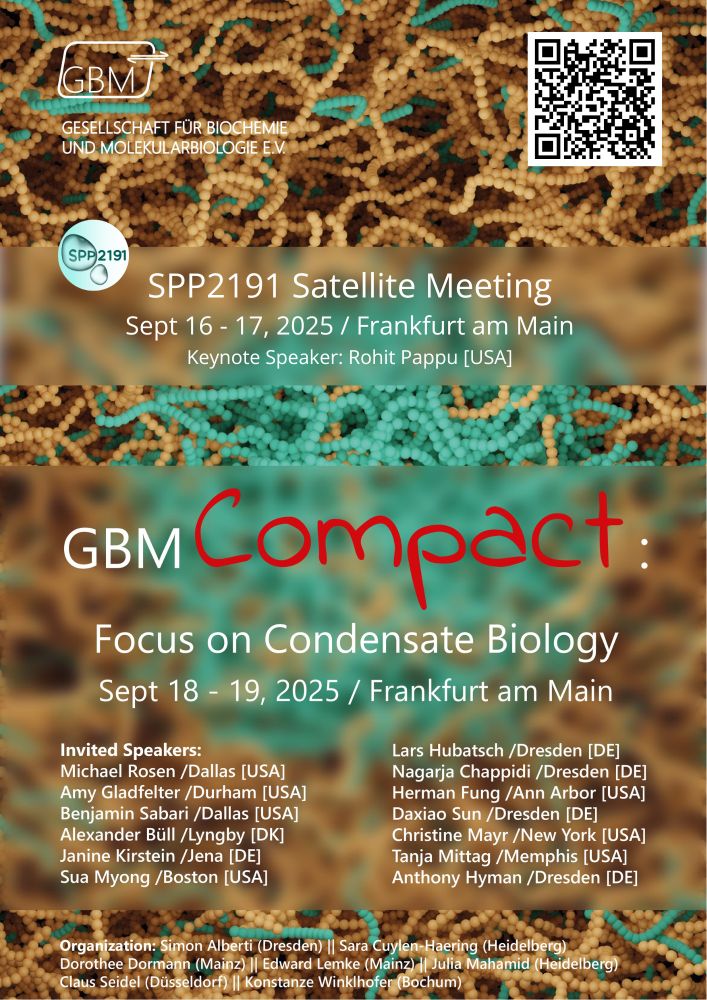
📢 Registration is open for the GBM Compact: Focus on Condensate Biology & SPP2191 Satellite Meeting! This is sure to be an incredible event diving into the latest in phase separation research with leading scientists.
📍 Frankfurt am Main
📅 Sept 16–19, 2025
🌐 shorturl.at/ZGQch
@gbmev.bsky.social
16.05.2025 08:16 —
👍 8
🔁 2
💬 0
📌 1

Data-driven extraction of human kinase-substrate relationships from omics datasets
Phosphorylation forms an important part of the signalling system that cells use for decision making and regulation of processes such as cell division …
We present SELPHI 2.0 a machine learning model integrating >40 sequence, omics and structural features to predict kinase-substrate interactions between 420 kinases and 240K phosphosites and improve interpretation of global phosphoproteomics data www.sciencedirect.com/science/arti...
16.05.2025 09:09 —
👍 24
🔁 13
💬 1
📌 0
Led by @vvouts.bsky.social in @rhp-lab.bsky.social, we measured the degron potency of >200,000 30-residue tiles from >5,000 cytosolic human proteins and trained an ML model for degrons
📜 www.biorxiv.org/content/10.1...
🖥️ github.com/KULL-Centre/...
15.05.2025 12:44 —
👍 33
🔁 17
💬 0
📌 0
Join us in Vienna on Sep 8-10 with an incredible speaker lineup!
03.05.2025 10:56 —
👍 25
🔁 7
💬 1
📌 0
Limits of deep-learning-based RNA prediction methods
Motivation: In recent years, tremendous advances have been made in predicting protein structures and protein-protein interactions. However, progress in predicting the structure of RNA, either alone or...
In this evaluation of AlphaFold3 (and other methods), we show that (i) accurate predictions are limited to RNA structures/complexes with structural similarity to PDB and (ii) that current methods are bad at estimating the accuracy of the predictions. www.biorxiv.org/content/10.1...
05.05.2025 13:01 —
👍 86
🔁 31
💬 1
📌 5
Excited to share our preprint on the molecular architecture of heterochromatin in human cells 🧬🔬w/ @jpkreysing.bsky.social, @johannesbetz.bsky.social,
@marinalusic.bsky.social, Turoňová lab, @hummerlab.bsky.social @becklab.bsky.social @mpibp.bsky.social
🔗 Preprint here tinyurl.com/3a74uanv
11.04.2025 08:35 —
👍 359
🔁 141
💬 12
📌 20

🧬 Don't miss out the PSB Symposium on " #MachineLearning in Cellular #StructuralBiology " at the EPN Campus Grenoble, France, on 26-27 June 2025 🧬
🐦Early Bird rate until 15 April (registration deadline 25 May)
Info & registration: www.psb-grenoble.eu/psbsymposium2025
#AI #Proteindesign
19.03.2025 16:08 —
👍 7
🔁 5
💬 0
📌 0
Remember to join us at 6pm CET April 14 for the next seminar in our series with Prof. Anne-Claude Gingras (@uoft.bsky.social) and Dr. Veronica Venafra.
Register to attend: tinyurl.com/register-pmc-seminar
You can find recordings of previous seminars here: www.youtube.com/@PMCModularity
11.04.2025 07:58 —
👍 4
🔁 5
💬 0
📌 0

Holdup Multiplex Assay for High-Throughput Measurement of Protein–Ligand Affinity Constants Using a Mass Spectrometry Readout
The accurate description and subsequent modeling of protein interactomes require quantification of their affinities at the proteome-wide scale. Here we develop and validate the Holdup Multiplex, a versatile assay with a mass spectrometry (MS) readout for profiling the affinities of a protein for large pools of peptides. The method can precisely quantify, in one single run, thousands of affinity constants over several orders of magnitude. The throughput, dynamic range, and sensitivity can be pushed to the performance limit of the MS readout. We applied the Holdup Multiplex to quantify in a few sample runs the affinities of the 14–3–3s, phosphoreader proteins highly abundant in humans, for 1000 different phosphopeptides. The seven human 14–3–3 isoforms were found to display similar specificities but staggered affinities, with 14–3–3γ being always the best binder and 14–3–3ε and σ being the weakest. Hundreds of new 14–3–3 binding sites were identified. We also identified dozens of 14–3–3 binding sites, some intervening in key signaling pathways, that were either stabilized or destabilized by the phytotoxin Fusicoccin-A. The results were corroborated by X-ray crystallography. Finally, we demonstrated the transferability of the Holdup Multiplex by quantifying the interactions of a PDZ domain for 5400 PBM peptides at once. The approach is applicable to any category of protein-binding ligands that can be quantifiable by mass spectrometry.
Holdup Multiplex Assay for High-Throughput Measurement of Protein-Ligand Affinity Constants Using a Mass Spectrometry Readout #JACS pubs.acs.org/doi/10.1021/...
25.03.2025 13:07 —
👍 6
🔁 3
💬 0
📌 0
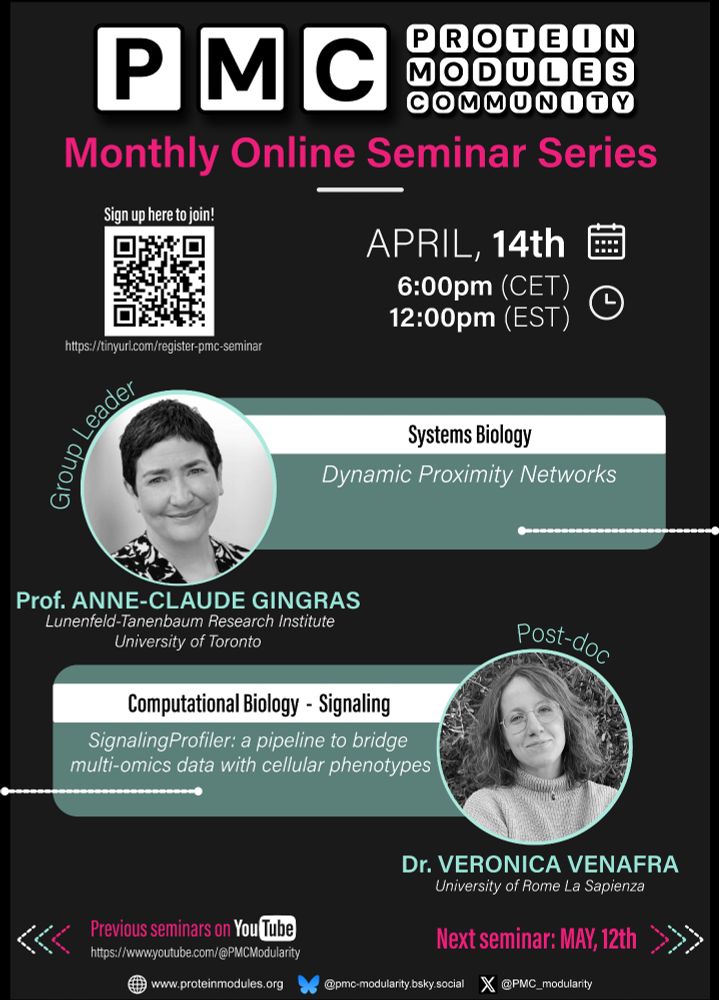
Join us at 6pm CET April 14 for the next seminar in our series with Prof. Anne-Claude Gingras (@uoft.bsky.social) and Dr. Veronica Venafra.
Register to attend: tinyurl.com/register-pmc-seminar
(1/2)
25.03.2025 14:53 —
👍 4
🔁 5
💬 1
📌 2

Next up in the ProSE Seminar Series: Devlina Chakravarty (@devlinac.bsky.social) presents "Mutations Switch Folds in Proteins".
Join us to explore how mutations reshape protein structures!
April 8, 3PM GMT
Register here: tinyurl.com/prose-seminar3
#ProSESeminar #ProteinEvolution #StructuralBiology
26.03.2025 14:27 —
👍 13
🔁 7
💬 1
📌 1