We will be updating this page with news and further details, so please follow us to stay in the loop.
Until then; Välkommen, och vi ses alla nästa år!
#ISELV #ISELV19 #ISELVUppsala
We will be updating this page with news and further details, so please follow us to stay in the loop.
Until then; Välkommen, och vi ses alla nästa år!
#ISELV #ISELV19 #ISELVUppsala
This meeting will mark both 20 years since the last time ISELV was in Uppsala and 60 years since the very first meeting held in Stockholm in 1967.
#ISELV #ISELV19 #ISELVUppsala
Following on from our post yesterday, we are honoured to announce that we will be hosting the 19th International Symposium on Early and Lower Vertebrates (ISELV) meeting here in Uppsala in 2027!
#ISELV #ISELV19 #ISELVUppsala #fossilfriday

Gathering of researchers and alumni of Uppsala vertebrate paleo lab.
We also had a chance to reconnect with our broad network of alumni and collaborators, shown below, and share both memories of Uppsala and fresh ideas for projects and collaborations.
#ISELV18
The conference, co-organised by Hassan 1st University, Berrechid, and the University of Zurich, was a fantastic showcase of international research and the contributions of Morocco to that research, and we thank and congratulate the organisers for a great meeting.
26.02.2026 15:51 — 👍 0 🔁 0 💬 1 📌 0This February, the Uppsala team attended and presented at the 18th ISELV in Berrechid, Morocco, sharing our research with the global early vertebrate community #ISELV18 @iselv18.bsky.social
26.02.2026 15:51 — 👍 1 🔁 1 💬 1 📌 0


#ISELV18 was incredible, even the parts that weren't early vertebrates related! #morocco #fossils
23.02.2026 17:44 — 👍 2 🔁 2 💬 0 📌 0Vanavond in het 8 uur journaal over ons nieuwe onderzoek waarin wij ontdekten dat mosasauriërs ook in rivieren voorkwamen! #aardwetenschappen #paleontologie #mosasaurus @vuamsterdam.bsky.social @uuvertpalaeo.bsky.social @ndgspaleo.bsky.social @perahlberg.bsky.social @boydpaleo.bsky.social
15.12.2025 20:49 — 👍 31 🔁 4 💬 2 📌 1
Here it is! The #news of the week comes from two of our PIs, Mattias Jakobsson & the #humanevolution program, #UppsalaUniversity. Congratulations! www.uu.se/en/news/2025... #humanpast #genetics #Africa #AncientSouthernAfricans
04.12.2025 10:02 — 👍 3 🔁 1 💬 1 📌 0

Go my Bothriolepis... This year's fish pecan pie! Bothriolepis was a peculiar-looking placoderm from the Devonian period or the Paleozoic. It had two long pointed pectoral fins and silly little eyes on top of its head.
#fossil #fish #paleontology #bothriolepis

The hidden pattern of the primary teeth in an ancestral ray-finned fish provides a clue to how the strange lungfish dentition could have evolved simply by modifying the growth mode of bone. More information in this newly published piece from @uuvertpalaeo.bsky.social here: doi.org/10.1111/joa....
19.09.2025 14:54 — 👍 1 🔁 2 💬 0 📌 0
palaeontologists digging for fossils in soft sand
A team from our lab recently joined fieldwork organised by the University of Latvia, helping to excavate fossils from the Devonian, including armoured fish (Placoderms) and early tetrapods in western Latvia.
#fossilfriday #paleontology
"It is by love alone that we understand anything" -The birth of Bran, James Stephens
A new study comes from the questions you love to ask. My question "How do vertebral building blocks come together to make different anatomies?" inspired this project ❤️
onlinelibrary.wiley.com/doi/10.1111/...
Could a slab of ancient Australian rock rewrite everything we thought we knew about the origin of land-dwelling vertebrates? @perahlberg.bsky.social , @evobiouppsala.bsky.social @uuvertpalaeo.bsky.social , discusses: faculti.net/earliest-amn...
#natural sciences

Could a slab of ancient Australian rock rewrite everything we thought we knew about the origin of land-dwelling vertebrates? @perahlberg.bsky.social , @evobiouppsala.bsky.social @uuvertpalaeo.bsky.social , discusses: faculti.net/earliest-amn...
#natural sciences
‼️To all early vertebrate enthusiasts‼️
The 18th International Symposium on Early and Lower Vertebrates #ISELV will be held in Berrechid, Morocco on 3-8 February 2026! 🐟🦈🦎🦴
We look forward to hosting you there!
For more info, see our website (link in bio)
#fish #vertebrate #palaeontology #fossils


Back in Sweden to receive my diploma at the Uppsala University doctoral conferment ceremony, followed by a reception at Gustavianium and banquet at the Castle was incredibly special. I think it is only now dawning on me that I really did it, I really am Dr Melanie During.
24.05.2025 12:09 — 👍 43 🔁 3 💬 5 📌 0
Out Now in Nature! Amniote tracks from Australia push the timeline for terrestiality back 35 to 40 million years, with implications for our understanding of tetrapod evolution.
www.nature.com/articles/s41...

It's out! We describe probable reptile tracks from the earliest Carboniferous of Australia. This pushes the amniote record back by some 35-40 million years and implies that the tetrapod crown group originated deep in the Late Devonian. The paper is Open Access. 🧪
www.nature.com/articles/s41...

Fossilized claw prints thought to belong to an amniote, an early relative of reptiles, have been found on a slab of rock from Australia dated to about 356 million years ago. The findings in @nature.com, suggest the origin of amniotes is earlier than expected:
#fossil

When it comes to understanding when animals first walked on land, finding footprints of animals that literally pressed their feet into the ground absolutely holds the key.
Congratulations to all authors including my former supervisor: @perahlberg.bsky.social
www.nature.com/articles/s41...

The Biology PhD school asked me to write a blog post about my research, now it’s up and I can go back to staring at fish www.uu.se/en/departmen...
02.05.2025 07:00 — 👍 2 🔁 2 💬 1 📌 0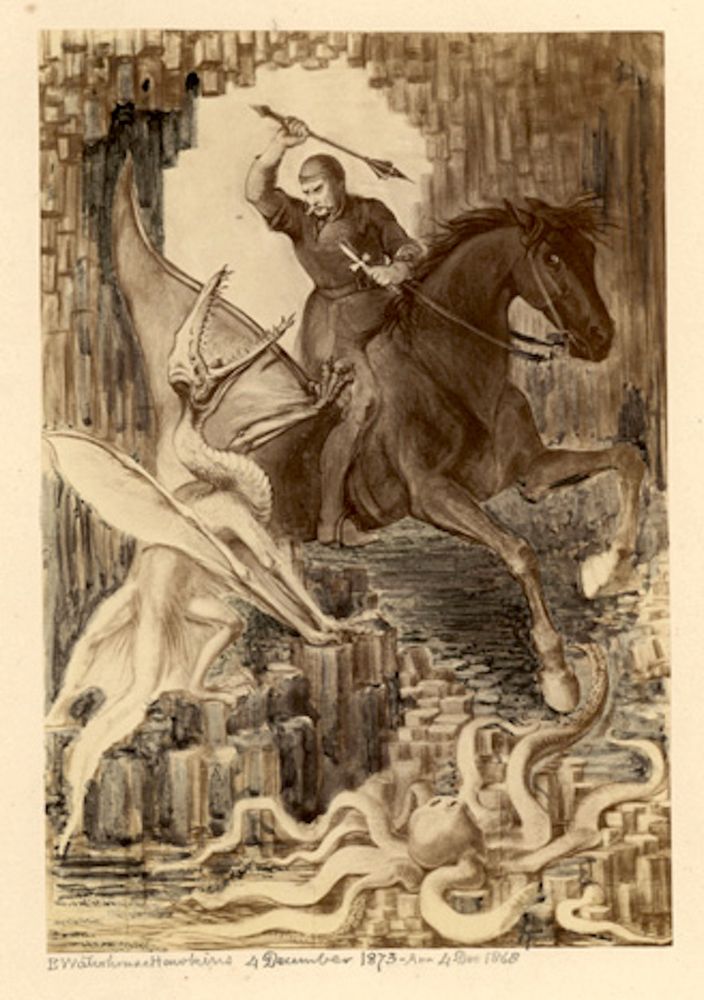
An old monochrome painting of a knight, Saint George, mounted on a horse about to clout a nearby pterosaur on the head with a mace. The setting is Fingal's Cave on the island of Staffa in Scotland, with columnar basalt all around. For some reason an octopus beneath the horse also appears to be aiding the pterosaur in its fight.
#StGeorge and the Pterodactyl (1873), by Benjamin Waterhouse Hawkins of @cpdinosaurs.bsky.social fame, to illustrate his suggestion that #dragon 🐲 legends may have been inspired by encounters with living pterosaurs #StGeorgesDay
Not sure how the octopus fits in 🐙

We are pleased to announce the opening of our new Tomography Support Center, now available for all @uu.se employees and students. We welcome collaborations with anyone interested in using microCT and synchrotron scanning.
Learn more here: www.uu.se/institution/...
Congratulations!
10.04.2025 14:19 — 👍 0 🔁 0 💬 0 📌 0
PeerJ Congratulates Elsa Leflaëc & Victor López Rojas - Award winners at The 5th Palaeontological Virtual Congress
Learn more about their research on the PeerJ blog bit.ly/42EHFPA
#5thPVC #Palaeontology
@palaeovc.bsky.social

We have a new preprint! Mapping and analyzing nearly 5,000 full mitogenomes across Africa.
First major update on mtDNA distribution since Salas et al. 2002, "The making of the African mtDNA landscape." Congrats to Imke Lankheet and thanks to all collaborators!
📄 www.biorxiv.org/content/10.1...

A beige graphic with a collection of dried, brown fish specimens arranged below the text "Plenty of fish in the... Linnean collection".
It is #WorldAquaticAnimalDay today! While fish are far from the only ones hanging out in the water, we're having a look at some of the dried specimens in our collection, and what they are still teaching us.
Check out the secrets hidden within our collections here:
www.linnean.org/news...

Update from our expedition to Mars: No new early Tetrapods.
01.04.2025 09:18 — 👍 4 🔁 2 💬 0 📌 0
Atlas, axis, and cervical vertebra 3 of a fossil crocodylian
It is a very happy #fossilfriday as I sent back a revised manuscript last night, a years-in-the-making review that is the reason I find my phone full of pictures like this every time I've been to a museum:
"Asiatosuchus" depressifrons anterior cervical vertebrae (sans proatlas)

