Despite the world being on fire, I can't help but be thrilled to announce that I'll be starting as an Assistant Professor in the Cognitive Science Program at Dartmouth in Fall '26. I'll be recruiting grad students this upcoming cycle—get in touch if you're interested!
07.05.2025 22:08 —
👍 143
🔁 24
💬 17
📌 4

Figure 1: Foraging trial diagram. On each trial participants chose to harvest the tree they were at (down arrow key) or travel to a new tree (right arrow key), during the travel they completed an effortful task, after which they arrived at a new patch with a replenished supply of apples. The tree is a green circle and rectangular brown trunk. The apples are red and lined up in a row on the bottom of the screen. There is a warrior avatar with a shield, helmet, and sword who jumps to harvest the apples.
I'm elated to share my PhD keystone paper published
@PNAS
www.pnas.org/doi/10.1073/... I've poured my heart & soul into this project since 2016 (8 yrs!) & I'm happy to introduce the Effort Foraging Task to the world #CognitivePsychology #Motivation #Effort #Foraging #DecisionMaking 🧵
26.01.2024 17:58 —
👍 81
🔁 45
💬 5
📌 0

Optimal Nudging for Cognitively Bounded Agents: A Framework for Modeling, Predicting, and Controlling the Effects of Choice Architectures
Happy to belatedly "announce" that our paper on nudging has been published in Psych Review! We understand nudges as changing the "meta-level decision-making problem", influencing people's choices by influencing what they think about it.
psycnet.apa.org/record/2024-...
11.01.2024 21:15 —
👍 33
🔁 15
💬 1
📌 1
New preprint! Here, we examine how the specificity of learning computations adapts to the reward structure of the environment and influences memory across development.
osf.io/preprints/ps...
Read on for more details. 🧵⬇️
13.11.2023 16:17 —
👍 24
🔁 11
💬 1
📌 1
I’m really jazzed to continue this line of work so feedback is much appreciated! Lastly, this work would not have been possible without my advisor @aaronbornstein.bsky.social and the Conte Center at UCI, whose empirical work greatly informed our approach towards modeling adversity. (10/10)
23.10.2023 19:04 —
👍 1
🔁 0
💬 0
📌 0
In this paper, we show that these maladaptive behaviors can emerge from adaptive developmental processes. There’s other analyses that I haven’t mentioned in this thread — including how different dimensions of adversity interact in non-additive ways. Check out the paper to read about those! (9/10)
23.10.2023 19:03 —
👍 0
🔁 0
💬 1
📌 0

It also produces a negativity bias, another feature of anhedonia. To simulate adulthood, we “froze” agents’ temporal representations and then placed them in an environment with predictably timed rewards. ELU agents’ showed larger prediction errors when reward was omitted than when received. (8/10)
23.10.2023 19:03 —
👍 0
🔁 0
💬 1
📌 0
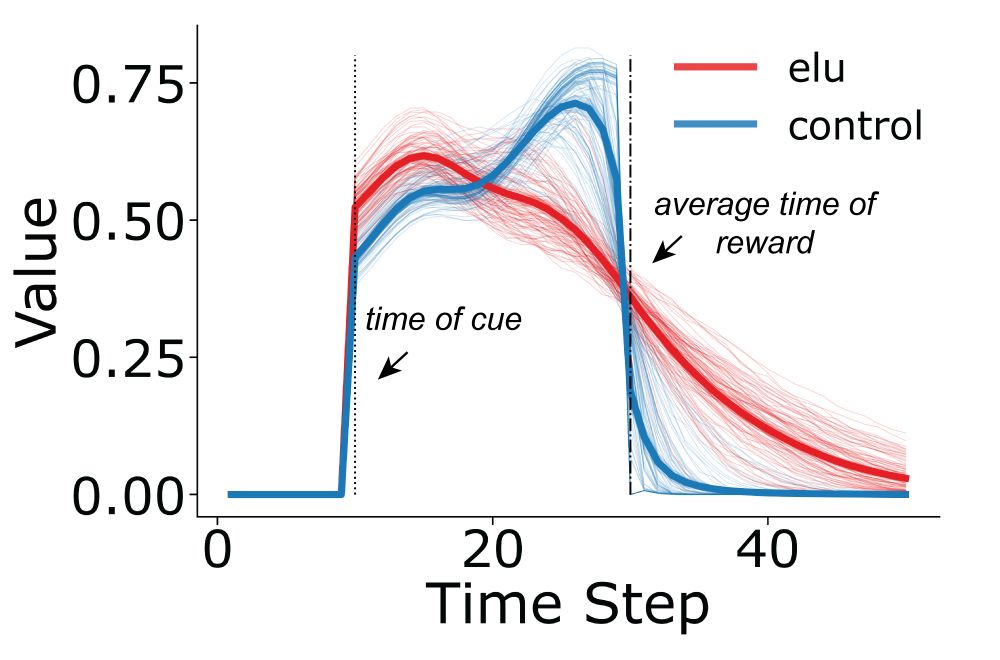
It diminishes reward expectations at the time points just before reward is most likely to occur. Let’s say these Pavlovian values were transferred to instrumental actions — this would produce reduced motivation to pursue rewards, one characterizing feature of anhedonia. (7/10)
23.10.2023 19:03 —
👍 0
🔁 0
💬 1
📌 0
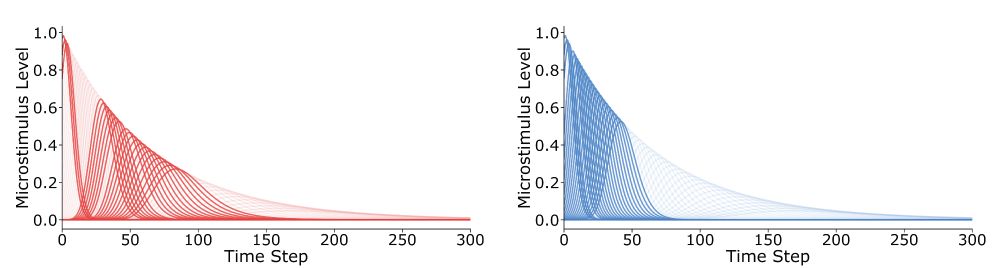
Agents developed temporal representations that mimicked the statistics of their environment. Early Life Unpredictability agents (ELU) ended up relying on less precise representations, which temporally “smeared” their reward expectations. This temporal smearing has important consequences. (6/10)
23.10.2023 19:02 —
👍 0
🔁 0
💬 1
📌 0

We had two groups of agents who experienced different degrees of unpredictability in reward timing. By manipulating unpredictability in the *timing* rather than *presence* of reward, we could isolate the impact of unpredictability from environment richness. (5/10)
23.10.2023 18:58 —
👍 0
🔁 0
💬 1
📌 0

Under this variant of the TD model, time intervals are represented with a weighted set of temporal receptive fields, microstimuli, that vary in their precision or “spread.” The weights are adjusted with experience to make better predictions of if and when reward will occur following the cue. (4/10)
23.10.2023 18:58 —
👍 0
🔁 0
💬 1
📌 0
As a first approach to this question, we simulated a temporal difference (TD) learning model undergoing Pavlovian conditioning. Importantly, the model had a non-standard representation of time, using microstimuli. (3/10)
23.10.2023 18:57 —
👍 0
🔁 0
💬 1
📌 0
Lots of work has shown that reinforcement learning computations differ in adults with mood and anxiety disorders. We asked: could these “computational phenotypes” be a reflection of individuals’ developmental environments? (2/10)
23.10.2023 18:57 —
👍 1
🔁 0
💬 1
📌 0
Really excited to share our new paper where we use a reinforcement learning model to demonstrate that rational adaptation to an unpredictable early life environment can produce key characteristics of anhedonia (1/10) onlinelibrary.wiley.com/doi/10.1111/...
23.10.2023 18:56 —
👍 29
🔁 17
💬 1
📌 1
New manuscript! Here, we fit 27 different models to behavior in both humans and monkeys to understand what computations drive patch foraging decisions. Comments/questions/criticisms/suggestions definitely welcome!
18.10.2023 02:57 —
👍 14
🔁 10
💬 0
📌 0
ELM Lab @ UNH
Hi Bluesky! I’m recruiting PhD students to help launch the Exploration, Learning, and Mind Lab at U of New Hampshire Psych in Fall 2024!
Check out our lab website at liquinlab.github.io for more info, and feel free to get in touch if you’re interested in applying!
#CogSci #DevPsych #PsychSciSky
16.10.2023 18:19 —
👍 38
🔁 32
💬 0
📌 1

Memory precision and age differentially predict the use of decision-making strategies across the lif...
Scientific Reports - Memory precision and age differentially predict the use of decision-making strategies across the lifespan
New lab paper! Memory precision and age each affect different decision systems. The lab's first foray into cognitive aging, fearlessly lead by
Dr. Sharon Noh. Details in her 🐦🧵 twitter.com/sharon_noh/s... - and out now in Scientific Reports: www.nature.com/articles/s41...
13.10.2023 01:23 —
👍 27
🔁 13
💬 0
📌 0