It will go much faster than described above.
The ocean warming was paused for two and a half years.
bsky.app/profile/clim...
It will go much faster than described above.
The ocean warming was paused for two and a half years.
bsky.app/profile/clim...

... which will accelerate all of this towards the coming northern summer.
gml.noaa.gov/ccgg/trends/...
This also means that we're already certain, in February, that 2026 will be the warmest year since records began, and could shatter the previous record year (2024) by a full degree (or even more)!


We're already seeing global sea surface temperatures rapidly following the trend. The estimated impact is a 0.8°C to 1.6°C rise in global atmospheric temperature, just in the first half of 2026!
And then we haven't even mentioned the concentration of CO₂ in the atmosphere, ...
As a result, Niño indices 1 and 2 will very quickly rise towards +3.5°C to +4°C, and Niño indices 3, 3.4, and 4 will follow very quickly, possibly reaching +3°C or higher in June.
www.tropicaltidbits.com/analysis/oce...
www.tropicaltidbits.com/analysis/oce...
www.tropicaltidbits.com/analysis/oce...

Drake Passage (Scotia Sea)
What is now at stake is the fact that very important large icebergs have left the convergence zone (A76C, A23, A74A, etc.), and that no other crucial icebergs will enter the convergence zone for the next 16 to 20 months.
Icebergs D33A, D33C, D35 & A81 are moving too slow.


Important developments stay under the radar, while they will affect billions of people in the coming months.
Few people know this, but the icebergs drifting out of the Weddell Sea have a significant impact on the Niño 1 and 2 indices, and therefore indirectly also on the Niño 3, 3.4, and 4 indices!


This should be world news, but it has been overshadowed by global conflicts.
We must be very aware that we have had a pause in the rise in global average sea surface temperature and the global average atmospheric temperature. This pause lasted about two and a half years.
@reuters.com

Geopolitical posturing and resource-grabbing: Trump is distracting from the real Greenland problem, as climate warming melts the ice, raising sea levels and disrupting ocean currents and weather patterns across the globe.My new post:
iceblog.org/2026/02/21/g...
Here we see a clear, continuous ice flow from northeast to southwest. Only in the run-up to spring tide in the Lincoln Sea is a two-day retreat visible. We see this happening here around February 13th. A freeze-up does not seem to be in sight yet.
A permanent open Nares Strait is the third bad sign.
...
11.02.2026 09:14 — 👍 0 🔁 0 💬 0 📌 0
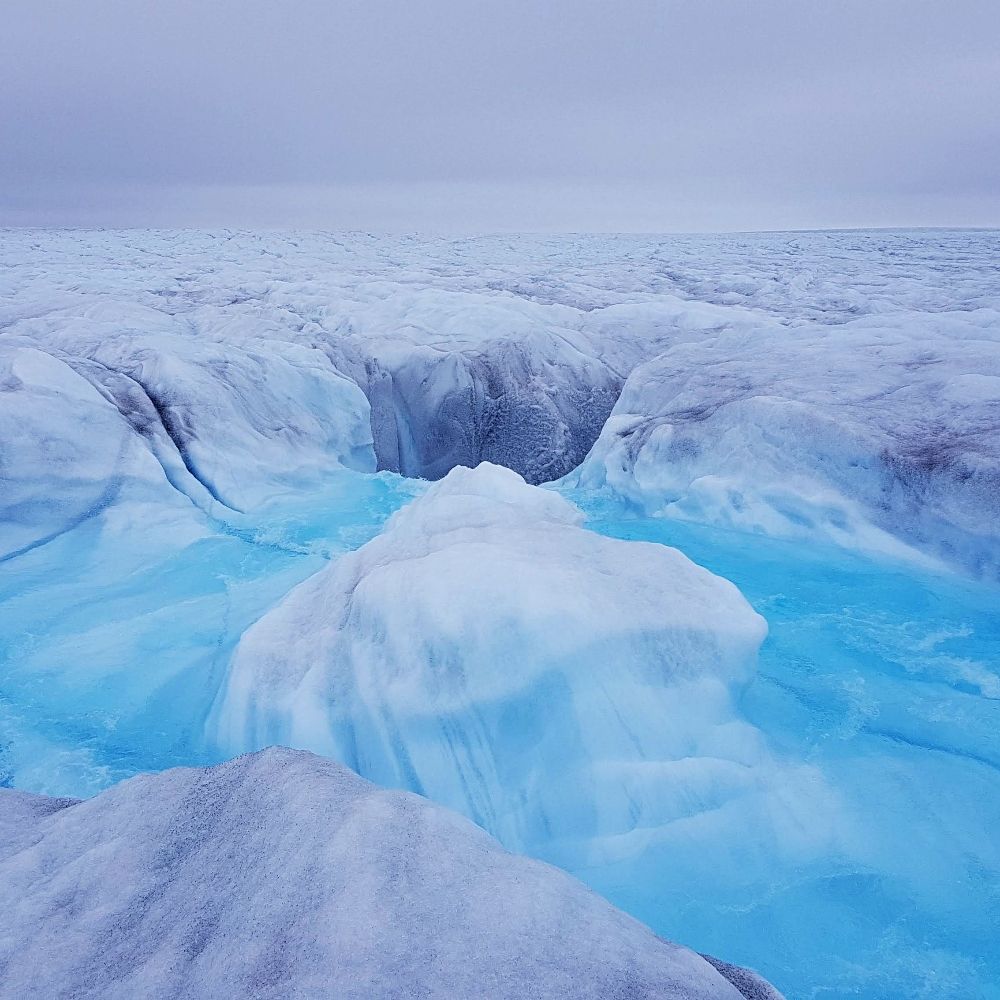
Blue ice in foreground and towering pinnacles under a blue sky on the background
Leaving Antarctica with computers full of data, notebooks full of notes + numbers and just about as much kit as we brought (+ some waste for correct disposal). Travelling out via the gobsmacking #WhiteDesert.
#Antarctica, you've been wonderful, who knows when we'll meet again... #iQ2300
Multi-year ice has not been present for several years.
Very important to keep an eye on.
Arctic sea ice!!
The speed at which sea ice is being expelled from the Arctic Ocean (in February!!!) via the Lincoln Sea and via the Nares Strait is indeed very alarming.
We mustn't forget that this fact means that virtually no robust, new, thick sea ice can form north of Canada and Greenland!
Global sea level is rising by 0.1 mm per day in the short term.
Let that sink in for a moment.

The weakening of Pine Island Glacier & Thwaites Glacier (Pine Island Bay, West Antarctica) peaks today.
We should expect complete collapse of both glacier tongues (and by extension the glaciers themselves) between 2026 & 2028, as harsh as that may sound.
worldview.earthdata.nasa.gov?v=-1840525.9...
The Nares Strait (NW of Greenland) is still open!!
This channel connects Baffin Bay with the Lincoln Sea (Arctic Ocean).
The Nares Strait itself consists of several segments, including:
Smith Sound (the southernmost part)
Kane Basin
Kennedy Channel
Hall Basin
Robeson Channel (the northernmost part)
- Wilkins Ice Shelf -
(West Antarctica)
The ice shelf's incredibly strong ice bridge is cracking.
It doesn't have more than a few days left.
And then the entire ice shelf will disappear for good.
10,140 square kilometers.
Stay tuned.
#WilkinsIceShelf
worldview.earthdata.nasa.gov?v=-2271075.4...
We're just days away from a complete collapse of the Wilkins Ice Shelf.
The last crucial cracks are preparing for the ultimate weakening of the ice bridge.
It's only a matter of days before the entire ice shelf drifts into the ocean.
#WilkinsIceShelf
worldview.earthdata.nasa.gov?v=-2321605.6...

Global map showing surface air temperature trends for each December from 1975 to 2024. Only land areas are shown. Red shading is shown for warmer temperature trends, and blue shading is shown for colder temperature trends. Data is from NOAA/NESDIS/NCEI NOAAGlobalTempv6.0.0. The temperature trend scale is from -0.5°C/decade to +0.5°C/decade. Most all areas are warming, except for parts of Antarctic and eastern Asia.
Trends in December temperatures over land areas for the last 50 years...
Data from NOAAGlobalTemp v6.0.0 (www.ncei.noaa.gov/products/lan...)
For example, iceberg C36 (a remnant of the Ninnis Glacier), which has acted as a significant brake since early 2020, on the ice expulsion from the Wilkes Subglacial Basin, situated generally southward of George V Coast & westward of Prince Albert Mountains.
The anchorage is starting to give way.
--- Mertz Glacier ---
--- Ninnis Glacier ---
--- Cook Glacier ---
--- Wilkes Subglacial Basin ---
East Antarctica is often overlooked when it comes to glacier decline & land-ice melt.
But we'd like to point out that important things are happening there too.
share.google/e1fU1PnnlntU...
Every scientist & every world leader must now be focused on this:
Thwaites Glacier!
This 12-day run is crucial to understanding the problem.
There will be no slowdown in the shearing of the TEIS remnants, even if atmospheric temperatures unexpectedly drop below -20°C!
@thwaitesglacier.bsky.social

We're seeing a significant, rapid warming of the water basins near the Pine Island Glacier & the Totten Glacier. This could lead to very rapid, noticeable accelerations in the glacier tongues.
It appears to be a matter of weeks before the 1st fractures are seen.
earth.nullschool.net#current/ocea...
The next four months will be very exciting for the Pine Island Glacier Tongue, the Thwaites Glacier Tongue, and the central part of the Thwaites Glacier itself.
Here you can easily follow it day by day from the comfort of your own home:
worldview.earthdata.nasa.gov?v=-1820908.2...
Enjoy!
#PIG #TG
Some scientists argue that it might still be reversible.
But it's a matter of months, not years.
@climatenews.bsky.social
@climate.noaa.gov
@metoffice.gov.uk
@pyrn-official.bsky.social
@ran.org
@rainforestalliance.bsky.social
@ec.europa.eu
@barackobama.bsky.social
Hopefully, world leaders will begin to understand.
It's actually quite simple.
Doing nothing is murder. The murder of billions of people.
Meanwhile, all permafrost regions on Earth have become sources of CO₂ and our rainforests have become emitters, not CO₂ absorbers, since the coronavirus pandemic.

🌊 Coral reefs have orchestrated Earth’s climate for 250 million years
theconversation.com/coral-reefs-...

Our thanks to Rabbi Jonathan Wittenberg OBE for this moving article about the National Emergency Briefing.
Please sign the open letter to the Prime Minister and key broadcasters, calling for a televised emergency briefing to the nation: www.nebriefing.org/open-letter-...
#timetostepup #NEB2025

A better view.
FYI:
Pay close attention to what November is supposed to do, and what November will do now.


