AEA Journals's Avatar

AEA Journals

@aeajournals.bsky.social

The American Economic Association is a non-profit, non-partisan, scholarly association dedicated to the discussion and publication of economics research.

8,118 Followers  |  2 Following  |  696 Posts  |  Joined: 28.08.2024  |  1.6566

Latest posts by aeajournals.bsky.social on Bluesky

Preview
Who Profits from Amateurism? Rent-Sharing in Modern College Sports (Forthcoming Article) - Intercollegiate amateur athletics in the US have historically prevented student-athletes from receiving market wages, creating substantial economic rents that are primarily generated by men’s football and basketball programs. Using financial data from college athletic departments, we estimate rent-sharing elasticities to measure how rents flow to women’s sports and other men’s sports and lead to increased spending on athletic facilities and coaches’ salaries. Using player-level data, we find that the rent-sharing transfers spending away from students who are more likely to be Black and come from poor neighborhoods towards students more likely to be White and come from higher-income neighborhoods.

Forthcoming in AEJ: Applied Economics: "Who Profits from Amateurism? Rent-Sharing in Modern College Sports" by Craig Garthwaite, Nicole Holz, Jordan Keener, and Matthew Notowidigdo.

09.02.2026 09:28 — 👍 1    🔁 0    💬 0    📌 0

Preview
Shock Values: Prices and Inflation in American Democracy by Carola Binder (Forthcoming Article)

Forthcoming book review in the JEL: "Shock Values: Prices and Inflation in American Democracy by Carola Binder" by Michael D. Bordo.

09.02.2026 08:43 — 👍 3    🔁 1    💬 0    📌 0
Preview
The Effect of Low-Skill Immigration Restrictions On U.S. Firms and Workers: Evidence from a Randomized Lottery (Forthcoming Article) - U.S. firms hiring foreign workers in low-skill nonfarm jobs face a binding quota on the ‘H- 2B’ visa, allocated in part through a randomized lottery. We evaluate the quota’s marginal impact using the lottery, a novel firm survey, and a pre-analysis plan. Firms exogenously employing more H-2B workers in low-skill jobs increase production (elasticity 0.20–0.22), investment (1.5–2.1), and profits (0.15). The elasticity of substitution between H-2B and U.S. workers is very low (0.8–2.2). Thus the effect on U.S. employment is zero or positive overall, and positive in rural areas. Forensic analysis suggests similarly low substitutability of black-market labor.

Forthcoming in AEJ: Applied Economics: "The Effect of Low-Skill Immigration Restrictions On U.S. Firms and Workers: Evidence from a Randomized Lottery" by Michael A. Clemens and Ethan G. Lewis.

06.02.2026 09:46 — 👍 10    🔁 6    💬 0    📌 1
Preview
Serial Entrepreneurship in China (Forthcoming Article) - This paper studies entrepreneurship and firm creation through the lens of serial entrepreneurs – entrepreneurs who establish more than one firm. Using data covering the universe of Chinese firms, we document key facts about serial and non-serial entrepreneurs and develop a theory rationalizing how their behavior is shaped by ability, endowments, and capital market frictions. Serial entrepreneurs have higher average productivity and lower return on capital than non-serial entrepreneurs. However, this premium conceals significant heterogeneity, with a majority of serial entrepreneurs underperforming relative to non-serial entrepreneurs. We link these differences to capital market frictions favoring some, but not all, entrepreneurs.

Forthcoming in AEJ: Macroeconomics: "Serial Entrepreneurship in China" by Loren Brandt, Ruochen Dai, Gueorgui Kambourov, Kjetil Storesletten, and Xiaobo Zhang.

06.02.2026 09:01 — 👍 1    🔁 0    💬 0    📌 0
Preview
Journal of Economic Perspectives Vol. 40 No. 1 Winter 2026

The Winter 2026 issue of the Journal of Economic Perspectives (40, 1) is now available online at

04.02.2026 09:40 — 👍 4    🔁 0    💬 0    📌 0
Preview
The hidden social costs of cancer A Danish study shows that an adverse health shock increases the chances of criminal behavior.

A cancer diagnosis increases the likelihood of criminal behavior, representing a previously overlooked negative externality on society, say researchers at the Central Bank of Denmark, University of Copenhagen, and Tilburg University. #econsky www.aeaweb.org/research/cha...

04.02.2026 14:29 — 👍 12    🔁 1    💬 1    📌 2
Preview
When Democracy Falters: A Multidisciplinary, Multibook Review Essay on Polarization, Populism, and Authoritarianism (Forthcoming Article) - This multibook review argues that identity-driven polarization interacts with institutional design to erode democratic guardrails. Reading Heather Cox Richardson’s <i>Democracy Awakening</i>, Tom Schaller and Paul Waldman’s <i>White Rural Rage</i>, and Ezra Klein’s <i>Why We're Polarized</i> through an economist’s lens, I emphasize two claims. First, when institutions fail to deliver broadly shared security and dignity, anti-pluralist projects gain legitimacy and room to maneuver. Second, questions of belonging, citizenship, and the obligations of government to the people are informed by culture and institutional trust. The culture of the United States is not one that lends itself readily to ethnonationalism, but these books make a case for an America that is, and perhaps has always, been divided by notions of who “we” are. I situate the books within the economics literature on populism, polarization, and institutions, and examine what we can learn about rebuilding both prosperity and democratic resilience in the United States.

Forthcoming in the JEL: "When Democracy Falters: A Multidisciplinary, Multibook Review Essay on Polarization, Populism, and Authoritarianism" by Betsey Stevenson.

04.02.2026 08:52 — 👍 3    🔁 1    💬 0    📌 0
Preview
Degree-Weighted Social Learning (Forthcoming Article) - We study social learning in which agents weight neighbors’ opinions differently based on their degrees, capturing situations in which agents place more trust in well-connected individuals or, conversely, discount their influence. We derive asymptotic properties of learning outcomes in large stochastic networks and analyze how the weighting rule affects societal wisdom and convergence speed. We find that assigning greater weight to higher-degree neighbors harms wisdom but has a non-monotonic effect on convergence speed, depending on the diversity of views within highand low-degree groups, highlighting a potential trade-off between convergence speed and wisdom.

Forthcoming in AEJ: Microeconomics: "Degree-Weighted Social Learning" by Chen Cheng, Xiao Han, Xin Tong, Yusheng Wu, and Yiqing Xing.

03.02.2026 10:13 — 👍 3    🔁 0    💬 0    📌 0
Preview
Social Preferences over Ordinal Outcomes (Forthcoming Article) - We study social preferences in settings where someone who chooses on behalf of others knows how those individuals rank the available options but may lack cardinal information concerning those comparisons. Contrary to majoritarian principles, most people place more weight on pre- venting least-preferred outcomes for others than on enabling most-preferred outcomes. Ranks matter both intrinsically and because they provide a basis for inferring cardinal utility. Ordinal aggregation principles are stable across domains and countries with divergent political traditions. Designing attractive social choice mechanisms is challenging in practice partly because aggre- gation principles that make manipulation diffcult yield outcomes people consider normatively unappealing.

Forthcoming in the AER: "Social Preferences over Ordinal Outcomes" by Sandro Ambuehl and B. Douglas Bernheim.

03.02.2026 09:27 — 👍 8    🔁 3    💬 0    📌 0
Preview
Scoring the Behavioral Economics of Crime: Reflections on Unforgiving Places: The Unexpected Origins of American Gun Violence (Forthcoming Article) - In <i>Unforgiving Places</i>, Jens Ludwig makes a strong claim for the behavioral economics of crime, scoring it a knockout when pitted against conventional wisdom. Focusing on gun violence, he proposes a unifying explanation that draws on disciplines beyond economics, especially sociology, criminology, and psychology. Although the intended audience is mainly policymakers and the general public, scholars will benefit from reading Ludwig’s thought-provoking book. In this essay, I evaluate the book’s evidence and elaborate on the research needed to resolve unsettled hypotheses. I focus on several key issues, including linking self-control theory to cognitive processes; informal neighborhood social control; legitimacy in community policing; toxic environmental effects on cognition; the limits of administrative data; age-specific pathways of gun carrying; and the impact of social change. In the spirit of consilience that <i>Unforgiving Places</i> calls for, I argue that further engagement of the book’s framework with these issues yields a promising research agenda.

Forthcoming in the JEL: "Scoring the Behavioral Economics of Crime: Reflections on Unforgiving Places: The Unexpected Origins of American Gun Violence" by Robert J. Sampson.

02.02.2026 11:40 — 👍 5    🔁 1    💬 0    📌 0
Preview
Effects of Parental Death on Labor Market Outcomes (Forthcoming Article) - We use Danish administrative data to examine the effects of parental death on labor market outcomes. Leveraging the timing of sudden, first parental deaths and a matched-control difference-in-differences strategy, we find that men's earnings decline by 2%, while women's earnings decline by 3% following a parental death. Both women and men experience mental health deterioration, leading to increased use of psychological assistance and prescriptions for mental health conditions and opioids. Women with young children experience a comparatively larger earnings decline (around 4%) likely due to the loss of informal childcare.

Forthcoming in the AER: "Effects of Parental Death on Labor Market Outcomes" by Mathias Fjællegaard Jensen and Ning Zhang.

02.02.2026 10:54 — 👍 10    🔁 5    💬 0    📌 0
Preview
Innovation through Inventor Mobility: Evidence from Non-Compete Agreements (Forthcoming Article) - Proponents of labor mobility restrictions argue that innovation incentives more than offset harm to workers. Yet the causal effect of such policies on innovation is an open empirical question. Leveraging plausibly exogenous state-level changes in the enforceability of noncompete agreements, we find a significant negative effect on innovation. This effect is even larger for the most novel and innovative patents and firms. Further analysis shows that these negative effects on innovation cannot be explained by entry alone and instead likely result from reduced knowledge flows. Our findings suggest that labor mobility plays a crucial role in spreading knowledge across firms.

Forthcoming in AEJ: Applied Economics: "Innovation through Inventor Mobility: Evidence from Non-Compete Agreements" by Kate Reinmuth and Emma Rockall.

02.02.2026 10:09 — 👍 4    🔁 1    💬 0    📌 0
Preview
Labor Market Competition and the Assimilation of Immigrants (Forthcoming Article) - This paper shows that the wage assimilation of immigrants is the result of the intricate interplay between individual skill accumulation and dynamic labor market equilibrium effects. When immigrants and natives are imperfect substitutes, rising immigrant inflows widen the wage gap between them. Using a production function framework in which workers supply both general and host-country-specific skills, we show that this labor market competition channel explains about one fifth of the large increase in the average immigrant-native wage gap across arrival cohorts in the United States since the 1960s. The results further reveal substantial heterogeneity across different groups of immigrants.

Forthcoming in the AER: "Labor Market Competition and the Assimilation of Immigrants" by Christoph Albert, Albrecht Glitz, and Joan Llull.

02.02.2026 09:24 — 👍 9    🔁 2    💬 0    📌 0
Preview
Targeted Advertising in Elections (Forthcoming Article) - How does targeted advertising influence electoral outcomes? This paper presents a one-dimensional spatial model of voting in which a privately informed challenger persuades voters to support him over the status quo. I show that targeted advertising enables the challenger to persuade voters with opposing preferences and swing elections decided by such voters. Ex-ante commitment power is unnecessary---the challenger succeeds by strategically revealing different pieces of verifiable information to different voters. Publicizing all political ads would mitigate the negative effects of targeted advertising and help voters collectively make the right choice.

Forthcoming in AEJ: Microeconomics: "Targeted Advertising in Elections" by Maria Titova.

30.01.2026 11:22 — 👍 1    🔁 0    💬 0    📌 0
Preview
A Long and a Short Leg Make For a Wobbly Equilibrium (Forthcoming Article) - We provide a model to explain how the interaction between the spot and lending markets for stocks can lead to abrupt changes in short selling activity. Furthermore, rational short sellers may choose to abandon the market even as mispricing widens. We document empirically that the dynamics of short selling are fat-tailed and subject to abrupt changes, especially for the stocks that the model identifies as susceptible to such dynamics.

Forthcoming in the AER: "A Long and a Short Leg Make For a Wobbly Equilibrium" by Nicolae Gârleanu, Stavros Panageas, and Geoffery Zheng.

30.01.2026 10:37 — 👍 3    🔁 0    💬 0    📌 0
Preview
American Economic Review Vol. 116 No. 2 February 2026

The February 2026 issue of the American Economic Review (116, 2) is now available online at

30.01.2026 10:32 — 👍 2    🔁 0    💬 0    📌 0
Preview
The Lasting Effects of Working while in School: A Long-Term Follow-Up (Forthcoming Article) - This paper provides the first experimental evidence on the long-term effects of work-study programs, leveraging a randomized lottery design from a national program in Uruguay. Participation leads to a persistent 11 percent increase in formal labor earnings seven years after the program, driven by a 4 percent increase in the monthly probability of being employed and a 6 percent increase in monthly wages. Effects are significantly larger for men, while remaining positive for women. The program is highly cost-effective, outperforming most job training programs and reaching levels comparable to early childhood investments.

Forthcoming in AER: Insights: "The Lasting Effects of Working while in School: A Long-Term Follow-Up" by Mery Ferrando, Noemí Katzkowicz, Thomas Le Barbanchon, and Diego Ubfal.

30.01.2026 09:52 — 👍 3    🔁 1    💬 0    📌 0
Preview
Efficiency Criteria, Income Taxation, and Heterogeneous Elasticities (Forthcoming Article) - A common interpretation of Pareto-efficient policies is that, for some cardinal utility representations of preferences, they maximize utilitarian welfare. We show in the context of income taxation that such cardinalizations are often extreme, requiring unbounded curvature of utility with respect to consumption. Taxes can be justified as utilitarian without these extreme cardinalizations if and only if revenues are decreasing and concave in a class of narrowly targeted tax cuts. We reformulate this condition as a sufficientstatistics test. The test fails whenever elasticities of taxable income are too heterogeneous within some income level, as we argue is empirically likely.

Forthcoming in the AER: "Efficiency Criteria, Income Taxation, and Heterogeneous Elasticities" by John Sturm Becko and André Sztutman.

30.01.2026 09:07 — 👍 1    🔁 0    💬 0    📌 0
Preview
Innovation and Competition on a Rugged Technological Landscape (Forthcoming Article) - We propose a model of dynamic spatial competition over a rugged technological landscape where product quality is revealed only after market introduction. Firms enter sequentially, deciding whether and how to innovate—either beyond the frontier or within a niche between incumbents. Uncertainty about quality depends on the innovation type and increases with horizontal differentiation. Innovation is irregular, featuring frequent directional shifts and cycles between frontier and niche strategies. Ruggedness in the technological landscape deters innovation, leading to reduced entry, less product differentiation, narrower markets, and more intense competition compared to a world of certainty.

Forthcoming in AEJ: Microeconomics: "Innovation and Competition on a Rugged Technological Landscape" by Steven Callander, Nicolas S. Lambert, and Niko Matouschek.

30.01.2026 08:22 — 👍 2    🔁 0    💬 0    📌 0
Preview
Real Credit Cycles (Forthcoming Article) - We embed diagnostic expectations in a workhorse neoclassical model with heterogeneous firms and risky debt. A realistic degree of overreaction estimated from US firms’ earnings forecasts generates realistic credit cycles. Good times produce economic and financial fragility, predicting future disappointment of expectations, low bond returns, and investment declines. To generate the size of spread increases observed during 2007-9, the model requires only moderate negative shocks. Diagnostic expectations offer a realistic, parsimonious way to produce financial reversals in business cycle models.

Forthcoming in the AER: "Real Credit Cycles" by Pedro Bordalo, Nicola Gennaioli, Andrei Shleifer, and Stephen J. Terry.

29.01.2026 11:26 — 👍 4    🔁 0    💬 0    📌 0
Preview
Recurring Auctions with Costly Entry: Theory and Evidence (Forthcoming Article) - Recurring auctions are ubiquitous for selling durable assets such as artwork and homes, with follow-up auctions held for unsold items. We investigate such auctions theoretically and empirically. Theoretical analysis demonstrates that recurring auctions outperform single-round auctions when buyers face entry costs, enhancing efficiency and revenue due to sorted entry of potential buyers. Optimal reserve price sequences are characterized. Empirical findings from home foreclosure auctions in China reveal significant annual gains in efficiency (3.40 billion USD, 16.60%) and revenue (2.97 billion USD, 15.92%) using recurring auctions compared with single-round auctions. Implementing optimal reserve prices can further improve efficiency (3.35%) and revenue (3.06%).

Forthcoming in AEJ: Microeconomics: "Recurring Auctions with Costly Entry: Theory and Evidence" by Shanglyu Deng and Qiyao Zhou.

29.01.2026 10:41 — 👍 1    🔁 0    💬 0    📌 0
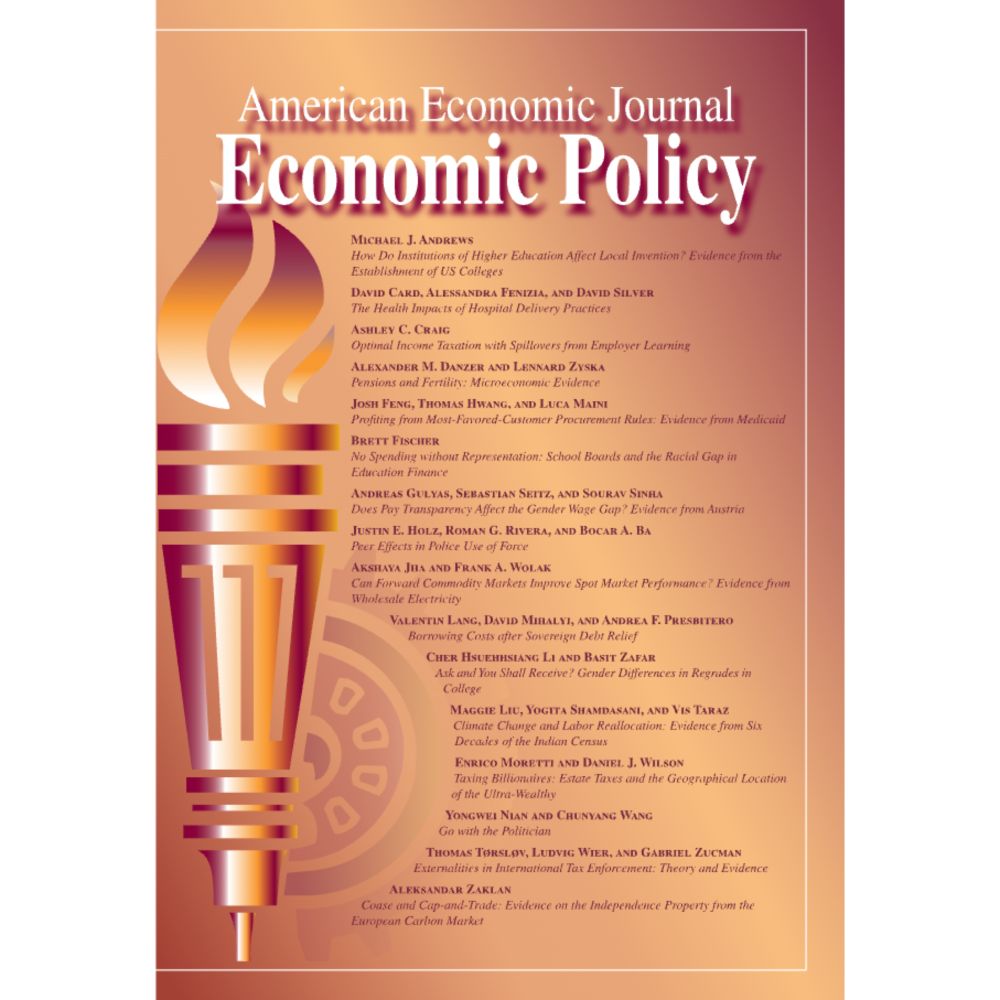
Preview
American Economic Journal: Economic Policy Vol. 18 No. 1 February 2026

The February 2026 issue of AEJ: Economic Policy (18, 1) is now available online at aeaweb.org/issues/834.

29.01.2026 15:33 — 👍 6    🔁 1    💬 0    📌 0
Preview
A quiet revolution The role of faith-based government policies in reshaping Americans’ beliefs and values.

A 'quiet revolution' in US regulations changed how social services were delivered and strengthened religious beliefs among evangelicals, as well as shifting their attitudes on political issues, say researchers at University of Copenhagen and the Rockwell Foundation. www.aeaweb.org/research/rel...

29.01.2026 14:55 — 👍 2    🔁 0    💬 0    📌 0
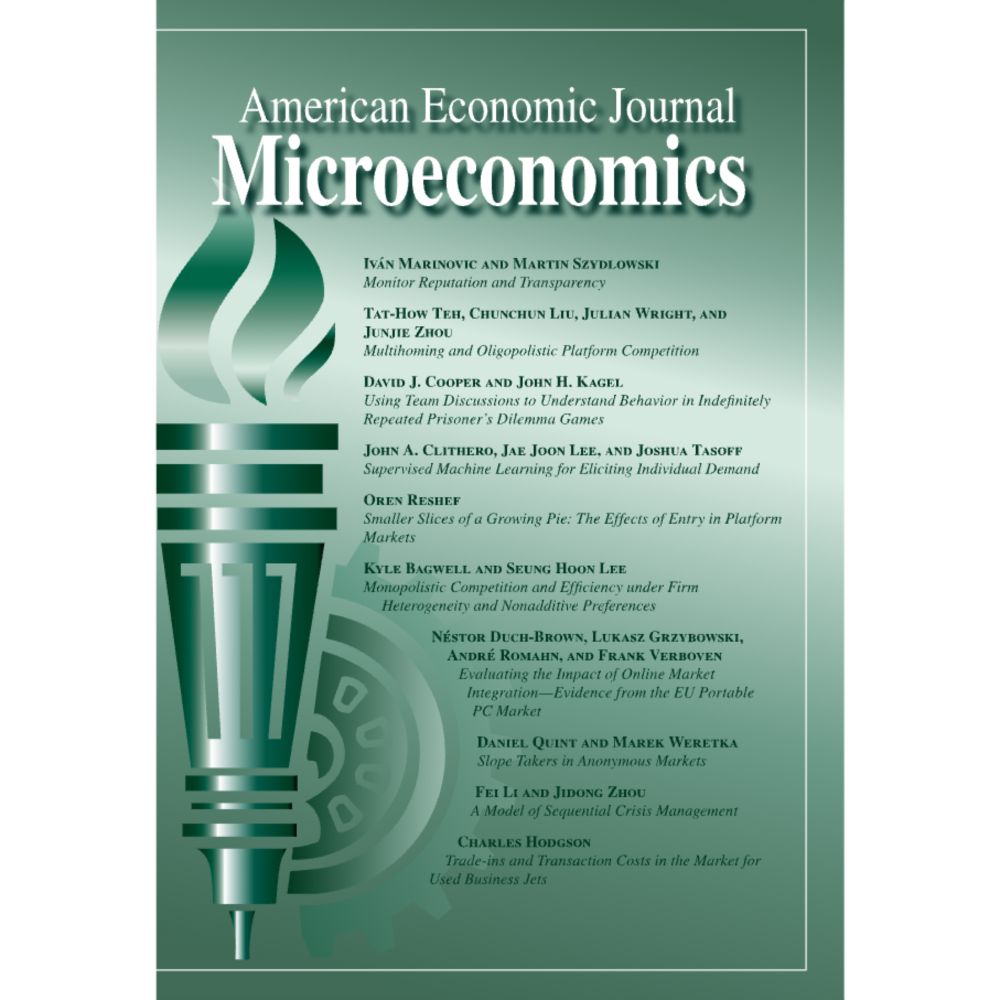
Preview
American Economic Journal: Microeconomics Vol. 18 No. 1 February 2026

The February 2026 issue of AEJ: Microeconomics (18, 1) is now available online at aeaweb.org/issues/833.

28.01.2026 14:50 — 👍 2    🔁 0    💬 0    📌 1
Preview
How Test Optional Policies in College Admissions Disproportionately Harm High Achieving Applicants from Disadvantaged Backgrounds (Forthcoming Article) - We analyze data from one elite institution and find that test score optional policies harm the likelihood of admission for high achieving applicants from disadvantaged backgrounds. Under test optional policies, these applicants submit test scores at too low a rate; they more than double their admissions probability (from 2.9 percent to 7.2 percent) by reporting scores. Our findings suggest that, more than commonly understood, elite institutions interpret test scores in the context of an applicant’s background. Thus, availability of test scores on an application can promote rather than hinder social mobility.

Forthcoming in AER: Insights: "How Test Optional Policies in College Admissions Disproportionately Harm High Achieving Applicants from Disadvantaged Backgrounds" by Bruce Sacerdote, Douglas O. Staiger, and Michele Tine.

28.01.2026 08:28 — 👍 4    🔁 1    💬 0    📌 0
Preview
Prime Locations (Forthcoming Article) - We develop a method for delineating prime locations—ultra-dense clusters of economic activity—within cities and apply it to comprehensive establishment data covering all US metropolitan areas. We further use big data to extend the analysis to a global context where administrative data are sparse. Many cities in the US and around the world are dominated by a small number of prime locations that can concentrate up to one-half of tradable services jobs on tiny shares of land and are dominant centers of economic gravity. In cities with fewer prime locations, a larger tradable services share concentrates in them.

Forthcoming in AER: Insights: "Prime Locations" by Gabriel M. Ahlfeldt, Thilo N. H. Albers, and Kristian Behrens.

27.01.2026 10:16 — 👍 6    🔁 1    💬 0    📌 0
Preview
The Effect of Public Insurance Design on Pharmaceutical Prices: Evidence from Medicare Part D (Forthcoming Article) - Public programs that provide benefits through private markets contend with strategic firm behavior. We study this dynamic in Medicare Part D. The Affordable Care Act closed a coverage gap in Part D by mandating drug manufacturers cover 50% of branded drug costs in the gap. Beneficiaries became 5 percentage points less likely to forgo prescriptions upon reaching the gap. However, manufacturers' response led to 21% higher drug prices, partially offsetting the insurance expansion. The closure was intended to be a $100 transfer to beneficiaries financed by manufacturers, but instead resulted in a $55 transfer to beneficiaries financed by the government.

Forthcoming in AEJ: Economic Policy: "The Effect of Public Insurance Design on Pharmaceutical Prices: Evidence from Medicare Part D" by Katja Hofmann and Zong Huang.

27.01.2026 09:31 — 👍 2    🔁 0    💬 0    📌 0
Preview
Games on Multiplex Networks (Forthcoming Article) - We develop a simple multilayer network model in which agents allocate effort across layers with heterogeneous structures, subject to an aggregate effort constraint. Incentives are shaped by agents’ network positions within each layer, and equilibrium behavior reflects both within- and cross-layer interactions. We analyze how shocks propagate through the network and characterize optimal targeting interventions. Our results show that effective policy design must account for effort allocation across layers. We also demonstrate that predictions from monolayer models can diverge sharply from those of multilayer models, underscoring the importance of accounting for network complexity in both empirical and policy analyses.

Forthcoming in the AER: "Games on Multiplex Networks" by Yves Zenou and Junjie Zhou.

27.01.2026 08:45 — 👍 5    🔁 1    💬 0    📌 0

Preview
Spillovers in State Capacity Building: Evidence from the Digitization of Land Records in Pakistan (Forthcoming Article) - Digitization reforms have been hailed as an effective way of strengthening state capacity. However, digitization can also fundamentally reshape the organization of bureaucracies. Using a unique administrative dataset on agricultural taxation and surveys of local bureaucrats from Punjab, Pakistan, we show that digitization reforms can have unintended consequences for state capacity. We exploit the staggered rollout of the digitization of land records in Punjab to show that digitization had a negative effect on tax collection. The fall in taxes was not due to a decrease in the tax base. Instead, digitization affected the bureaucracy's capacity to collect taxes.

Forthcoming in the AER: "Spillovers in State Capacity Building: Evidence from the Digitization of Land Records in Pakistan" by Shan Aman-Rana and Clement Minaudier.

26.01.2026 11:15 — 👍 8    🔁 2    💬 0    📌 0
Preview
Identifying Tax Compliance from Variation in Tax Policy: Theory and Empirics (Forthcoming Article) - Governments increasingly use changes in tax rules to combat evasion. We develop a general approach to point-identify tax compliance along with supply and demand elasticities. Identification requires data on prices and quantities, variation in tax policy, and a demand or supply shifter. We illustrate our approach using data on Airbnb collection agreements, where taxes are enforced by shifting the statutory burden away from hosts and onto renters via the platform. We find that taxes are paid on roughly zero to 1.6 percent of Airbnb transactions prior to enforcement.

Forthcoming in AEJ: Economic Policy: "Identifying Tax Compliance from Variation in Tax Policy: Theory and Empirics" by Andrew Bibler, Laura Grigolon, Keith F. Teltser, and Mark J. Tremblay.

26.01.2026 10:30 — 👍 3    🔁 0    💬 0    📌 0

@aeajournals is following 2 prominent accounts