
Dr. Ludmilla Figueiredo from #iDiV, Sonia Kéfi, Paul J. Van den Brink, @jsarmentocabral.bsky.social, @cedricscherer.com ...nice collaboration together with our #IZW staff from D6!
cran.r-project.org/web/packages...

@ecodynizw.bsky.social
mammals | wildlife | ecology | movement | disease | biodiversity | demography | behaviour | distribution | modelling News about science, research, and resources: https://ecodynizw.github.io/
Dr. Ludmilla Figueiredo from #iDiV, Sonia Kéfi, Paul J. Van den Brink, @jsarmentocabral.bsky.social, @cedricscherer.com ...nice collaboration together with our #IZW staff from D6!
cran.r-project.org/web/packages...

Our package estar for quantifying ecological stability is out: MEE @britishecologicalsociety.org! Provides 11 stability metrics for measuring stability at different levels of organization, from individuals to populations, communities + ecosystems. besjournals.onlinelibrary.wiley.com/doi/10.1111/...
02.03.2026 16:49 — 👍 11 🔁 5 💬 1 📌 0
Published in @jappliedecology.bsky.social!😀
We show how (Hierarchical) Hidden Markov Models ((H)HMMs) can be tailored to different epidemiological scenarios to infer disease status directly from animal movement data.
🔗 ttps://besjournals.onlinelibrary.wiley.com/doi/10.1111/1365-2664.70323

🌍 Excited to share the Move Disease Archive (MDA)—co-led by me and @kmorelle.bsky.social with support from Movebank, Move BON, Euromammals, and many partners!
A global collection of wildlife movement + disease data to understand behavior, spread & spillover!
🔗 kimx3725.github.io/move-disease...
📈Keen to learn how to quantify ecological stability? Join the EFI webinar by Ludmilla Figueiredo @idiv-research.bsky.social & Viktoriia Radchuk from #IZW to learn about package estar March 2nd, 18:00 CET.
@ecoforecast.bsky.social

Atlantic Puffin at Hornøya, Norway
New opening for a 3-year PhD project in 'Seabird Ecology in a Changing Arctic' at the Norwegian Institute for Nature Research (Tromsø) and the Arctic University of Norway (UiT). Apply before 25 Mar 2026. #seabirdscience @ninanatureresearch.bsky.social nina.attract.reachmee.com/jobs/84-phd-...
23.02.2026 15:46 — 👍 66 🔁 55 💬 1 📌 0
📢 You look for a student #Job? You'd like to contribute to current research topics about birds🪶🐦 & #WestNileVirus?
Then be part of a consortium on "Combating #WNV through an integrated #OneHealth approach" #TUBerlin , #Charite, #FUBerlin, #UniBayreuth ... Apply here at #IZW:
short.sg/j/63072339

Disease dynamics in wildlife: We used a spatially explicit eco-epidemiological model to analyze classical swine fever spread in Northern Germany. Discover how host movement decisions shape disease spread. #EcoEpidemiology #FLI @ufz.de 🐖 Read here: doi.org/10.1002/ecs2...;
@ecosphere-ua.bsky.social

Graphical depiction of workflow summarizing sample selection and two objectives: (I) investigating sex-specific excursion characteristics and (II) examining factors shaping excursions using generalized linear mixed models. Figure 1 from the paper: Extra-territorial excursions of Eurasian lynx (Lynx lynx) during the mating season across Europe

PhD student Yutong posing together with a statue of a metal Lynx (her research species for her PhD) outside in the Bavarian Forest National Park
First PhD paper from Yutong Liang on excursions of Eurasian #lynx during the mating season!🐱
Using data from 125 lynx across Europe, they found that extra-territorial mating excursions are a male-biased strategy, indicating active mate-searching🐈💕🐈
📰 doi.org/10.1098/rspb...
#Eurolynx #euromammals

Meta-analysis is ubiquitous in ecology, but it is poor at determining which conservation interventions work in which contexts
That’s why we’ve developed Precision Ecology, using methods developed in, eg, medicine to inform precise, data-informed conservation
www.nature.com/articles/s41...
Here are just a few of the co-authors mentioned that worked on that international collaboration: @annecharmantier.bsky.social
@paulcuchot.bsky.social @aubrypopecolab.bsky.social @dfauteux.bsky.social @datazoogang.de @dominiqueberteaux.bsky.social @steffopp.bsky.social @carsten-schradin.bsky.social

Out in @natcomms.nature.com, a collaborative paper showing that, across 73 species (including common terns), warmer years are associated with earlier phenology, and that populations in which such an association was observed have often been stable or increasing: www.nature.com/articles/s41...
19.01.2026 14:07 — 👍 41 🔁 14 💬 1 📌 0
@jcuofficial.bsky.social @ucc.ie @niooknaw.bsky.social
@umontpellier.bsky.social #CEFE @egioxford.bsky.social
@natcomms.nature.com
www.nature.com/articles/s41...

Led by Viktoriia Radchuk, an international collaboration shows phenological shifts in response to changing temperatures allow populations to remain stable or even increase in numbers.
Support from #sDiv @idiv-research.bsky.social

A selection of studied species is shown, with each inset giving information for that species on its generation time (T, in years; also depicted by the black bar next to it), its diet (carnivore: C, herbivore: H, and omnivore: O) and whether the species is a migrant (M) or a resident (R). The inset shows the number of studies per taxon and trait category. Illustration credits for the species pictures taken from Wikipedia: Svalbard reindeer—Bjørn Christian Tørrissen, four-striped grass mouse—C.R. Selvakumar, silver gull—JJ Harrison, snow petrel—Samuel Blanc, northern giant petrel—Liam Quinn, green turtle—Brocken Inaglory, green-rumped parrotlet—Jam.mohd, Columbian ground squirrel—Martin Pot, red-winged fairy-wren—John Anderson, grey-headed albatross—John Harrison. Two species pictures were provided by the co-authors of this study: painted turtle (credit: FJ) and Atlantic yellow-nosed albatross (credit: SOp). The remaining pictures were taken from Pixabay (https://pixabay.com/photos/).
In Nature Communications, our paper led by Viktoriia Radchuk shows that phenological change mediates global vertebrate responses to temperature. The study compiles 213 time series of phenotypes and population sizes, including data from Bylot. Read: urls.fr/w7ZKp9 @natcomms.nature.com 🧪🌿🌎🌐🦉🦑🦊🐻❄️
14.01.2026 16:20 — 👍 60 🔁 25 💬 0 📌 0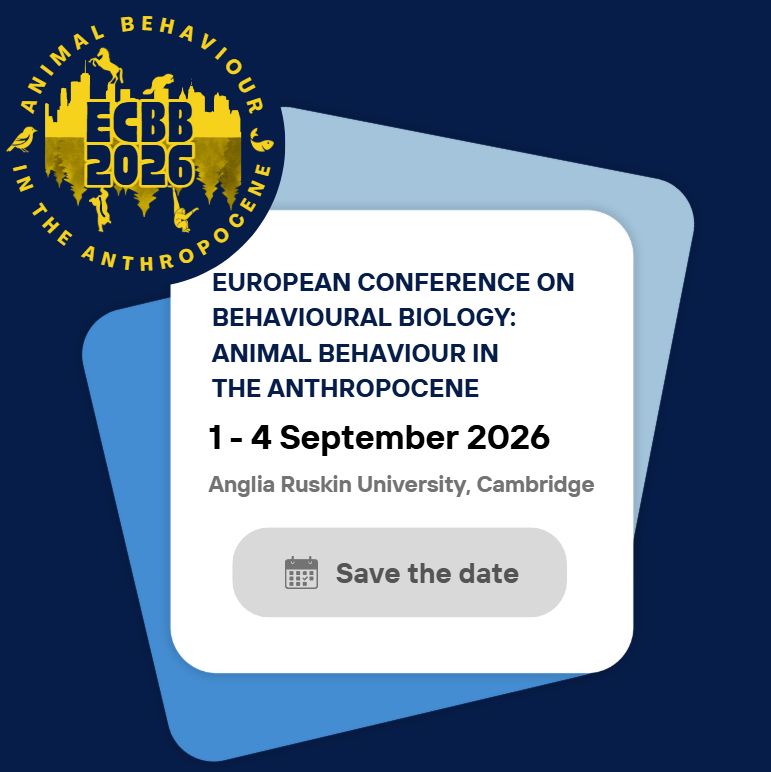
Save the date information for the upcoming European Conference on Behavioural Biology: Animal Behaviour in the Anthropocene. 1-4 September 2026 at Anglia Ruskin University, Cambridge, UK.
Save the date for the next European Conference on Behavioural Biology!
Animal Behaviour in the Anthropocene, 1-4 September 2026 at Anglia Ruskin University.
Watch this space for updates on speakers, plenaries, and calls for abstracts!
#AcademicSky #UpcomingConferences

A poster for the annual movement ecology social event that takes place as part of the British Ecological Society's annual meeting. There are photos of several different tagged animals (e.g. lion, sloth) and the text reads: "Wanna chat about movement ecology? Meet us at Innis & Gunner Tap Room, 81-83 Lothian Road, Edinburgh, EH3 9AW."
Are you at #BES2025? Come along to our popular annual social event from 16:00-19:30 on Tuesday at the Innis & Gunner Tap Room! #movecol @britishecologicalsociety.org
15.12.2025 16:25 — 👍 5 🔁 2 💬 0 📌 0
Behavioral Ecology
isbe2026.com

How to write a constructive peer review - see our new editorial, led by @biolumijeffence.bsky.social
With some of the team from @conphysjournal.bsky.social


For urban birds, vegetation acts as a natural buffer against urban stress. Even vegetated noisy areas can support high functional diversity, when human access is restricted.
#UrbanEcology #Birds #Modelling #FunctionalDiversity
New paper out @springernature.com / Urban Ecosystems 🪶🏘️
Tolles Interview mit unserer Doktorandin, Sinah! Im Gespräch mit dem Leibniz-Magazin, spricht sie über Herausforderungen in der Wissenschaft, ihren schönsten Moment im Leben als Forscherin und natürlich über ihr und unser charismatisches Forschungsobjekt, dem #EuropeanRedSquirrel #RedSquirrel 🐿.
11.12.2025 14:48 — 👍 2 🔁 0 💬 0 📌 0
An image for International Jaguar Day featuring a circular photograph of a jaguar against a dark green background. The jaguar, displaying its distinctive spotted coat pattern, is shown in its natural habitat among green foliage. The image has gold text reading "INTERNATIONAL JAGUAR DAY" at the top. Below the circular photo is text describing Mesoamerica's role as a wildlife corridor, mentioning various species including the jaguar. The IPBES logo appears in the bottom right corner. The color scheme uses gold and green tones throughout the design.
Did you know? 🐆 Jaguars, symbols of Mesoamerican biodiversity, are listed as Near Threatened on the IUCN Red List, with their population decreasing due to habitat loss, poaching & illegal trade.
On #InternationalJaguarDay, let's highlight their plight and the need to protect this iconic species.

A new training available on
📸processing of camera trap data using the AI-aided Agouti platform
💻producing density estimates using a standardized analysis procedure
https://www.youtube.com/watch?v=tWWnbUYXBFs
#CameraTrap
Deadline Dec 5th 2025
04.11.2025 21:44 — 👍 1 🔁 2 💬 0 📌 0
Ascarids and One Health: Emerging Challenges in Sustainable Control
14.11.2025 12:50 — 👍 5 🔁 2 💬 0 📌 0
✳️The deadline for our #BioLogging Special Issue has been extended to 28th February 2026✳️
The issue will feature research using #BioLogging in freshwater, marine & terrestrial ecosystems, with relevance for #Conservation & management 🐸🦓
Full info here ➡️ buff.ly/3WLtZz0
Deadline Dec 5th 2025
04.11.2025 21:44 — 👍 1 🔁 2 💬 0 📌 0
Photo with a blue tit and information text of how to apply for the announced postdoc position.
📢 #Postdoc (75%) 3+2 years on identifying #West-Nile-Virus wildlife hosts and #modelling spatial risk factors.
Be part of a consortium on "Combating #WNV through an integrated #OneHealth approach" w #TUBerlin , #Charite, #FUBerlin, #UniBayreuth and health authorities
▶️ tinyurl.com/yuhfwpdr

For the background of the project, read here:
www.fu-berlin.de/campusleben/...
