

Human hippocampal theta–gamma coupling coordinates sequential planning during navigation
Impressive study from Dan Bush's Lab at UCL:
www.pnas.org/doi/10.1073/...
Human hippocampal theta–gamma coupling coordinates sequential planning during navigation
Impressive study from Dan Bush's Lab at UCL:
www.pnas.org/doi/10.1073/...
Registration open 🎉
MEEP – Heidelberg Summer School on Memory and Sleep
www.zi-mannheim.de/forschung/ab...
Awesome new opportunity to join SWC if you are into human ephys.
13.02.2026 18:05 — 👍 4 🔁 1 💬 1 📌 0

Do you work or study in the fields of psychology, neuroscience, computer science, artificial intelligence, or philosophy?
What does the term 'representation' mean to you?
We invite you to participate in a brief survey on key conceptual questions across fields.
eu.surveymonkey.com/r/VX9GNXM

Thrilled that my paper is out in the @nature.com. We explored how the brain builds complex tasks by compositionally combining simpler sub-task representations. The brain flexibly performs multiple tasks by dynamically reusing neural subspaces for sensory inputs and motor actions
rdcu.be/eRVUk
New paper alert! 🚨
We found that the brain's compass is remarkably stable at two scales
1️⃣ the system maintains its internal organization for weeks
2️⃣ It "remembers" its orientation for weeks, even after a single visit
This may be key to how the brain aligns its other maps.
Paper: rdcu.be/e3waP
Can we make brains “smarter”? By boosting mitochondrial metabolism in neurons of memory circuits, we improved memory in flies and mice. Thrilled to see this work out - congrats to @amrapalianjali.bsky.social for spectacular work, and to all lab members for invaluable contributions!
11.02.2026 11:36 — 👍 58 🔁 20 💬 1 📌 6
Why did consciousness evolve at all? A superb special issue of @royalsocietypublishing.org brings together experts across disciplines to explore the functions of consciousness and why it emerged in some species but not others. @tecumsehfitch.bsky.social royalsocietypublishing.org/rstb/issue/3...
08.02.2026 12:47 — 👍 135 🔁 51 💬 6 📌 3
"..hippocampal-prefrontal systems represent emotion concepts in a map-like way at multiple levels of abstraction.."
Map-like representations of emotion knowledge in hippocampal-prefrontal systems
by
@yumengma.bsky.social and @pkragel.bsky.social
www.nature.com/articles/s41...
My lab is looking to recruit 1-2 paid summer interns to do wet lab work on learning in a unicellular organism (Stentor coeruleus). You can apply here:
forms.gle/b47WpSobjFjo...

Most people can call up pictures in their minds, visualizing the past & summoning images of the future. But for ~4% of us, such mental imagery is weak or absent. New edition of @nature.com has a nice introduction to how research on this phenomenon (aphantasia) opens up novel windows into the brain.🧪
04.02.2026 18:34 — 👍 62 🔁 20 💬 0 📌 5Infraslow modulation of theta synchrony in the hippocampus circuit during REM sleep https://www.biorxiv.org/content/10.64898/2026.01.30.702893v1
03.02.2026 03:16 — 👍 3 🔁 2 💬 0 📌 0Attention-like regulation of theta sweeps in the brain's spatial navigation circuit https://www.biorxiv.org/content/10.64898/2026.01.27.702083v1
28.01.2026 10:16 — 👍 3 🔁 1 💬 0 📌 0This is totally wild. Remember the object they are attending to is presented egocentrically, but the allocentric theta sweeps follow it. The whole system is wired up to provide something like an "integrated attention reflex".
28.01.2026 10:28 — 👍 36 🔁 5 💬 2 📌 0
Deadline is almost here, have you applied? fenskavlinetwork.org/who-we-are/a...
24.01.2026 13:38 — 👍 0 🔁 0 💬 0 📌 0Sequential coupling of sleep oscillations enables concept-neuron reactivation and supports information flow across the human hippocampal-cortical circuit https://www.biorxiv.org/content/10.64898/2026.01.15.699122v1
18.01.2026 08:15 — 👍 10 🔁 3 💬 0 📌 1
Can humans & animals really use internal maps to take shortcuts?
Tolman famously said yes - based largely on his Sunburst maze.
Our new review & meta-analysis suggests evidence is far weaker than you might think.
🧵👇 doi.org/10.1111/ejn....
@uofgpsychneuro.bsky.social @ejneuroscience.bsky.social
Very happy for this @ejneuroscience.bsky.social editorial on the importance of diverse research animals in neuroscience. We make the case that embracing a plurality of model organisms enriches the field and accelerates both basic and translational research. onlinelibrary.wiley.com/doi/10.1111/...
06.01.2026 07:47 — 👍 27 🔁 17 💬 2 📌 1What is the computational role of dendritic excitations? Byung Hun Lee and team mapped voltage dynamics throughout the dendritic trees of CA1 pyramidal neurons in mice navigating in virtual reality. www.biorxiv.org/content/10.6...
04.01.2026 06:17 — 👍 130 🔁 50 💬 3 📌 2Meta-learning is expressed through altered prefrontal cortical dynamics https://www.biorxiv.org/content/10.64898/2026.01.01.697272v1
02.01.2026 08:16 — 👍 5 🔁 3 💬 0 📌 0Subspace communication in the hippocampal-retrosplenial axis https://www.biorxiv.org/content/10.64898/2025.12.31.697203v1
02.01.2026 08:16 — 👍 9 🔁 1 💬 0 📌 0
❄️ A Year of #FENS: @fkne-scholars.bsky.social ❄️
🧠 #FKNE has continued throughout 2025 to champion excellence in European neuroscience by supporting researchers and strengthening scientific leadership across Europe
👉 Learn more about #FKNE here: buff.ly/2EWch1g

⚠️ New paper alert and what a way to end 2025! 🎉
Happy to share our story “Sleep-dependent infraslow rhythms are evolutionarily conserved across reptiles and mammals.” published today in Nature Neuroscience.
Sleeping dragons 🦎 and functional ultrasound!
Read the full paper here: rdcu.be/eWJHb 1/8
Deadline is approaching too fast!! Don’t miss it!
20.12.2025 10:42 — 👍 4 🔁 3 💬 0 📌 0
It's an important conversation for society to have - that ethical trade-off that @micheleabasso.bsky.social describes and you point to.
As we have it, we need to acknowledge that without animal research, new treatments for neurodegenerative and psychiatric conditions will be blocked/stalled.
Share and apply!
10.12.2025 19:02 — 👍 3 🔁 1 💬 0 📌 0
Another new paper from the lab: Predictive theories like the SR imply that navigators who navigate differently should have cognitive maps which differ in predictable ways. Here we show that this holds in mouse hippocampal CA1.
www.sciencedirect.com/science/arti...
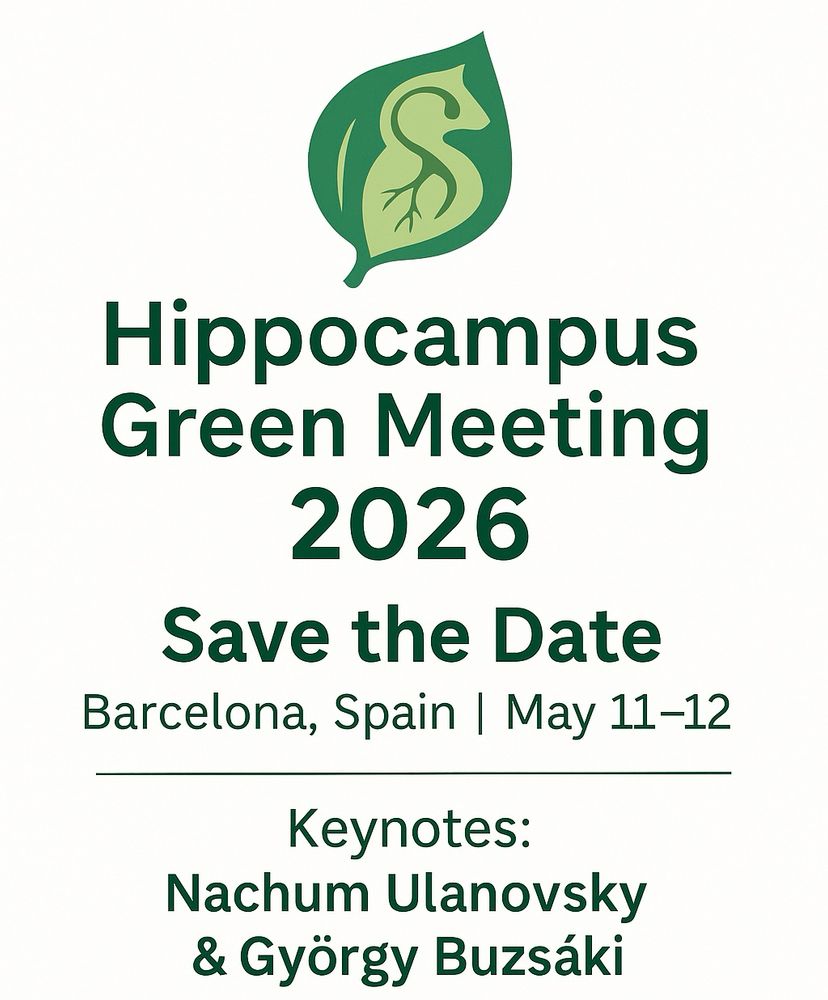
Happy to announce the 2nd Hippocampus Green Meeting
📍 Barcelona, Spain
🗓️ May 11–12, 2026
Organized together with Manu Valero, Lisa Roux and Dan Bendor
🎤 Keynotes: Nachum Ulanovsky & György Buzsáki
‼️ Call for abstracts now open
🔗 hippocampusgreen.net/wp/
#HippocampusGreen
You are a PI in Europe and have not yet filled in our questionnaire? Please do so! Let us find out the training needs of current PIs!
08.12.2025 09:57 — 👍 1 🔁 0 💬 0 📌 0
Terrific work led by @emmaroscow.bsky.social showing that hippocampal replay reflects events with large prediction errors, all the better to bootstrap learning as we slumber
Congratulations to Matt Jones & Nathan Lepora for seeing this through to the end!
www.nature.com/articles/s41...

