Research & Communications Officer
Research & Communications Officer
The Donnelly Centre is hiring a new Research and Communications Officer! As a vital part of our administration team, this role covers the external and internal communications of our community.
Learn more about the role and apply at the link below:
jobs.utoronto.ca/job/Toronto-...
17.02.2026 20:45 —
👍 2
🔁 2
💬 0
📌 0
Hi Alex,
Great to hear from you! Reach out to me by email and let's chat
12.02.2026 18:55 —
👍 2
🔁 0
💬 0
📌 0

We’re hiring: Research Group Leader in computational biology.
Are you generating more research ideas than you can explore? Lead cutting-edge AI & biology research at EMBL-EBI.
Apply by 11 April 2026: embl.wd103.myworkdayjobs.com/en-US/EMBL/j...
#ScienceCareers @ewaldlab.org @embl.org
10.02.2026 11:31 —
👍 39
🔁 50
💬 0
📌 2
Thanks Kieran!
30.01.2026 23:58 —
👍 0
🔁 0
💬 0
📌 0

Inferring cancer type-specific patterns of metastatic spread using Metient - Nature Methods
Metient is a statistical framework that infers patterns of metastatic spread and reconstructs cancer migration histories.
In a new paper, we introduce Metient, a new method to reconstruct the migration history of metastatic clones, and learn cancer-type specific patterns of metastatic spread, from bulk or single-cell sequencing data.
www.nature.com/articles/s41...
29.01.2026 17:45 —
👍 28
🔁 13
💬 3
📌 1

AlphaGenome is out in @nature.com today along with model weights! 🧬
📄 Paper: www.nature.com/articles/s41...
💻 Weights: github.com/google-deepm...
Getting here wasn’t a straight path. We discussed the story behind the model, paper & API in the following roundtable: youtu.be/V8lhUqKqzUc
28.01.2026 21:02 —
👍 83
🔁 39
💬 4
📌 1
Now with a bioinformatics/genomics label 🖥️🧬
29.01.2026 18:07 —
👍 4
🔁 3
💬 0
📌 0

GitHub - morrislab/metient
Contribute to morrislab/metient development by creating an account on GitHub.
If you’re interested in using Metient, please find our tool (installable via pip) and tutorials here: github.com/morrislab/me...
29.01.2026 17:45 —
👍 1
🔁 0
💬 0
📌 0

Migration histories inferred by Metient on lineage tracing data of lung adenocarcinoma that metastasized to mediastinal lymph tissue, the other lobe of the lung, and the liver. Solutions on the Pareto front show a tradeoff between seeding from the mediastinum and metastatic migrations, with higher ranked solutions involving more seeding from the mediastinum.
Metient is the first multiobjective method to scale to 1000s of nodes. We showcase this on single-cell lineage tracing data in lung adenocarcinoma, where Metient assigns an early role to mediastinal lymph tissue in subsequent metastatic spread.
29.01.2026 17:45 —
👍 1
🔁 0
💬 1
📌 0

Percentage of site polyclonality in cohorts of patients with metastatic melanoma, ovarian cancer, neuroblastoma, and non-small cell lung cancer. Polyclonality is higher in melanoma (mean ~80%) than the other cohorts (mean ~20-45%).
In a large cancer cohort, Metient posits that 33% of metastatic sites were seeded by multiple tumor clones, suggesting that migration via cancer cell clusters could be common, thus supporting therapies that disrupt their formation.
29.01.2026 17:45 —
👍 1
🔁 0
💬 1
📌 0

Method overview of Metient, showing how sequencing of tumor samples from primary and metastatic tumors is used to infer a Pareto front of metastatic migration histories. The Pareto front is determined by three parsimony metrics describing metastatic spread: (1) migrations, the number of times a clone is established at a new site; (2) comigrations, the number of migration events involving multiple clones traveling together or in sequential waves; and (3) seeding sites, the number of sites from which clones migrate. These Pareto-optimal solutions are calibrated using genetic distance and organotropism.
Metient first maps out a Pareto front of plausible metastatic histories using stochastic optimization. Then it uses new biologically grounded “metastases priors” to score histories without making ad hoc assumptions about metastatic spread.
29.01.2026 17:45 —
👍 1
🔁 0
💬 1
📌 0
To answer these questions, Metient reconstructs the migration histories of metastasis by identifying the historical cancerous clones that colonized each new site. This labeling is a complex combinatorial, multi-objective discrete optimization problem that Metient solves using a novel approach.
29.01.2026 17:45 —
👍 1
🔁 0
💬 1
📌 0

Diagram showing different modes of metastatic spread: (a) Schematics show different seeding patterns: primary-only spread, single source spread (only one metastasis seeds), multisource spread (multiple metastases seed), and reseeding between sites. (b) Schematic illustrating monoclonal versus polyclonal seeding of metastases, where polyclonal seeding can occur as cell clusters or in sequential waves. (c) A schematic illustrating monophyletic and polyphyletic seeding. Monophyletic indicates that the seeding clone closest to the root can reach every other seeding clone on the clone tree (i.e., metastatic competence is only gained once).
Metient can help answer key questions about metastatic spread:
How often do metastases seed other metastases?
How often do multiple clones seed a single metastasis?
Is metastatic potential rare, or gained multiple times by the same cancer?
29.01.2026 17:45 —
👍 1
🔁 0
💬 1
📌 0
Inferring cancer type-specific patterns of metastatic spread using Metient - Nature Methods
Metient is a statistical framework that infers patterns of metastatic spread and reconstructs cancer migration histories.
In a new paper, we introduce Metient, a new method to reconstruct the migration history of metastatic clones, and learn cancer-type specific patterns of metastatic spread, from bulk or single-cell sequencing data.
www.nature.com/articles/s41...
29.01.2026 17:45 —
👍 28
🔁 13
💬 3
📌 1
The corrected version is also wrong
06.01.2026 23:39 —
👍 1
🔁 0
💬 0
📌 0

Join @stirlingchurchman.bsky.social,
@moffittlab.bsky.social, @saramostafavi.bsky.social, me and all speakers for the 2026 CSHL meeting Systems Biology: Global Regulation of Gene Expression, March 11-14. Abstract deadline January 9! More infos and registration at meetings.cshl.edu/meetings.asp...
29.12.2025 09:00 —
👍 46
🔁 22
💬 1
📌 1
SAVE THE DATE: the yearly NY Population Genetics meeting will be back on March 9 2026, generously hosted by the
@simonsfoundation.org. Details to follow. Please RT.
14.11.2025 17:05 —
👍 60
🔁 39
💬 2
📌 4
We are very excited to share the first preprint of a new direction for our group. Led by the fearless duo of @arthurwchow.bsky.social and @hoyinchu.bsky.social, our foray into computational protein design—
14.12.2025 10:38 —
👍 25
🔁 10
💬 1
📌 0

The Reactome Knowledgebase 2026
Abstract. The Reactome Knowledgebase (https://reactome.org) is a freely accessible, expert-curated, open-source, and open-data resource that describes huma
New Reactome paper in NAR 2026 Databases Issue: doi.org/10.1093/nar/...
Redesigned Angular interface
ReacFoam & entity-level visualizations
Multi-omics analysis tools
React-to-Me chatbot
FAIR-compliant, CoreTrustSeal certified, and ELIXIR-recognized
🖥️🧬
08.12.2025 21:26 —
👍 9
🔁 6
💬 0
📌 1

True
06.12.2025 17:09 —
👍 6
🔁 1
💬 3
📌 0
It's always exciting when the latest edition of JASPAR comes out. Great leadership by @amathelier.bsky.social and pleased to welcome @anshulkundaje.bsky.social to the journey. #Jaspar2026
academic.oup.com/nar/advance-...
03.12.2025 04:52 —
👍 14
🔁 4
💬 1
📌 0
![Comic. Panels up to the 10-year point are grayed out. New panels since the Ten Years comic, which chronicles the first ten years of PERSON 1's journey with cancer: (1) [two people in bed] PERSON 1 (woman): One more chapter? PERSON 2 (man): Don’t we both have to get up early? PERSON 1: Nnnnnggggh PERSON 2: Sure, good point. (2) [many people wearing masks, walking while looking at graphs on their phones] (3) [birds landing on people] PERSON 2 in beanie and scarf: Hah! They like *my* seeds best. PERSON 1 in scarf holding phone with a bird sitting on it: Wait, how do I take a picture of this one? (4) [two people rowing boats with tree landscape] (5) [Person 1 carries overflowing stack of things to Person 2 in bed] PERSON 1: I brought you honey lemon tea, more pillows, a cinnamon roll, Tylenol, another blanket, a– PERSON 2: It was just Appendicitis, I’m really– PERSON 1: *It is my turn to take care of you and I am going to do it right!* (6) [Two people in car] (7) [still in car) PERSON 1: Oh my god. PERSON 2: Oh my god. (8) [car driving] PERSON 1: Pull over! PERSON 2: I am! (9) [both people get out of car] (10) [Large colored panel of aurora borealis over water with both people looking on] (11) [Person 1 sits against tree while Person 2 lies on the ground] PERSON 1: Fifteen years. No sign of the cancer. (12) I *am* having some weird symptoms. Joint pain. Fatigue. I think I’m losing my close-up vision. PERSON 2: Yeah. Me too. (13) PERSON 2: I think we’re getting old. (14) PERSON 1: I guess that’s okay. PERSON 2: It’s all I wanted.](https://cdn.bsky.app/img/feed_thumbnail/plain/did:plc:cz73r7iyiqn26upot4jtjdhk/bafkreihwhjblp5lyiwp63ouar7ocfea7evmckytoeo7rkfuoo4gw5rnrra@jpeg)
Comic. Panels up to the 10-year point are grayed out. New panels since the Ten Years comic, which chronicles the first ten years of PERSON 1's journey with cancer: (1) [two people in bed] PERSON 1 (woman): One more chapter? PERSON 2 (man): Don’t we both have to get up early? PERSON 1: Nnnnnggggh PERSON 2: Sure, good point. (2) [many people wearing masks, walking while looking at graphs on their phones] (3) [birds landing on people] PERSON 2 in beanie and scarf: Hah! They like *my* seeds best. PERSON 1 in scarf holding phone with a bird sitting on it: Wait, how do I take a picture of this one? (4) [two people rowing boats with tree landscape] (5) [Person 1 carries overflowing stack of things to Person 2 in bed] PERSON 1: I brought you honey lemon tea, more pillows, a cinnamon roll, Tylenol, another blanket, a– PERSON 2: It was just Appendicitis, I’m really– PERSON 1: *It is my turn to take care of you and I am going to do it right!* (6) [Two people in car] (7) [still in car) PERSON 1: Oh my god. PERSON 2: Oh my god. (8) [car driving] PERSON 1: Pull over! PERSON 2: I am! (9) [both people get out of car] (10) [Large colored panel of aurora borealis over water with both people looking on] (11) [Person 1 sits against tree while Person 2 lies on the ground] PERSON 1: Fifteen years. No sign of the cancer. (12) I *am* having some weird symptoms. Joint pain. Fatigue. I think I’m losing my close-up vision. PERSON 2: Yeah. Me too. (13) PERSON 2: I think we’re getting old. (14) PERSON 1: I guess that’s okay. PERSON 2: It’s all I wanted.
Fifteen Years
xkcd.com/3172/
26.11.2025 22:32 —
👍 11746
🔁 2452
💬 289
📌 241
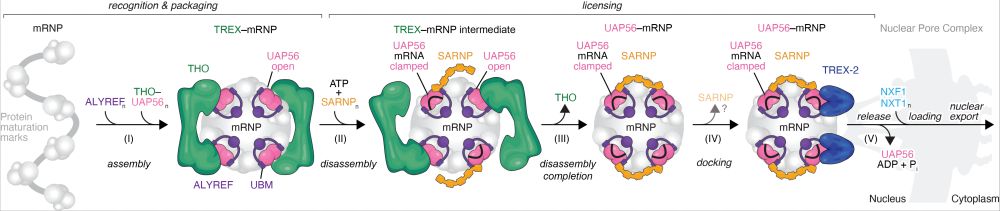
Messenger RNA is made in the nucleus before it is exported to the cytoplasm for translation. But how are only correctly made mRNAs chosen and remodeled in the nucleus for export?
Our new paper investigates the nuclear events leading to human mRNA export. www.nature.com/articles/s41.... (1/4)
21.11.2025 05:02 —
👍 60
🔁 25
💬 2
📌 2

Screenshot of paper title
Great collaboration with @gingraslab.bsky.social
& congrats to lead author Vesal.
Paper: www.nature.com/articles/s41...
Thanks to @sinaihealth.bsky.social
23.10.2025 13:40 —
👍 12
🔁 5
💬 0
📌 1
Congratulations! Great result!!
10.11.2025 18:39 —
👍 1
🔁 0
💬 0
📌 0

Human DICER1 hotspot mutation induces both loss and gain of miRNA function
Nature Structural & Molecular Biology - Jee et al. study a cancer hotspot allele of DICER1 that disrupts RNaseIIIb activity. Beyond ablating 5p hairpin cleavage, 3p passenger strands are...
new Lai lab paper @natsmb.nature.com! Dicer is specifically mutated in cancer, but we don't fully understand its molecular/reg impacts. with @danweihuangfu.bsky.social, we characterized the first knockin Dicer hotspot in hESCs, and found unexpected defects in miRNA biogenesis! 🧬 1/4
rdcu.be/eOc0q
10.11.2025 16:43 —
👍 47
🔁 10
💬 5
📌 0
Good morning to all the puppies not observing the time change
02.11.2025 11:30 —
👍 7
🔁 2
💬 1
📌 0
The toddlers say 👋
02.11.2025 14:03 —
👍 1
🔁 0
💬 0
📌 0