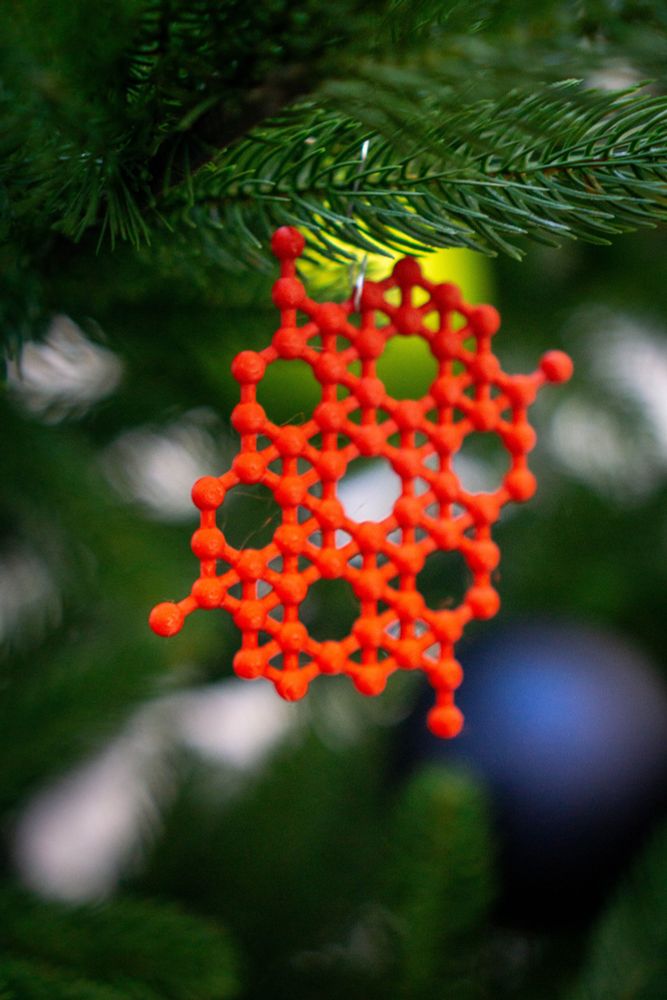
Sunshine, science & good food! ☀️ We enjoyed the surprisingly nice weather in Bochum last week with the scientific team around a BBQ. Connecting outside the lab is crucial for recharging and inspiring better research! 🔬 #Science #Research #Teamwork #BeautifulMaterials
06.05.2025 11:59 — 👍 1 🔁 0 💬 0 📌 0

Superconducting Tc vs distance from the hull of stability
The Maximum Tc of Conventional Superconductors at Ambient Pressure
Through analysis of electron-phonon calculations for over
20000 metals, we critically examine this question.
arxiv.org/abs/2502.18281
26.02.2025 16:03 — 👍 2 🔁 1 💬 0 📌 1

✅ 8 Semiregular (Archimedean) Tilings – Combining two or more polygons while maintaining uniformity—each vertex has the same surroundings!
These patterns are key to geometry, architecture, and—most importantly for us—materials science! 🏗️🔬
#3DPrinting #MaterialsScience
25.02.2025 13:53 — 👍 2 🔁 0 💬 0 📌 0
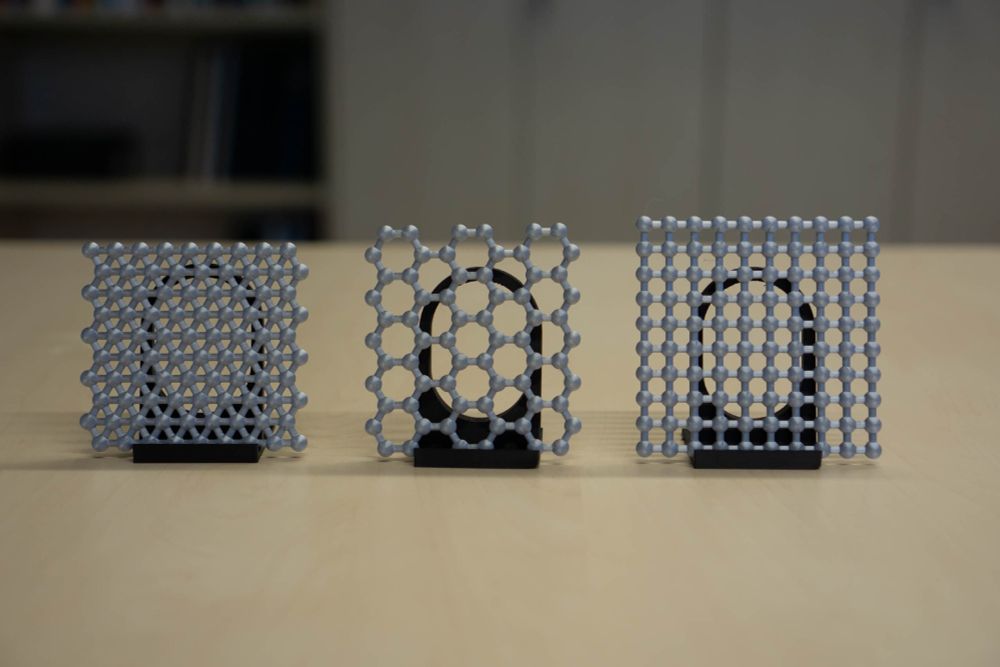
Did you know that only 11 convex uniform tilings can perfectly cover a flat surface using regular polygons—where every vertex has the same surroundings?
🖨️ What we printed:
✅ 3 Regular (Platonic) Tilings – Made from a single polygon type: triangle, square, or hexagon.
25.02.2025 13:53 — 👍 6 🔁 1 💬 1 📌 0

🌍 What’s next?
Many applications:
- Expanding the Alexandria database 🏛️
- Designing materials with tailored properties 🔬
- Accelerating breakthroughs in energy storage & semiconductors
We’re just getting started!
28.01.2025 15:16 — 👍 1 🔁 0 💬 0 📌 0

🏆 Results we’re proud of:
- 8x more likely to generate stable structures than baselines (e.g., PyXtal with charge compensation)
- Fast: 1,000 novel structures/min ⚡
- Control over space group, composition, and stability
- Releasing 3 million compounds generated by the model 📥
28.01.2025 15:16 — 👍 1 🔁 0 💬 1 📌 0
💡 What makes it unique?
- Fully leverages Wyckoff positions (discrete + continuous parameters)
- Trained across the periodic table & 230 space groups
- Condition on critical properties like stability
28.01.2025 15:16 — 👍 1 🔁 0 💬 1 📌 0
🧪 Why this matters:
Materials are the foundation of modern technology—fueling everything from batteries to semiconductors.
However, generating stable 3D structures near the convex hull is challenging:
- Efficiency ⚡
- Symmetry ⚖️
- Stability 🏔️
Matra-Genoa adresses these challenges.
28.01.2025 15:16 — 👍 1 🔁 0 💬 1 📌 0
🚀 Big News!
We’re thrilled to share our latest work: “A Generative Material Transformer using Wyckoff Representation” 🌌
Discover Matra-Genoa – where AI meets Materials Science.
📄 Check out the pre-print: arxiv.org/abs/2501.16051
#AIforScience #GenerativeAI #MaterialsScience
28.01.2025 15:16 — 👍 5 🔁 2 💬 1 📌 0

These compact stackings aren’t just for atoms—next time you see stacked oranges in a store, think crystallography! 🧠💡
17.01.2025 09:37 — 👍 0 🔁 0 💬 0 📌 0
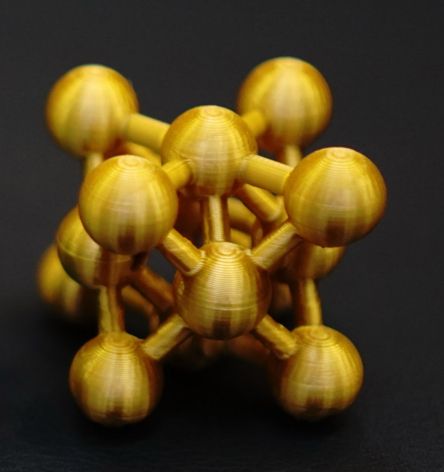
Face-Centered Cubic (FCC, the golden structure in tic-tac-toe above):
A cube with atoms on its faces. Look closely—it’s also alternating hexagon layers (A-B-C-A-B-C), filling ~74% space! ✨
Elements: Au, Cu, Al, etc.
17.01.2025 09:37 — 👍 1 🔁 0 💬 1 📌 0

Hexagonal Close-Packed (HCP):
Layers of hexagons stacked A-B-A-B. Efficiently fills ~74% of space.
Elements: Mg, Ti, Zn, etc.
17.01.2025 09:37 — 👍 0 🔁 0 💬 1 📌 0

Body-Centered Cubic (BCC, the silver structure in tic-tac-toe above):
A cube with an atom at its center. Simple but not most space-efficient (~52%). 🧊
Elements: Fe, Na, Cr, etc.
17.01.2025 09:37 — 👍 0 🔁 0 💬 1 📌 0
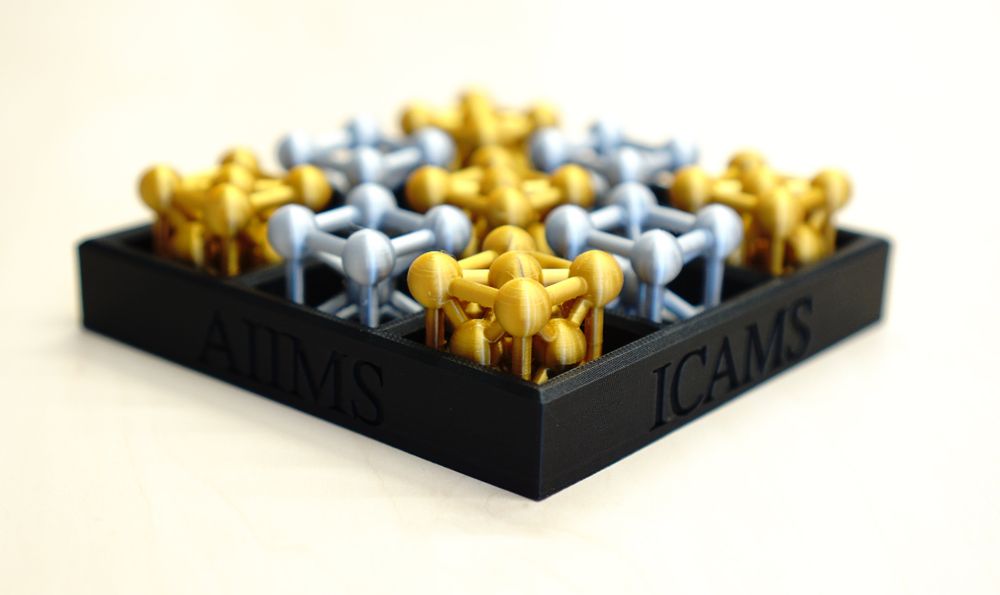
3D printing crystal structures isn’t just fun—it helps us see and understand their geometry! In our group we want to make crystallography exciting and accessible.
Today, we’re exploring efficient atomic stackings. 🧵
17.01.2025 09:37 — 👍 3 🔁 1 💬 1 📌 0
You’re absolutely right—we’ve been a bit too quick with the labeling. We’ll revise it for the next version. Thank you for pointing this out!
29.12.2024 19:26 — 👍 1 🔁 0 💬 0 📌 0
To the best of our knowledge, such systems are not included in the training set. Additionally, phonons or force constants are not used as training targets. Finally, results for most uMLIPs are not that good
29.12.2024 19:25 — 👍 0 🔁 0 💬 0 📌 0
Good point, it’s true that the training set for all the uMLIPs includes the primitive unit cell of these compounds. However, when calculating phonons, we use supercells containing approximately 200 atoms with slightly displaced positions.
29.12.2024 19:25 — 👍 0 🔁 0 💬 1 📌 0
5/5
🔑 Key takeaway: uMLIPs are ready for production use in phonon calculations! But choose wisely - not all models performing well on standard benchmarks will give you accurate phonon properties. Training data & architecture choices matter more than model complexity.
24.12.2024 15:47 — 👍 1 🔁 0 💬 0 📌 0

4/5
📊 The tested models fall into 3 clear tiers:
- Tier 1: MatterSim (excellent)
- Tier 2: SevenNet, MACE, CHGNet, M3GNet (good)
- Tier 3: ORB, OMat24 (needs work for phonons)
24.12.2024 15:47 — 👍 5 🔁 0 💬 1 📌 0

3/5
⚠️ Surprising finding: ORB & OMat24 excel at geometry optimization but struggle with phonons. Why? They predict forces directly instead of deriving them from energy gradients. This leads to issues with the small atomic displacements needed for phonon calculations.
24.12.2024 15:47 — 👍 1 🔁 0 💬 1 📌 0
2/5
🎯 Most accurate model? MatterSim steals the show for phonon predictions! It achieves errors even smaller than the difference between PBE & PBEsol functionals. What's interesting is it outperforms more complex equivariant networks while being based on simpler M3GNet architecture.
24.12.2024 15:47 — 👍 1 🔁 0 💬 1 📌 0

📣 We've benchmarked 7 leading universal Machine Learning Interatomic Potentials on their ability to predict phonon properties across ~10,000 semiconductors
Some models are already matching DFT accuracy (MatterSim) while others need work (ORB, OMat24)
Read here: arxiv.org/abs/2412.16551
#compchem
24.12.2024 15:47 — 👍 22 🔁 2 💬 4 📌 1
5/5
🔑 Key takeaway: uMLIPs are ready for production use in phonon calculations! But choose wisely - not all models performing well on standard benchmarks will give you accurate phonon properties. Training data & architecture choices matter more than model complexity.
24.12.2024 15:42 — 👍 0 🔁 0 💬 0 📌 0
3/5
⚠️ Surprising finding: ORB & OMat24 excel at geometry optimization but struggle with phonons. Why? They predict forces directly instead of deriving them from energy gradients. This leads to issues with the small atomic displacements needed for phonon calculations.
24.12.2024 15:42 — 👍 0 🔁 0 💬 0 📌 0
2/5
🎯 Most accurate model? MatterSim steals the show for phonon predictions! It achieves errors even smaller than the difference between PBE & PBEsol functionals. What's interesting is it outperforms more complex equivariant networks while being based on simpler M3GNet architecture.
24.12.2024 15:42 — 👍 0 🔁 0 💬 1 📌 0

We’re very happy to launch our social media page of our combined research groups, led by Professors Silvana Botti and Miguel Marques, at Ruhr University Bochum! 🌟
We combine ab-initio methods and machine learning to design innovative materials for energy applications. ⚡
Follow us and repost 📢
20.12.2024 15:12 — 👍 12 🔁 3 💬 0 📌 1