Aaron Kesselheim's Avatar

Aaron Kesselheim

@akesselheim.bsky.social

Professor of Medicine, Brigham and Women's Hospital/Harvard Medical School; Director, Program On Regulation, Therapeutics, And Law (PORTAL)

618 Followers  |  68 Following  |  67 Posts  |  Joined: 12.10.2023
Posts Following

Posts by Aaron Kesselheim (@akesselheim.bsky.social)

Preview
One Pivotal Trial, the New Default Option for FDA Approval — Ending the Two-Trial Dogma | NEJM This Sounding Board announces a new FDA policy that the default requirement for FDA approvals will be one robust pivotal trial plus confirmatory evidence, rather than two trials.

This is just needless, self-destructive, and problematic as regulatory policy. Also there never was and isn’t a two trial “dogma.” Bad headline, NEJM.
www.nejm.org/doi/full/10....

21.02.2026 20:00 — 👍 7    🔁 1    💬 0    📌 0
Preview
Experts argue recent FDA expert panels may violate FACA requirements The US Food and Drug Administration@s (FDA) increasing reliance on holding expert panels, rather than advisory committees, for external expert advice may violate the Federal Advisory Committee Act (FA...

Great coverage of Joseph Daval and my article in JAMA on the highly problematic new FDA use of “expert panels”: www.raps.org/news-and-art...

19.02.2026 02:30 — 👍 0    🔁 0    💬 0    📌 0
Preview
Stigma, Scarcity and the Price of Legitimacy: Chronic Pain Advocacy and the Politics of Pharmaceutical Partnerships in Canada This study examines how chronic pain advocates in Canada navigated fraught relationships with pharmaceutical companies amid escalating concerns about the adverse public health impacts of opioids. Dra...

Stigma, Scarcity & the Price of Legitimacy: Chronic Pain Advocacy & the Politics of Pharmaceutical Partnerships in Canada

Daniel Eisenkraft Klein, Benjamin Hawkins, Quinn Grundy, Robert Schwartz

onlinelibrary.wiley.com/doi/full/10....

I think findings here potentially transferable to obesity...

08.01.2026 14:44 — 👍 3    🔁 2    💬 0    📌 0

Pitfall…had a sequel?! What more to the story was there?

26.12.2025 02:51 — 👍 1    🔁 0    💬 0    📌 0
Preview
The Trump administration is turning drug review into make-a-deal “FDA decision-making may be reduced to a sequence of ‘make-a-deals’ with Trump, his FDA, or even political allies,” experts warn.

With the problematic national priority review voucher in the news again today (FDA staff not involved in decisionmaking? Really?), here’s our overview of how it opens the FDA up to corruption and moves us further and further away from “gold standard” reviews: www.statnews.com/2025/11/21/f...

21.11.2025 22:44 — 👍 2    🔁 0    💬 0    📌 0

What he said

31.10.2025 22:22 — 👍 2    🔁 0    💬 0    📌 0

I filed an amicus brief on behalf of 24 professors challenging the interim PTO director's illegal policy of blocking IPRs for any patent that is more than a few years old.

drive.google.com/file/d/1NhrG...

22.09.2025 20:38 — 👍 35    🔁 11    💬 0    📌 2
Preview
9 answers to burning questions about pharmaceutical ads Got questions about the FDA’s new plans around pharmaceutical ads? We’ve got answers.

Reprint of my Substack with @ylepidemiologist.bsky.social today in @statnews.com. Check it out if you’re interested in recent “moves” the FDA is making on drug ads. As with most claims this admin makes … IBIWISI: www.statnews.com/2025/09/13/p...

13.09.2025 19:55 — 👍 2    🔁 1    💬 0    📌 0
Preview
Pharmaceutical ads in the U.S.: Top questions answered The Administration's order and what can actually be done

Another fun collaboration with @ylepidemiologist.bsky.social in Substack with a post on DTC drug ads and the new administration announcement claiming to seek greater enforcement: yourlocalepidemiologist.substack.com/p/pharmaceut...

10.09.2025 14:58 — 👍 3    🔁 1    💬 0    📌 0
Preview
homer simpson says that 's bad in front of a bookshelf ALT: homer simpson says that 's bad in front of a bookshelf

CBER bein’ like

09.08.2025 15:49 — 👍 1    🔁 0    💬 1    📌 0

High brand-name drug prices fall once a generic enters the market. In a new @journalgim.bsky.social article, Ravi Gupta, CRRIT Co-Director @jsross119.bsky.social, and colleagues from @portalresearch.org assess associations between patents, revenue, and generic competition.

21.07.2025 15:35 — 👍 0    🔁 2    💬 1    📌 0

Superman. See it.

13.07.2025 01:59 — 👍 2    🔁 0    💬 1    📌 0
Preview
FDA publishes rejection letters sent to drugmakers, with a big caveat The FDA published more than 200 letters that it sent to companies when it rejected their medicines, but the letters came with a caveat.

<10% of these were not previously published (via STAT). Remember Sniglets? What term can we create for something that is self-promoted as a major step forward but is not really in reality even close to that?

www.statnews.com/2025/07/10/f...

11.07.2025 15:21 — 👍 0    🔁 0    💬 0    📌 0
Preview
Trump’s Ongoing Tariff Chaos Will Make Medications Less Affordable And Harder To Find | Health Affairs Forefront In his first term, Trump made a lot of noise about lowering drug prices but accomplished little of consequence. The noise continues, but it is now accompanied by new ill-conceived initiatives, includi...

New @healthaffairs.bsky.social Forefront covering the recent EOs on drug prices and tariffs -- little good news for prices or access -- www.healthaffairs.org/content/fore...

04.07.2025 10:40 — 👍 2    🔁 1    💬 0    📌 0
Preview
PORTAL Post | July 2025 New faculty members, the ORPHAN Cures Act, “hyaluronidase hopping,” and more from PORTAL

New PORTAL Post from @portalresearch.org for June. Sign up to receive these directly to your inbox!

mailchi.mp/eb7d1808132b...

04.07.2025 10:37 — 👍 1    🔁 0    💬 0    📌 0
Preview
Data manipulation within the US Federal Government A US Department of Veterans Affairs dataset compiling veteran health-care use in 2021 was quietly amended on March 5, 2025. A column titled gender was renamed sex, and the words were also switched in ...

Unrecorded manipulation of large datasets has been common in the US government since Trump's election -- bad for science, trust, and transparency -- in @thelancet.com from Janet Freilich and myself: www.thelancet.com/journals/lan...

04.07.2025 09:44 — 👍 0    🔁 0    💬 0    📌 0
Congress Should Remove The Rare Disease Carve-Out From Medicare Drug Price Negotiation, Not Expand It | Health Affairs Forefront Expansion of the Medicare drug price negotiation rare disease drug carve-out would unnecessarily limit the number of drugs eligible for negotiation, allow for continued high drug prices for products that earn billions of dollars in Medicare, and introduce a new set of misaligned incentives.

Language is now back in the Senate version of the OBBA that would undermine Medicare price negotiation for drugs with Orphan Drug Act designation. Here's our HA Forefront published yesterday (!) from Helen Mooney and @benro.me on why it is a very bad idea:
www.healthaffairs.org/do/10.1377/f...

28.06.2025 16:54 — 👍 2    🔁 2    💬 0    📌 1
Preview
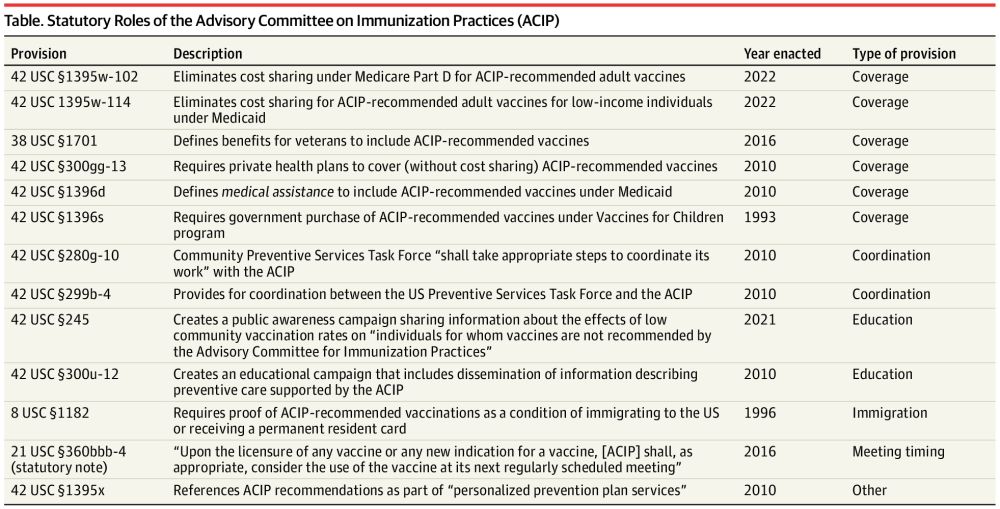
Legal Challenges for the Advisory Committee on Immunization Practices This Perspective offers an analysis of the legal foundations in the context of these and other challenges to the role of the Advisory Committee on Immunization Practices.

New in @jama.com, Joseph Daval and I discuss legal issues surrounding ACIP including its role in setting government policy and dealing with politically-motivated agendas arising from its new membership: jamanetwork.com/journals/jam...

26.06.2025 19:51 — 👍 5    🔁 3    💬 0    📌 0
Thank You to Our 2024 Peer Reviewers | Journal of Law, Medicine &amp; Ethics | Cambridge Core Thank You to Our 2024 Peer Reviewers

Thanks to the 2024 peer reviewers for @jlme-journal.bsky.social, with a list here: www.cambridge.org/core/journal...

11.06.2025 18:05 — 👍 4    🔁 2    💬 0    📌 0
Preview
Your top 10 FAQ on drug prices Some clarity for this wildly confusing topic.

I helped Your Local Epidemiologist answer some of her pressing Substack subscriber questions on drug prices. yourlocalepidemiologist.substack.com/p/your-top-1...

15.05.2025 18:31 — 👍 3    🔁 1    💬 0    📌 1

A classic!

13.05.2025 00:56 — 👍 0    🔁 0    💬 0    📌 0

New Health Affairs Forefront post on the Medicare negotiation "biologic bonus" and the massive financial hit to patients and the health care system of delaying small molecule negotiation from 9 to 13 years, led by Chris Cai and @benro.me: www.healthaffairs.org/content/fore...

08.05.2025 16:57 — 👍 0    🔁 1    💬 0    📌 0
Preview
Opinion | It’s not hard to see through RFK Jr.’s ‘radical transparency’ pledge So far, what’s been released is little more than tactics in pursuit of Kennedy’s own agenda.

New op-ed with @drjoshs.bsky.social and Peter Lurie about the agenda-driven reality of 'radical transparency' -- www.washingtonpost.com/opinions/202...

24.04.2025 13:10 — 👍 4    🔁 2    💬 0    📌 1

Interesting new op-ed! Very proud of Max: thehill.com/opinion/5180...

07.03.2025 18:20 — 👍 3    🔁 0    💬 0    📌 0
Preview
Spending After Sacubitril-Valsartan vs Renin-Angiotensin System Blockers for Heart Failure This cohort study assesses health care costs after initiating sacubitril-valsartan compared to an angiotensin-converting enzyme inhibitor or an angiotensin II receptor-blocker in Medicare patients bei...

Analysis from former @portalresearch.org fellow Catherine Hwang and @benro.me showing the extent of out-of-pocket costs associated with starting brand-name Entresto over ACEI/ARB for heart failure and implications for overall spending: jamanetwork.com/journals/jam...

16.02.2025 16:15 — 👍 2    🔁 1    💬 0    📌 0
Preview
Out of Pocket Getting Out of Hand — Reducing the Financial Toxicity of Rapidly Approved Drugs | NEJM The FDA often exercises flexibility in deciding whether to approve highly promising drugs for patients in desperate need of treatment options. But it doesn’t consider a drug’s likely financial toxi...

New in @nejm.org from Peter Ubel, Astrid Grouls and myself on "financial toxicity" and how to consider it in the context of new drugs @portalresearch.org: www.nejm.org/doi/abs/10.1...

16.02.2025 16:13 — 👍 9    🔁 3    💬 0    📌 0
Preview
Physician Experiences With and Perspectives on Clozapine Prescribing This survey study examines physician-prescriber experiences with and perspectives on the clozapine risk evaluation and mitigation strategy.

Survey of clozapine prescribers shows satisfaction with the REMS but desire for more educational info, led by @asarpatwari.bsky.social & team at @portalresearch.org in collab with FDA, where world class scientists are sadly being censored and forced out of their jobs: jamanetwork.com/journals/jam...

14.02.2025 15:48 — 👍 3    🔁 2    💬 0    📌 0

Preview
Predicting patent challenges for small-molecule drugs: A cross-sectional study Ally Memedovich and colleagues report on patent challenges within the first year of eligibility among small-molecule drugs approved by the FDA from 2007-2018 and investigate the extent to which market...

Interesting use of modeling to predict the timing of patent challenges seeking generic drug entry in PLoS Medicine, led by Ally Memedovich and @portalresearch.org faculty affiliate Reed Beall at Univ Calgary - journals.plos.org/plosmedicine...

14.02.2025 15:38 — 👍 0    🔁 0    💬 0    📌 0
Preview
a philadelphia eagles logo with the words " it 's a win " below it ALT: a philadelphia eagles logo with the words " it 's a win " below it
10.02.2025 12:47 — 👍 1    🔁 0    💬 0    📌 0
Abstract: The U.S. market for prescription drugs is failing many Americans. Drug prices in the U.S. are nearly three times higher than in comparable countries, and evidence shows that patients regularly forego essential medicines because they cannot afford them. Additionally, shortages of important medicines are common. In partial response, California recently passed a law to enable public manufacture and distribution of medicines, starting with insulin, a drug needed by millions of diabetics in the state. Many other states, as well as the federal government, are considering similar action to drive down prices of older drugs and to help resolve shortages.  Public production could yield important benefits, but there are legal obstacles to overcome at every step, from developing the product at the bench to getting it to the patient. This Article maps the primary legal and logistical issues these programs will face and describes how they can be overcome. We focus most of our attention on a major challenge that has not yet been properly described: even if states succeed in manufacturing affordable, high-quality drugs, how can they ensure that the drugs will actually reach the millions of patients who need them? After all, private, generic manufacturers already struggle to enter the market and distribute cheaper alternatives. We propose that states can succeed in ways that private entities cannot because they have unique legislative and regulatory mechanisms to counteract the concentrated power of market intermediaries. Using tools like mandatory contracts and regulatory requirements that require middlemen to carry publicly produced medicines, states can facilitate market entry and ensure that the maximum number of patients can access low-cost public products. This bottleneck, therefore, provides a further justification for public pharma—it can not only mitigate drug pricing and access issues, but possibly improve market access for private firms too.

Abstract: The U.S. market for prescription drugs is failing many Americans. Drug prices in the U.S. are nearly three times higher than in comparable countries, and evidence shows that patients regularly forego essential medicines because they cannot afford them. Additionally, shortages of important medicines are common. In partial response, California recently passed a law to enable public manufacture and distribution of medicines, starting with insulin, a drug needed by millions of diabetics in the state. Many other states, as well as the federal government, are considering similar action to drive down prices of older drugs and to help resolve shortages. Public production could yield important benefits, but there are legal obstacles to overcome at every step, from developing the product at the bench to getting it to the patient. This Article maps the primary legal and logistical issues these programs will face and describes how they can be overcome. We focus most of our attention on a major challenge that has not yet been properly described: even if states succeed in manufacturing affordable, high-quality drugs, how can they ensure that the drugs will actually reach the millions of patients who need them? After all, private, generic manufacturers already struggle to enter the market and distribute cheaper alternatives. We propose that states can succeed in ways that private entities cannot because they have unique legislative and regulatory mechanisms to counteract the concentrated power of market intermediaries. Using tools like mandatory contracts and regulatory requirements that require middlemen to carry publicly produced medicines, states can facilitate market entry and ensure that the maximum number of patients can access low-cost public products. This bottleneck, therefore, provides a further justification for public pharma—it can not only mitigate drug pricing and access issues, but possibly improve market access for private firms too.

Feels v strange to post a paper this week, but @akapczynski.bsky.social, Trudel Pare, Sahil Agrawal, and I wrote a legal roadmap to help states win (and defend) public pharma initiatives.

We've sent it out, so law review folks- check your inboxes! #lawsky

papers.ssrn.com/sol3/papers....

07.02.2025 13:31 — 👍 23    🔁 8    💬 1    📌 1