

We've done a little on this, and it would be great to do more. Here's a 2022 report on knowledge about international news (obviously many of these items are outdated now): www.pewresearch.org/global/2022/...
30.10.2025 00:08 — 👍 7 🔁 1 💬 1 📌 1
We've done a little on this, and it would be great to do more. Here's a 2022 report on knowledge about international news (obviously many of these items are outdated now): www.pewresearch.org/global/2022/...
30.10.2025 00:08 — 👍 7 🔁 1 💬 1 📌 1
We've got a new report looking at views about AI around the world. Roughly 8-in-10 have heard at least a little about AI. On balance, people are more concerned than excited about its growing presence in daily life. Concerns are especially common in the U.S.
www.pewresearch.org/global/2025/...

Our new poll finds that majorities in 20 of 25 nations say their political system needs major changes or complete reform, but many doubt change can happen. And elected officials get poor reviews for honesty and understanding the needs of ordinary people. pewrsr.ch/3Vipr1T
17.09.2025 14:33 — 👍 13 🔁 4 💬 1 📌 0
The authors write that religion generally declines between generations in three steps: People participate in worship services less often. The importance of religion declines in their personal lives. Belonging to religion becomes less common. They call this the Participation-Importance-Belonging (P-I-B) sequence. In this sequence, generations first shed aspects of religion that require more time and resources. People are slower to shed religious identity, which is not necessarily as burdensome. In the early stage of secular transition, generations differ primarily in their religious participation. In some countries that remain highly religious today, recent surveys show that each country’s share of adults under age 40 who frequently attend religious services has dropped below the share of older adults who do so. Many African countries are currently in this early stage. For example, in Senegal, 78% of older adults attend worship services weekly, but younger adults are 14 percentage points less likely to do so. Yet almost all adults in Senegal – both young and old – still identify as Muslims and consider religion very important in their lives.

In the medium stage of secular transition, generations differ in their religious participation, importance and belonging. In countries that are moderately religious, all three steps in the P-I-B sequence are visible in recent surveys. Adults under 40 attend services less frequently than their elders, are less likely to say religion is important in their lives and are less likely to identify with any religion. This is the case currently in the U.S., along with many other countries in the Americas and Asia.

In the late stage of secular transition, generations differ primarily in religious belonging. The authors contend that this is because the first two steps have been completed. The shares of older adults who attend services and who consider religion important in their lives have already dropped to low levels, similar to those of younger adults. In the least religious countries today, the main difference between age groups is that younger adults are less likely to identify with any religion. Many countries in Europe have reached this stage. For example, in Denmark, 79% of older adults remain religiously affiliated, but adults under 40 are 26 points less likely to say they belong to any religion. Attendance at religious services and self-assessments of the importance of religion are low among people of all ages.
A secular transition is happening in countries around the world. Detailed explanation🧪 www.nature.com/articles/s41...
Many Muslim-majority countries, Hindu-majority India in early stage. Countries with large Buddhist & Christian populations in later stages.
Blog: www.pewresearch.org/short-reads/...

59% of Americans say they are not confident Trump can make wise decisions about the Russia-Ukraine war
www.pewresearch.org/short-reads/...

We’ve got a new @pewresearch.org survey of 24 countries exploring views of the US and Trump. Ratings for the US have declined since last year in most countries. Majorities generally lack confidence in Trump’s leadership of world affairs and his ability to handle specific issues.
pewrsr.ch/4kFqPH0
Our Global Attitudes team here at Pew Research Center is hiring a Research Assistant. Great opportunity to work with great colleagues on international research.
www.linkedin.com/jobs/view/42...

We've got a new @pewresearch.org report exploring US attitudes on international affairs, including questions on foreign aid - it finds substantial public support for several forms of aid.
www.pewresearch.org/global/2025/...

New report, based on data from 35 countries, shows that people value free expression but not everyone thinks they have it
pewrsr.ch/42LKUDC

In a @pewresearch.org survey conducted in late March, 52% of Americans said increased tariffs on China will be bad for the US. 24% said good, 6% said no real effect, and 19% weren't sure. See more in our new report.
www.pewresearch.org/global/2025/...
We've got a new @pewresearch.org report looking at US public opinion on key elements of Trump's foreign policy, including questions on USAID, the Russia-Ukraine war, Gaza, Greenland, tariffs on China, climate, and WHO.
www.pewresearch.org/global/2025/...
Great news! @pewresearch.org is now active on Bluesky
07.04.2025 19:38 — 👍 9 🔁 1 💬 0 📌 0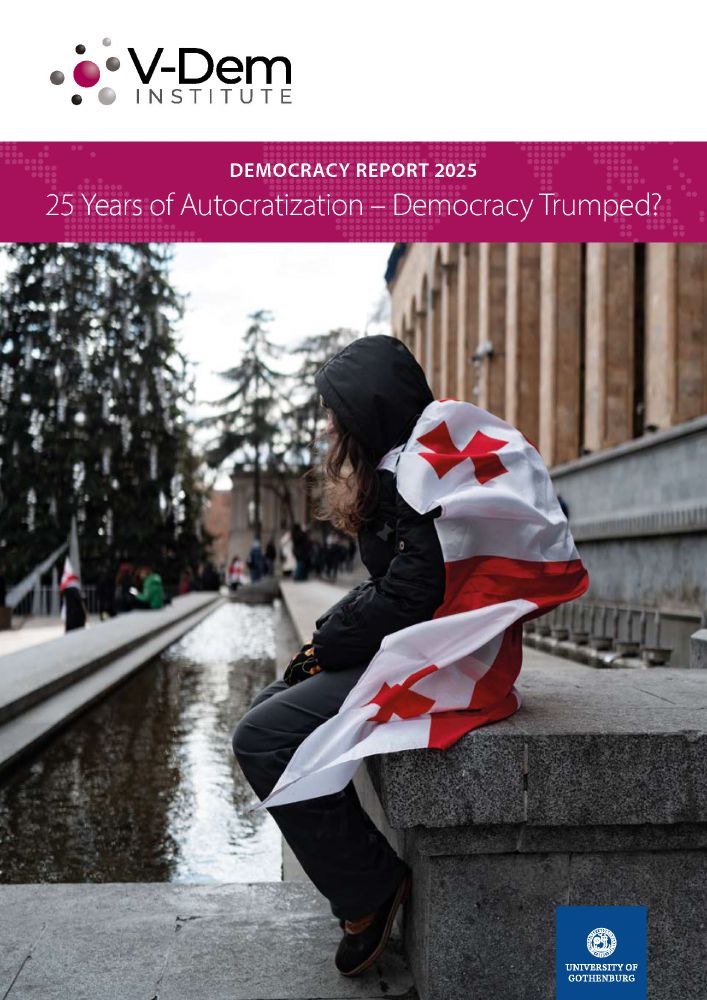
📢 Out now! Democracy Report 2025:
25 Years of Autocratization - Democracy Trumped?
Read the Report: v-dem.net/publications...
Download the V-Dem Dataset v15: v-dem.net/data/the-v-d...
#DR25 #DemocracyReport2025 #VDemDatasetV15
#Polisky #PoliSciSky #PoliticalScienceData #PoliticalScience
It was great being on the new episode of the @revdem2020.bsky.social podcast to talk about my recent @jodemocracy.bsky.social article
07.03.2025 15:34 — 👍 1 🔁 0 💬 0 📌 0
📣 NEW: #FreedomInTheWorld 2025 is now LIVE!
freedomhouse.org/report/freed...
Violence and repression around elections, ongoing armed conflicts, and the spread of authoritarian practices contributed to the 19th consecutive year of global freedom in decline.
(1/🧵)

New poll finds that 85% of Democrats have an unfavorable view of Musk while 73% of Republicans have a favorable view of him. But younger Republicans are not as positive about Musk as older Republicans are.
www.pewresearch.org/short-reads/...

New poll: 65% of U.S. adults say it would be too risky to give Trump more power to deal the nation’s problems (it's just 39% among Republicans)
www.pewresearch.org/short-reads/...

We have some new data on views in the US about support for Ukraine, as well as a question on NATO. We continue to see big partisan gaps.
pewrsr.ch/42Rk7HR

Talked to @richardwike.bsky.social and @moynihanpatrick.bsky.social about their research on how people feel about how democratic their democracies are - and how they could be more responsive to people. Our conversation here: podcasts.apple.com/us/podcast/c...
31.01.2025 00:21 — 👍 2 🔁 2 💬 0 📌 0
"Why the World in Down on Democracy" by Richard Wike.
Rich essay by @richardwike.bsky.social with much food for thought.
My take-away: most citizens are unhappy and unclear about what they want - which is why they rhetorically embrace any alternative to the current system (while not participating in these alternatives when having the chance).

"[Citizens] still value representative democracy, but they also desire a new era of representation with significant changes to the relationship between leaders and the citizens they represent,” writes @richardwike.bsky.social.
"Why the World Is Down on Democracy":
muse.jhu.edu/pub/1/a...

Pew Research Center is hiring several interns for the summer, including one for our Global Attitudes team. It’s a great opportunity and great place to spend the summer.
pewtrusts.wd5.myworkdayjobs.com/en-US/Center...

Still an amazing long term trend plot:
12.01.2025 16:08 — 👍 2 🔁 1 💬 0 📌 0The remarkable thing about this polling is that Keir Starmer has a net approval rating of -33, but is still 10 points ahead of Kemi Badenoch as best PM (though 16 points behind 'none of these').
11.01.2025 21:15 — 👍 62 🔁 14 💬 7 📌 1
Most people think economic inequality is a big problem for their country, and see the excessive political sway of the rich as the leading cause, according to a report by the Pew Research Center.
09.01.2025 20:48 — 👍 509 🔁 85 💬 71 📌 21
We’ve got a new report on views around the world about inequality. Strong concerns about it across the 36 nations we polled. And most say rich people’s political influence is a big reason why there is so much inequality.
pewrsr.ch/4g7QjK9
Thanks, Peter
07.01.2025 13:43 — 👍 1 🔁 0 💬 0 📌 0
I’m excited to share this new @jodemocracy.bsky.social article that looks at why so many people around the world are frustrated with the way democracy is working - particularly with how representation is working. And it explores ideas about what might improve things.
muse.jhu.edu/article/947886

This 2024 election summary by @richardwike.bsky.social et al, for @pewresearch.org provides an interesting global perspective as we head into the new year.
“angry at the political status quo, voters in many countries sent a message of frustration.”
www.pewresearch.org/global/2024/...
Citizens of modern democracies are unsatisfied with the way representation is working. Writes @richardwike.bsky.social Often, they feel they have no voice in politics. Many say leaders are out of touch, unresponsive and serve the interests of the wealthy and powerful. muse.jhu.edu/pub/1/articl...
03.01.2025 12:20 — 👍 3 🔁 1 💬 1 📌 1