
Btw. This was the brightest green band I was able to capture during the #Aurora. I was really surprised how bright it was.
21.01.2026 13:27 — 👍 2 🔁 0 💬 0 📌 0
Btw. This was the brightest green band I was able to capture during the #Aurora. I was really surprised how bright it was.
21.01.2026 13:27 — 👍 2 🔁 0 💬 0 📌 0


A few more pictures of the #Aurora from last night. Imaged on the Gehrenberg in BW south Germany.
20.01.2026 17:52 — 👍 4 🔁 0 💬 0 📌 0Surprisingly yes. The green streaks sometimes form brighter "blobs" for a second or two which are bright enough to visibly illuminate objects. I noticed it when my camera cast shadows on my hands.
20.01.2026 01:11 — 👍 2 🔁 0 💬 1 📌 0
Aurora over southern Germany/Switzerland/Austria
Its not everyday that #Astrophotography has to take a backseat for northern lights this intense in southern Germany. First time for me to see them bright enough to cast shadows.
20.01.2026 00:31 — 👍 72 🔁 16 💬 2 📌 0
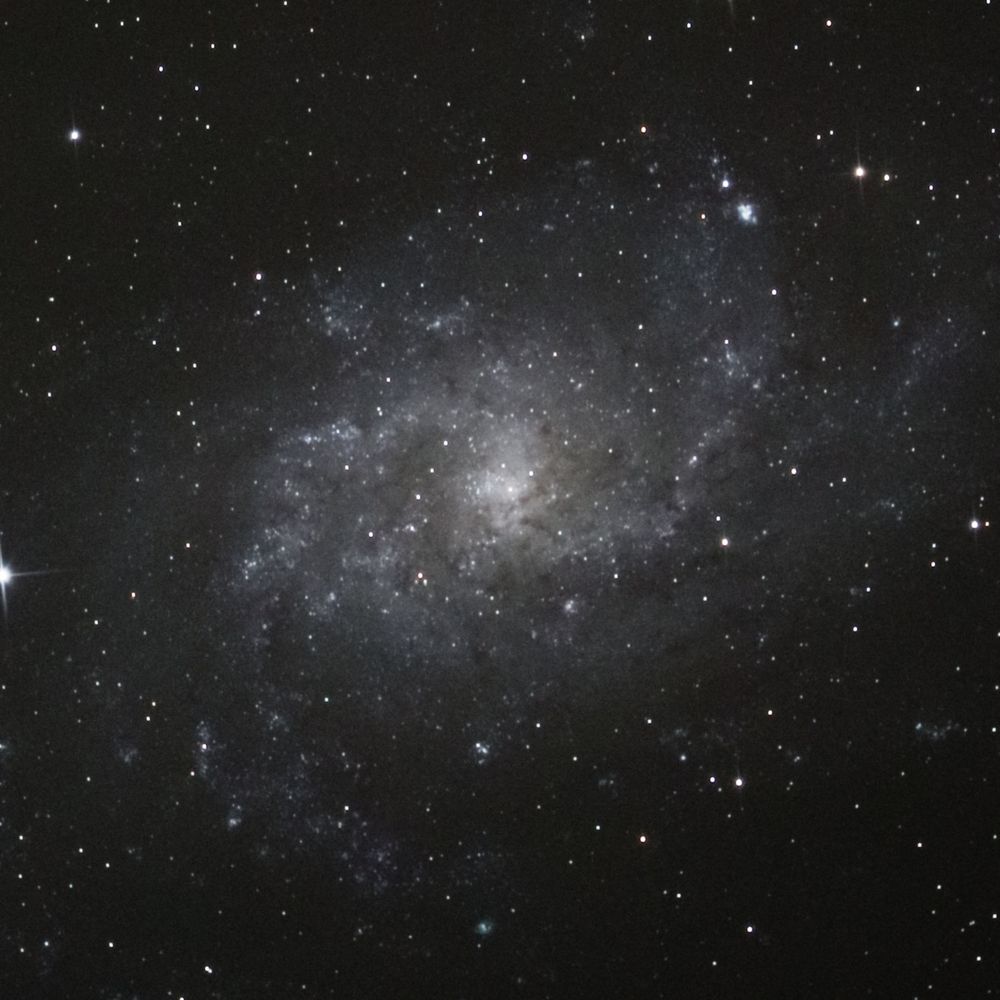
M33 in the constellation Triangulum. With the HII region NGC604 visible in the outer regions of the upper spiral arm. Imaged with my SW 130/650mm Newton and Canon EOS 750d on a SW HEQ5 Pro mount.
Image of M33 in the constellation Triangulum from ~August last year. It is always fascinating what an old DSLR can achieve with a bit of patience.
Of course a modern dedicated camera like a Asi 2600 is more efficient for #Astrophotography but at 5 to 6 times the price? Maybe a 2 GOTO mount instead?

Jupiter with the Great Red Spot visible, imaged in early January 2026 with a 130/650mm Newton and ASI676 MC planetary camera.
Finally had a short gap in the clouds a few days ago to capture the Great Red Spot on Jupiter. Imaged with my SW 130/650mm Newton and ZWO ASI 676 MC camera + 2x barlow.
#Astrophotography
Thanks. It is indeed a beautiful object both for visual and photographic astronomy.
05.01.2026 17:36 — 👍 0 🔁 0 💬 0 📌 0
Double cluster in Perseus. Imaged with a 130/650mm Newton and Canon EOS 750d.
The double cluster im Perseus (NGC 869 and 884), is a nice broadband target for #Astrophotography even when the Moon is out. I myself love the diffraction spikes caused by the secondary spider of Newton or RC telescopes for these types of targets. Imaged last year during a rare clear night in autumn
04.01.2026 21:09 — 👍 26 🔁 6 💬 1 📌 0
Image of Jupiter with Ganymede transit and Io photobomb. Imaged with 130/650mm SW Newton and ASI 676MC camera + 2x telecentric barlow.
An other image from the same #Astrophotography night as the last image of Jupiter with Ganymede transit and the Io photobomb. Really have to try and get an other shot of Jupiter with its Red Spot visible, but somehow timing never seems to work out.
01.01.2026 20:56 — 👍 24 🔁 1 💬 0 📌 0Happy New Year everybody!
01.01.2026 00:00 — 👍 2 🔁 0 💬 0 📌 0
Jupiter through a 130mm Newton with 2x telecentric barlow and ZWO ASI 676MC camera. Transit of Ganymede in the middle and it's shadow on the right visible. Moon Io to the left of Jupiter.
Weather overnight was clear for the first time in what feels like months. With seeing this good and a bright Moon out, Jupiter was the obvious target for #Astrophotography.
Despite the limited aperture of my 130mm Newton Ganymedes transit was easy to capture with Io squeezing into the frame too.
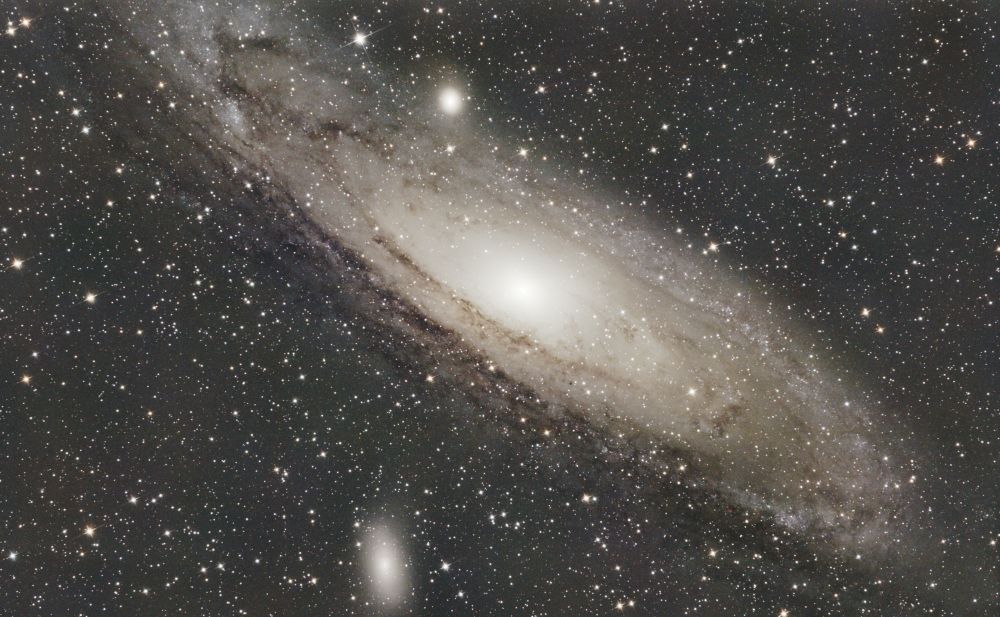
Galaxy M31 imaged with a 130mm F5 Newton telescope and Canon EOS 750d Camera.

Crop of M31 galaxy with LRN AT2025abao left of the middle.

Full resolution Crop of LRN AT2025abao.
Haven't seen a lot of posts about the Luminous Red Nova AT2025abao in M31 on here, so I thought I give it a try and 2 days ago weather cleared up just long enough to get a bit of #Astrophotography data. I was really surprised that it was visible even in single subs.
29.11.2025 23:36 — 👍 26 🔁 3 💬 0 📌 0


The Veil nebula in Cygnus imaged with my Samyang 135mm F2 lens. A great #Astrophotography target for Summer and early Autumn. Despite its distance of ~2500 lightyears, this supernova remnant just fit into the frame. Total exposure time about 2 hours.
12.11.2025 19:49 — 👍 20 🔁 3 💬 0 📌 0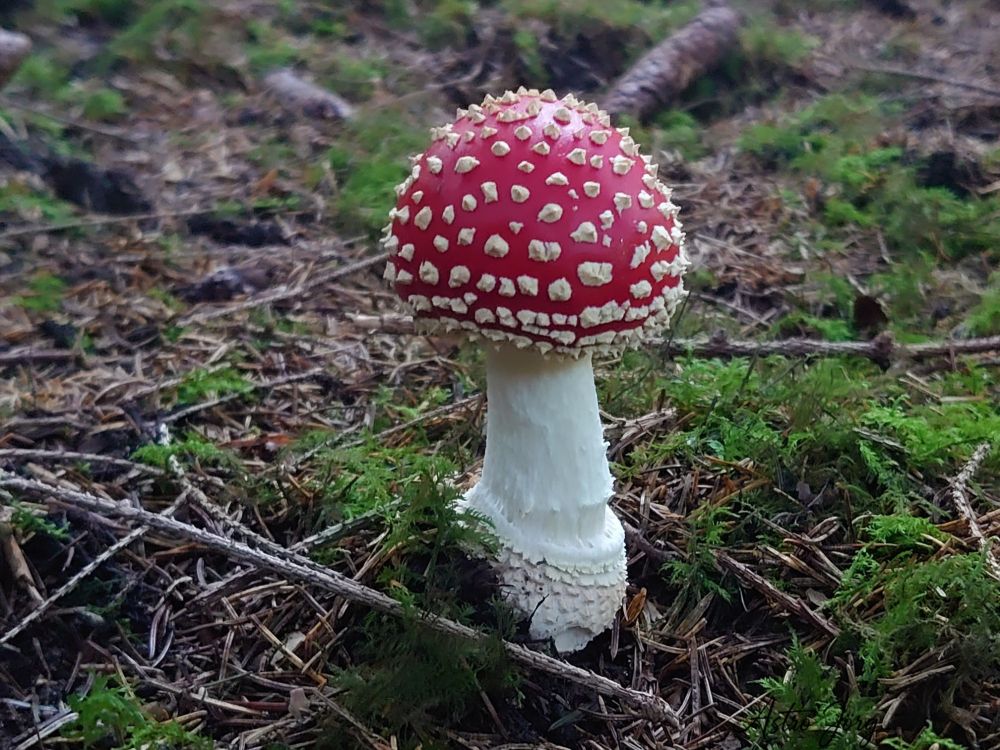

Still no clear weather in sight, so here are a few more fly agaric from my local forest.
#mushroom

Comet Lemmon in the evening hours of October 18th.
Had a quick glimpse between the clouds on comet C/2025 A6 (Lemmon) in Canes Venatici well after sunset. Composite of around 3 minutes worth of 1 second untracked images.
#Astrophotography

Fly agaric in a spuce forest, growing out of the mossy ground.
An other fly agaric growing in my local forest, while I'm waiting for a clear sky.
#mushroom

More mushrooms from a local forest. The damp weather really helps them grow very fast.
06.10.2025 20:11 — 👍 0 🔁 0 💬 0 📌 0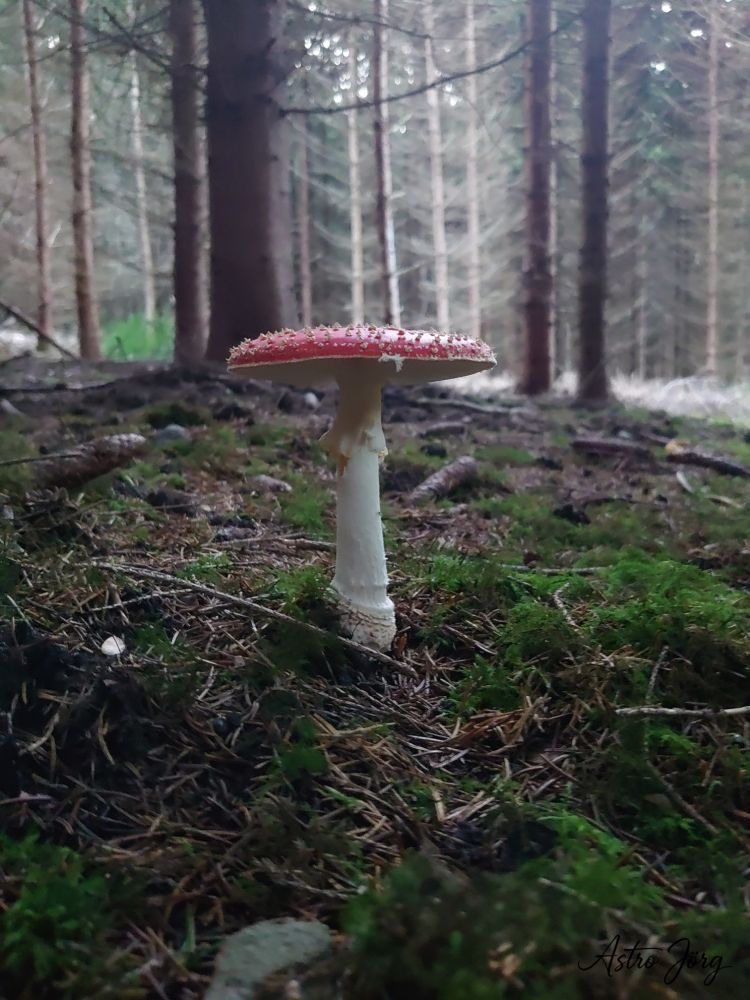
Fly agaric in a spuce forest.
As expected from this season, its cloudy and no stars in sight. But on the other hand mushroom season is in full swing.
06.10.2025 18:47 — 👍 0 🔁 0 💬 0 📌 0I'd really wanted to get an other 3 to 4 hours of images to enhance the finer details in the nebula but with bad weather in the forecast and October/November ahead its unlikely I get an other chance this year. Especially with only two good hours a night for this target in ideal conditions.
22.09.2025 23:52 — 👍 0 🔁 0 💬 0 📌 0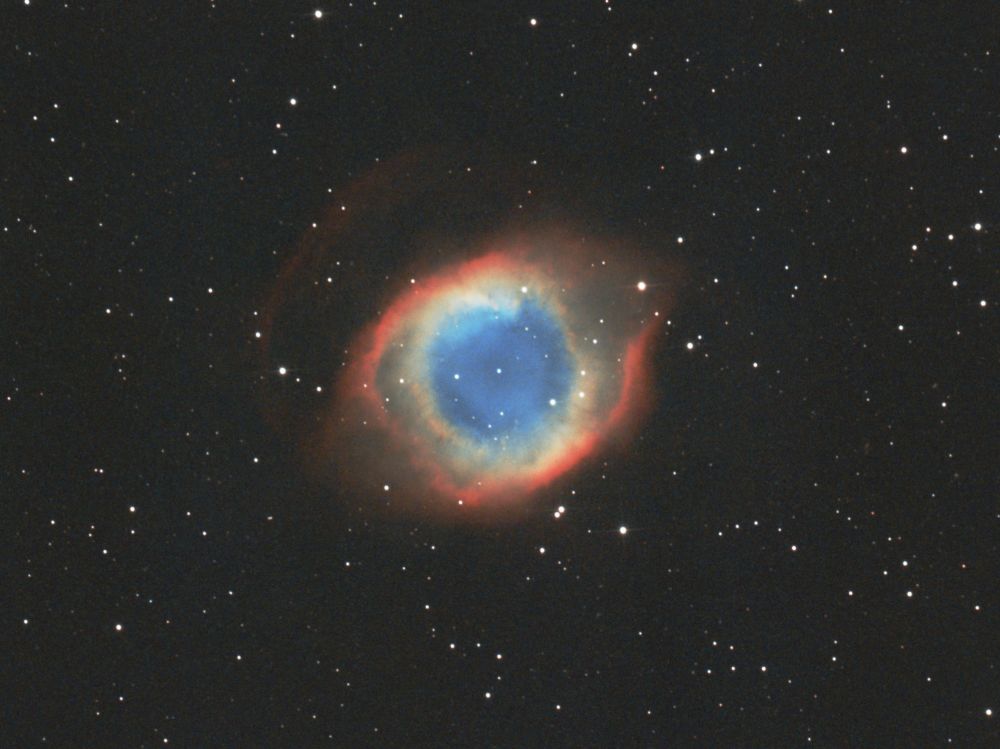
Helix Nebula imaged with a Canon EOS 700d on a 130mm Newton telescope. I used an Astronomik UHC filter for better contrast due to low elevation from the horizon. The image is composed from roughly 160 two minute exposures, stacked to create an image with about 5h30min total integration time.
The Helix Nebula or Caldwell 63 is a planertary nebula in the constellation Aquarius. When it comes to planetary nebulas, it's apparent size is extremely large and its features and structures become visible even in mid sized telescopes. Making it a very interesting #Astrophotography target.
22.09.2025 22:11 — 👍 57 🔁 9 💬 1 📌 0I'm not going to lie, A Questar is a really nice telescope. Both in terms of quality and as a piece of art.
12.09.2025 15:57 — 👍 1 🔁 0 💬 0 📌 0Definitely not ideal. Better would be a 200mm edgeHD with a small pixel planetary camera or something similar, but that's what I had available and it works pretty well.
11.09.2025 23:12 — 👍 1 🔁 0 💬 1 📌 0
Of course.
I was using a 130/650mm Newton with two barlow lenses stacked for a total of ~3500mm focal length. Tracked but unguided with a Skywatcher HEQ5 pro and imaged with a Canon EOS 250d. A bit overkill, but thats the configuration I used on Saturn right next to it.
Yes. But none of them are named stars. That particular one is a mag 15 star in the Gaia DR2 catalog. But there are also a few artefacts from the camera sensor that survived the stacking, since I used less than 10 pictures for this one.
10.09.2025 21:52 — 👍 1 🔁 0 💬 0 📌 0
Neptune and its moon Triton through Telescope at 3500mm focal length.
Neptune and it's moon Triton(which might actually be a captured dwarf planet) in the early morning hours of 6th September.
10 second exposures at f27 where just enough to make Triton visible without resulting in trailing lights.
#Astrophotography

Moon through a 130/650mm Newton telescope with Canon EOS 250d. 15 images stacked to reduce atmospheric wobble and processed in Siril.
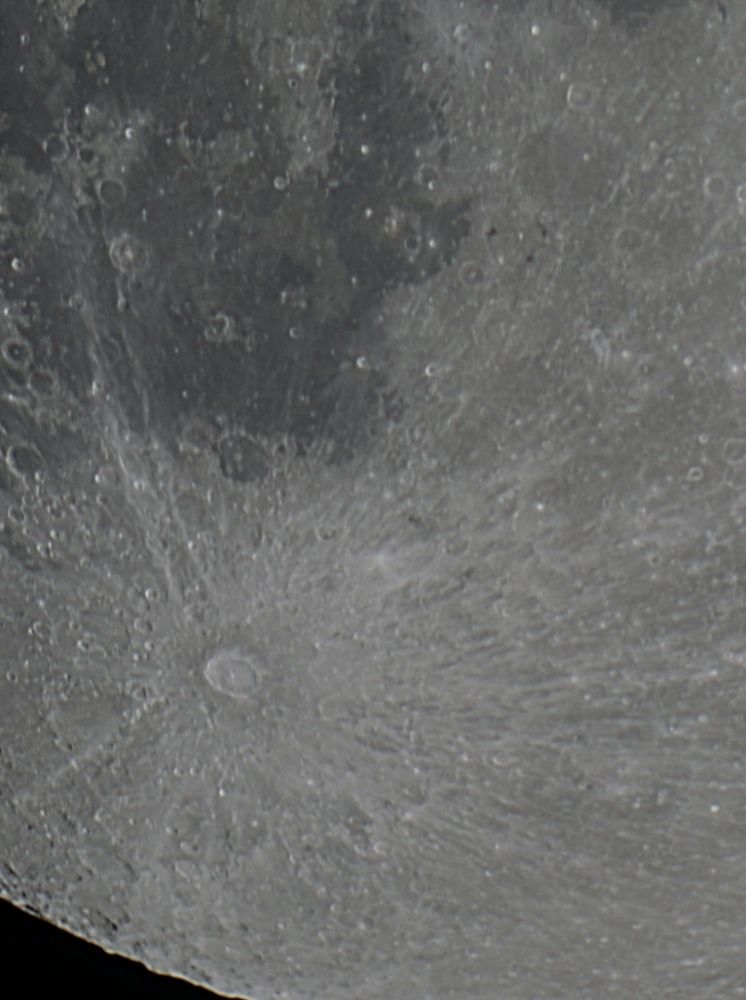
Tycho crater on the Moon


Pythagoras crater on the Moon.
Besides the planets there is of course the Moon as a bright target. I tried to utilize the full width and length of an APS-C sensor by using a 2x telecentric barlow. The cropped in images should provide full resolution of some regions.
#Astrophotography

Saturn as photographed through a small telescope. Processing with Autostakkert and Siril.
While Deep Space has to take a back seat in #Astrophotography during the current Moon phase, I'm trying to squeeze out every last bit out of my Deep Space Rig for planetary imaging.
Here is Saturn through my 130mm Newton and Canon EOS 250d.
Those are really great shots. And looking at the telescope used I am not surprised that I was barely able to image it at all
20.08.2025 23:39 — 👍 0 🔁 0 💬 0 📌 0
Visibility should be much better in November. Sky conditions might be tricky though in my area.
Good luck.

To highlight the position in the Image.
It's very faint but definitely in the correct position. Captured on the 18th August 2025 around 20:15 UTC.