Join us for an online talk "How to Be a Scientific Superpower" by Cassidy Sugimoto. Drawing on cutting-edge metascience, she will discuss how countries and institutions can build scientific excellence, shape global influence, and organize research systems on a global scale.
29.11.2025 13:58 —
👍 3
🔁 3
💬 0
📌 0

new paper by Sean Westwood:
With current technology, it is impossible to tell whether survey respondents are real or bots. Among other things, makes it easy for bad actors to manipulate outcomes. No good news here for the future of online-based survey research
18.11.2025 19:15 —
👍 777
🔁 390
💬 41
📌 126

This is a panel on “Book History with Internet Data”, with 8 panelists from different IMLS/iSchools, funded by SHARP.
Over the past two decades, a variety of internet-based datasets have emerged related to books, reading habits, and reader communities—ranging from crowd-sourced genre tags and online reviews to platforms like BookTok. These datasets are increasingly valuable for research in reading and readership, often complementing traditional book history approaches. However, they also raise new questions and challenges. To explore these opportunities and foster interdisciplinary collaboration, this panel will bring together eight panelists from diverse fields to discuss questions, such as:
How can we critically understand the relationship between Internet-based “book” data and traditional research materials?
What are the methodological challenges and potential pitfalls of using digital data in book history research?
How can interdisciplinary approaches enrich the analysis of Internet book and reader datasets?
Here are our amazing panelists:
- Micah Bateman, Assistant Professor, School of Library and Information Science, The University of Iowa
- Melanie Walsh, Assistant Professor, an Assistant Professor in the Information School and an Adjunct Assistant Professor in the English Department, University of Washington
- Wenyi Shang, Assistant Professor, School of Information Science & Learning Technologies, University of Missouri
- Cici Ling, Assistant Professor, Department of Informatics, Luddy School of Informatics, Computing, and Engineering, Indiana University Bloomington
- Kai Li, Assistant Professor, School of Information Sciences, The University of Tennessee, Knoxville
- Andrew Zalot, Assistant Professor, College of Education, East Carolina University
- Alex Wingate, PhD Candidate, Department of Information and Library Science, Luddy School of Informatics, Computing, and Engineering, Indiana University Bloomington
Hi DH friends, join us on Nov 10, 10-11 am CT, for “New Book History Research with Internet Data”, a hybrid panel sponsored by SHAR, to explore challenges and opportunities of using Internet data and digital methods for book history research. More info in the poster attached and comments :)
06.11.2025 18:09 —
👍 19
🔁 9
💬 3
📌 4
Excited to join the “New Book History Research with Internet Data” panel at Indiana University Bloomington on Nov 10. We’ll discuss how online data (reviews, platforms, metrics) reshape book history & publishing studies.
🔗 events.iu.edu/siceiub/even...
#BookHistory #DigitalHumanities
04.11.2025 03:41 —
👍 3
🔁 0
💬 0
📌 0
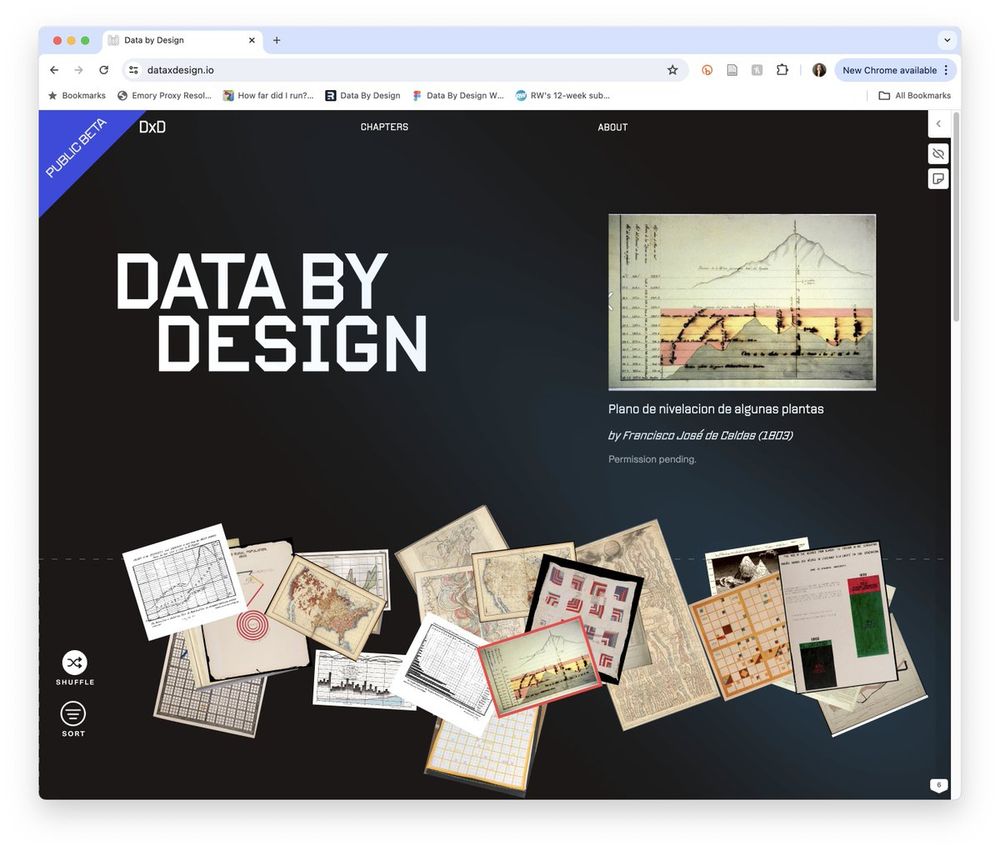
A screenshot of the front page of the Data by Design website, featuring a bunch of charts in a jumble and one, of a mountain and measurements by Francisco José de Caldas, featured at the top right.
I am beyond thrilled to share that DATA BY DESIGN: AN INTERACTIVE HISTORY OF DATA VISUALIZATION, 1789-1900 is now open for community review at 💚 📊 dataxdesign.io 📊 💙. It's the work of 15+ people across 5 institutions, 2 continents, 2 babies, and a global pandemic. A 🧵 but first:
21.05.2024 14:32 —
👍 230
🔁 90
💬 9
📌 3

2025 Summit on Responsible Computing, AI, and Society
2025 Summit on Responsible Computing, AI, and Society
Applications are open for the Doctoral Consortium at the 2025 Summit on Responsible Computing, AI, and Society rcais.github.io. Taking place October 27, 2025.
Applications received by September 15 will receive full consideration.
24.07.2025 13:24 —
👍 6
🔁 4
💬 1
📌 0
This is really interesting. However, I want to point out that if you select "case-insensitive," "however" is still becoming more popular during the past century.
16.07.2025 13:30 —
👍 0
🔁 0
💬 0
📌 0
GraphEidos: A Dataset of Visual Rhetoric in Digital Humanities | Journal of Open Humanities Data
I'm glad to share the new data paper in the Journal of Open Humanities Data with my wonderful collaborator @nalsi.bsky.social and students!! 😇 Check out our work here: openhumanitiesdata.metajnl.com/articles/10....
09.07.2025 15:00 —
👍 2
🔁 1
💬 0
📌 0
And the paper is published here: www.nature.com/articles/s41....
11.06.2025 13:52 —
👍 1
🔁 0
💬 0
📌 0
Congratulations, Naz!
29.05.2025 02:24 —
👍 1
🔁 0
💬 1
📌 0
We analyze projects funded by the National Natural Science Foundation of China, NSFC (2010–2015) and find persistent gender gaps in PI roles and team structure.
HOWEVER, gender-diverse teams = more publications 📈
#GenderEquity #STEM #ChinaResearch
24.05.2025 13:47 —
👍 2
🔁 0
💬 0
📌 0
Gender disparities in STEM research enterprise in China
Gender diversity is essential to the creation of high-quality research and scientific advances. This study provides a large-scale analysis of gender disparities
🚨 Excited to share our latest study (forthcoming in Humanities and Social Sciences Communications) collaborated with Dr. Chaoqun Ni and Xiang Zheng::
Gender disparities in STEM research enterprise in China
👉 ssrn.com/abstract=523...
24.05.2025 13:43 —
👍 3
🔁 0
💬 1
📌 1

Where there’s a will there’s a way: ChatGPT is used more for science in countries where it is prohibited
Abstract. Regulating AI is a key societal challenge, but effective methods remain unclear. This study evaluates geographic restrictions on AI services, focusing on ChatGPT, which OpenAI blocks in seve...
Really glad that this is out! Fantastic collaboration with @honglin-bao.bsky.social and @innovation.bsky.social!
Key insight: Knowledge diffusion is nearly impossible to constrain—where there's a will, there's a way. From the atomic bomb to ChatGPT, determined minds always find a path.
1/3
19.04.2025 00:42 —
👍 10
🔁 4
💬 1
📌 0
Feel free to share with colleagues who work in #SciSci #Scientometrics #STIpolicy #DataCuration or #OpenResearch!
14.04.2025 13:03 —
👍 1
🔁 0
💬 0
📌 0
This is a great opportunity to publish datasets that explore:
📊 R&D investments and funding flows
🔬 Scientific collaboration and infrastructure
📚 Research outputs like publications, patents, software
📈 Impact metrics and societal outcomes
14.04.2025 13:02 —
👍 0
🔁 0
💬 0
📌 0
About the Guest Editors | Data on Science and Innovation Processes, Outputs and Outcomes
This Scientific Data collection aims to gather data descriptors on high-quality, reusable datasets that illuminate the inputs, processes, and outputs of science and innovation.
🎉 Excited to share that Scientific Data is launching a new collection: "Data on Science and Innovation Processes, Outputs and Outcomes." This special issue welcomes data descriptors of datasets that shed light on how science and innovation work—from inputs to outcomes. www.nature.com/collections/...
14.04.2025 13:01 —
👍 3
🔁 0
💬 2
📌 1

Just published on the blog, Assistant Professor Kai Li gives new perspectives on challenges and opportunities for large-scale analyses on data use and data citations. makedatacount.org/read-our-blo...
03.04.2025 17:24 —
👍 2
🔁 1
💬 0
📌 0

INTRODUCTION
Modern-Day Oracles or Bullshit Machines?
Jevin West (@jevinwest.bsky.social) and I have spent the last eight months developing the course on large language models (LLMs) that we think every college freshman needs to take.
thebullshitmachines.com
04.02.2025 16:12 —
👍 2704
🔁 990
💬 168
📌 240
I am also a long-time fan of his and just read the City a week ago. I would say the story itself is not as interesting as Hard-Boiled Wonderland (that shares a key plotline). At least I am less impressed for various reasons. But it is still clearly Haruki in terms of key theme and style.
07.01.2025 21:49 —
👍 1
🔁 0
💬 0
📌 0

The economic, psychological, spiritual, technological, and intellectual needs of a human being are usually more difficult and less profitable to satisfy than the carefully engineered and manipulated "wants" inculcated by fad and fashion
The more I read and think about generative AI and what its creators want us to do with if, the more I'm reminded of this quote from Victor Papanek's 'Design for the Real World'
20.12.2024 12:33 —
👍 36
🔁 11
💬 0
📌 4

Advising governments about science is essential but difficult. So train people to do it
A great scientist doesn’t necessarily make an effective science adviser — but schooling and practice can help to bridge the gap.
Every government needs effective science advisers; not every scientist is a born adviser but schooling and practice can help to bridge the gap, as we argue in this week’s Nature’s editorial
@natureportfolio.bsky.social 🧪
www.nature.com/articles/d41...
06.12.2024 08:41 —
👍 56
🔁 19
💬 1
📌 2
how do researchers use LMs in their work & why?
we surveyed 800 researchers across fields of study, race, gender, seniority asking their opinions on:
🐟 which research activities (eg coding, writing)
🐠 benefits vs risks
🦈 willingness to disclose
findings in @simonaliao.bsky.social's thread 🧵
02.12.2024 20:55 —
👍 32
🔁 5
💬 0
📌 0
I guess I am surprised to see so many academic friends who are super interested in birds. This kind of answered my question of why Wingspan is such a popular board game.
25.11.2024 01:22 —
👍 1
🔁 0
💬 0
📌 0

A poem about information organization and retrieval written by ChatGPT. Read it in the last session of my class. The students seem to like it.
22.11.2024 02:23 —
👍 1
🔁 0
💬 0
📌 0

Pereira, M. do M. (2024). Rethinking power and positionality in debates about citation: Towards a recognition of complexity and opacity in academic hierarchies. The Sociological Review. https://doi.org/10.1177/00380261241274872
Science is political in so many ways. One of them is reflected in #citation politics. And we all do it, willingly or not.
This paper is a glimpse into how some strategies (e.g. decolonizing or diversifying citations) that aim to undermine existing hierarchies have limitations worth thinking about.
19.11.2024 08:51 —
👍 140
🔁 41
💬 1
📌 6
I will assign this in future classes—it nails one common argument I find unconvincing in regards to students, which is the idea of LLMss as interlocutors to help refine thinking—that only really works if you’re an expert who can spot the mistakes—students are typically not in a position to do that
18.11.2024 17:12 —
👍 44
🔁 5
💬 4
📌 0