Joe Sperling's Avatar

Joe Sperling

@jsperling91.bsky.social

Research assistant professor at Colorado School of Mines. Still on X but didn’t wanna miss the science on here. Actinides are neat.

39 Followers  |  29 Following  |  8 Posts  |  Joined: 03.12.2024
Posts Following

Posts by Joe Sperling (@jsperling91.bsky.social)

Preview
Non–linear bonding trends in maleonitrile-1,2–dithiolate complexes of the transuranium actinides - Nature Communications Although the trivalent actinides are similar to the lanthanide series in terms of chemistry and bonding, their structures and properties can diverge significantly. Here, the authors report a series of...

I remember seeing the americium crystals from like 20 ft away. Great job Nick! #fblockrocks www.nature.com/articles/s41...

20.08.2025 16:10 — 👍 0    🔁 0    💬 0    📌 0

Preview
Molecular complexes of low-valent f-elements from lanthanum to californium This review outlines the structure and chemistry of divalent lanthanides and actinides in small molecule systems, focusing on the less accessible diva…

@hbwineinger.bsky.social wrote this review for those interested in low valent f elements #fblockrocks www.sciencedirect.com/science/arti...

25.07.2025 18:39 — 👍 12    🔁 5    💬 0    📌 0
Post image Post image Post image

Neptunium (Np3+) has a beautiful alexandrite effect. Left is one lab, center is natural sunlight, and right is a lab under fluorescent lighting. 5f-5f transitions are magical. This is the same solution. Some great pics taken by @jp_brannon #fblockrocks #actinides

13.06.2025 03:01 — 👍 2    🔁 0    💬 0    📌 0
Preview
Effects of the Inverse Trans-Influence in a Berkelium(III) Phosphine Oxide Complex An example of a 249Bk3+ phosphine oxide complex has been prepared to examine and quantify the effects of the inverse trans-influence (ITI) on a late actinide complex. This has been accomplished through a comparison of cis and trans Bk-ligand bonds in the meridional berkelium(III) complex, BkBr3(OPCy3)3 (OPCy3 = tricyclohexylphosphine oxide). A detailed bond metric analysis was completed that includes the shortest published distance for a Bk3+–O bond, attributed to the smaller coordination number of Bk3+ of six in mer-BkBr3(OPCy3)3. ITI calculations of the trans Bk3+–O bond provide an ITI value (98.5(2)%) comparable to that of mer-AmBr3(OPCy3)3 (98.2(2)%) and indicate a small 5f orbital contribution to bonding. This effect is discussed in the context of the isomorphous lanthanide(III) series where the ITI is calculated to be higher for mer-BkBr3(OPCy3)3 than in most Ln3+ analogues.

249Bk (t1/2 ~330 days) is a beta blasting bully, but sometimes things work out #fblockrocks #bkallday @teasactinides.bsky.social pubs.acs.org/doi/10.1021/...

10.06.2025 14:50 — 👍 9    🔁 3    💬 0    📌 0
Preview
Unveiling the covalency of versatile Pu(iii)-N bonds in a unique plutonium(iii) complex A trivalent plutonium–pyrazinyl–tetrazolate complex Na2[Pu(Hdtp)(dtp)2(H2O)4]·9H2O (Pu_dtp, H2dtp = 2,3-di-1H-tetrazol-5-ylpyrazine) was synthesized through metathesis reaction of plutonium bromide an...

Plutonium chemistry is wack and this compound is another reason to provide evidence towards that #fblockrocks @teasactinides.bsky.social
pubs.rsc.org/en/content/a...

13.05.2025 00:58 — 👍 8    🔁 2    💬 0    📌 0
Preview
Insights into the Complexation of Actinides by Diethylenetriaminepentaacetic Acid from Characterization of the Americium(III) Complex Diethylenetriaminepentaacetic acid (DTPA) is a frequently used chelator in the nuclear and medical industries, especially for the complexation of trivalent actinides. However, structural data on these complexes in the solid-state have long remained elusive. Herein, a detailed structural analysis of the presented crystal structures of [C(NH2)3]4[Nd(DTPA)]2·nH2O and [C(NH2)3]4[Am(DTPA)]2·nH2O, where [C(NH2)3]+ is guanidinium, details the subtle differences in the Lewis acidity between a lanthanide/actinide pair of similar ionic sizes. Contractions in nitrogen–metal bond lengths between neodymium(III) and americium(III) were observed, while the metal–oxygen bonds remained relatively consistent, highlighting the marginal favorability for actinide complexation over the lanthanides with moderately soft N-donors. Spectroscopic analysis shows significant splitting of many transitions and relatively strong electronic interactions with traditionally low-intensity transitions in the americium complex, as is demonstrated in the 7F0→7F5 transitions. Pressure-induced spectroscopic analysis showed surprisingly little effect on the americium complex, with 5f→5f transitions either not shifting or marginally shifting from 2 to 3 nm at 11.93 ± 0.06 GPa─atypical of a soft, N-donor americium complex under pressure. Large voids occupied by water molecules in between the complexes within the crystal structure may be responsible for the lack of pressure response in the 5f→5f transitions.

This is a heavy hitting americium structure great job brian! @teasactinides.bsky.social pubs.acs.org/doi/10.1021/...

12.03.2025 22:42 — 👍 7    🔁 1    💬 0    📌 0
Preview
High-Pressure Effects on an Octa-Hydrated Curium Complex: An Experimental and Theoretical Investigation An octa-hydrated curium compound [Cm(H2O)8](Hdtp)(dtp)·H2O (Cm1, H2dtp = 2,3-di(tetrazol-5-yl)pyrazine) along with its lanthanide analogues [Ln(H2O)8](Hdtp)(dtp)·H2O (Ln1, Ln3+ = La3+–Nd3+, Sm3+–Lu3+)...

I am super proud of this paper. It was a massive, multi-year undertaking by three different groups. If you've ever wanted to understand the high-pressure behavior of curium, here it is. @gagliardilaura.bsky.social #fblockrocks #nuclear #chemsky #bluesci #highpressure
pubs.acs.org/doi/full/10....

04.02.2025 16:47 — 👍 12    🔁 3    💬 0    📌 1
Preview
Coordination Chemistry and Photoluminescence of Sm(II) Dibenzo-24-crown-8 Complexes Three Sm(II) dibenzo-24-crown-8 (db24c8) complexes were synthesized in anhydrous, air-free conditions via the reaction of SmI2 with db24c8 and tetrabutylammonium tetraphenylborate ([TBA][BPh4]; where ...

I'm excited to see this one published! Samarium(II) dibenzo-24-crown-8 complexes from solutions of MeCN, THF, and DME.

pubs.acs.org/doi/10.1021/...

22.01.2025 18:39 — 👍 6    🔁 2    💬 0    📌 0
Post image

I love pictures of clean californium. This small quantity has enough gamma radiation to give you your annual background dose in ~30 minutes on contact pictured here is the oxalate #fblockrocks

08.01.2025 00:43 — 👍 6    🔁 2    💬 0    📌 0
Preview
A comprehensive approach for elucidating the interplay between 4fn+1 and 4fn5d1 configurations in Ln2+ complexes Lanthanides (Ln) are typically found in the +3 oxidation state. However, in recent decades, their chemistry has been expanded to include the less stable +2 oxidation state across the entire series exc...

What an awesome way to start the year!
pubs.rsc.org/en/content/a...

03.01.2025 16:33 — 👍 11    🔁 2    💬 0    📌 0
Preview
Isolation of Inner-Sphere Aquo Complexes of Samarium(II) The cis-anti-cis and cis-syn-cis isomers of [Sm(dicyclohexano-18-crown-6)(H2O)2]I2 exhibiting trans water molecules bound to the Sm2+ ion have been isolated and characterized. Sm2+ possesses an electrochemical potential sufficient for water reduction, and thus these complexes add to the recent body of evidence that the oxidation of Sm2+ by water can operate by a mechanism that is not straightforward. These complexes are obtained by the direct addition of stoichiometric amounts of water to solutions of the respective Sm(dicyclohexano-18-crown-6)I2 isomers under an inert atmosphere. The parent complex, Sm(dicyclohexano-18-crown-6)I2, lacking coordinating water molecules can be obtained through rigorous exclusion of water. It was determined that the bulky cyclohexano-substituents deter intramolecular interactions between [Sm(dicyclohexano-18-crown-6)(H2O)2]I2 complexes and slow the oxidization of the metal centers. The extent of the stability of these complexes to the presence of water has been further probed through cyclic voltammetry, where it was found that the redox potential of both isomers of [Sm(dicyclohexano-18-crown-6)(H2O)2]I2 maintains quasi-reversible behavior with a 50,000-fold excess of water to Sm2+ in solution with the cis-syn-cis complex being quasi-reversible at even higher concentrations of water. Solution-phase spectroscopy of these complexes in acetonitrile shows a corresponding hypsochromic shift of the Sm2+ 4f → 5d transition typically observed in the visible region from Sm2+ complexes. The crystalline compounds obtained in this study support solid-state spectroscopic trends observed from other Sm2+ crown-ether complexes containing iodide counterions, wherein the proximity of the iodide ions to the metal center determines whether the complex can exhibit 4f → 4f photoluminescence.

This article was years in the making. Did you think water could coordinate to Sm(II) without being reduced? Well it can. Congratulations Todd! #Chemsky #Bluesci #samarium #rareearths #fblockrocks

pubs.acs.org/doi/10.1021/...
07.01.2025 17:19 — 👍 10    🔁 4    💬 1    📌 0
Preview
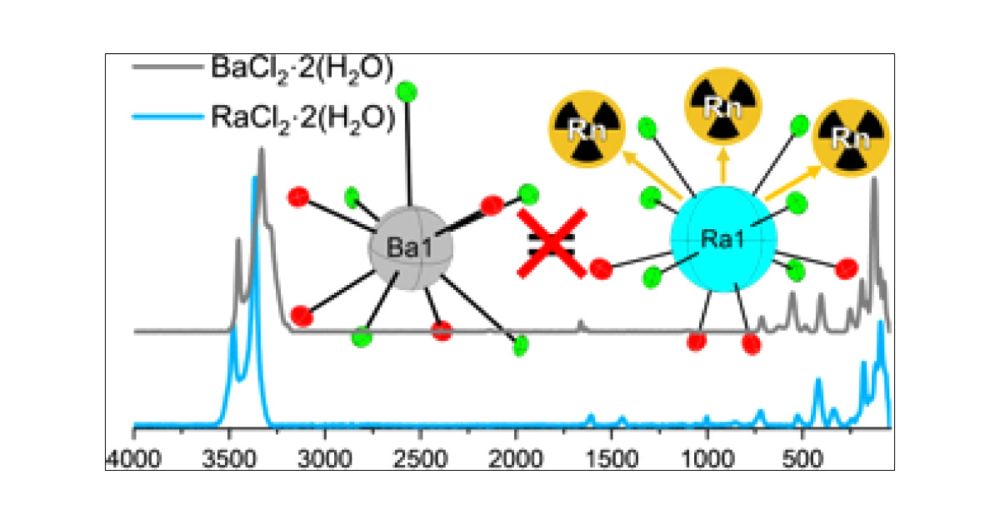
Deviation between the Structural Chemistry of Barium and Radium Halides: Synthesis and Characterization of RaX2·H2O and RaX2·2H2O (X– = Cl– and Br–) To develop the structural chemistry of radium, the halide compounds RaX2·H2O and RaX2·2H2O (X– = Cl– and Br–) have been synthesized and characterized and serve as benchmarks for comparisons with more complex compounds in the future. In contrast with historic reports on the structural chemistry of radium, the Ra2+ chlorides differ from their Ba2+ analogues. For MCl2·H2O (M2+ = Ba2+, Ra2+), the variance between the metal coordination environments manifests as a small, local distortion that becomes more apparent in the extended structure. However, differences between RaCl2·2H2O and BaCl2·2H2O are more pronounced with a 10-coordinate Ra2+ cation being observed instead of a nine-coordinate Ba2+ in BaCl2·2H2O. RaBr2·nH2O (n = 1 or 2) are isomorphous with the Ba2+ analogues. Raman spectroscopy was used as an additional probe of these compounds and reveals substantial shifts and different vibrational modes between RaX2·H2O and RaX2·2H2O compared to BaX2·2H2O.

Super happy with this article. Ra-226 makes Cf-249 look cold. There's more radium chemistry to come after the holidays. #Chemsky #bluesci #radium #nuclear #fblockrocks
pubs.acs.org/doi/full/10....

13.12.2024 17:15 — 👍 5    🔁 2    💬 0    📌 0
Post image

Hi bluesky, meet blueplutonium #fblockrocks

03.12.2024 20:49 — 👍 3    🔁 0    💬 0    📌 0