04.02.2026 21:30 — 👍 1 🔁 0 💬 0 📌 0

@icrs.bsky.social
Principal association of coral reef scientists, managers, and enthusiasts worldwide. To promote acquisition & dissemination of scientific knowledge to secure coral reefs for future generations through reserach, education, policy. linktr.ee/icrs.links
04.02.2026 21:30 — 👍 1 🔁 0 💬 0 📌 0


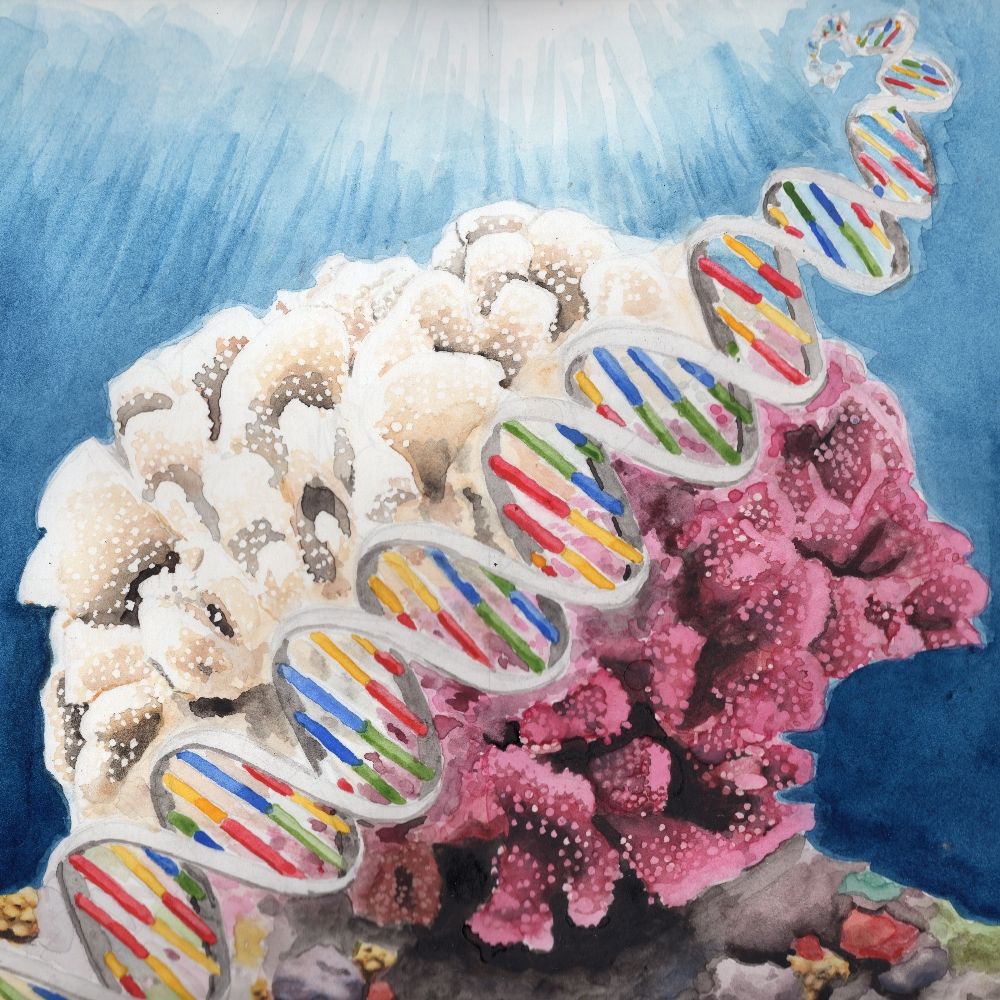
How exactly does climate change influence interactions between photosymbionts and their marine animal hosts? 🔥 🥵
Learn more in this recently published paper: link.springer.com/article/10.1...
🪸 Have a newly published coral reef paper? Share it with us so we can help communicate the science! 📢
04.02.2026 21:27 — 👍 0 🔁 0 💬 0 📌 0

Graphic with a semi-transparent background showing branching coral. At the top, a dark blue rectangular banner displays the text “Membership renewals” in light blue, partially overlaid on the circular ICRS logo. The logo features a blue gradient background with a white brain coral illustration at the lower left and a school of white fish at the upper right. At the bottom, a light blue band includes a calendar icon with the text “International Coral Reef Society’s membership period runs from 1st January to 31st December,” followed by a icon with 3 people and the text “Membership categories include Individual, Student, Family, and Lifetime options.” Below this, a small hand-swipe icon appears with the text “Swipe to learn about our membership benefits!”

Graphic with a semi-transparent background showing a brain coral. At the top, a dark blue rectangular banner displays the text “Membership benefits”. Below, a bulleted list: electronic access to the Society’s scientific journal Coral Reefs; receipt of and the right to publish in the online news journal Reef Encounter; reduced registration fees for the International Coral Reef Symposium and other Society-sponsored meetings; eligibility to be nominated for Society awards, including grants and fellowships; access to online resources, including the Membership Directory; eligibility to stand for election as an Officer or Councillor; the right to vote in Officer and Councillor elections and at General Meetings and Support coral reef science and young scientists. At the bottom, icons depict a scientific journal and a person speaking at a podium to an audience.
♻️ Time to renew your ICRS membership!
Swipe through to explore the benefits of being part of the ICRS community.
💡 More information on membership categories and fees here: coralreefs.org/about-icrs/i...


✈️🌊 Travel to the 16th ICRS Symposium just got easier!
Apply for Special Travel Awards, including Student Travel Grants, the John Ogden President’s Awards, and Dalio Travel Grants. 📅 Don’t miss out—apply now! tinyurl.com/ICRSAwards


 26.01.2026 16:26 — 👍 1 🔁 1 💬 0 📌 0


 26.01.2026 16:26 — 👍 1 🔁 1 💬 1 📌 0


ICRS Awards, Honors, and Fellowships recognize excellence in coral reef research and conservation across career stages.
Know an ICRS colleague whose work deserves recognition? Nominate them!
🔗 More information: coralreefs.org/awards-honor...

Travel Awards for the 16th ICRS Symposium 2026, due 15 February 2026
Student Travel Grants
John Ogden President’s Awards for 2026 ICRS Symposium Attendance
Dalio Travel Grants for Malaysian Reef Practitioners
see all ICRS awards at coralreefs.org/awards-honor....

Split-style background showing the left half of a coral reef image with a large, pale orange branching coral prominently in the foreground. At the top appear the ICRS logo and the UN Ocean Decade symbol. On the right, white text reads: “By the end of 2025, the Ocean Decade had launched over 700 Actions in 78 countries, created 10,000+ knowledge products to guide ocean conservation, and helped shape policies like the BBNJ Agreement to protect oceans worldwide — and one of these actions is led by ICRS.” The phrases “700 Actions in 78 countries,” “10,000+ knowledge products,” and “shape policies” are bolded.

Continuation of the previous slide’s split reef image, now showing the right half of the same coral scene. At the top appear the ICRS logo and the UN Ocean Decade symbol. On the right, white text reads: “The International Coral Reef Society (ICRS) is an endorsed action of the UN Ocean Decade, supporting early-career scientists, funding coral reef research, and promoting global collaboration — helping protect and conserve reefs and oceans worldwide.” The phrases “endorsed action of the UN Ocean Decade” and “helping protect and conserve reefs and oceans worldwide” are bolded.

Background image of a coral reef with a brain coral on the left and several fish swimming nearby. At the top appear the ICRS logo and the UN Ocean Decade symbol. White text reads: “We’ve made progress, but our oceans and coral reefs still face great challenges! Join us in supporting the UN Ocean Decade and ICRS.Learn more at https://oceandecade.org/ ” The phrase “face great challenges!” is bolded.

Ocean-themed background with sunlight rays visible entering the water from above and branching corals along the bottom. At the top appear the ICRS logo and the UN Ocean Decade symbol. Centered in large text and in quotation marks is the phrase: “THE SCIENCE WE NEED FOR THE OCEAN WE WANT.”
18.01.2026 17:46 — 👍 3 🔁 1 💬 0 📌 0
Background image of a coral reef featuring a branching orange coral at the center surrounded by small orange fish. At the top are the ICRS logo — a circular emblem with a brain coral on the left and a school of fish on the right — next to the UN Ocean Decade symbol, an abstract swirl resembling a whirlpool. Below, the text reads “WE ARE HALFWAY THROUGH THE UN OCEAN DECADE” and “WHAT DOES IT MEAN FOR OUR OCEANS?”, with an arrow on the right indicating to swipe.

Split-style background showing the left half of a sea turtle with a coral reef below. At the top appear the ICRS logo and the UN Ocean Decade symbol. On the left, white text reads: “Launched in January 2021, the UN Ocean Decade (2021–2030) unites scientists, policymakers, and communities worldwide to drive a revolution in ocean science.” The phrase “revolution in ocean science.” is bolded.

Continuation of the previous slide’s split image, now showing the right half of the same sea turtle with a coral reef below. At the top appear the ICRS logo and the UN Ocean Decade symbol. On the right, white text reads: “Throughout the Ocean Decade, partners collect data, share information, and create knowledge to help governments and organizations make better, science-based decisions, from local communities to global policy.” The phrase “make better, science-based decisions” is bolded.
🌊 We’re halfway through the UN Ocean Decade!
Swipe to learn what this global initiative means and what has been achieved so far, including ICRS as an endorsed Decade Action supporting coral reef science worldwide.
Explore more: oceandecade.org
Together, we can make waves for the ocean, join us!


Happy New Year! 🌊🪸 2026 is shaping up to be an exciting year for coral reef events and conferences worldwide. Here’s to a year of meaningful collaboration and action to protect, manage, and restore reefs. Know of an event we’ve missed? Drop a comment and share it with our coral community!
08.01.2026 03:28 — 👍 5 🔁 2 💬 0 📌 0(9/9) Which reef personality matches you? 🌊
Reply with yours or tag a friend who fits one of these personalities 👇

Credited photo by atese/Canva showing two blue cleaner fish with black stripes cleaning the mouth of a parrotfish.
(8/9) 🐟 Cleaner fish — The tidy one!
Cleaner fish remove parasites and dead skin from other fish in exchange for food — a win-win relationship for both. In the photo, two cleaner fish are even cleaning a parrotfish’s mouth!

Credited photo by adokon/Canva showing an orange starfish with yellow spots on a coral.
(7/9) ⭐ Starfish — Taking it easy.
Starfish move slowly using a water vascular system that powers their tube feet, feeding on mollusks and other invertebrates at what appears to be a relaxed pace.

Credited photo by Luiza P. Campos showing several circular, golden-colored zooxanthellae cells.
(6/9) 🟢 Zooxanthellae — In charge of the food!
These microalgae live inside coral tissues, providing up to 95% of the coral’s energy through photosynthesis. Their partnership is essential for coral survival and the reef’s health.

Credited photo by Katherine OBrien/Canva showing a brown moray eel with white and light blue spots hiding in a crevice within a coral reef.
(5/9) 🐍 Moray eel — Hiding from the holiday chaos!
Moray eels spend most of their time hiding in reef crevices, ambushing prey that comes too close. Their secretive nature makes them one of the reef’s most elusive residents.

Credited photo by bearacreative/Canva showing a yellow Christmas Tree Worm with brown details sitting on a coral.
(4/9) 🌲 Christmas tree worm — Always holiday ready!
These colorful polychaetes use their feathery “Christmas tree” structures, called radioles, to filter plankton and small particles from the water, while also helping them breathe.

Credited photo by pniesen/Canva showing an orange branching coral with a school of fish nearby.
(3/9) 🪸 Hard coral — The party host!
Corals provide shelter, homes, and breeding sites for marine organisms, forming reefs that harbour over ¼ of marine life. Truly the reef’s ultimate party host!

Credited photo by DJ Mattaar/Canva showing a light blue parrotfish with pink details grazing on algae growing on a coral.
(2/9) 🐠 Parrotfish — Always snacking!
Parrotfish spend much of their time grazing on algae that compete with corals, making them essential herbivores on the reef.
(1/9) 🌊 Which reef personality are you this holiday season?
From social to secretive, active to relaxed — the reef has it all.
Scroll through the thread to see which reef organism matches your holiday vibe 👇


Got a new publication you’d like to share? 📄📸 Send us photos of your work, and we’ll help translate your research into bite-sized insights that reel in a wider audience. To kick things off, we’re featuring a new publication exploring approaches to restoring turbid nearshore coral reefs 🌊🪸
22.12.2025 08:49 — 👍 5 🔁 0 💬 0 📌 1(6/6)🔗 Learn more and register here: www.icrs2026.nz/registration
We look forward to welcoming you to ICRS 2026 in Auckland!
(5/6) Abstract submissions update:
- Over 2,700 submissions received!
- Authors will be notified from 12 February 2026
(4/6) 🎓 Scholarships available:
• Pacific Scholarship: for delegates from South Pacific Island nations
• Minderoo Foundation Indian Ocean Fellowship: for delegates from Indian Ocean developing nations
• ICRS Awards: additional travel support from the ICRS
www.icrs2026.nz/scholarships
(3/6) Early bird registrations are available!
✔️ Lower registration rates
⏰ Close on 24 May 2026 | 11:59 PM (NZT)
More information: www.icrs2026.nz/registration
(2/6) The 16th International Coral Reef Symposium:
📅 19–24 July 2026
📌 Auckland, New Zealand
(1/6) 🌊 ICRS 2026 registrations are OPEN!
Working together to ensure a future for coral reefs - join us next year in New Zealand!
www.icrs2026.nz

Slide with the text “Coral News” in white inside a dark-blue rounded rectangle in the upper left corner. In the upper right corner is the ICRS logo: a white line-drawing of a brain coral on a blue background, with a small school of fish above it. Centered below is the title “AI Robots Drop Baby Corals to Restore the Great Barrier Reef” in dark blue. Farther down, a paragraph in dark blue reads: “Humans and machines are joining forces to restore the Great Barrier Reef. AIMS scientists and RRAP engineers developed a new tool called the Deployment Guidance System (DGS).” Then, another dark-blue paragraph: “This is a marine robotics and AI tool that helps place juvenile corals in the best possible locations across the Reef.” At the bottom of the slide, there is a photo credited to Chris Bartlett/Australian Institute of Marine Science, which shows two researchers testing the DGS in a boat.

Slide written “Coral News” in white inside a dark-blue rectangle in the upper left corner. In the upper right corner is the ICRS logo: a white line-drawing of a brain coral on a blue background, with a small school of fish above it. Centered below is the title “AI Robots Drop Baby Corals to Restore the Great Barrier Reef” in dark blue. Farther down, a paragraph in dark blue: “This DGS combines ecological knowledge, computer modelling and real-time AI.” Below that, another paragraph: “It guides vessels, selects prime sites and deploys coral seeding devices with precision at a scale humans alone could never reach.” Below: “It’s not about replacing people - it’s about amplifying our impact, working with robots to give reef restoration its best shot at success.” At the bottom, a photo credited to: Patrick McCosker/Australian Institute of Marine Science, showing 3 people on a small boat during fieldwork at sea.
🤖🪸 Can AI help restore coral reefs?
Scientists are testing a tool that combines robots and AI to assist the placement of baby corals across the Great Barrier Reef.
Today’s Coral News!

Graphic with a semi-transparent background showing branching coral polyps. At the top, a dark blue rectangular banner displays the text “Membership renewals” in light blue, partially overlaid on the circular ICRS logo. The logo features a blue gradient background with a white brain coral illustration at the lower left and a school of white fish at the upper right. At the bottom, a light blue band includes a calendar icon with the text “International Coral Reef Society’s membership period runs from 1st January to 31st December,” followed by a megaphone icon with a percent symbol and the text “High-income nations can lock in the current $1,200 rate by signing up for Life Membership by 31st December 2025.” Below this, a small hand-swipe icon appears with the text “Swipe to learn about our membership benefits!”

Graphic with a semi-transparent background showing branching coral polyps. At the top, a dark blue rectangular banner displays the text “Membership benefits” in light blue. Below, a bulleted list outlines the benefits of ICRS membership: electronic access to the Society’s scientific journal Coral Reefs; receipt of and the right to publish in the online news journal Reef Encounter; reduced registration fees for the International Coral Reef Symposium and other Society-sponsored meetings; eligibility to be nominated for Society awards, including grants and fellowships; access to online resources, including the Membership Directory; eligibility to stand for election as an Officer or Councillor; and the right to vote in Officer and Councillor elections and at General Meetings. At the bottom, icons depict a scientific journal with an atom symbol and a person speaking at a podium to an audience.
♻️ Time to renew your ICRS membership!
Explore the benefits of being part of the ICRS community and learn more about membership categories and fees:
coralreefs.org/about-icrs/i...
Questions about membership or renewals? Let us know in the comments.