El Banco de Cerebros del @hospitalclinic.bsky.social
@idibaps.bsky.social ha colaborado de nuevo con
David Pellerin y Bernard Brais, quienes identificaron esta expansión como causa frecuente de una ataxia de inicio tardío y están haciendo un magnífico trabajo estudiando la enfermedad
08.08.2025 10:54 —
👍 1
🔁 0
💬 0
📌 0
8/ Más allá de este caso, el estudio muestra cómo las expansiones repetitivas pueden comportarse de forma muy diferente según el tejido, y cómo esto puede moldear la clínica de una enfermedad.
08.08.2025 10:54 —
👍 0
🔁 0
💬 1
📌 0
7/ Conclusión del estudio: La expansión del GAA•TTC en FGF14 tiene un sesgo específico hacia el cerebelo. Esto podría explicar por qué la SCA27B afecta de forma tan “pura” al cerebelo y no a otras regiones cerebrales.
08.08.2025 10:54 —
👍 0
🔁 0
💬 1
📌 0
6/ Más hallazgos:
➡ Cuanto más larga la repetición inicial y mayor la expresión de FGF14 en el tejido, mayor la expansión somática.
➡ La metilación de FGF14 no difiere entre pacientes y controles en cerebelo.
08.08.2025 10:54 —
👍 0
🔁 0
💬 1
📌 0
5/ Resultados en cerebro:
🧠 La repetición es estable en casi todas las regiones… …excepto en el cerebelo:
📈 Hemisferios cerebelosos → expansión 3,15× mayor
📈 Vermis cerebeloso → expansión 2,72× mayor
08.08.2025 10:54 —
👍 0
🔁 0
💬 1
📌 0
4/ Resultados en tejidos periféricos (sangre, piel):
✅ Mínima inestabilidad
✅ Sin cambios relevantes incluso tras >20 años
Conclusión: la repetición es estable fuera del sistema nervioso central.
08.08.2025 10:54 —
👍 0
🔁 0
💬 1
📌 0
3/ El equipo analizó:
🔹 156 muestras de sangre tomadas en >20 años de 69 personas
🔹 Fibroblastos y células madre pluripotentes inducidas
🔹 Cerebros post mortem de 6 pacientes y 6 controles
🔹 Perfil de metilación con secuenciación de lectura larga
08.08.2025 10:54 —
👍 0
🔁 0
💬 1
📌 0
2/ Sabemos que esta repetición genética es muy inestable al pasar de padres a hijos. Lo que no sabíamos:
📌 ¿Cambia también dentro del cuerpo a lo largo de la vida (inestabilidad somática)?
📌 ¿O incluso entre regiones del cerebro (mosaicismo)?
08.08.2025 10:54 —
👍 0
🔁 0
💬 1
📌 0
🧵1/ La Ataxia espinocerebelosa tipo 27B(SCA27B) es una ataxia autosómica dominante causada por una expansión GAA•TTC en el gen FGF14.
Clínicamente: pérdida de coordinación y equilibrio.
Neuropatología: pérdida neuronal casi exclusiva del cerebelo. Pero…¿por qué tan selectivo?
08.08.2025 10:54 —
👍 0
🔁 0
💬 1
📌 0
La repetición GAA•TTC en FGF14-SCA27B muestra una marcada expansión somática, especialmente en el cerebelo.
Estudio completo aquí: [Somatic instability of the FGF14-SCA27B GAA•TTC repeat reveals a marked expansion bias in the cerebellum - PMC]. Más detalles en el hilo ⬇️
08.08.2025 10:54 —
👍 1
🔁 1
💬 1
📌 0

Lluc did a fantastic job presenting his undergraduate thesis from #UniBarcelona at the
@SCatalanaNeuro
Brilliant, hardworking, and eager to learn — I can’t wait to see the bright future ahead of him!
@hospitalclinic.bsky.social @idibaps.bsky.social
08.05.2025 16:03 —
👍 5
🔁 1
💬 0
📌 0

Avui presentem els resultats de l'asimetria cortical en ADAD de la cohort @hospitalclinic.bsky.social i DIAN-OBS. Proporcionem evidència que l'asimetria podria ser un biomarcador potencial per la detecció i seguiment de l'ADAD @idibaps.bsky.social @uocuniversitat.bsky.social
08.05.2025 15:51 —
👍 3
🔁 1
💬 0
📌 0
Great news at last! Lecanemab is approved in Europe. @hospitalclinic.bsky.social
ec.europa.eu/newsroom/sante…
15.04.2025 19:10 —
👍 0
🔁 0
💬 0
📌 0

This is what happiness looks like to me: walking side by side, sharing laughs, arguments, random thoughts, hopes and disappointments — or simply walking in silence. Just connecting.
So, so proud of these two.
Thank you, #CaminoDeSantiago, for this beautiful gift.
14.04.2025 17:40 —
👍 5
🔁 0
💬 0
📌 0

Plus, co-moderating the session with Dr. Tanzi, an inspiration from my early research days. And to top it off, an email confirming the award of a European grant as part of the research team. Feeling energized and grateful! #Alz_ClinicBCN
02.04.2025 11:17 —
👍 3
🔁 1
💬 0
📌 0
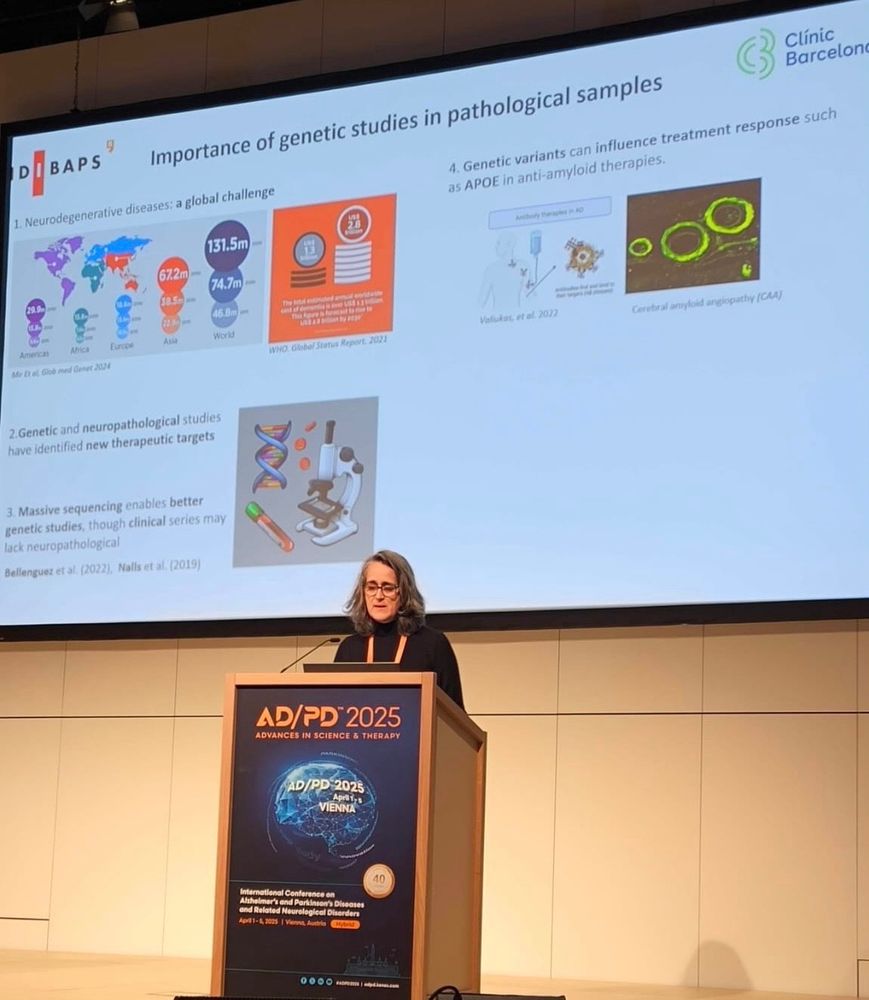
What a morning! Presenting the results of the study on the correlation between genetic risk variants for AD and PD and neuropathological findings of 831 patients from the Neurological Tissue Bank of @hospitalclinic.bsky.social @idibaps.bsky.social in collaboration #univmiami, at the #ADPDMeeting.
02.04.2025 11:15 —
👍 9
🔁 1
💬 1
📌 0
@Alz_ClinicBCN @hospitalclinic.bsky.social @idibaps.bsky.social
23.03.2025 11:36 —
👍 0
🔁 0
💬 0
📌 0
The 17q21.31 region, with its H1/H2 haplotypes and three large CNVs, is the strongest PSP risk locus. In this collaboration led by Wan-Ping Lee at UPENN. We found that increased γ copies are associated with higher PSP risk and altered gene expression.
pubmed.ncbi.nlm.nih.gov/40055946/
23.03.2025 11:36 —
👍 2
🔁 1
💬 1
📌 0