
We've just
launched a Discord server for #jsPsych users to collaborate and get technical help.
I'll be hosting office hours tomorrow from 10:30-11:30 AM EDT. Hop in with any questions!
discord.gg/RCKWJ4qb3p
We've just
launched a Discord server for #jsPsych users to collaborate and get technical help.
I'll be hosting office hours tomorrow from 10:30-11:30 AM EDT. Hop in with any questions!
discord.gg/RCKWJ4qb3p
I have a full course on R for Psychology and Neuroscience, which includes sample programs and lecture videos. Also has some recommended books on R programming. Perfect for beginners!
rworkshop.missouri.edu
🚀 We’re creating a PsychoPy Cheat Sheet to help students get started fast!
If you could give a new user one tip for their first 30 minutes with PsychoPy, what would it be?
We’d love your ideas! (They might even join our PsychoPy tips in the app 😉 )
💡👇

New paper day! Whereas earlier studies have shown that human eye movement patterns are influenced by the physical properties of remembered stimuli, we show that they are also influenced by stimulus meaning. h/t to Ali Pexsa (not on bluesky) who led this work.
tinyurl.com/4y4aev3a

I recorded a step-by-step tutorial of programming experiments in PsychoPy for undergrad thesis students in my lab. Sharing it here for anyone new to programming in psychology, or those transitioning to PsychoPy from other software. www.youtube.com/watch?v=CMJX...
20.06.2025 22:31 — 👍 41 🔁 17 💬 4 📌 1
Did you make a cool #OpenScience tool using Brain Map? Submit it to our community tools page!
Tools should use Brain Map resources, extend the use of data, provide new ways to access and analyze data, or support educational use.
Learn more and submit:
portal.brain-map.org/explore/tool...

Philosophy of Biology On PBS Stations | 13 x 26-Minute Episodes How can philosophy advance biology? How can biology influence philosophy? In this in-depth series on Philosophy of Biology, featuring pioneers and leaders of this burgeoning field, Closer to Truth explores its insights, novelties, challenges and implications. We ask evolution how life on earth came to be as it is, and how humans came to be as we are. We address biologically based issues, such as sex/gender, race, cognition, culture, morality, healthcare, religion, alien life, and more. When philosophy and biology meet, sparks fly as both are enriched. Why Philosophy of Biology? Philosophy of Biology has two sides: the process of science and the content of biology. We address key questions. What is the nature of life? How does evolution work and what are its challenges? How to consider race, sex/gender, cognition, culture, morality, healthcare, religion, alien life and alien intelligences. How Can Philosophy Probe Evolutionary Biology? Explore evolution, its scope and depth. How did life on earth come to be as it is, and how did humans come to be as we are? What are the deep principles driving evolution? What are evolution's challenges and open questions? PEDIGREE OF MAN. What are the Units or Levels of Selection? While evolution is how life on earth came to be, where does the evolution occur? At what level of the hierarchy of life - from genes to individuals to groups to species — does evolution work its selection magic? Is it multilevel? What is Evolutionary Developmental Biology? Two big ideas in biology: the evolution of species via mutation, fitness and natural selection; and the embryological development of individuals, from fertilized egg to whole organisms. How do these two big ideas-"Evo-Dev," as it's called—relate? What novel ideas emerge? How do Reductionism and Emergence Dance? Can biology be explained entirely in terms of chemistry and then physics? If so, that's "reductionism." Or are there…

What is Biological Information? What is information in biology? Information is essential for analyzing data and testing hypotheses. But what is information in molecular genetics and neuroscience? What in evolution, population genetics and levels of selection? Why is computational biology transformational? What is Human Nature? What is "human" nature? While human beings are animals, we believe we are special, radically different from other animals. Why? What traits are unique to humans? Are we sure? How to explore human nature from an evolutionary perspective? How did Cognition and Emotion Evolve? What can evolution reveal about the developmental history of thinking and feeling? How did cognition and emotion (affect) co-develop over evolutionary time? Can evolution help solve the mystery of consciousness? Can Philosophy Discern Sex & Gender? Sexual questions abound. What is "normal" sexual behavior in light of diverse sexual variations? LGBTQ+ issues? Is sex in animal models relevant for human sexuality? A philosophical perspective can provide clarity. Is Race Real? Race is obviously real — historically, socially, politically. What about biologically? We explore biological facts about race and their implications. What's the relationship between color and race? Are human races subspecies of homo sapiens? Is race a "natural kind?" How to form a coherent theory of race? Evolution vs. Religion: Anything New? Two kinds of questions probe evolution vs. religion. The first explores discrepancies, even contradictions, between the science of evolution and the beliefs of religion. The second examines how religion itself evolved. What does Transhumanism Foreshadow? Humanity's future is now framed by artificial intelligence (Al) and increasing interventions in the body to enhance features and functions. This is transhumanism. Considering the stakes, and the dangers, a philosophical perspective is imperative. What Would Alien Life & Intelligences Mean? What could life be as we do…

Contributors to CTT’s Philosophy of Biology series (alphabetically): Carol Cleland, Paul Davies, Richard Dawkins, Helen De Cruz, Terrence Deacon, John Dupre, Peter Godfrey-Smith, Paul Griffiths, Stuart Kauffman, Philip Kitcher, Norman Lents, Lisa Lloyd, Alan Love, Denis Noble, Martin Nowak, Samir Okasha, Massimo Pigliucci, Anya Plutynski, Rachell Powell, Alex Rosenberg, Michael Ruse, Elliott Sober, Quayshawn Spencer, Joshua Swamidass, Robert Trivers, Geoffrey West.
13 episodes in PBS's Closer to Truth series on the *Philosophy of Biology*, with a fantastic lineup of #philsci #hpbio #evobio speakers & topics, beginning with "Why Philosophy of Biology?"
Viewable on website
closertotruth.com/project/phil...
(via Alan Love) 🧪 #philsky
Lots of content out there about open science in psychology in terms of science *content*. Where is the conversation about open science *tooling* in psychology: I want to learn more about the research platforms, tools, ecosystems people are trying to build in?
15.06.2025 17:45 — 👍 19 🔁 5 💬 8 📌 0
Fiction as Cognitive Infrastructure: A Catalog A curated list of 50 fiction books that simulate advanced problem-solving cognition, inspired by the frameworks in David Jonassen’s Learning to Solve Complex Scientific Problems. Each book acts as a training ground for your hippocampus, prefrontal cortex, and metacognitive engine. The Martian by Andy Weir: Real-time constraint solving, chunking, hypothesis testing Anathem by Neal Stephenson: Philosophical simulation modeling, paradigm switching, epistemic transfer Permutation City by Greg Egan: Recursive self-modeling, metaphysical simulation, infinite logic loops Blindsight by Peter Watts: Collaborative cognition, knowledge gaps, epistemic rupture Contact by Carl Sagan: Cross-domain reasoning, information signal decoding Cryptonomicon by Neal Stephenson: Multi-domain modeling, logic puzzles, tactical monitoring House of Leaves by Mark Z. Danielewski: Ill-structured spatial modeling, ambiguity layering Cloud Atlas by David Mitchell: Fractal narrative structure, identity modeling Three-Body Problem by Liu Cixin: Simulation theory, chaotic system modeling Use of Weapons by Iain M. Banks: Temporal reversal, problem reframing, recursive causality The Fifth Head of Cerberus by Gene Wolfe: Representational ambiguity, identity modeling The Raw Shark Texts by Steven Hall: Symbolic reprogramming, narrative recursion Invisible Cities by Italo Calvino: Metaphorical city modeling, conceptual reframing The Dispossessed by Ursula K. Le Guin: Sociopolitical system modeling, constraint negotiation Flatland by Edwin A. Abbott: Dimensional reasoning, representational limits

Roadside Picnic by Arkady & Boris Strugatsky: Heuristic trial/error, black-box affordance sensing Engine Summer by John Crowley: Epistemic erosion, myth-based modeling The Left Hand of Darkness by Ursula K. Le Guin: Cultural model shifting, deep narrative reframing Catch-22 by Joseph Heller: Constraint paradox modeling, recursive logic loops The Player of Games by Iain M. Banks: Strategic abstraction, systemic game logic Gödel, Escher, Bach by Douglas Hofstadter: Self-reference, abstraction laddering The Book of the New Sun by Gene Wolfe: Reframed knowledge construction, conceptual recursion Exhalation by Ted Chiang: Scientific introspection, conceptual minimalism Pattern Recognition by William Gibson: Signal-noise parsing, ambiguity modeling The Trial by Franz Kafka: Problem detection under extreme ill-structure The Gone-Away World by Nick Harkaway: Epistemic collapse, reality filtering The Mezzanine by Nicholson Baker: Micro-metacognition, chunk-level problem mapping Life: A User’s Manual by Georges Perec: Nonlinear system modeling, object-oriented knowledge Pale Fire by Vladimir Nabokov: Narrative ambiguity, metarepresentational construction Remainder by Tom McCarthy: Recursive memory simulation, environmental modeling Lexicon by Max Barry: Linguistic schema control, identity manipulation The Intuitionist by Colson Whitehead: Representational paradigm conflict Einstein’s Dreams by Alan Lightman: Time-space constraint reimagination The Inheritance Trilogy by N. K. Jemisin: Power modeling, constraint reformation Version Control by Dexter Palmer: Temporal drift modeling, epistemic regret reasoning Little, Big by John Crowley: Slow epistemic layering, magical realism reframing Light by M. John Harrison: Fractured narrative modeling, temporal abstraction The Affirmation by Christopher Priest: Recursive identity ambiguity, memory modeling

City of Saints and Madmen by Jeff VanderMeer: Multi-source archive modeling, contradiction synthesis Amatka by Karin Tidbeck: Linguistic affordance decay, system fragility Diaspora by Greg Egan: Trans-human abstract modeling, deep recursive simulation The Investigation by Stanisław Lem: Statistical anomaly modeling, hypothesis rejection Embassytown by China Miéville: Symbolic mutation, linguistic affordance engineering Cloud and Ashes by Greer Gilman: Symbolic recursion, mythic structure modeling The Physicists by Friedrich Dürrenmatt: Role-switching, ethical modeling Engineered Worlds Vol. 1 by Gerry Canavan & Joseph Matheny (eds.): Socio-technical constraint systems Dark Matter by Blake Crouch: Multiverse schema branching The Gone World by Tom Sweterlitsch: Future-state reasoning, recursive uncertainty The Echo Maker by Richard Powers: Cognitive failure modeling, relational epistemology
A curated list of 50 fiction novels that simulate advanced problem-solving cognition
14.06.2025 14:55 — 👍 16 🔁 4 💬 2 📌 1Wrapping up #ica25 with @rzhprfshr.bsky.social presenting our work with @joebayer.bsky.social reviewing the research under the broad umbrella of “social connection”. And perfect timing because the paper was published TODAY at @natrevpsychol.nature.com 🥳 rdcu.be/erayE
16.06.2025 21:14 — 👍 38 🔁 16 💬 1 📌 0
Open Encyclopedia of Cognitive Science logo
It’s been an incredible year since launching the Open Encyclopedia of Cognitive Science (OECS), and we’re thrilled to celebrate its 100th article: “Shared Intentionality” by renowned developmental psychologist Michael Tomasello. Read it here: oecs.mit.edu/pub/sep9e3c2
#CogSci @oecs-bot.bsky.social
Pleased to announce my new open access paper out in Developmental Psychology:
The Development of the “First Thing That Comes to Mind”
with @xphilosopher.bsky.social and @ebonawitz.bsky.social
psycnet.apa.org/fulltext/2026-25569-001.html
#CogSci #PsychSciSki #DevSci
(1/10)
Thanks for all your interest in sharing cognitive psych teaching! There're 3 ongoing 🧵's now:
1️⃣ syllabus & general tips 👉 tinyurl.com/ktbrk7mm
2️⃣ useful videos 👉 tinyurl.com/z43hecdz
3️⃣ demos 👉 tinyurl.com/5n7pkp38
Check out these 🧵's & pls share your favorite resources! I'll share a complied list.
I am so excited to share that our paper 'A neural basis for distinguishing imagination from reality' is now published in @cp-neuron.bsky.social! 🧠✨ See thread below! doi.org/10.1016/j.ne...
05.06.2025 15:04 — 👍 179 🔁 67 💬 8 📌 8
We started a company to provide enterprise-level support for open-source statistical software @jaspstats.bsky.social . Our website with the mission and offers just went online!
Is your business paying large licensing fees for statistical software? Are you looking for a change? Check it out!

takes a village to raise a man
25.05.2025 17:19 — 👍 0 🔁 0 💬 0 📌 0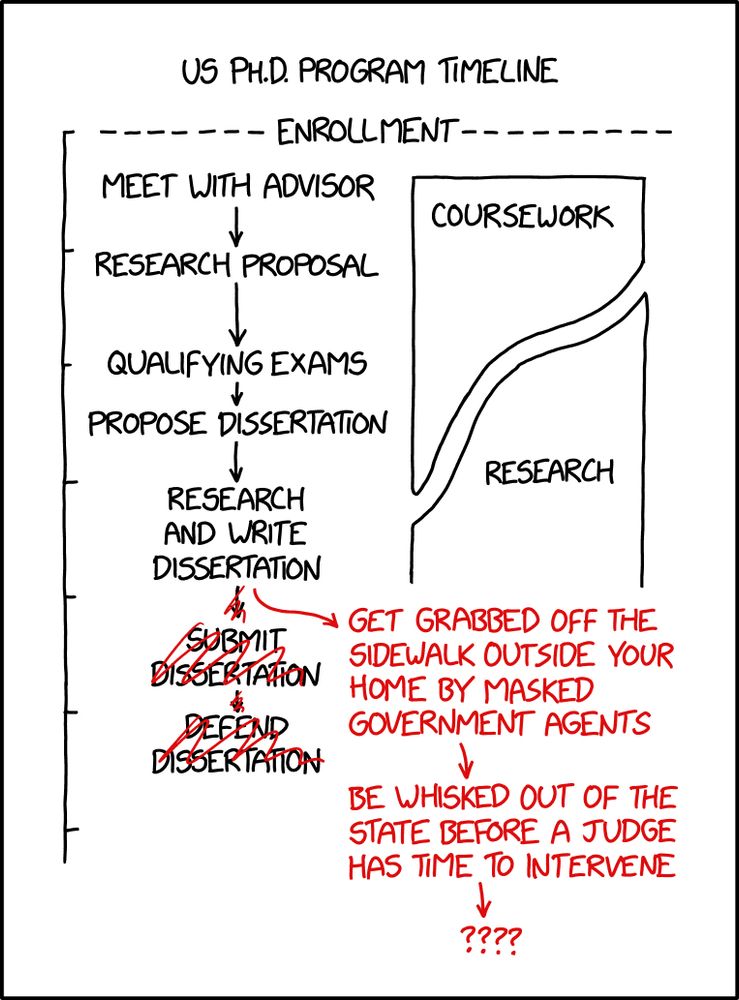
PhD Timeline xkcd.com/3081
25.04.2025 15:32 — 👍 60139 🔁 20580 💬 591 📌 831
Finally got around to incorporating all Github feedback on my open access textbook, making around 20 minor improvements, and updating some references. 17 chapters of state of the art stats and methods education, freely available for any course you teach. lakens.github.io/statistical_...
17.05.2025 15:58 — 👍 184 🔁 59 💬 6 📌 1
"the use and reference to ancestry informative markers, unless clearly explained, may be misinterpreted due to a sociogenetic essentialist bias as confirming the genetic basis of social groups" link.springer.com/article/10.1...
17.05.2025 08:10 — 👍 41 🔁 21 💬 0 📌 2i think there's probably a bigger replication crisis in India nobody wants to talk about here #PsychSciSky
15.05.2025 12:40 — 👍 0 🔁 0 💬 0 📌 0
sunset trees mountain river sky
15.05.2025 09:44 — 👍 1 🔁 0 💬 0 📌 0We don't use AI. One time AI unknowingly showed up in one of our stock photos we used and people correctly yelled at us until we took it down and figured out how it happened. We employ human artists who breathe and eat and make stuff with their corporeal limbs and brains.
07.05.2025 16:25 — 👍 2398 🔁 232 💬 29 📌 22
Any teachers with an interest in cognitive psychology (@cogscisci.bsky.social for example) should watch/listen to this @braininspired.bsky.social podcast with @prestonlab.bsky.social
www.youtube.com/watch?v=JRil...
Starts with...

Looking up some social psychology teaching resources and realised that the most succinct and accessible explanation of Festinger & Carlsmith's (1959) cognitive dissonance experiments ... is set to the tune of 'Torn' by Natalie Imbruglia: youtu.be/Mx-Sf0QoiLQ?...
14.03.2025 13:16 — 👍 15 🔁 5 💬 1 📌 0Post the amazing science things you have done with federal funding.
28.01.2025 20:51 — 👍 1554 🔁 603 💬 170 📌 317
Music and Science book cover featuring a listener with headphones
I'm proud to announce a new textbook for #musicscience titled "Music and Science: A Guide to Empirical Research". It covers methods in music psychology, empirical research, #openresearch & music computation in 298 pages. For details, see doi.org/10.4324/9781.... Codes at tuomaseerola.github.io/emr/
25.11.2024 12:47 — 👍 74 🔁 34 💬 6 📌 4
A lot of #psychology teachers find teaching split-brain research challenging (understandably!), so I was pleased to be able to contribute a guide to teaching them to the BPS teachers toolkit @bpsofficial.bsky.social @bps-dartp.bsky.social
www.bps.org.uk/member-netwo...
#UKEd #Edusky

Algorithmic Design: Lasse Hansen Research & Layout: Lasse Damgaard Posters: lassedamgaard.redbubble.com
#MedSky🧪 #NeuroSky #academicsky #publichealth The Cognitive Disorder Atlas @sciencenews.bsky.social
imgur.com/vmnMjhU
See here for the health psychology researchers starter pack #1: go.bsky.app/9Xfk7Wo
28.12.2024 05:17 — 👍 8 🔁 3 💬 0 📌 0