
fuck, I’m sorry, I can’t compete with this
03.03.2026 13:29 — 👍 17701 🔁 4067 💬 53 📌 837fuck, I’m sorry, I can’t compete with this
03.03.2026 13:29 — 👍 17701 🔁 4067 💬 53 📌 837
Crying face wojack says "Professor won't you please answer your emails -- at least look in your inbox, it's part of your job" is being responded to by a wojack version of me that is just saying "No, I'm scared."
Sometimes it do be like that
22.02.2026 19:10 — 👍 477 🔁 32 💬 11 📌 1thank u 😌😌😌
22.02.2026 19:42 — 👍 2 🔁 0 💬 0 📌 0
My bluesky search for Emily Tilton brings two responses, the second of which is from the philosopher and the first of which is from an erotic fiction blog writing about the author Emily Tilton's anal sex fiction.
Coda: in fact in making OP I even ran into the issue.
22.02.2026 10:05 — 👍 15 🔁 1 💬 0 📌 0
DISAMBIGUATION There is a reason I publish as 'Emily C. R. Tilton' and not just 'Emily Tilton'. There is another Emily Tilton who publishes erotic novels. If you google my name, many of her books come up. This disambiguation section serves to emphasize that I did not write these books. Given my interest in (feminist) sexual ethics, I think this coincidence is extremely funny. My favorite plotline is from her book Bought and Trained: women sign up for a concubine training program and (consensually) have their memory of consenting to this program erased. You can read the blurb for this book here. I have not actually read this book and so cannot recommend more than the blurb. I recognize that this particular storyline puts some pressure on my insistence that I did not write this book--the plotline reads like a philosopher's thought experiment. This is part of why I am so amused by this coincidence.
Philosopher @nippleslipple.bsky.social has one of my favourite websites in the discipline just for this (emilytilton11.wixsite.com/website/disa...).
22.02.2026 10:05 — 👍 105 🔁 18 💬 6 📌 0
i accidentally let my old domain expire and now a strange AI website has popped up in its place (🤪) so now I have a new website 😬
emilytilton11.wixsite.com/website

A brief observation on the relationship between antecedent status and reviewing incentives. Liam Kofi Bright ABSTRACT It is often believed that academics are especially harsh in their evaluation of work that critiques their own ideas. I dispute that claim. Rather, I say, consideration of the credit incentives for academics reviewing critique of their own work should lead us to expect them to typically be particularly generous to critique of their own work.
In what many are calling the most CV efficient strategy ever, I have my 2026 paper out already (relax for the rest of the year comrades!) and it's actually a bit of a joke one. Link here: www.tandfonline.com/doi/full/10.... and abstract attached. But I'll just tell the story of how it came to be....
22.01.2026 06:51 — 👍 125 🔁 25 💬 14 📌 5
I am a humanist in the following vague sense. I have great faith in people's capacity to peacefully come together and do better than we've thus far done. Not only do I hope for a better world that we can all share in, but I think such could be created by our own hands working in unison. I think that to a far greater extent than we presently do, we could arrange ourselves by rationally and collectively deliberating as equals to decide upon our purposes and means of satisfying those. This could be achieved, I think, in a way that would not only be consistent with the real freedom to be eccentric and think differently, but would to a significant degree enhance such liberties as we have managed to secure under the present socio-economic arrangement.

I think that our traditions of literary and artistic production are valuable in moving us towards this world. They refine our sensibilities, help us engage in empathetic identification, and vividly present both ideals and object lessons for us to learn from directly. Only those last need be directly political, the first two can often be achieved (may even be best achieved) by ostensibly apolitical works, which avoid didactically insisting upon some moral. For instance, the Miyazaki film Kiki's Delivery Service does wonders for encouraging empathy and solidarity and a kind of feminism, without this being the obvious or overt "message" of the film.

That such things are useful is, to me, a consequence of a more general belief that there can be suasion by moral charisma and ostentatious decency. Beyond the more indirect methods of artistic moral suasion, there is also an importance to direct moral appeal. Doing this requires speaking hard truths to power, and making those who wield authority feel the human stakes of their actions. On such occasions what matters is the ability to bring emotionally affecting messages to bear in support of rationally supported action. This comes from a kind of Sentimentalist meta-ethics and theories of rhetoric I take to be grounded in various humanistic traditions of thought: I hope we can properly align the emotional cadence of one's message to the appropriate or fitting response that will benefit as many people as possible as much as possible. Ethical theory as well as aesthetic, psychological, and sociological analysis, will all play its role in doing this well.
I found an old blog post in drafts that I decided to modify somewhat and put out - my own little plea for humanism, why I self-describe and generally consider myself a humanist. Not sure if anyone else will care, but fwiw here it is.
sootyempiric.blogspot.com/2018/06/the-...
thinking about this excellent paper and the danger of the epistemic mission civilatrice, in which one engages with another viewpoint in order to convert its adherents, while firmly committed to not being converted oneself
[this has been an exercise in sticking "epistemic' in front of things]
ahh I'm glad you like the paper! :)
27.12.2025 17:11 — 👍 1 🔁 0 💬 0 📌 0
woo! this weird little paper (‘moorean skepticism’) is now forthcoming :) i argue we should see descartes as a social epistemologist and moore as a particularly pessimistic kind of skeptic.
you can check it out here: philpapers.org/rec/TILMSW
bsky.app/profile/nipp...
this paper also seems relevant to the discussion, especially the part about the smug "everyone thinks that" tone
Want to read some rad queer philosophy, in the form of short snazzy personal essays? Check out the most recent issue of the APA Studies in LGBTQ+ Philosophy, cheekily titled "Make philosophy queer again!" which I've edited! 1/
23.10.2025 18:48 — 👍 31 🔁 19 💬 1 📌 2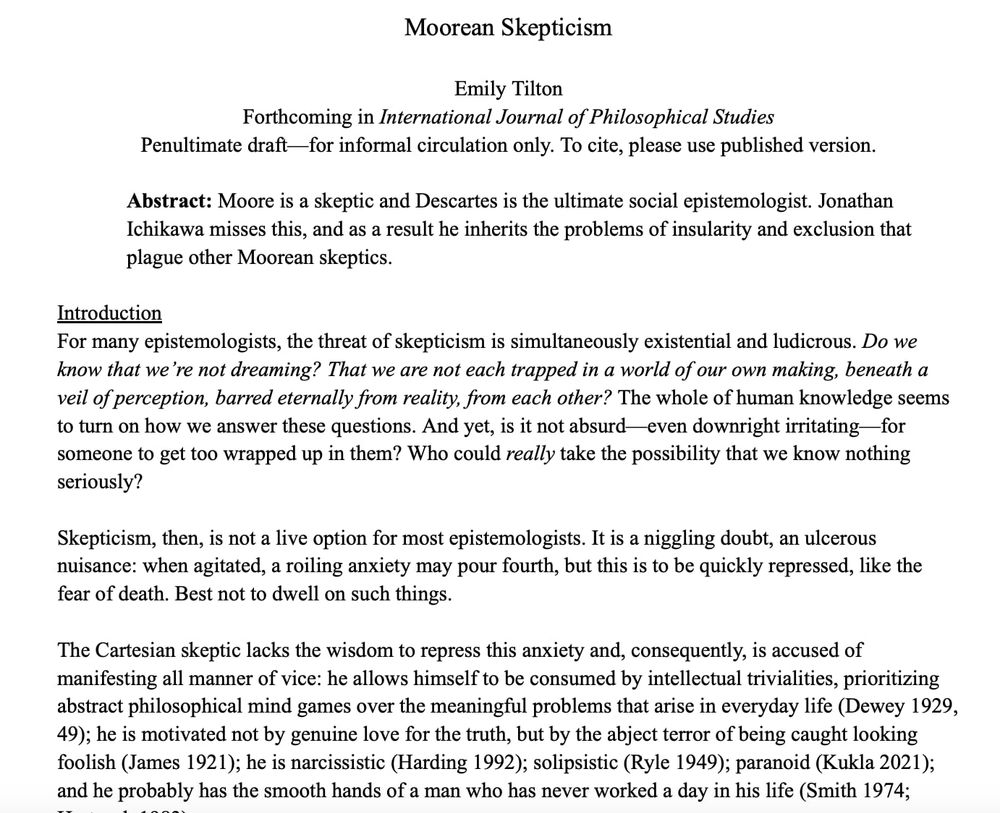
Moorean Skepticism Emily Tilton Forthcoming in International Journal of Philosophical Studies Penultimate draft—for informal circulation only. To cite, please use published version. Abstract: Moore is a skeptic and Descartes is the ultimate social epistemologist. Jonathan Ichikawa misses this, and as a result he inherits the problems of insularity and exclusion that plague other Moorean skeptics. Introduction For many epistemologists, the threat of skepticism is simultaneously existential and ludicrous. Do we know that we’re not dreaming? That we are not each trapped in a world of our own making, beneath a veil of perception, barred eternally from reality, from each other? The whole of human knowledge seems to turn on how we answer these questions. And yet, is it not absurd—even downright irritating—for someone to get too wrapped up in them? Who could really take the possibility that we know nothing seriously? Skepticism, then, is not a live option for most epistemologists. It is a niggling doubt, an ulcerous nuisance: when agitated, a roiling anxiety may pour fourth, but this is to be quickly repressed, like the fear of death. Best not to dwell on such things. The Cartesian skeptic lacks the wisdom to repress this anxiety and, consequently, is accused of manifesting all manner of vice: he allows himself to be consumed by intellectual trivialities, prioritizing abstract philosophical mind games over the meaningful problems that arise in everyday life (Dewey 1929, 49); he is motivated not by genuine love for the truth, but by the abject terror of being caught looking foolish (James 1921); he is narcissistic (Harding 1992); solipsistic (Ryle 1949); paranoid (Kukla 2021); and he probably has the smooth hands of a man who has never worked a day in his life (Smith 1974; Hartsock 1983).
mostly, though, this paper is a response to @jichikawa.bsky.social’s book epistemic courage. i argue that epistemic courage may not be as virtuous (and skepticism may not be as vicious!) as jonathan suggests.
23.10.2025 16:58 — 👍 14 🔁 1 💬 0 📌 0
woo! this weird little paper (‘moorean skepticism’) is now forthcoming :) i argue we should see descartes as a social epistemologist and moore as a particularly pessimistic kind of skeptic.
you can check it out here: philpapers.org/rec/TILMSW
 18.10.2025 20:03 —
👍 35
🔁 6
💬 0
📌 0
18.10.2025 20:03 —
👍 35
🔁 6
💬 0
📌 0

quotes from cybertruck owners
We wanted to know what it was like to own a Cybertruck. So @zoeschiffer.bsky.social went to the desert got this absolutely amazing quotes (and Michelle Groskopf took the pictures!) www.wired.com/story/owning...
16.10.2025 11:24 — 👍 7196 🔁 1257 💬 262 📌 379
Fanone gets it: Opposition to political assassinations includes people whose views have no redeeming qualities, like Charlie Kirk.
Sugarcoating his views not only is dishonest in itself, it conveys that maybe you wouldn't oppose assassination of people whose views you don't sugarcoat.
[reading a story about a guy who annoyed everyone so much he was sentenced to death by acclamation]
philosophers: this is a story about a guy being cool
subscribe to my newsletter. i am the only journalist brave enough to read the About section of centrist think tanks.
stringinamaze.net/subscribe
One of the most pernicious delusions social media spreads in our age faux-populism is that there is an alternative to having an ‘expert class’. There is not. Yes, they can have biases. Yes, they can be wrong. Yes, they can even be corrupt. There still is no alternative. The world is complicated.
27.08.2025 19:55 — 👍 475 🔁 87 💬 14 📌 9shout out to dan greco for letting me keep this in here 😂
26.08.2025 15:12 — 👍 5 🔁 0 💬 0 📌 0hahaha thank you that part also makes me laugh 😂
26.08.2025 05:31 — 👍 1 🔁 0 💬 0 📌 0yay!
25.08.2025 23:16 — 👍 1 🔁 0 💬 0 📌 0
i argue that:
1) impurist epistemologies are not more socially engaged just because they “make space” for social, moral, and political factors in ways purists do not,
2) comparing standpoint theory and moral/pragmatic encroachment is unhelpful, and
3) feminists’ aversion to purism is misplaced

Abstract: An emerging narrative links the rise of social epistemology with the decline of a purist epistemological orthodoxy. The thought that motivates this narrative is that impurist epistemologies make space for social, moral, and pragmatic considerations, where purist epistemologies do not, which transforms epistemology from something that was once overly idealized and abstract into something that makes meaningful contact with the social realities of knowledge. Despite the intuitive appeal of this narrative, I argue that it owes its plausibility to a lack of conceptual clarity. When we more clearly articulate the contours of the purist orthodoxy, we see that i) different varieties of impurism make space for social, moral, and pragmatic considerations in importantly different ways, which complicates how this set of views hangs together, and ii) even the strictest of purists can attend to social, moral, and pragmatic factors in the sense necessary for producing socially-engaged epistemology.
Yay! This paper on impurist epistemology and the social turn is now forthcoming at Philosophy Compass :)
You can check it out here! philpapers.org/rec/TILIEA
honestly A+ trolling of Daniel Kodsi
29.07.2025 15:55 — 👍 9 🔁 2 💬 3 📌 0“please look over the proofs” i’m sure they’re fine
28.07.2025 11:31 — 👍 98 🔁 5 💬 7 📌 0But in its actual content I think it's true & important: retaining the ability to see a behaviour as actually anti social and worthy of condemnation, without writing off the person engaged in the behaviour as unworthy of any support or incapable of improvement, is morally foundational. Vital.
26.07.2025 08:53 — 👍 71 🔁 9 💬 3 📌 1