a close up of a cat 's face with red eyes .
Alt: A close up of a cat's face with heart eyes (Cat heart GIF)
Thanks to all the coauthors!
This was a major collective effort, led by @mdemartino.bsky.social and @claottoni.bsky.social, and involving many collaborators in Europe and other regions. @erc.europa.eu #ercfelix @naturalsciences-be.bsky.social #NationalGeographic #aDNA #cats🐈🐈⬛
28.11.2025 20:45 — 👍 1 🔁 0 💬 0 📌 0

meme of a cat making the popular Italian gesture, also known as the “Blursed Italian Cat” in Reddit.
The full story of how cats became our global companions is still unfolding… and we’re getting close 🫣
28.11.2025 20:45 — 👍 0 🔁 0 💬 1 📌 0
But big gaps remain! Right now, the genetic diversity of North African and Levant wildcats is represented by just five individuals from Morocco, Tunisia, and Israel. More ancient and modern genomes are needed, especially from Egypt, a key and yet uncovered region 🗝️
28.11.2025 20:45 — 👍 0 🔁 0 💬 1 📌 0
Altogether, our findings point to a broader, more complex domestication process that may have involved multiple regions, multiple cultures and multiple wildcat populations 🌍
28.11.2025 20:45 — 👍 0 🔁 0 💬 1 📌 0

a large group of soldiers are lined up in rows
Alt: A large group of cat soldiers are lined up in rows (Roman army cat GIF)
⏱️The earliest European domestic cat genomes appeared at multiple Roman imperial sites across Italy, Austria, Serbia, and England, suggesting that the Romans imported cats and spread them rapidly through their vast commercial and military networks
28.11.2025 20:45 — 👍 1 🔁 0 💬 1 📌 0
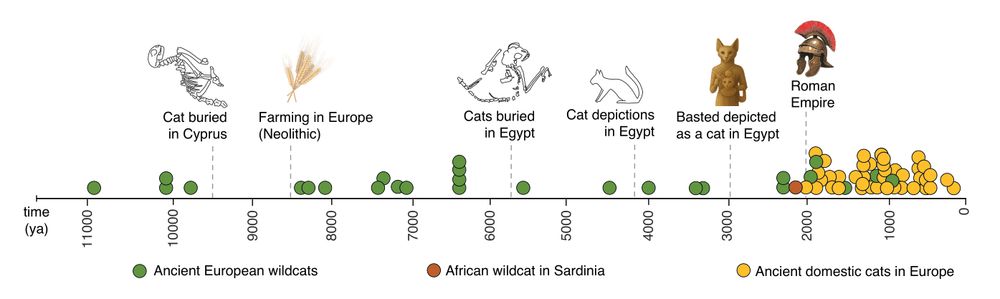
Timeline of cat dispersal in Europe. Ancient genomes are shown as filled circles with European wildcats in green, domestic cats in yellow and the African wildcat found in Sardinia in red. The African wildcat sample found in Sardinia dates back to the second century BCE. Domestic cats appear in Europe only during the last 2000 years.
Modified from the article
So, domestic cats arrived in Europe only 2000 years ago! This means millennia after the Neolithic, and most likely from North Africa rather than the Levant 😳
28.11.2025 20:45 — 👍 0 🔁 0 💬 1 📌 0

Map showing the present-day distribution of the European and North African wildcats modified from the IUCN. The red arrow shows that Northwest African wildcats were introduced to Sardinia and the yellow arrow shows that all domestic cats in Europe were introduced from North Africa.
Modified from the article.
1️⃣First, cats from Northwest Africa were brought to Sardinia, where they founded the island’s present-day wildcat population.🐈
2️⃣Then, a later dispersal event, around 2,000 years ago, was responsible for the introduction of domestic cats from North Africa into Europe.🐈⬛
28.11.2025 20:45 — 👍 0 🔁 0 💬 1 📌 0
So, what did we learn? 🧐
Our results suggest that at least two genetically distinct cat populations were introduced to Europe between 2000 and 3000 years ago :
28.11.2025 20:45 — 👍 0 🔁 0 💬 1 📌 0

Map of Europe, Anatolia and North Africa showing the location of the samples we analysed. The legend shows that these samples range from the final Mesolithic until present-day.
Modified from the figure 1 of the article.
We analysed 70 ancient cat genomes from Europe and Anatolia, spanning the last 11000 years. We also generated 17 low- to mid-coverage genomes from modern and museum specimens of wildcats across Italy (including Sardinia), Bulgaria, and North Africa 🗺️
28.11.2025 20:45 — 👍 0 🔁 0 💬 1 📌 0

Frame from the 1970 Walt Disney movie, The Aristocats, showing the two adult cats, Duchess and O’Malley with the three kittens, Berlioz, Marie and Toulouse, sitting on a sofa.
People love cats !!!😻 They are globally distributed and among the most popular pets, yet, as familiar as these creatures are, the timing and circumstances of their domestication and dispersal remain uncertain🤔
28.11.2025 20:45 — 👍 0 🔁 0 💬 1 📌 0

Cover of the vol. 390, issue n°6776 of Science (AAAS) featuring a shorthair domestic cat.
🚨NEW pub in @science.org !!!🚨
🐈⬛🐈 The dispersal of domestic cats from North Africa to Europe around 2,000 years ago 🐈⬛🐈
Our article provides novel evidence suggesting new hypotheses about the history of domestic cats!🧬
🧵
28.11.2025 20:45 — 👍 6 🔁 3 💬 1 📌 0