In summary, our work demonstrates that RPA exhaustion can activate SLFN11-dependent cell death in response to replication stress induced from diverse sources and across multiple different cancer cell types. Our work could help explain why SLFN11 is silenced in half of all cancer cell lines. (9/9)
09.01.2026 14:42 —
👍 1
🔁 0
💬 0
📌 0

We utilised QIBC to demonstrate that ST1926 potently induces RPA exhaustion, in line with previous work. ST1926 activated ATF4, an ISR-regulated transcription factor, in a SLFN11-dependent manner. Importantly, ATF4 activation was predominantly observed in cells undergoing RPA exhaustion. (8/9)
09.01.2026 14:42 —
👍 1
🔁 0
💬 1
📌 0

Finally, we wanted to determine whether RPA exhaustion was a general mechanism to induce SLFN11 activation. By screening various DNA damaging agents and inhibitors of DDR proteins, we found that ST1926, an inhibitor of DNA polymerase alpha, potently induced SLFN11-dependent cell death. (7/9)
09.01.2026 14:42 —
👍 0
🔁 0
💬 1
📌 0

Further, we induced RPA exhaustion by performing a titration of siRNA targeting RPA2, which led to a SLFN11- and GCN2-dependent sensitisation of PrimPol KO cells to cisplatin. (6/9)
09.01.2026 14:42 —
👍 0
🔁 0
💬 1
📌 0

We hypothesised that RPA exhaustion could activate SLFN11 and promote apoptosis through engagement of SLFN11 with ssDNA. Using an established QIBC technique, we found that PrimPol KO cells exhibited higher rates of RPA exhaustion. (5/9)
09.01.2026 14:42 —
👍 0
🔁 0
💬 1
📌 0

We found that the ssDNA binding activity of SLFN11 was required to confer cisplatin sensitivity when repriming was inactivated, which correlated with how PrimPol KO cells were particularly sensitive to loss of the RPA heterotrimeric complex when challenged with cisplatin. (4/9)
09.01.2026 14:42 —
👍 0
🔁 0
💬 1
📌 0

Our work discovered that loss of the primase-polymerase PrimPol conferred cisplatin sensitivity only in cell lines that express SLFN11. When repriming is inactivated, cisplatin induces ssDNA accumulation at stalled replication forks, leading to SLFN11- and ISR (GCN2)-dependent apoptosis. (3/9)
09.01.2026 14:42 —
👍 0
🔁 0
💬 1
📌 0

SLFN11 is a tRNA nuclease that induces p53-independent apoptosis in response to DNA damage. Half of all annotated cancer cell lines have lost SLFN11 expression, leading to chemoresistance and high tolerance of replication stress. However, how DNA damage activates SLFN11 has remained unclear. (2/9)
09.01.2026 14:42 —
👍 2
🔁 0
💬 1
📌 0
Client Challenge
We are excited to share that our latest work from the lab aimed at understanding how the tRNA nuclease SLFN11 is activated in response to DNA damage and replication stress has just been published in @natcellbio.nature.com!
Open access link: www.nature.com/articles/s41...
(1/9)
09.01.2026 14:42 —
👍 36
🔁 12
💬 1
📌 2
‼️ Excited to share our new paper out now in @science.org ‼️
We describe a new tetrameric RAD51 paralog complex – XRCC3-RAD51C-RAD51D-XRCC2 – which caps the end of RAD51 filaments.
Link: www.science.org/doi/epdf/10....
Thread ⬇️ (1/8)
07.11.2025 10:15 —
👍 79
🔁 19
💬 1
📌 2
New preprint from the lab led by @ssegurabayona.bsky.social identifying SLFN11 activity as a barrier to ALT establishment.
11.09.2025 08:17 —
👍 4
🔁 0
💬 0
📌 0
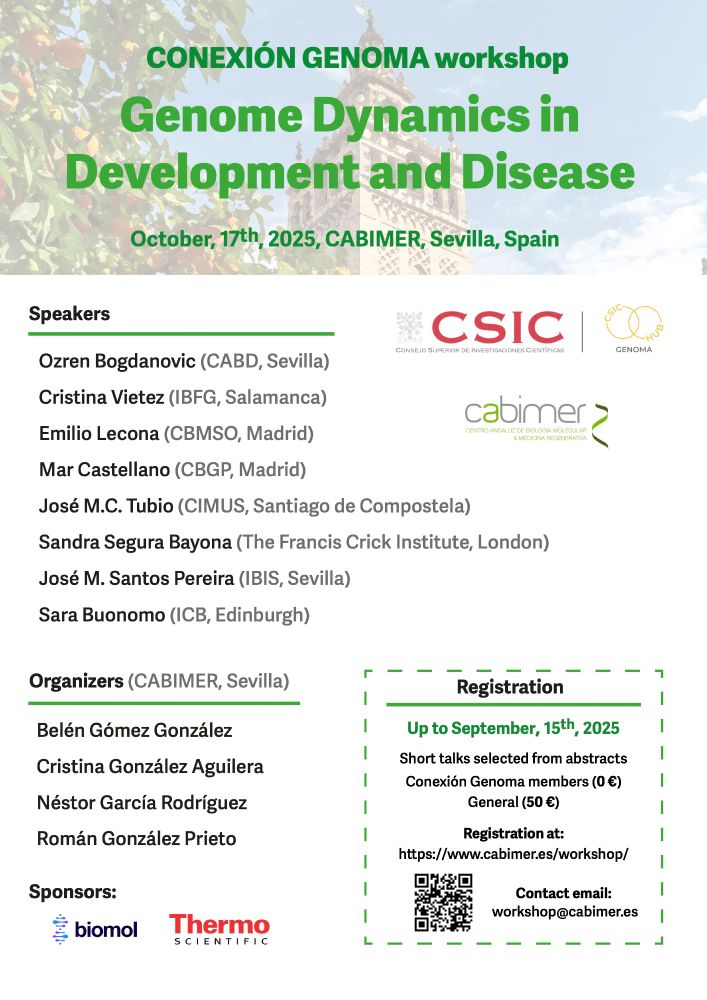
Save de date! Join us at @cabimer.bsky.social on October 17th for the @GenomaHubCSIC Workshop in "Genome Dynamics in Development and Disease". Slots available for talks! Registration opens soon!!
30.05.2025 12:44 —
👍 7
🔁 8
💬 0
📌 1
Chemical biology: www.linkedin.com/jobs/view/42...
Cell biology: www.linkedin.com/jobs/view/42...
Structural biology: www.linkedin.com/jobs/view/42...
27.05.2025 21:52 —
👍 0
🔁 0
💬 0
📌 0
We are looking to recruit three posts at the @crick.ac.uk in structural biology, cell biology, and pharmacology to join a 20+ strong multidisciplinary team focused on delivering the first precision medicines for the treatment of ALT cancers. Interested? Please check out the advertised jobs below:
27.05.2025 21:52 —
👍 3
🔁 4
💬 1
📌 0