We are hiring on the IBM Core AI team. Feel free to DM me. 🙂 Job posting form - forms.gle/zZ2FHDg5sPVq...
Our group builds the technology that makes agentic AI reliable, observable, and governable at enterprise scale, with open research and tooling for evaluating agents and improving them.
03.12.2025 22:13 —
👍 3
🔁 1
💬 0
📌 0

After nearly a decade in academia, I am thrilled to share my next chapter: I am joining IBM as an AI Architect in the new Core AI group.
We are building an AgentOps platform to observe, evaluate, and optimize enterprise AI agents and we are hiring. DM me if interested.
17.11.2025 19:32 —
👍 14
🔁 1
💬 3
📌 0
Very happy for this to finally be published! We developed new machine learning methods for scalable mapping of synaptic connectivity using holographic optogenetics and compressed sensing.
www.nature.com/articles/s41...
29.09.2025 19:26 —
👍 19
🔁 4
💬 1
📌 0
We present our preprint on ViV1T, a transformer for dynamic mouse V1 response prediction. We reveal novel response properties and confirm them in vivo.
With @wulfdewolf.bsky.social, Danai Katsanevaki, @arnoonken.bsky.social, @rochefortlab.bsky.social.
Paper and code at the end of the thread!
🧵1/7
19.09.2025 12:37 —
👍 17
🔁 12
💬 2
📌 0

Two flagship papers from the International Brain Laboratory, now out in @Nature.com:
🧠 Brain-wide map of neural activity during complex behaviour: doi.org/10.1038/s41586-025-09235-0
🧠 Brain-wide representations of prior information in mouse decision-making: doi.org/10.1038/s41586-025-09226-1 +
03.09.2025 16:22 —
👍 124
🔁 69
💬 2
📌 12
Excited to co-organize our NeurIPS 2025 workshop on Foundation Models for the Brain and Body!
We welcome work across ML, neuroscience, and biosignals — from new approaches to large-scale models. Submit your paper or demo! 🧠 🧪 🦾
11.07.2025 19:51 —
👍 8
🔁 1
💬 0
📌 0
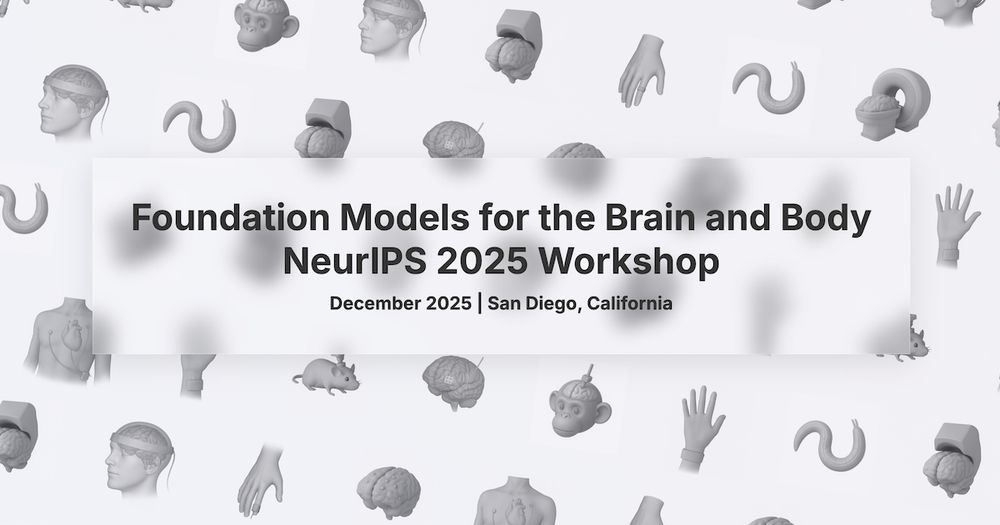
Excited to announce the Foundation Models for the Brain and Body workshop at #NeurIPS2025! 🧠📈 🧪
We invite short papers or interactive demos on AI for neural, physiological or behavioral data.
Submit by Aug 22 👉 brainbodyfm-workshop.github.io
11.07.2025 17:01 —
👍 33
🔁 10
💬 0
📌 3
Neural Encoding and Decoding at Scale (NEDS) is now accepted to @icmlconf.bsky.social as a spotlight (top 2.6%)! 🧠 🧪
02.05.2025 15:17 —
👍 11
🔁 3
💬 0
📌 0
Super cool. 😀 Exciting to see the practical use cases of electrical stimulation for treating neurological disorders
01.05.2025 15:36 —
👍 4
🔁 0
💬 0
📌 0
We’re hiring postdocs to join my lab at UNC. If you’re interested in adolescence, brain, and social development, DM me. Our work incorporates fMRI, social media, and longitudinal methods. We study risks and opportunities in adolescence. If you’re at #SRCD2025 and want to meet, please reach out!
30.04.2025 19:31 —
👍 62
🔁 42
💬 1
📌 0
I asked "on the other platform" what were the most important improvements to the original 2017 transformer.
That was quite popular and here is a synthesis of the responses:
28.04.2025 06:47 —
👍 204
🔁 43
💬 4
📌 3
Whoever is at the @iclr-conf.bsky.social workshops, feel free to reach out to meet! Looking for fun neuro conversations since there aren’t any neuro workshops 😢
27.04.2025 01:54 —
👍 3
🔁 0
💬 0
📌 0
POYO+
POYO+: Multi-session, multi-task neural decoding from distinct cell-types and brain regions
Scaling models across multiple animals was a major step toward building neuro-foundation models; the next frontier is enabling multi-task decoding to expand the scope of training data we can leverage.
Excited to share our #ICLR2025 Spotlight paper introducing POYO+ 🧠
poyo-plus.github.io
🧵
25.04.2025 22:14 —
👍 44
🔁 10
💬 1
📌 1
It’s been great working with you 😄
22.04.2025 00:18 —
👍 2
🔁 0
💬 1
📌 0
@steinmetzneuro.bsky.social
21.04.2025 17:57 —
👍 0
🔁 0
💬 0
📌 0
Eva Dyer, Chandramouli Chandrasekaran, Nicholas A. Steinmetz, and Liam Paninski (ran out of characters!)
21.04.2025 17:34 —
👍 1
🔁 0
💬 1
📌 0
Han Yu (@hanyu42.bsky.social)
Ph.D. student at Columbia Center for Theoretical Neuroscience
This work was led by @hanyu42.bsky.social who tirelessly worked to make this possible. In collaboration with Hanrui Lyu, Ethan Yixun Xu, @mostsquares.bsky.social, @kenjilee.bsky.social, Fan Yang, Andrew M. Shelton, Shawn Olsen, Sahar Minavi, Olivier Winter, @intlbrainlab.bsky.social, and
21.04.2025 17:34 —
👍 1
🔁 0
💬 1
📌 0
We are still working on the codebase and aim to release a tool soon that users can download, fine-tune, and apply to their own datasets!
21.04.2025 17:34 —
👍 2
🔁 0
💬 1
📌 0

We evaluate NEMO on brain region localization by predicting the region of individual neurons (and nearby groups) using only the extracted features, and compare it to baseline methods.
NEMO again outperforms both the VAE-based and supervised approaches.
21.04.2025 17:34 —
👍 0
🔁 0
💬 1
📌 0

We scale NEMO to the full IBL Brain-Wide Map dataset: 675 insertions from over 100 animals, yielding 37,017 high-quality neurons.
Without using any labels, NEMO's features align closely with anatomical regions and are consistent across labs.
21.04.2025 17:34 —
👍 0
🔁 0
💬 1
📌 0


We benchmark NEMO against two SOTA cell-type classification methods, PhysMAP and a VAE (Beau et al., 2025), using two optotagged datasets from the mouse cerebellum and visual cortex.
NEMO outperforms all baselines, including fully supervised models, with minimal fine-tuning.
21.04.2025 17:34 —
👍 0
🔁 0
💬 1
📌 0

We construct a paired dataset of spike trains and waveforms for all neurons, transforming spiking activity into an ACG image (Beau et al., 2025) that captures autocorrelation across firing rates.
NEMO is trained to align ACGs and waveforms in a shared embedding space.
21.04.2025 17:34 —
👍 0
🔁 0
💬 1
📌 0

In vivo cell-type and brain region classification via multimodal...
Current electrophysiological approaches can track the activity of many neurons, yet it is usually unknown which cell-types or brain areas are being recorded without further molecular or...
Building on current multimodal cell-type classification methods (Lee et al. 2024 and Beau et al. 2025), we introduce a contrastive learning method for spiking activity and extracellular waveforms called NEMO. 🐟
Paper: Paper: openreview.net/forum?id=10J...
Website: ibl-nemo.github.io
21.04.2025 17:34 —
👍 5
🔁 0
💬 1
📌 0
Thrilled to share our state-of-the-art method for in vivo cell-type classification and brain region localization, NEMO, which is now now a spotlight at @iclr-conf.bsky.social !
We use NEMO to characterize the electrophysiological diversity of cell-types across the entire mouse brain. 🐭 🧪 🧠
21.04.2025 17:34 —
👍 70
🔁 19
💬 1
📌 2
Redirecting
Agreed! But here's a note of caution: in the brain, different behavioral contexts can engage completely different neurons! Julie Lee in our lab published this in 2022 (and I'm still digesting the implications).
"Task specificity in mouse parietal cortex"
www.cell.com/neuron/fullt...
18.04.2025 21:32 —
👍 8
🔁 2
💬 2
📌 0
Wow, this is fascinating. Thanks for sharing!
19.04.2025 00:20 —
👍 0
🔁 0
💬 0
📌 0
This point is really important. We will need to train models across diverse behavioral contexts, rather than over-interpreting results from a single experimental setup or task!
18.04.2025 18:02 —
👍 2
🔁 0
💬 1
📌 0
Totally agree. Data is the bottleneck in neuroscience, and far more costly than compute.
But if we find that performance saturates with more data, it might reflect under-parameterized models. So both are key to interpret scaling.
18.04.2025 16:02 —
👍 6
🔁 0
💬 0
📌 1
@mehdiazabou.bsky.social and I have discussed this a lot and he has given me a lot of good feedback on this topic.
18.04.2025 15:02 —
👍 2
🔁 0
💬 0
📌 0
The Chinchilla paper (Training Compute-Optimal Large Language Models, Hoffmann et al., 2022) is widely regarded as a gold standard for empirically characterizing and optimizing scaling laws for large language models - arxiv.org/pdf/2203.15556
18.04.2025 15:00 —
👍 1
🔁 0
💬 1
📌 0


