Illustration of people interacting with light bulb flowers on a plant.
"Grow Your Own" (GYO) programs were created to encourage members of local communities to become teachers: aiming to address shortages and increase diversity within the profession. Researchers offer new ways to measure the effectiveness of such programs: bit.ly/3IcXMwz.
26.09.2025 15:02 —
👍 0
🔁 1
💬 1
📌 0

“Grow Your Own” (GYO) programs have emerged as a new approach to expanding teacher supply, addressing localized shortages, and diversifying the profession. However, little is known about the scale and design of GYO programs, which recruit and support individuals from the local community to become teachers. We conduct a quantitative content analysis of 94 GYO initiatives and find that “GYO” is an umbrella term used to describe teacher pipeline programs with very different purposes, participants, and program features. Although nearly all GYO initiatives aim to increase local supply, far fewer offer programming aligned with reducing shortages in hard-to-staff subjects and schools, increasing diversity, and improving effectiveness. We propose a new classification scheme to facilitate more precise discussions of GYO programs.
My paper with @matthewakraft.com describing the variety of Grow Your Own teacher programs nationally is out in print in @erjournal-aera.bsky.social!
EdResearcher: journals.sagepub.com/doi/10.3102/...
Open Access: edworkingpapers.com/sites/defaul...
04.09.2025 13:06 —
👍 14
🔁 3
💬 0
📌 0
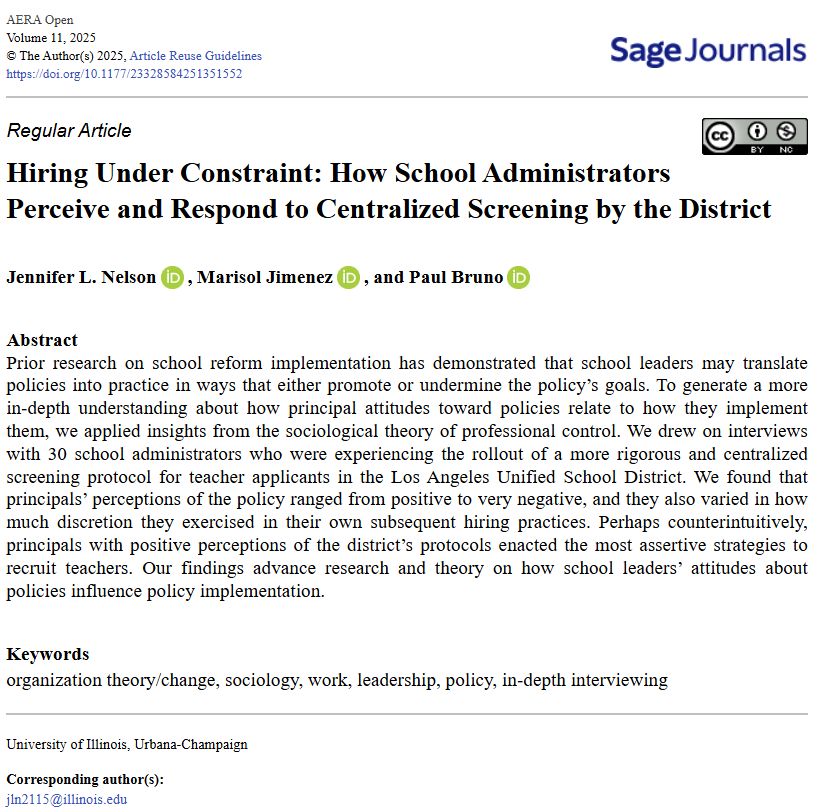
New from Jennifer Nelson, Marisol Jimenez, and me in AERA Open:
Hiring Under Constraint: How School Administrators Perceive and Respond to Centralized Screening by the District doi.org/10.1177/2332...
Open access!
02.07.2025 12:24 —
👍 12
🔁 6
💬 1
📌 2

GYO program classification scheme
We propose a classification scheme that suggests that we should refer to GYO programs by their target population &/or programming. E.g. a GYO HS teaching scholarship, a GYO teacher residency, a GYO para cert program.
30.04.2025 12:50 —
👍 0
🔁 0
💬 1
📌 0
We conclude that GYO programs are macro category describing a diverse class of teacher pipeline programs rather than a specific recruitment strategy. We need more precise language to describe them to ensure we are talking about the same thing!
30.04.2025 12:50 —
👍 0
🔁 0
💬 1
📌 0

GYO program characteristics by high school vs adult program
While GYO programs have the potential to increase tchr diversity, reduce shortages, & improve tchr quality & retention, few GYO initiatives have program features aligned w/ these goals
30.04.2025 12:50 —
👍 0
🔁 0
💬 1
📌 0

GYO program characteristics by high school vs adult program
However, few high school GYO initiatives directly lead to or provide support towards certification. Over 90% of GYOs targets adults require participants to become certified w/ 70% offering financial assistance towards cert
30.04.2025 12:50 —
👍 0
🔁 0
💬 1
📌 0

Graph of GYO participant types. 60% high schoolers, 40% paras, 20% community members, 20% college students
The most common type of GYO program encourages high school students to become teachers through coursework, extracurricular activities or teaching scholarships
30.04.2025 12:50 —
👍 0
🔁 0
💬 1
📌 0
Other than that they don’t have much else in common. They vary widely in their other purposes, who they target for participation, & programming. We found 49 unique combinations of participant types & program features across 65 GYO programs!
30.04.2025 12:50 —
👍 0
🔁 0
💬 1
📌 0
We find that most GYO programs aim to expand teacher supply by recruiting individuals from the local community to become teachers. But…
30.04.2025 12:50 —
👍 1
🔁 0
💬 1
📌 0
Sage Journals: Discover world-class research
Subscription and open access journals from Sage, the world's leading independent academic publisher.
Ecstatic that Grow Your Own: An Umbrella Term for Very Different Localized Teacher Pipeline Programs is out in Ed Researcher!
doi.org/10.3102/0013...
@matthewakraft.bsky.social & I explore how the term GYO is used, describe GYO program variation & examine alignment btwn GYO purposes & programming
30.04.2025 12:50 —
👍 9
🔁 6
💬 1
📌 0
To remedy this, we outline important research questions & the specific data we need to evaluate them. We hope GYO programs, district & prep program leaders, & funders use this research agenda to inform their data collection & evaluation efforts!
11.04.2025 18:05 —
👍 2
🔁 0
💬 0
📌 0
GYO programs are difficult to study. They’re small size, their effects take years to observe plus we need for connected data across institutions & a good comparison group to study them.
11.04.2025 18:05 —
👍 0
🔁 0
💬 1
📌 0

Research Agenda: Grow Your Own Teachers
This research agenda identifies key questions and data sources that can be used to uncover how GYO programs shape education, influence teacher outcomes, affect school and district performance, improve...
Excited to share the @newamerica.org Grow Your Own (GYO) Teacher Research Agenda I co-authored w/ Amaya Garcia Brad Carl Conra Gist Jason Greenberg Motamedi Jenny Seelig & Roey Ahram!
We know little about the effectiveness of GYO programs. We need more research!
www.newamerica.org/education-po...
11.04.2025 18:05 —
👍 9
🔁 2
💬 2
📌 0
Conclusion: choice is not good or bad. Choice is used by relatively disadv. Ss. There are positive fx of urban charters & interdist. choice on student achievement. Unregulated choice is just not a viable strategy for reducing segregation. 11/12
04.04.2025 15:36 —
👍 0
🔁 0
💬 1
📌 0
Policy Implication: Public sch choice, by itself, is unlikely to reduce sch segregation. Choice policies found to desegregate limit the influence of adv. families and reduce barriers to access 10/12
04.04.2025 15:36 —
👍 0
🔁 0
💬 1
📌 0
2) the reductions in between district seg. may be due to a pattern of trading up. Districts who gain & lose students through interdistrict choice may become more racially similar to disadvantaged districts that primarily lose students. 9/12
04.04.2025 15:36 —
👍 0
🔁 0
💬 1
📌 0
This implies: 1) the reasons why disadv. families use choice may differ by type. Charter sch families may have choose more accessible schs w/ Ss of similar backgrounds whereas interdistrict choosers may want to attend highly resourced schs 8/12
04.04.2025 15:36 —
👍 0
🔁 0
💬 1
📌 0
Reasons for these patterns: A higher pct of Ss who use choice are Black or econ. Dis. compared to resident Ss in the same dist. Charter sch Ss attend schs w/ more same race Ss while interdistrict users attend schs w/ more advantaged Ss 7/12
04.04.2025 15:36 —
👍 0
🔁 0
💬 1
📌 0
We find negative fx of charter sch enrollment on btn dist seg but they are too small to rule out null fx. Inter-district choice seems to reduce btn dist White-non-White seg, but only in regions with charters 6/12
04.04.2025 15:36 —
👍 0
🔁 0
💬 1
📌 0
However, in districts w/o charter schs, interdistrict choice does increase economic segregation. These increases may be due to how district’s assign choice students to schs. Choosers apply to the dist & dist picks the sch they attend 5/12
04.04.2025 15:36 —
👍 1
🔁 0
💬 1
📌 0

Charter school and inter-district choice effects on racial & economic segregation. Increases in charter school enrollment increase segregation. No statistically significant effect of interdistrict choice
We confirm prior findings that charter sch enrollment increases within dist racial & economic segregation. We find no AVERAGE fx of interdistrict enrollment on within dist seg. 4/12
04.04.2025 15:36 —
👍 0
🔁 0
💬 1
📌 0

percent of Michigan students attending a school outside their resident district or a charter school
We study interdistrict choice b/c of its direct potential to reduce btwn district seg. It lets students attend schs in other districts. In Michigan, over 10% of students use interdistrict choice. 3/12
04.04.2025 15:36 —
👍 0
🔁 0
💬 1
📌 0
While sch choice advocates argue that it can reduce sch segregation by reducing influence of residential seg., intradistrict & charter sch choice have limited power to affect btwn district seg., a pervasive form of segregation. 2/12
04.04.2025 15:36 —
👍 1
🔁 0
💬 1
📌 0
Congrats, Matt! Well deserved.
18.03.2025 14:01 —
👍 0
🔁 0
💬 0
📌 0