
Thank you!!
07.04.2025 16:13 — 👍 0 🔁 0 💬 0 📌 0Thank you!!
07.04.2025 16:13 — 👍 0 🔁 0 💬 0 📌 0This result is remarkable for two reasons. First, it offers a sufficient condition for when individuals can afford to remember less than their opponent. Second, it helps identify equilibria among reactive-n strategies more efficiently, as it reduces the number of deviations that need to be checked.
06.04.2025 12:25 — 👍 6 🔁 1 💬 0 📌 0We prove that in this setting there always exists a best response that only depends on the last n-1 events, thus allowing a player to remember less than their opponent without any harm to their payoff.
06.04.2025 12:24 — 👍 5 🔁 1 💬 0 📌 0We consider additive games, where each player’s payoff is the sum of two components, and each component only depends on the action of a single player. Further we suppose that the opponent plays a reactive-n strategy, i.e. their moves depend on the opposing player's last n moves.
06.04.2025 12:24 — 👍 5 🔁 1 💬 0 📌 0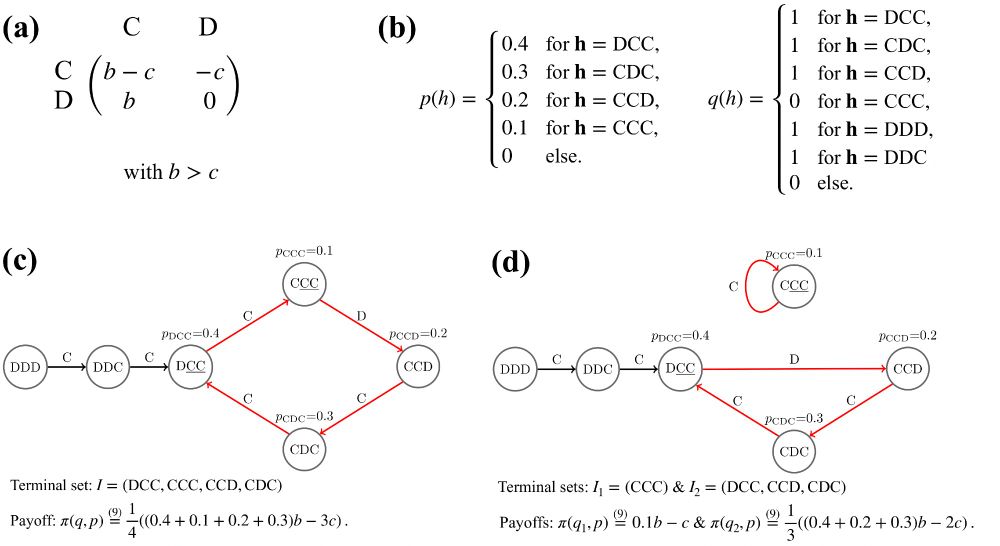
How valuable is memory? In my very first paper, now published in Economics Letters, together with @chilbe.bsky.social and @nikoletaglyn.bsky.social, we give sufficient conditions under which a player can afford to remember less than their opponent. 🧵
📜 doi.org/10.1016/j.ec...