🎉 New preprint: Bayesian Competence Inference guides Knowledge Attribution and Information search
If someone knows that Venus is the only planet in the Solar System that rotates clockwise, will they also know what Earth’s only natural satellite is? What about which planets have no moons at all?
13.11.2025 17:16 — 👍 27 🔁 11 💬 1 📌 0
Redirecting
🧠 New paper alert! Can people infer others’ values not from what they choose, but simply from what comes to mind? Across four studies, we show they can—drawing on an intuitive theory of how options are generated.
doi.org/10.1016/j.cognition.2025.106238
👇
05.11.2025 19:31 — 👍 27 🔁 15 💬 1 📌 0

I’m recruiting #PhD students to join my Lab for Infant Learning and Cognition (LILAC) at @ucsantabarbara.bsky.social! We study how infants learn about the natural world from others 🌱 If you’re interested in #devpsych, #EvPsych, and #infantstudies, please reach out and apply! More info below (1/2)
27.10.2025 16:22 — 👍 24 🔁 15 💬 1 📌 2
In case you don't know already, the journal Open Mind has a Bluesky account that automatically posts new papers:
@openmindjournal.bsky.social
The journal is diamond open access (free to read, free to publish) thanks to the support of MIT Press, Harvard Library, & MIT Library.
24.10.2025 12:03 — 👍 106 🔁 33 💬 4 📌 2
Thrilled to announce a new paper out this weekend in
@cognitionjournal.bsky.social.
Moral psychologists almost always use self-report scales to study moral judgment. But there's a problem: the meaning of these scales is inherently relative.
A 2 min demo (and a short thread):
1/7
28.09.2025 21:44 — 👍 32 🔁 10 💬 1 📌 1

Ever wanted to read about an old problem almost nobody cares about anymore?
Well, I wrote about it.
🧵
24.09.2025 08:54 — 👍 35 🔁 13 💬 1 📌 0

A new study by Zach Horne et al. combines history of science and psychology experiments to document the appeal of 'intrinsic' explanations: scientists and laypeople are drawn to explanations that appeal to an object's inherent properties.
www.pnas.org/doi/10.1073/...
22.09.2025 16:36 — 👍 4 🔁 0 💬 1 📌 0

Reply to Quillien: Intuitive preferences and interpretive humility in intentionality judgments | PNAS
Reply to Quillien: Intuitive preferences and interpretive humility in intentionality
judgments
I also recommend Gervais et al.'s thoughtful reply: pnas.org/doi/10.1073/...
(As they highlight, their broader arguments about cultural evolution and religion are not the target of my critique, and their cross-cultural findings remain intriguing despite the interpretive difficulties)
18.09.2025 17:07 — 👍 1 🔁 0 💬 0 📌 0
So this commentary is my small contribution to the skeptic's side of that broader debate.
18.09.2025 17:06 — 👍 1 🔁 0 💬 1 📌 0


The problem is that this strategy would also allow us to 'infer' that people have intuitive preferences for nuclear explosions, or sending people to concentration camps:
18.09.2025 17:04 — 👍 0 🔁 0 💬 1 📌 0

People tend to attribute more intentionality to agents that did something bad. It is tempting to use this effect as a way to covertly measure people's implicit attitudes, as Will Gervais and colleagues do in a recent paper on attitudes toward atheism:
www.pnas.org/doi/10.1073/...
18.09.2025 17:03 — 👍 0 🔁 0 💬 1 📌 0
Intention judgments are not a reliable measure of intuitive preferences | PNAS
Intention judgments are not a reliable measure of intuitive preferences
Can we use the way that people attribute intentions to others in order to infer people's intuitive preferences and attitudes?
I've written a short letter highlighting ways that this strategy can go wrong:
www.pnas.org/doi/10.1073/...
18.09.2025 17:02 — 👍 7 🔁 1 💬 1 📌 0
Causal Perception(s)
The human visual system has specialized modular processing for multiple distinct categories of causal events.
My new paper with my lab manager Katharina Wenig in Cognitive Science, "Causal Perception(s)"
Free open access: onlinelibrary.wiley.com/doi/epdf/10....
#CogSci #PsychSciSky
🧵(1/22)
31.08.2025 07:18 — 👍 45 🔁 13 💬 3 📌 1
Fantastic opportunity to join the cogsci community at Edinburgh:
20.08.2025 15:23 — 👍 4 🔁 0 💬 0 📌 0
Imagine if all the money academics pour into OA fees at for-profit publishing corporations went instead to academic societies, which exist to support science; or to university presses, which exist to support academia
02.08.2025 16:50 — 👍 33 🔁 8 💬 4 📌 1
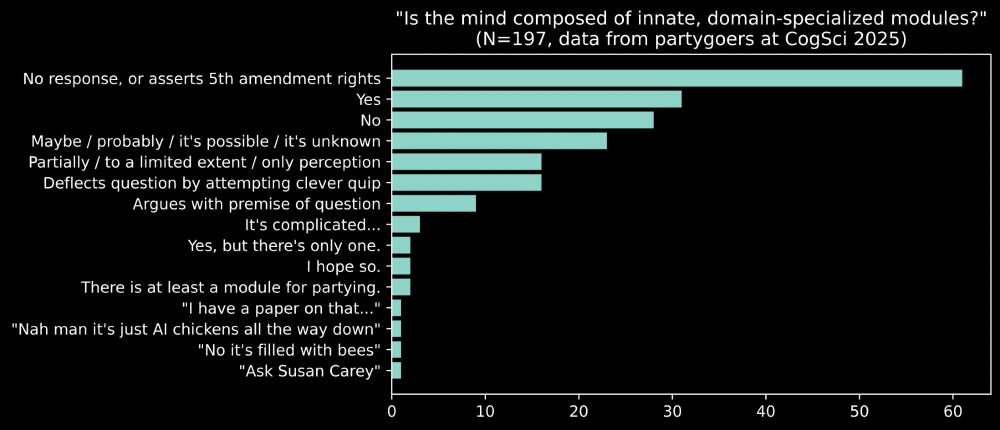
A bar chart showing frequencies of answers to the question "Is the mind composed of innate, domain-specialized modules?" with N=197. The most prominent bars are no response (~60), yes (~30) and yo (~30). The rest of the entries are funny, e.g. "I hope so."
Thanks to a rogue Partiful RSVP form at #cogsci2025, I seem to have collected an unexpectedly large dataset (N=197) of whether cognitive scientists think the mind is composed of innate, domain-specialized modules…
02.08.2025 16:56 — 👍 36 🔁 6 💬 0 📌 2
Overall, our work makes sense of why people tend to rely on social stereotypes more than they should if they were idealized Bayesian observers: they tend to preferentially allocate their limited cognitive resources to encoding group membership information.
02.08.2025 17:58 — 👍 0 🔁 0 💬 1 📌 0

We also find that the optimal policy exhibits the same 'outgroup homogeneity bias' as people: it tends to represent outgroup members are more similar to each other than they are. Again, this is especially the case when cognitive resources are very limited.
02.08.2025 17:57 — 👍 0 🔁 0 💬 1 📌 0
This explains why social stereotypes often act as 'energy-saving' devices for prediction, as social psychologists have found: people are for example more likely to use stereotypes when they are under cognitive load.
02.08.2025 17:57 — 👍 2 🔁 0 💬 1 📌 0
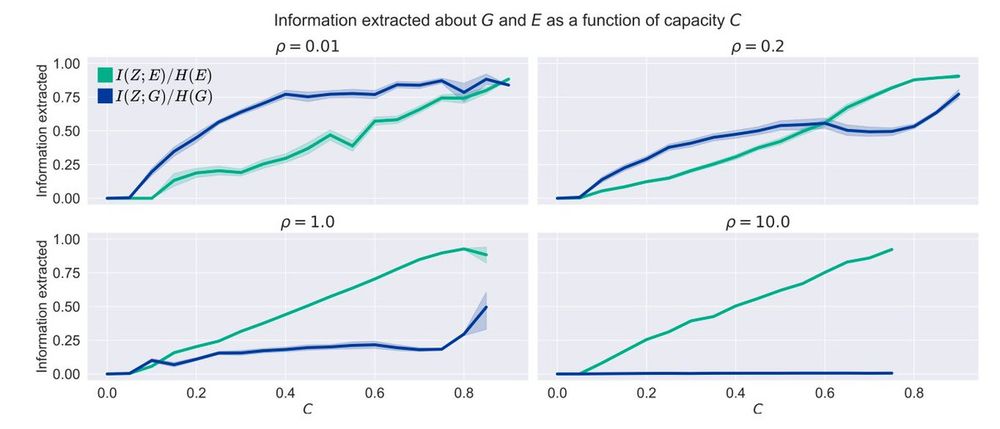
Our key result: under limited resources, the optimal policy preferentially encodes information about group membership (blue) and tends to discard individuating information (teal).
This tendency only reverses if group membership has very low task relevance.
02.08.2025 17:56 — 👍 1 🔁 0 💬 1 📌 0

We study agents who have to predict the behavior of other agents.
Agents have limited cognitive resources: they can only extract so much information from the environment, and have to prioritize which information to encode (group membership or individuating info).
02.08.2025 17:56 — 👍 0 🔁 0 💬 1 📌 0
When predicting someone's behavior, people typically rely on both:
-individuating information (e.g. what that person did in the past),
-group membership,
We want to explain why people integrate these two types of information as they do, working from first principles.
02.08.2025 17:55 — 👍 0 🔁 0 💬 1 📌 0
Our new #cogsci2025 paper led by @maxtaylordavies.bsky.social is a task analysis of agent representation under resource constraints:
🧵
02.08.2025 17:55 — 👍 12 🔁 4 💬 1 📌 0

Recent studies suggest that manipulating "growth mindset" might not improve students' academic performance
This new research suggests that it has a different effect. Growth mindset makes people more inclined to *blame* students for their failures
escholarship.org/content/qt4k...
01.08.2025 17:13 — 👍 15 🔁 3 💬 0 📌 0
Really loving this kind of engagement between the psychology and philosophy of causation.
So much better than psychologists re-explaining how people are just oh so irrational and philosophers examining their intuitions about increasingly elaborate tales of rock throwing and firing squads 😉
29.07.2025 13:50 — 👍 21 🔁 10 💬 0 📌 0
Academic; cats, culture, child development, cultural evolution, social learning; she/her #BiInSci
https://esc.dec.ens.fr/fr
PhD @Stanford studying cognitive science & AI
Prev: Pre-doc Fellow @Harvard, Econ & CS research with Paul Romer, Stats & ML @UniofOxford, Econ @Columbia
Cultural evolution - Cognitive Science - Cognitive Anthropology. Assistant Professor of Organizational Behavior at Stanford GSB. Formerly postdoc fellow at the Santa Fe Institute.
https://rodrigodiaz946.wixsite.com/philosophy
Computational cognitive scientist, developing integrative models of language, perception, and action. Assistant Prof at NYU.
More info: https://www.nogsky.com/
asst prof @Stanford linguistics | director of social interaction lab 🌱 | bluskies about computational cognitive science & language
lecturer in quant methods in psych at edinburgh uni.
Exploring language, concepts, and perception @ Yale
www.gaborbrody.com
Psych PhD student @Harvard
PhD student at MIT philosophy; learning how to flip a fair coin. https://sites.google.com/view/helena-fang/
PhD candidate @EP_UCL | Decision-making, applied statistics, & meta-analysis | Open science | Previously @ResMaPsychology
Associate Professor at UCL Experimental Psychology; math psych & cognitive psychology; statistical and cognitive modelling in R; German migrant worker in UK
Postdoctoral research associate at UCL
https://tianweigong.github.io/
PI Computational Cognitive Science (BoCoCo) lab in Edinburgh 🏴
https://zhaobn.github.io
Social Psychologist | Postdoc @Wharton UPenn | Exploring Psychological Flexibility | Behavior Change for Good | https://ko-ahra.github.io/
Associate professor at UCSB. Evolutionary and computational perspectives on human mating. Occasional nature photos. He/him.
https://www.danconroybeam.com/
PhD candidate in Brain and Cognitive Sciences @MIT studying legitimacy, punishment and social learning
Psych prof @ UCCS. Arab secular humanist.
Evo, cognition, & emotion.
Bylines in @AreoMagazine, @NautilusMag, @PsychToday.
EN, AR, FR. Views own.
laithalshawaf.com
phd student building computational models of social cognition @ edinburgh | prev imperial, ucl, inria
https://maxtaylordavi.es