Were it not for the all too frequent school shootings, one could easily get the impression there are no schools in the US
24.01.2026 13:30 —
👍 11
🔁 3
💬 0
📌 0
Kudos to Yuan-zhen Liu and Philip F. Thomsen, who led the work. Thanks to all collaborators, Jesper Bechsgaard, Lynn Dicks, Toke Thomas Høye, Trine Bilde and Sean Birk Bek Craig
30.12.2025 16:55 —
👍 0
🔁 0
💬 0
📌 0
The rarest species, Andrena marginata, showed severe decline in the most recent 50-100 y
The other rare species, Bombus veteranus, had gone through steep decline more than 1000 y ago and a more stable trend since then
One of the common spp, B. pascuorum, showed pop size changes on a 50 ky time scale
30.12.2025 16:55 —
👍 0
🔁 0
💬 1
📌 0
🐝 We used pooled whole-genome sequencing data to reconstruct demographic history for two rare and two common wild bee species
📉 The two rare species showed lower historical population sizes than the two common species
📊 The approach was validated using simulated data
doi.org/10.1111/mec....
30.12.2025 16:55 —
👍 6
🔁 1
💬 1
📌 0

Could it be because some human activities mimicked lost megafauna impacts from the evolutionary (Pleistocene) landscapes in which species arose and developed? The Holocene has in many ways presented aberrant ecosystem properties
16.12.2025 21:38 —
👍 2
🔁 0
💬 1
📌 0
A great ecologist and scientist. His southern hemisphere perspective on “European” ecology was very stimulating and thought-provoking.
15.12.2025 18:29 —
👍 3
🔁 0
💬 0
📌 0
Huge thanks to Ditte, @srosbakh.bsky.social & all collaborators
11.12.2025 08:20 —
👍 1
🔁 0
💬 0
📌 0
Next step: Comparison with recent data to identify winners, lossers and drivers of change 🌳🍂🥀
11.12.2025 08:20 —
👍 0
🔁 0
💬 1
📌 0

@dittemch.bsky.social has led the digitization of the historical dot maps of plant species distribution in Denmark. After a lot of harmonization and validations, the data (10 x 10 km grid) are now out with a preprint describing the procudure.
#biodiversity_change #legacy_data
11.12.2025 08:20 —
👍 10
🔁 1
💬 2
📌 0
@skjoldsoendergaard.bsky.social something for you?
04.12.2025 18:31 —
👍 0
🔁 0
💬 0
📌 0
Så er udkast til habitatkonsekvensvurderingen af Tangeværket ude!
Tak til @Altingetdk
Jeg håber du læser med, @jeppebruus.bsky.social
#vildgudenå
legacy.altinget.dk/misc/udkast-...
13.11.2025 10:55 —
👍 10
🔁 3
💬 1
📌 1
Hommage to Sofia Corradi, who conceived the idea of academic degrees without borders - the Erasmus Program
20.10.2025 06:33 —
👍 1
🔁 0
💬 0
📌 0
Pretty mindblowing!
18.10.2025 17:39 —
👍 4
🔁 0
💬 0
📌 0
Parallelodiplosis galliperda – Plant Parasites of Europe
Indeed the asexual generation of the gall wasp Neuroterus quercusbaccarum on common oak. If you pop some galls off, you may find larvae of the inquiline gall midge Parallelodiplosis galliperda bladmineerders.nl/parasites/an...
18.10.2025 07:52 —
👍 2
🔁 0
💬 0
📌 0


Bumble #bee #pollination of #linden already 24.6 milllion years ago - cool new empirical illustration of the deep roots of the ecologies of modern-day species www.sci.news/paleontology...
(photo 1: commons.wikimedia.org/wiki/File:Bombus_hypnorum_-_Tilia_cordata_-_Keila.jpg)
17.10.2025 05:11 —
👍 51
🔁 15
💬 0
📌 1
Thanks in particular to Michele Di Musciano, Riccardo Testolin and Ale Chiarucci for stearing the boat safely ashore
13.10.2025 07:41 —
👍 1
🔁 0
💬 0
📌 0
The results only tell us that site selection was (a lot) better than random, not if the management of N2000 sites secured long-term persistence of biodiversity. Alas, lots of evidence suggest the opposite.
#N2K #spatialconservationplanning
13.10.2025 07:41 —
👍 1
🔁 0
💬 1
📌 0

Front cover of the European Butterfly Red List, showing Polyommatus humedasae. The report can be downloaded at https://www.bc-europe.eu/webpage.php?name=red-list-butterflies-2025
The new European Butterfly Red List is published today, with worrying findings. Over 1/4 (28%) of Europe’s 442 species are threatened with extinction or are close to being so. The situation is far worse for our 148 endemic species, 40% are now threatened or nearly so www.bc-europe.eu/webpage.php?...
11.10.2025 09:17 —
👍 166
🔁 109
💬 3
📌 5

Random street corner in Leuven BE
#stopgenocide
11.10.2025 17:16 —
👍 6
🔁 0
💬 0
📌 0
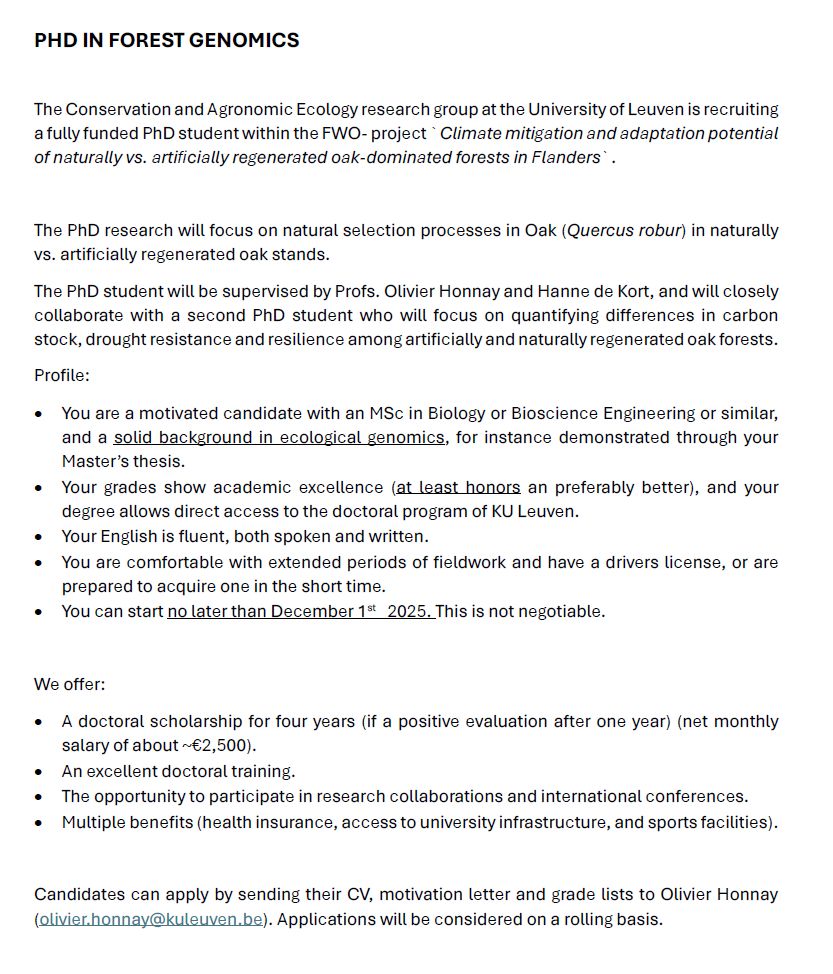
📢 Vacancy: I am urgently recruiting a PhD candidate to join a project on selection processes in pedunculate oak.
📅 Start date: no later than December 1st.
03.10.2025 08:09 —
👍 7
🔁 8
💬 0
📌 1
Well, I believe it’ll be more applicable than the binary concept in less studied taxa and regions, as it is less evidence demanding when it comes to questions like “how did the species arrive in the focal area” etc.
27.09.2025 20:24 —
👍 0
🔁 0
💬 0
📌 0
Thank you, Camilla Colding-Jørgensen for leading this important work, and to @jcsvenning.bsky.social and @r-ejrnaes.bsky.social for the collaboration, which was funded by the 15 June Foundation
26.09.2025 19:05 —
👍 3
🔁 0
💬 0
📌 0
Using the flora of Denmark, we show that a large proportion of species are treated as 'native' by one source and as 'non'native' by others, i.e. are of uncertain status. Using a graduated definition, most of these species end up in the 'near-native' category
26.09.2025 19:05 —
👍 2
🔁 0
💬 1
📌 0
Native and near-native species share most of their Pleistocene history. Are near-natives may well be our new natives under global climate change.
26.09.2025 19:05 —
👍 2
🔁 0
💬 1
📌 0