Early Career Scientist Awards 2026
Application to the UW-Madison Evolution Seminar Series - Early Career Scientist Awards.
Wisconsin Evolution is accepting applications for our Seminar Series' Early Career Scientist Award. Come share your evolution research and visit UW-Madison's evolution community. Open to grad students and postdocs (<5 yrs post PhD) from outside UW-Madison.
Apply by Dec 15th here: shorturl.at/4a4O6
19.11.2025 20:55 — 👍 39 🔁 56 💬 2 📌 1
Super excited that the bulk of my PhD work is now preprinted! Here we used whole-community competition, or coalescence, experiments to quantify selection acting on genetically diverged strains within larger communities. (1/n)
www.biorxiv.org/content/10.1...
11.11.2025 17:14 — 👍 102 🔁 48 💬 3 📌 2
Deadline for this is tonight! Now is the time to sign up!!
01.08.2025 16:14 — 👍 5 🔁 1 💬 0 📌 0
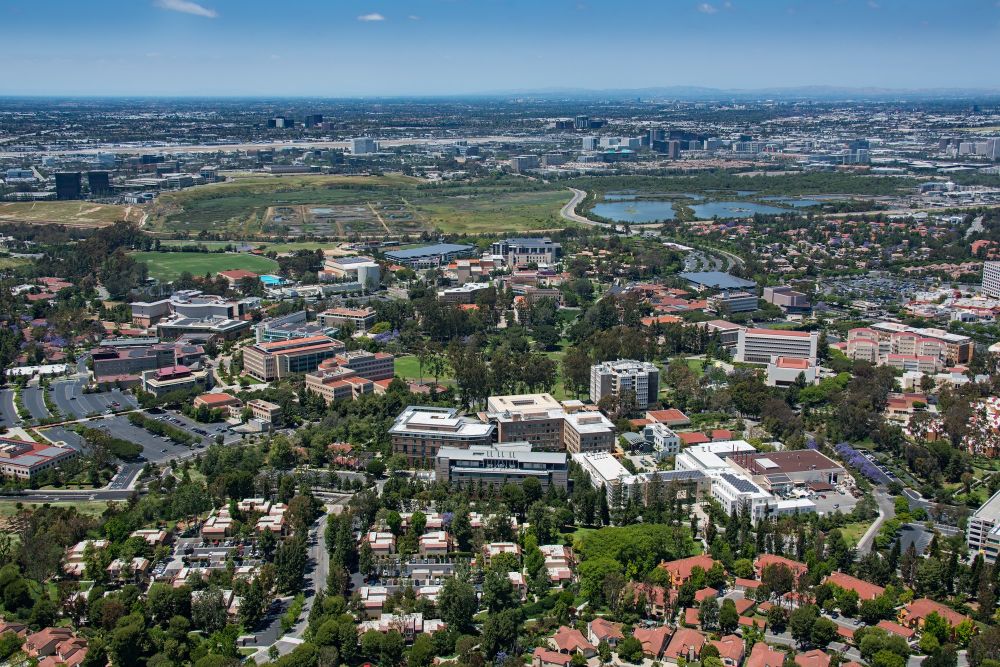
Junior, Assistant, or Associate Specialist – Xue Lab
University of California, Irvine is hiring. Apply now!
The Xue lab at UC Irvine is looking for a staff scientist to support our work investigating how microbes interact and evolve in the gut microbiome! Open to a wide range of previous experience levels, see ad for more.
recruit.ap.uci.edu/JPF09601
17.07.2025 20:32 — 👍 116 🔁 112 💬 0 📌 3

Bacteriophage infection drives loss of β-lactam resistance in methicillin-resistant Staphylococcus aureus
In methicillin-resistant Staphylococcus aureus, evolution of bacteriophage resistance causes trade-offs that re-sensitize the bacteriato β-lactam antibiotics.
I'm excited to announced that the version of record of this article is out in @elife.bsky.social. With the other first coauthor My Tran, we found that phage resistance cause reduced beta-lactam resistance and reduced virulence phenotypes in diverse MRSA strains.
elifesciences.org/articles/102...
10.07.2025 18:36 — 👍 17 🔁 13 💬 2 📌 1

A flyer with the heading McClintock Letter-Writing Workshop. Details are Friday, June 6th, 12pm ET and 9am PT, virtual.
Want to write to your community about the importance of science funding?
Join me on zoom this Friday at 12pm ET / 9am PT to learn to write an op-ed as part of the #McClintockLetters initiative!
Sign up to write a letter and register for the workshop here:
blogs.cornell.edu/asap/events-...
03.06.2025 14:37 — 👍 34 🔁 25 💬 1 📌 9
Scientists, reach out to your local communities about the importance of funding science! Write an op-ed to your local newspaper as part of the #McClintockLetters.
Please spread the word and sign up! DM me if you're interested and need help getting started. I'm trained as a writer and happy to help.
23.05.2025 18:37 — 👍 30 🔁 18 💬 1 📌 0
This is a fantastic initiative and I would highly encourage folks to participate!
23.05.2025 16:27 — 👍 4 🔁 2 💬 0 📌 0
I wrote/interviewed folx shortly after everything started to crumble in Jan, but I was re-reminded that communities prevail. There are amazing people doing beautiful things to improve our communities, and I’m excited to highlight their work. berkeleysciencereview.com/article/2025...
15.05.2025 15:28 — 👍 4 🔁 2 💬 0 📌 1


The 2nd Hablemos de Ciencia Symposium was a success! This event was started last year to create a venue for UW-Madison researchers to communicate science in Spanish. Science is done for and by speakers of different languages. The language(s) that we use to communicate science should reflect that!
24.04.2025 02:10 — 👍 12 🔁 3 💬 1 📌 0
Really honored to read this thoughtful perspective on our paper, thanks so much to @contaminatedsci.bsky.social!
07.04.2025 22:25 — 👍 10 🔁 1 💬 0 📌 0
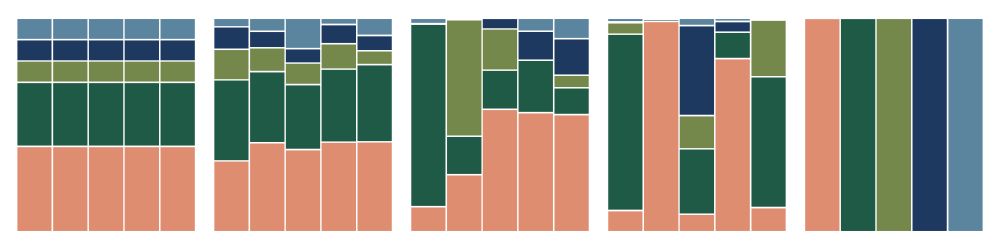
5 relative abundance plots arranged to have increasing compositional variability (variability across relative abundance samples, here vertical bars)
1/ Hey y'all, I'm excited to share my latest paper, which is out now in PNAS! We introduce FAVA, a statistical framework to measure compositional variability across microbiome samples. If you want to measure variability across a stacked bar plot, FAVA is for you! Paper: doi.org/10.1073/pnas...
14.03.2025 20:46 — 👍 207 🔁 73 💬 5 📌 2
Huge thank you to my mentors @ksxue.bsky.social, KC Huang, David Relman, @benjaminhgood.bsky.social, @petrovadmitri.bsky.social, and everyone else involved in the work for their valuable feedback and suggestions throughout, and I’m super excited to finally have this out in the world!
11.03.2025 13:22 — 👍 2 🔁 1 💬 0 📌 0
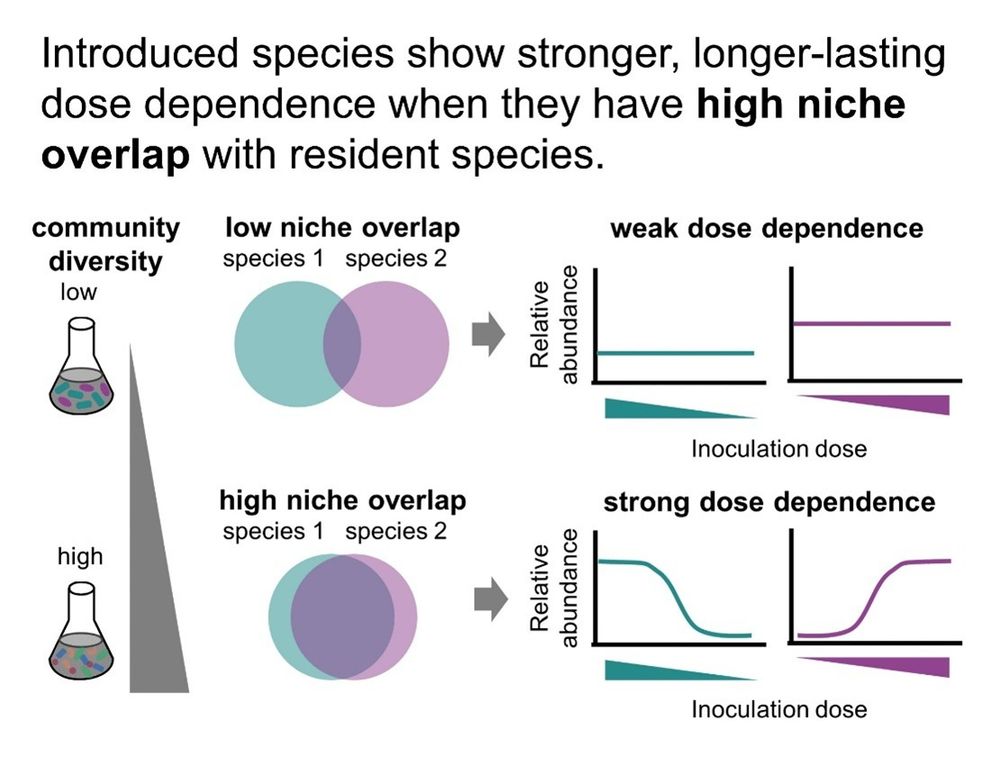
A graphical abstract titled “Introduced species show stronger, longer-lasting dose dependence when they have high niche overlap with resident species.” Below the title are two rows of images. In the top row from left to right are a culture flask labeled “low community diversity”, a Venn diagram labeled “low niche overlap” with two slightly overlapping circles labeled “species 1” and “species 2”, and a plot titled “weak dose dependence” that shows inoculation dose on the x-axis and relative abundance on the y-axis with two flat lines corresponding to the two species. In the bottom row from left to right are a flask labeled “high community diversity”, a Venn diagram titled “high niche overlap” with strongly overlapping circles, and a plot titled “strong dose dependence” with two relative abundance lines that slope strongly in opposite directions.
Overall, our findings demonstrate that initial conditions can have a lasting impact on the outcomes of species introductions, and that these impacts are especially pronounced in diverse communities.
11.03.2025 13:22 — 👍 2 🔁 0 💬 1 📌 0
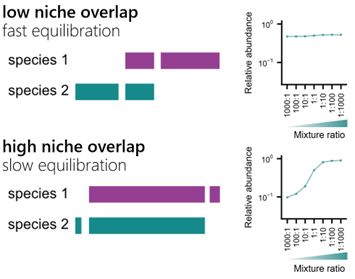
A schematic with two rows of images. In the top row on the left are a set of colored bars of different sizes representing the relative resource niche sizes of two species. The bars are mostly non-overlapping and are labeled “low niche overlap, fast equilibration.” On the right is a plot that shows mixture ratio on the x-axis and relative abundance on the y-axis, with a flat line showing a lack of dose dependence for a single species. In the bottom row from left to right are a set of colored bars with greater overlap labeled “high niche overlap, slow equilibration” and a plot showing a sloped line representing stronger dose dependence for a single species.
Using a consumer-resource model and metabolomics, we identified niche overlap between introduced and resident species as a strong predictor of the importance of initial dose.
11.03.2025 13:22 — 👍 0 🔁 0 💬 1 📌 0
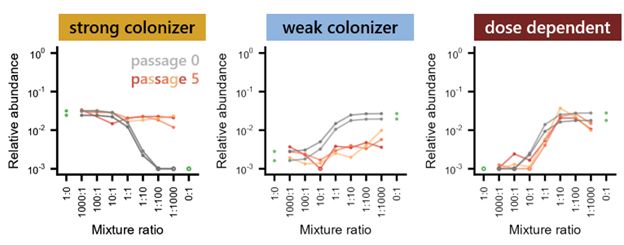
Three plots with mixture ratio on the x-axis and relative abundance on the y-axis. Each plot shows the relative abundance of a single species at passage 0 and 5 after community mixtures. The plot on the left is labeled “strong colonizer” and shows a species whose relative abundance at passage 5 is flat across mixture ratios and above its passage 0 abundance. The plot in the middle is labeled “weak colonizer” and shows a species whose relative abundance is at passage 5 is flat across mixture ratios and lower than its passage 0 abundance. The plot on the right is labeled “dose dependent” and shows a species whose relative abundances at both passages 0 and 5 are sloped across mixture ratios.
The answer? It’s complicated, of course, and depends on the identity of the introduced microbes and which species are already present. Across a set of mixtures of gut microbial communities, we observed a range of species colonization behaviors from dose independence to strong dose dependence.
11.03.2025 13:22 — 👍 0 🔁 0 💬 1 📌 0
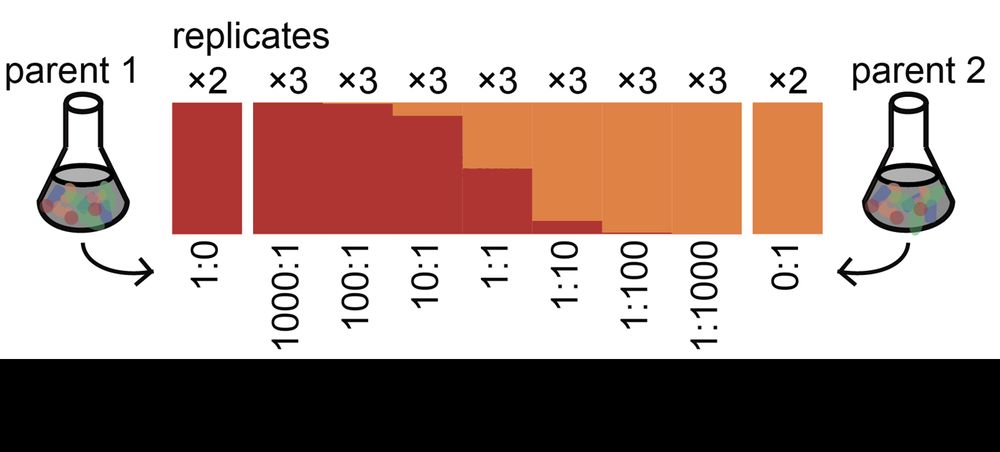
A schematic representing mixtures of gut microbial communities at different ratios. Two culture flasks labeled “parent 1” and “parent 2” flank a set of vertical red and orange bars labeled with ratios 1000:1, 100:1, 10:1, 1:1, 1:10, 1:100, and 1:1000, with relative heights corresponding to these ratios. There are also solid red and orange bars on either side representing 1:0 and 0:1 ratios, respectively. Above the bars are written the number of replicates (2 for 1:0 and 0:1 ratios and 3 for all other ratios), and below the bars is written passage 5× (~40 generations).
To do this, we mixed a set of in vitro gut microbial communities together at various initial ratios ranging over six orders of magnitude, and we used 16S sequencing to track the final relative abundances of each species after ~40 generations of growth.
11.03.2025 13:22 — 👍 1 🔁 0 💬 1 📌 0
PNAS
Proceedings of the National Academy of Sciences (PNAS), a peer reviewed journal of the National Academy of Sciences (NAS) - an authoritative source of high-impact, original research that broadly spans...
I’m thrilled to share my first ever publication, now published in PNAS! www.pnas.org/doi/10.1073/...
With mentorship from the amazing @ksxue.bsky.social, I looked at how the outcomes of species introductions to microbial communities are influenced by the number of introduced microbes.
11.03.2025 13:22 — 👍 89 🔁 31 💬 1 📌 1

secretarybird absolutely serving while walking through some dry grass
shoutout to secretarybird, one of the most underrated birds
23.11.2024 03:18 — 👍 840 🔁 114 💬 24 📌 11
I feel incredibly lucky to have gotten to work with Katherine over the last five years, she’s a truly amazing and one of a kind mentor and person! Would highly encourage any interested students or postdocs to reach out to her!
20.11.2024 00:17 — 👍 10 🔁 1 💬 0 📌 0
I’d love to be added, thanks!
12.11.2024 14:22 — 👍 1 🔁 0 💬 0 📌 0
I am mobilizing + giving free weekly science communication workshops in a private community for scientists + media who want to join the battle vs misinformation. I wasn't planning on doing this so soon but this is urgent. ALL scientists "hard" + "soft" DM with your credentials for details.
07.11.2024 15:59 — 👍 375 🔁 140 💬 14 📌 10
I’d love to be added!
11.11.2024 07:05 — 👍 1 🔁 0 💬 1 📌 0
Tried to put together a Microbial Evolution starter pack, but there were so many great people I didn't want to leave out it turned into 3 starter packs
Comment or DM me if you were missed or would like to be added!
A thread (1/3)
go.bsky.app/6pkuYhi
20.10.2024 21:56 — 👍 145 🔁 87 💬 27 📌 7
Anything by David Quammen!
04.10.2024 20:24 — 👍 2 🔁 0 💬 0 📌 0
Ancient & military historian specializing in the Roman economy and military. PhD from UNC History. More impressive credential is that I have beaten both Dark Souls and Elden Ring.
Blogs at acoup.blog
RNA, microbiology, infectious disease; Helmholtz Institute for RNA-based Infection Research & University of Würzburg, Germany
www.helmholtz-hiri.de
Wants to know how the physical world shapes biological systems. Passionate about reducing academia's carbon footprint. https://experts.exeter.ac.uk/25980-wolfram-moebius
Postdoc in Westra lab, University of Exeter, Cornwall, UK
Interested in host-MGE and MGE-MGE interactions.
💛Temperate phages!
Microbial evolution 🦠 | MbyRes in Westra Lab at the University of Exeter | Trinity College Dublin graduate | 🇮🇳🇮🇪🇬🇧
Microbial Evolution - AMR - University of Manchester
Post-doc at the PBE lab | Interested in plasmids, integrons, evolution, and many other things 😅
PhD candidate in Medical Microbiology, University of Zurich | AMR evolution in the gut microbiome
Head of the School of Infection, Inflammation & Immunology @ Uni Birmingham. Proud Scot. Oversaw a few Covid PCR tests
Postdoc studying evolutionary microbiology with phage and pseudomonas at MMSB Lyon, France with Anne Chevallereau in the MEEP group (She/Her)
Microbial ecology / evolution / genomics @ University of York
Evolutionary genomics of bacteria
Professor DTU Biosustain · Proud PI @labnikel.bsky.social · SynBio · Metabolic Engineering · @novo-nordisk.bsky.social Ascending Investigator & Distinguished Innovator · He/him🏳️🌈
Bioinformatics, molecular biology & evolution
The University of Manchester, UK
mum of two+microbiologist. Navigating career in science post kids 👩🏽🔬
Currently - PDRA Manchester uni, MERMan research group - bacterial mutation rates and DNA repair 🦠
Personal projects underway - Bdellovibrio: evolution, ecology and agriculture 🌱
PhD student studying eco-evolutionary dynamics of hot spring microbial communities 🧫🧬🌋
She/Her 🏳️🌈
PhD student | University of Manchester
Looking at bacterial evolution in lots of different ways 🧪🧬. Member of @mermanchester.bsky.social
Career Development Research Fellow at St John's College, University of Oxford.
Evolution, comparative genomics, cooperation, horizontal gene transfer, plasmids.
https://www.anna-dewar.com/
I do benchformatics (bad at the bench, bad at bioinformatics) at Evodynamics Lab (IRYCIS) - Madrid
Postdoc | Studying Microbial Interactions, Natural Products & BGCs
Into Science, politics and travels 🏳️🌈
📍Madison, WI