Camille Roux's Avatar

Camille Roux

@crouxevo.bsky.social

218 Followers  |  235 Following  |  9 Posts  |  Joined: 17.01.2025  |  2.0048

Latest posts by crouxevo.bsky.social on Bluesky

Time to publish ethically: DAFNEE, a database of academia-friendly journals in ecology and evolutionary biology.

New preprint: we advertise DAFNEE, a database of academia-friendly eco-evo-archaeo journals. 1/6
#AcademicPublishing #ecoevo #archaeology #EthicalPublishing #SocietyJournals #DiamondOpenAccess
doi.org/10.32942/X24...

24.06.2025 18:42 β€” πŸ‘ 77    πŸ” 69    πŸ’¬ 1    πŸ“Œ 6
Preview
Time to publish responsibly: DAFNEE, a database of academia-friendly journals in ecology and evolutionary biology Abstract. The current economics of scientific publishing reveal a profound imbalance: academia pays prices far exceeding the actual costs of publication. R

Time to publish responsibly: DAFNEE, a database of academia-friendly journals in ecology and evolutionary biology url: academic.oup.com/jeb/article/...

01.12.2025 21:01 β€” πŸ‘ 42    πŸ” 24    πŸ’¬ 0    πŸ“Œ 1
Preview
Time to publish responsibly: DAFNEE, a database of academia-friendly journals in ecology and evolutionary biology Abstract. The current economics of scientific publishing reveal a profound imbalance: academia pays prices far exceeding the actual costs of publication. R

DAFNEE, a useful database of academic-friendly journals in #Ecology and Evolutionary #Biology

academic.oup.com/jeb/advance-...

02.12.2025 07:06 β€” πŸ‘ 29    πŸ” 20    πŸ’¬ 0    πŸ“Œ 0

Improving two-step cancer treatment strategies based on evolutionary models, but above all a nice evolutionary rescue model that should be of interest to everyone. #PopGen #CanEcoEvo

29.11.2025 11:16 β€” πŸ‘ 7    πŸ” 7    πŸ’¬ 0    πŸ“Œ 0
Portail Emploi CNRS - Offre d'emploi - Post-doctoral fellow (M/F): Assessing the power of current methods to detect balancing selection in population genomic datasets

Seeking a postdoc position?
​Balancing selection is a fascinating process: malaria resistance, self-incompatibility,etc. Yet, countless examples remain hidden in genomes!
​If this question intrigues you, the project led by Laure Segurel and Violaine Llaurens (Paris + Lyon) is perfect! urlr.me/Huj2De

18.11.2025 10:16 β€” πŸ‘ 7    πŸ” 14    πŸ’¬ 0    πŸ“Œ 0

Looking forward to the next POPGROUP meeting ? Still a few more days for registration.
πŸ‘‡

05.11.2025 09:18 β€” πŸ‘ 2    πŸ” 1    πŸ’¬ 0    πŸ“Œ 0

Only a few days left to register and join us in Lille for this first ever French edition of PopGroup!

05.11.2025 09:49 β€” πŸ‘ 6    πŸ” 4    πŸ’¬ 0    πŸ“Œ 0
Preview
We left the US and moved to France Hello readers, I got big updates! Some of you already know this, but it’s getting more real and more official every month: my family and I have left the US and moved to France! A few months ago I q…

I started a new job in Montpellier, France!
Happy about new opportunities, sad about the state of things in the US.

abetterscientist.wordpress.com/2025/10/26/w...

27.10.2025 19:19 β€” πŸ‘ 157    πŸ” 33    πŸ’¬ 15    πŸ“Œ 1
Preview
Sexual selection and speciation: a meta-analysis of comparative studies Abstract. Understanding the drivers of biodiversity is a central goal in evolutionary biology. In particular, sexual selection has long been proposed as a

Does #SexualSelection fuel #Speciation?

Our new #meta-analysis of comparative studies finds support for a positive relationship, but the rather moderate global effect suggests it’s not necessarily a dominant force.

doi.org/10.1093/evle...

22.10.2025 11:24 β€” πŸ‘ 61    πŸ” 30    πŸ’¬ 4    πŸ“Œ 1
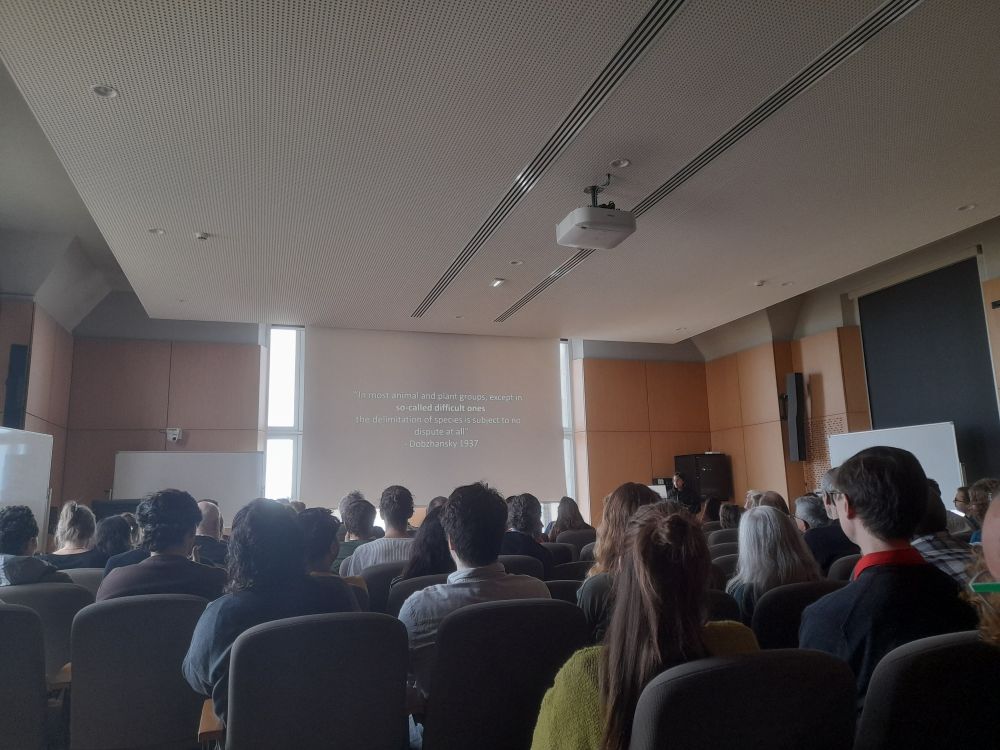
Post image

Wonderful day ending with @couplingdmi.bsky.social who spoke about dock mussels and how anthropogenic hybridization altered marine habitats

Thanks, now I want to go diving in commercial ports in Brittany to see them

22.10.2025 20:20 β€” πŸ‘ 7    πŸ” 2    πŸ’¬ 0    πŸ“Œ 0

What a nice start and amazing first day of Jacques Monod conference on bridging the micro macroevolution gap #cjm25 plenty of fascinating talks and posters

Didn't react quickly enough to illustrate all of them, just catch a few

21.10.2025 20:44 β€” πŸ‘ 5    πŸ” 2    πŸ’¬ 1    πŸ“Œ 0

Just took my breakfast at the #cjm25 speciation conference and around me in a 50m2 breakfast room were seated Nick Barton, Craig Moritz, Amaury Lambert, Maud tenaillon, Ludovic Orlando, Stuart Baird, John Welch, Daniel Matute etc... This density of 🀯🀯🀯 !

21.10.2025 06:01 β€” πŸ‘ 14    πŸ” 2    πŸ’¬ 0    πŸ“Œ 0
Post image Post image Post image Post image

What a nice start to the Jacques Monod conference #cjm25 on speciation in Roscoff, Britany. What an inspiring lineup of talks and scientists. Even the weather is remarkably welcoming, for now, at least. 🀩

21.10.2025 19:47 β€” πŸ‘ 15    πŸ” 4    πŸ’¬ 0    πŸ“Œ 0
Post image

Arrived at Roscoff in Brittany for the conference Jacques Monod on #speciation. What a view ! Do we have a hashtag? #cjm25? First plenary lecture was tonight on our (in)hability to predict diversification rates from microevolutionary processes.

20.10.2025 20:43 β€” πŸ‘ 27    πŸ” 2    πŸ’¬ 0    πŸ“Œ 0

Very happy to announce that the next POPGROUP meeting will take place in Lille on 7-9 January !

Follow β€ͺ@popgroup2026.bsky.social for all updates.

πŸ“’ Please share widely ! πŸ“’β€¬

29.09.2025 13:05 β€” πŸ‘ 13    πŸ” 11    πŸ’¬ 0    πŸ“Œ 0
Population Genetics group 59

Exciting news!
The next #PopGroup meeting will take place in Lille 🍟, France, 7–9 January 2026 – just 1 hour by train from London, Brussels, and Paris.

This year, PopGroup will also host ALPHY, the annual meeting of Evolutionary Genomics.

More info: populationgeneticsgroup.org.uk

See you there !

29.09.2025 08:52 β€” πŸ‘ 45    πŸ” 53    πŸ’¬ 1    πŸ“Œ 2
Object: Postdoc Position 

Building a phylogenetic model for horizontal transfers of transposable elements 

A postdoctoral position (24 months) is available to work at EGCE (Gif-sur-Yvette, France, CNRS / UniversitΓ© Paris-Saclay) from January 2026. 

Transposable elements (TEs) are repetitive DNA sequences capable of promoting their own mobility. They are widespread across the tree of life and often represent a substantial fraction of eukaryotic genomes. Beyond their ability to invade genomes, TEs are frequently reported to undergo horizontal transfer, enabling their colonization of new hosts. However, understanding and predicting how horizontal transfers shape the distribution of TEs among species is far from straightforward. In particular, estimates of transfer rates based on documented cases are both biased and approximate, since transfers occurring close to speciation events are virtually undetectable. This project aims to develop explicit phylogenetic models of TE evolution that incorporate horizontal transfers, and to use these models to obtain statistical estimates of key evolutionary dynamics of TE families across species (e.g., horizontal transfer and extinction rates). The postdoctoral project will focus on exploring the impact of horizontal transfers on the distribution of TE presence/absence among related species, using statistical and/or computational approaches.

Object: Postdoc Position Building a phylogenetic model for horizontal transfers of transposable elements A postdoctoral position (24 months) is available to work at EGCE (Gif-sur-Yvette, France, CNRS / UniversitΓ© Paris-Saclay) from January 2026. Transposable elements (TEs) are repetitive DNA sequences capable of promoting their own mobility. They are widespread across the tree of life and often represent a substantial fraction of eukaryotic genomes. Beyond their ability to invade genomes, TEs are frequently reported to undergo horizontal transfer, enabling their colonization of new hosts. However, understanding and predicting how horizontal transfers shape the distribution of TEs among species is far from straightforward. In particular, estimates of transfer rates based on documented cases are both biased and approximate, since transfers occurring close to speciation events are virtually undetectable. This project aims to develop explicit phylogenetic models of TE evolution that incorporate horizontal transfers, and to use these models to obtain statistical estimates of key evolutionary dynamics of TE families across species (e.g., horizontal transfer and extinction rates). The postdoctoral project will focus on exploring the impact of horizontal transfers on the distribution of TE presence/absence among related species, using statistical and/or computational approaches.

Context

The position will be part of a 4-year collaborative project funded by the French National Agency (ANR). The research consortium gathers two departments (from Paris-Saclay university and from UniversitΓ© Lyon 1), and involves 7 Pls and 5 postdocs and PhD students devoted to distinct workpackages of the project. The postdoc will be based at EGCE, which is part of the Institute for Ecology and Evolution (IDEEV). The institute offers an exciting and active scientific life, it is located on the new research campus of Paris-Saclay, 35 km south of Paris. 

Relevant references

Gilbert C et al. 2018. Horizontal acquisition of transposable elements and viral sequences: patterns and consequences. Cur. Opin. Genet. Dev. 49:15-24.

Le Rouzic A et al. 2013. Reconstructing the Evolutionary History of Transposable Elements. Genome Biol. Evol. 5:77-86.

Wallau GL et al. 2016. VHICA, a New Method to Discriminate between Vertical and Horizontal Transposon Transfer: Application to the Mariner Family within Drosophila. Mol Biol Evol 33:1094-1109.

Profile

We are looking for a motivated early career theoretical biologist, with a PhD in theoretical evolutionary biology. Skills in statistics, programming, bio-informatics, and phylogenetic models will be appreciated.

Application

Formal applications (CV and cover letter) have to be deposited on the CNRS job portal https://emploi.cnrs.fr/Offres/CDD/UMR9191-ARNLER-006/Default.aspx?lang=EN.

Context The position will be part of a 4-year collaborative project funded by the French National Agency (ANR). The research consortium gathers two departments (from Paris-Saclay university and from UniversitΓ© Lyon 1), and involves 7 Pls and 5 postdocs and PhD students devoted to distinct workpackages of the project. The postdoc will be based at EGCE, which is part of the Institute for Ecology and Evolution (IDEEV). The institute offers an exciting and active scientific life, it is located on the new research campus of Paris-Saclay, 35 km south of Paris. Relevant references Gilbert C et al. 2018. Horizontal acquisition of transposable elements and viral sequences: patterns and consequences. Cur. Opin. Genet. Dev. 49:15-24. Le Rouzic A et al. 2013. Reconstructing the Evolutionary History of Transposable Elements. Genome Biol. Evol. 5:77-86. Wallau GL et al. 2016. VHICA, a New Method to Discriminate between Vertical and Horizontal Transposon Transfer: Application to the Mariner Family within Drosophila. Mol Biol Evol 33:1094-1109. Profile We are looking for a motivated early career theoretical biologist, with a PhD in theoretical evolutionary biology. Skills in statistics, programming, bio-informatics, and phylogenetic models will be appreciated. Application Formal applications (CV and cover letter) have to be deposited on the CNRS job portal https://emploi.cnrs.fr/Offres/CDD/UMR9191-ARNLER-006/Default.aspx?lang=EN.

Come and join our team! A 2-year postdoc position is available in our "Genome Evolution" department at Univ Paris Saclay. We want to play with phylogenetic models accounting for horizontal transfers of transposable elements. Application& details on the official portal: emploi.cnrs.fr/Offres/CDD/U...

24.09.2025 11:45 β€” πŸ‘ 8    πŸ” 9    πŸ’¬ 0    πŸ“Œ 3
The Ants That Broke Biology
YouTube video by 7 Days of Science The Ants That Broke Biology

If you’ve heard about our study on ants producing two different species but are still confused about how it works (and don’t have time to read the paper), this 10-minute video made by @bengthomas.bsky.social is very informative:
www.youtube.com/watch?v=Z-O4...

Paper: www.nature.com/articles/s41...

15.09.2025 16:04 β€” πŸ‘ 28    πŸ” 13    πŸ’¬ 1    πŸ“Œ 1
Preview
Shedding Light on the Grey Zone of Speciation along a Continuum of Genomic Divergence Author Summary Isolated populations accumulate genetic differences across their genomes as they diverge, whereas gene flow between populations counteracts divergence and tends to restore genetic homog...

Thanks!
The study looked at 20 vertebrate pairs and 41 invertebrate pairs. In the original paper focused on animals (2016, time flies...), the comparison showed no effect based on whether they were vertebrates or invertebrates, or on their r/K ecological strategy.
journals.plos.org/plosbiology/...

12.09.2025 12:59 β€” πŸ‘ 1    πŸ” 0    πŸ’¬ 0    πŸ“Œ 0
Preview
Rapid establishment of species barriers in plants compared to animals Speciation, the process through which new reproductively isolated species emerge from ancestral populations, occurs due to the gradual accumulation of barriers to gene flow within genomes. To date, th...

For those who don't have access, the last bioRxiv version is largely similar to the final printed version
www.biorxiv.org/content/10.1...

12.09.2025 09:06 β€” πŸ‘ 2    πŸ” 0    πŸ’¬ 0    πŸ“Œ 0
Post image

This allowed us to link molecular divergence with genetic connectivity in plants and animals. (A) Gene flow stops sooner between plant species than between animal species. (B) Genomic barriers emerge faster in plant genomes than in animals.

12.09.2025 07:54 β€” πŸ‘ 7    πŸ” 1    πŸ’¬ 0    πŸ“Œ 0
Post image

Using population genomic approaches, we measured (A) average genomic divergence and (B) the probability that each plant or animal pair corresponds to: (2) two populations of the same species, (3) a complex of semi-isolated species, or (4) two fully isolated species

12.09.2025 07:54 β€” πŸ‘ 4    πŸ” 0    πŸ’¬ 1    πŸ“Œ 0
Post image

In this study, we analyzed the demographic histories of 280 plant pairs and 61 animal pairs using genomic data describing both intraspecific polymorphism and interspecific divergence

12.09.2025 07:54 β€” πŸ‘ 3    πŸ” 0    πŸ’¬ 1    πŸ“Œ 0
Post image

Hybridization and introgression are major evolutionary processes. Since the 1940s, the prevailing view has been that they shape plants far more than animals. In our new study (www.science.org/doi/10.1126/...
), we find the opposite: animals exchange genes more, and for longer, than plants

12.09.2025 07:54 β€” πŸ‘ 200    πŸ” 120    πŸ’¬ 3    πŸ“Œ 3
Preview
Rapid establishment of species barriers in plants compared with that in animals Speciation, the process by which new reproductively isolated species emerge from ancestral populations, results from the gradual accumulation of barriers to gene flow within genomes. To date, the noti...

Check out this cool work from @crouxevo.bsky.social and others, congrats!!! πŸ₯³
Rapid establishment of species barriers in plants compared with that in animals | Science www.science.org/doi/10.1126/...

12.09.2025 07:10 β€” πŸ‘ 7    πŸ” 8    πŸ’¬ 0    πŸ“Œ 0
Preview
Robust and accurate Bayesian inference of genome-wide genealogies for hundreds of genomes - Nature Genetics SINGER is a method for creating ancestral recombination graphs to understand the genealogical history of genomes. The method has increased speed, and thus scalability, without sacrificing accuracy.

SINGER, our ARG inference method, is finally published and freely available online:

doi.org/10.1038/s415...

It was a long journey – 16 months from initial submission to acceptance. Is it just me, or has peer review gotten more arduous lately? 4+ rounds of review isn't so unusual these days...

11.09.2025 03:50 β€” πŸ‘ 101    πŸ” 52    πŸ’¬ 1    πŸ“Œ 3

@crouxevo is following 20 prominent accounts