New from the EIC! 🗞️
This issue covers the Rethinking Theorizing in Implementation Science symposium, new #impsci resources, and an online #knowledgesynthesis course.
Don’t miss the EIC Board update — and enjoy the read!
Go to newsletter ➡️ mailchi.mp/f95fe033dc76...
12.11.2025 09:37 —
👍 0
🔁 5
💬 0
📌 0

Infographic for 7-step process to integrate equity considerations into research & evidence synthesis. Steps include main actions & optional extra approaches that require additional resources
Step 1: Identify disadvantaged populations. Specify groups using frameworks like PROGRESS-Plus. Extra: Engage people with lived experience and equity experts; develop a logic model considering context, trends, and health disparities.
Step 2: Examine available data. Identify studies analysing prespecified groups, noting reviews and high-quality RCTs. Extra: Use search filters for subgroup analyses, conduct equity-focused systematic reviews, contact authors for disaggregated data.
Step 3: Evaluate baseline risk. Screen study references for differences in baseline risk of adverse events across groups. Extra: Contact authors, search for large non-randomised studies, review outcome importance to prespecified groups.
Step 4: Assess representation. Identify excluded populations and use Participation to Prevalence Ratio to measure group representation. Extra: Contact global organisations for epidemiological data and authors for participant characteristics.
Step 5: Appraise analyses. Evaluate analyses across reported and prespecified groups using appropriate methods. Extra: Contact authors for data and interview stakeholders.
Step 6: Note implementation barriers. Assess barriers and retention of prespecified groups in interventions and recruitment. Extra: Review policy and grey literature, create logic models to understand barriers.
Step 7: Suggest implementation strategies. Review evidence and propose solutions to overcome barriers in applying recommendations. Extra: Consult individuals with lived experience, engage with vulnerable populations, and survey knowledge users such as through FACE surveys.


7 steps for operationalising the GRADE-equity criterion to inform guideline recommendations:
1️⃣ Identify disadvantaged populations
2️⃣ Examine available data
3️⃣ Evaluate baseline risk
4️⃣ Assess representation
5️⃣ Appraise analyses
6️⃣ Note implementation barriers
7️⃣ Suggest implementation strategies
24.10.2025 00:51 —
👍 5
🔁 1
💬 1
📌 0
21.10.2025 18:06 —
👍 1
🔁 1
💬 0
📌 0

💡Join our next IMPACT webinar on Nov 26, 17-18.30 CET! Dr. Julia Moore will talk on "Supporting Implementation: Core Competencies and Functions of Implementation Teams" followed by a round table discussion. #impsci #IMPACT-Swiss 👉🏽 https://nursing.wufoo.com/forms/z1u6ciq81gfn7lm/
23.10.2025 10:30 —
👍 2
🔁 3
💬 0
📌 0
Join us on October 23.! We are celebrating 10 years🥳🎂
17.10.2025 12:35 —
👍 1
🔁 0
💬 0
📌 0
#ImpSci community! This may be of interest to you, too.
26.08.2025 18:10 —
👍 7
🔁 3
💬 0
📌 0
For our German-speaking #ImpSci community: If you or anyone you know are interested in a solid introduction to the field, join us online in October; and if you want a bit more input on a concrete project, add the November days.
22.08.2025 05:24 —
👍 2
🔁 2
💬 0
📌 0
Super helpful resource on using the CFIR in implementation research and practice. The appendices in this paper are gold!
18.08.2025 20:33 —
👍 4
🔁 2
💬 0
📌 0
I just ran my first CNA (Coincidence analysis)! So fun to explore the data this way! Thanks @cna-method.bsky.social and @edmiech.bsky.social and the rest of the CNA crew for a great workshop in Copenhagen.
20.06.2025 11:41 —
👍 1
🔁 2
💬 1
📌 0

📢 Join us for the June EPIS Office Hours! We’re excited to welcome Dr. Marisa Sklar as our guest host this month! Please note: June’s office hours will be held at only one time point (8-9 am PT) drop by to ask questions and connect with an EPIS expert. #EPISFramework
05.06.2025 21:59 —
👍 1
🔁 2
💬 1
📌 0

CIRcUL is live at #EIE2025!
Our stand is ready and steady — come and meet Laura Keyes and Andrew Bray as they showcase how CIRcUL is driving impactful Implementation Research.
#ImpSci @laurakeyes.bsky.social @andy1608.bsky.social @unioflimerick.bsky.social @implementeic.bsky.social
05.06.2025 12:42 —
👍 13
🔁 3
💬 1
📌 0

Second keynote by Anette Boaz at #EIE2025 emphasis that implementation is deeply relational work with adaptive relational implementation strategies having the most impact on policy.
05.06.2025 10:10 —
👍 14
🔁 4
💬 0
📌 1
The Samurai Bear, the superhero of #impsci and a friend of @carlrmay.bsky.social, had a very important message at the #EIE2025: “TRUST is the glue that links people, things and their contexts”. @implementeic.bsky.social
05.06.2025 10:28 —
👍 8
🔁 5
💬 0
📌 1

The #EIE2025 has officially started! Leah and Bianca welcoming us all to two days of implementation discussion, insights and shared learning. @circul.bsky.social
05.06.2025 08:31 —
👍 15
🔁 7
💬 0
📌 0

Importance of Trust in implementation #EIE2025
05.06.2025 08:51 —
👍 20
🔁 5
💬 0
📌 1
#eie2025 @carlrmay.bsky.social "Brother, Sister, we don't need no fascist groove thang" trust and the current context #impsci
05.06.2025 09:13 —
👍 4
🔁 2
💬 1
📌 0
@circul.bsky.social
05.06.2025 09:49 —
👍 2
🔁 1
💬 0
📌 0
So excited for this! And especially since we are (finally) welcoming everyone to Newcastle for the conference this week! 🙌🏼
05.06.2025 05:56 —
👍 6
🔁 2
💬 0
📌 0
EIE has started with the European network meeting. Implementers from Norway, Netherlands, Germany, Spain, UK, Ireland and Belgium discussing their networks. #EIE2025
04.06.2025 12:49 —
👍 3
🔁 1
💬 0
📌 0
Yes please:-).
04.06.2025 21:34 —
👍 1
🔁 0
💬 1
📌 0
I’ve started an implementation science research starter list. Let me know if you would like to join in!
go.bsky.app/5zGNTnB
08.11.2024 14:06 —
👍 57
🔁 30
💬 51
📌 2
On my way tomorrow! Looking forward to seeing familiar faces and meeting new colleagues. Especially to the fun opening with the Science Slam Wednesday 4th at the Brinkburn Brewery @implementeic.bsky.social
02.06.2025 20:01 —
👍 2
🔁 0
💬 0
📌 0
Congratulations 🎉
02.06.2025 08:21 —
👍 3
🔁 0
💬 0
📌 0
I am so looking forward to this fun event with creative ways to communicate about implementation science!
01.06.2025 09:34 —
👍 5
🔁 1
💬 0
📌 0
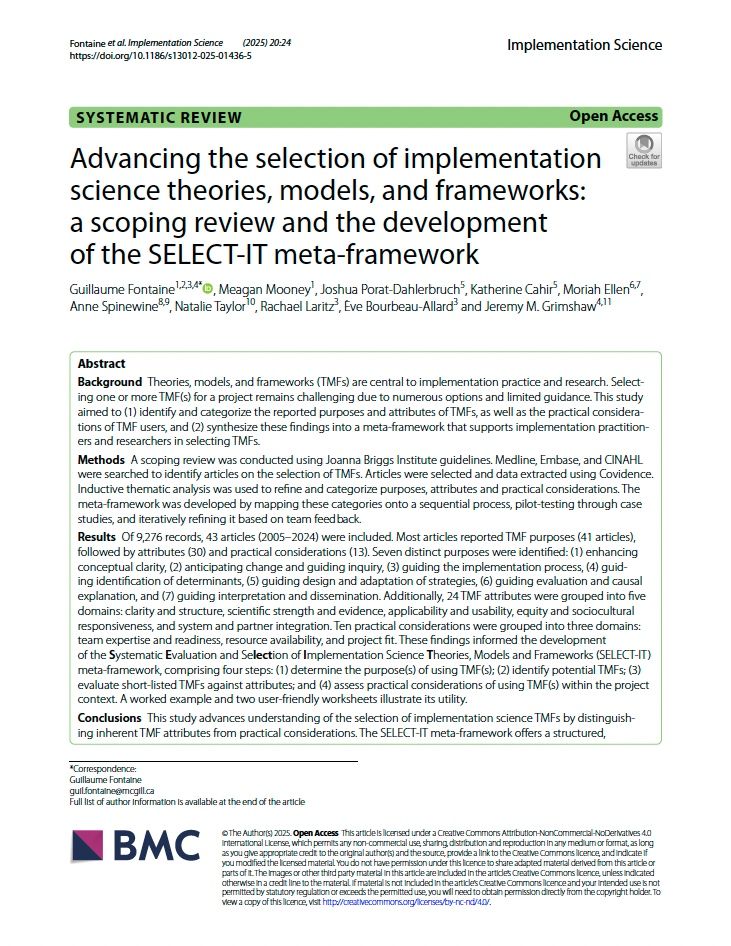
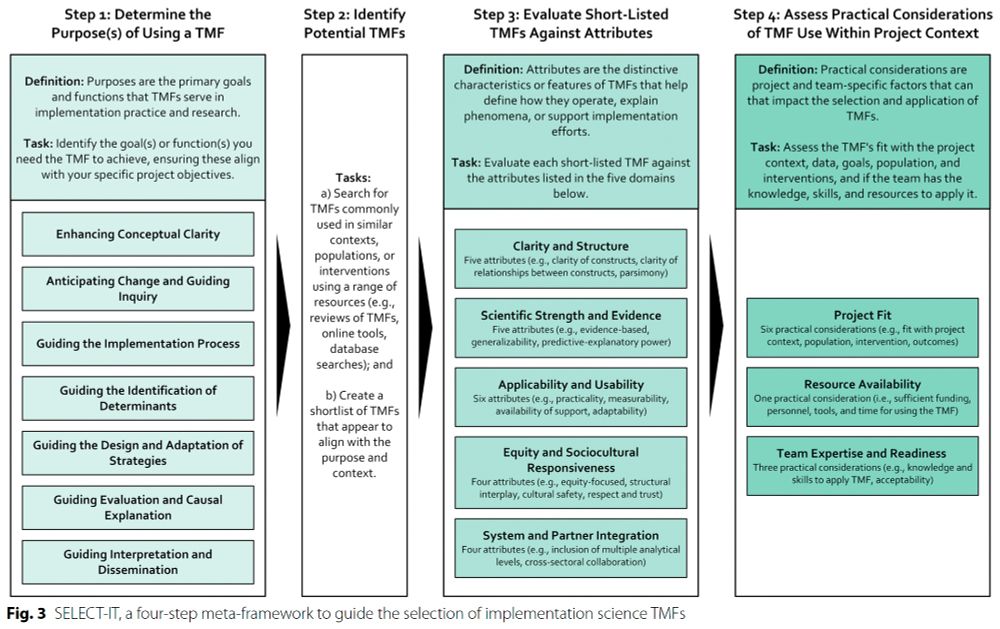
How do you decide which theory, model, or framework (TMF) should guide your next implementation project? Our team has just published SELECT-IT in @implementsci.bsky.social — a four-step meta-framework that turns that question into a replicable process: doi.org/10.1186/s130... @jgrimshaw.bsky.social
28.05.2025 16:05 —
👍 13
🔁 10
💬 0
📌 0

Introduction to Causal Data Analysis & Modeling with Coincidence Analysis
Learning causal data analysis with Coincidence Analysis from the ground up.
www.uib.no/en/cna/17272...
Looking forward to meeting researchers from around the world at the upcoming 4-day CNA workshop in Copenhagen on 19 May 2025, immediately followed by the 2-day CNA conference on 23 May. This is the only training of its kind in the world and led by Michael Baumgartner.
05.05.2025 16:50 —
👍 2
🔁 2
💬 0
📌 0

Just attended CNA(coincidence analysis) workshop in Copenhagen. Met a lot of smart and interesting people, learned a lot and I can’t wait to digg into the method. @cna-method.bsky.social
24.05.2025 12:31 —
👍 4
🔁 2
💬 0
📌 0

It's crunch time for participants in the 2025 European Implementation Event #EIE2025! 🙃 If your dance card is empty from June 4 to 6, join us! We have a packed program for you: implementation.eu/eie2025-prog... #ImpSci
23.05.2025 05:58 —
👍 3
🔁 1
💬 0
📌 0
Extremely proud of PhD student Laura Caci, who has led this work on "Organizational readiness for change: A systematic review of the healthcare literature" - more exciting publications to follow! #ImpSci journals.sagepub.com/doi/10.1177/...
16.05.2025 07:34 —
👍 8
🔁 4
💬 0
📌 0