Pleased to share our new pre-print on inter-household networks of ESBL-producing E. coli in rural Malawi.
Coupled genomic and spatial analyses show that people in nearby households are often colonised by the same #AMR strains, highlighting transmission beyond individual homes.
tinyurl.com/5fsbv6n4
16.02.2026 15:18 —
👍 0
🔁 0
💬 0
📌 0

Volume 381 Issue 1941 | Philosophical Transactions of the Royal Society B | The Royal Society
Influential themed journal issues across the life sciences.
The work was conducted as part of the HUGS (Hybridisation in Urogenital Schistosomiasis) study in southern Malawi. Several other papers from the HUGS study, and related work by other groups, are featured in the same theme issue
royalsocietypublishing.org/rstb/issue/3...
08.01.2026 11:40 —
👍 0
🔁 0
💬 0
📌 0
These patterns raise important questions about current diagnostics and clinical morbidity in zoonotic schistosome transmission zones across Africa.
08.01.2026 11:40 —
👍 0
🔁 0
💬 1
📌 0
In this larger cohort of children, we frequently detected DNA from classically urogenital (S. haematobium) and livestock-associated (S. mattheei) schistosome species in faeces, and identified potential cross-species interactions that may influence worm migration.
08.01.2026 11:40 —
👍 0
🔁 0
💬 1
📌 0

Unexpected Zoonotic and Hybrid Schistosome Egg Excretion Patterns, Malawi, 2024
Unexpected Zoonotic and Hybrid Schistosome Egg Excretion Patterns, Malawi, 2024
This work builds on the case reports published last year in Emerging Infectious Diseases, where we first reported atypical eggs from the Schistosoma haematobium group detected in faeces in Mangochi District, Malawi
wwwnc.cdc.gov/eid/article/...
08.01.2026 11:40 —
👍 0
🔁 0
💬 1
📌 0

Graphical Abstract: The transfer of antimicrobial resistance genes (ARGs) from environmental microbes to pathogens is a critical but underexplored One Health driver of antimicrobial resistance. Here, we evaluate freshwater snails, which are geographically widespread aquatic invertebrates, as environmental reservoirs of ARGs. We collected faeces from eight gastropod genera at 15 freshwater locations across Malawi, Uganda, Zanzibar and the UK and conducted the first freshwater snail faecal metagenomic study.
Freshwater snail faecal metagenomes reveal environmental reservoirs of antimicrobial resistance genes across two continents. Read the full article in MGen: doi.org/10.1099/mgen... #MGen
17.09.2025 11:02 —
👍 6
🔁 3
💬 0
📌 0
@gcagatgcaatg.bsky.social @russstothard.bsky.social
21.08.2025 10:51 —
👍 0
🔁 0
💬 0
📌 0

Excited to share our new paper in Microbial Genomics! We studied freshwater snail faecal microbiomes in Malawi, Uganda, Zanzibar & the UK, and found #AMR gene reservoirs posing risks where human, animal and environmental health intersect 🐌💩
Read here ➡️ www.microbiologyresearch.org/content/jour...
21.08.2025 10:51 —
👍 4
🔁 1
💬 2
📌 1
YouTube video by MicrobesNG
Living Liverpool - a microbial map of the city
🚨 NEW VIDEO DROP 🚨
We love supporting our customers with complex sequencing projects! Take a look behind-the-scenes at a unique project from Adam Robert’s team at LSTM!
They collected 125 samples —from lakes to benches & bins—to build a microbial map of Liverpool 🏙️🦠
🎬 youtu.be/dVLKp9RsRYs #MicroSky
13.05.2025 11:13 —
👍 1
🔁 1
💬 1
📌 0
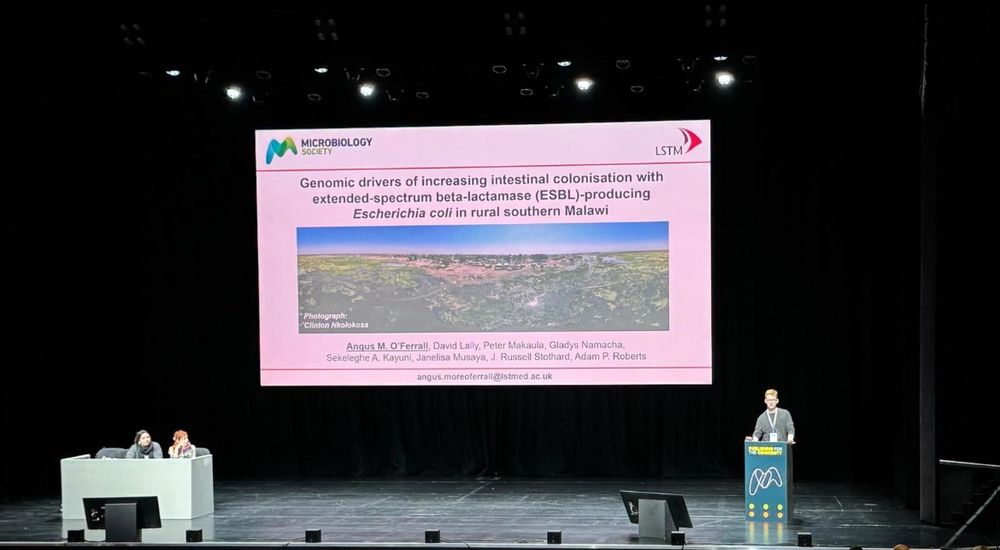
Grateful for the chance to present in the Knocking Out #AMR forum at @microbiologysociety.org annual conference #Microbio25
Looking forward to building on this work with colleagues in Malawi for positive public health impact
02.04.2025 08:46 —
👍 8
🔁 1
💬 0
📌 0
Freshwater snail faecal metagenomes reveal environmental reservoirs of antimicrobial resistance genes across two continents https://www.biorxiv.org/content/10.1101/2025.02.26.640299v1
27.02.2025 03:17 —
👍 1
🔁 1
💬 0
📌 0
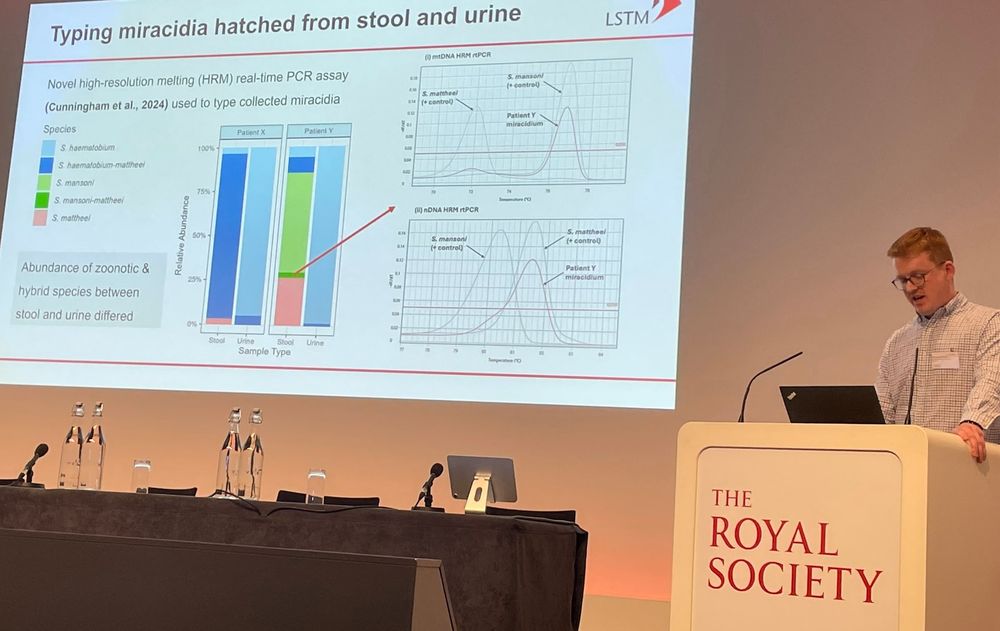
The HUGS team from LSTM were at the Royal Society earlier this month for a focused meeting on hybrid schistosomes in Africa.
Improved disease control in animals - a tough but crucial step towards elimination.
We wrote a short blog of our activities there: www.lstmed.ac.uk/news-events/...
17.02.2025 10:31 —
👍 0
🔁 0
💬 0
📌 0