Leah McPhillips's Avatar

Leah McPhillips

@leahmcphillips.bsky.social

Microbiology PhD student in Tung Le’s lab at the John Innes Centre - interested in all things Streptomyces and plasmid related πŸ”¬πŸ§« She/Her

64 Followers  |  98 Following  |  11 Posts  |  Joined: 26.02.2025
Posts Following

Posts by Leah McPhillips (@leahmcphillips.bsky.social)

Preview
PhD Scholarship at Monash University - MACSYS Do cutting-edge research at the intersection of cryo‑EM, genome-wide profiling, and AI-driven modelling. Work with world‑class cryo-EM/cryo-ET imaging and AI tools to discover how the dangerous bacter...

Come do a PhD with me and @trevor-lithgow.bsky.social at @monashuniversity.bsky.social ! We’re at the leading edge of pathogen biology using cutting edge Cryo-EM and AI-driven genetic screens to uncover the mysteries of outer membrane biology. Reach out to me for a chat!

macsys.org/phd-scholars...

25.02.2026 06:48 β€” πŸ‘ 16    πŸ” 17    πŸ’¬ 0    πŸ“Œ 0

Enjoy all the BBQing from your desk!!

24.01.2026 10:38 β€” πŸ‘ 0    πŸ” 0    πŸ’¬ 0    πŸ“Œ 0

Yay huge congrats Tom and everyone involved!

16.12.2025 09:08 β€” πŸ‘ 2    πŸ” 0    πŸ’¬ 0    πŸ“Œ 0
Post image

Delighted to see the main work from my PhD finally published in @mbio.bsky.social! It all started with the observation that deleting the cutRS two-component system in S. venezuelae caused this amazing explorer phenotype in the presence of glucose. But what was going on?! (1/n)

16.12.2025 02:40 β€” πŸ‘ 42    πŸ” 18    πŸ’¬ 1    πŸ“Œ 2
The conserved two-component systems CutRS and CssRS control the protein secretion stress response in Streptomyces

Very happy to see this remarkable work published. Led by @tommclean.bsky.social and @ainsley-beaton.bsky.social. We show how Streptomyces bacteria sense & respond to misfolded secreted proteins. A great collaboration with @barriewilks.bsky.social

#microsky

1/2

journals.asm.org/doi/epub/10....

15.12.2025 14:39 β€” πŸ‘ 25    πŸ” 18    πŸ’¬ 1    πŸ“Œ 0
Preview
Stable inheritance of the Streptomyces linear plasmid SCP1 by dual ParABS partition systems Low-copy-number plasmids often rely on dedicated maintenance mechanisms, such as partitioning systems, to ensure stable inheritance across generations. These partition systems actively segregate siste...

And lots more to unpack! Find the preprint here!

www.biorxiv.org/content/10.6...

11.12.2025 13:36 β€” πŸ‘ 1    πŸ” 0    πŸ’¬ 0    πŸ“Œ 0

🧡 7/7 Despite this, both SCP1 ParBs behave like canonical CTPase ParBs, and have exquisite DNA-binding specificity for their parS sites, highlighting how these systems can coexist on one plasmid. But, when put to the test, only the ParB1 protein, not the ParB2 protein, contributed to SCP1 stability.

11.12.2025 13:33 β€” πŸ‘ 1    πŸ” 0    πŸ’¬ 1    πŸ“Œ 0

🧡 6/7 However, the SCP1 ParBs had less conserved CTPase domains, suggesting they may deviate in their ability to bind/hydrolyse CTP. Are both the SCP1 ParBs bona fide ParB partitioning proteins? And moreover, do they actually play a role in maintaining SCP1 in its multicellular Streptomyces host?!

11.12.2025 13:33 β€” πŸ‘ 1    πŸ” 0    πŸ’¬ 1    πŸ“Œ 0
Post image

🧡 5/7 Enter SCP1! It’s a fascinating plasmid for many reasons. Historically, it’s been so important for our understanding of Streptomyces genetics, it encodes an antibiotic biosynthetic gene cluster, it’s linear, but most interestingly of all, it has not one but two type I HTH-ParB systems.

11.12.2025 13:32 β€” πŸ‘ 2    πŸ” 0    πŸ’¬ 1    πŸ“Œ 0

🧡 4/7 The most common combo was two type I HTH-ParB systems. These systems have a CTP-dependent molecular switch, ParB, which binds CTP through a highly conserved CTPase domain. To investigate how two type I HTH-ParB systems can coexist on a single plasmid, we needed a plasmid to study!

11.12.2025 13:31 β€” πŸ‘ 1    πŸ” 0    πŸ’¬ 1    πŸ“Œ 0
Post image

🧡 3/7 We set out to identify diverse plasmids encoding partition systems and found many plasmids didn’t just have one system, they had multiple! And they often had multiple of the same partition system type. In theory, this could actually disrupt plasmid partition if these systems overlapped!!

11.12.2025 13:30 β€” πŸ‘ 1    πŸ” 0    πŸ’¬ 1    πŸ“Œ 0
Post image

🧡 2/7 But what about their distribution across wider bacterial diversity? And how do these systems maintain plasmids in bacteria that do not divide by binary fission, such as Streptomyces, which have a complex filamentous life cycle?

11.12.2025 13:29 β€” πŸ‘ 5    πŸ” 1    πŸ’¬ 1    πŸ“Œ 0
Post image

🧡 1/7 Plasmid partition systems segregate plasmid copies during cell division. There are several evolutionarily distinct partition system types and we understand (relatively) well the distribution of these types and how they function in unicellular bacteria, namely in enterobacteria such as E. coli.

11.12.2025 13:28 β€” πŸ‘ 1    πŸ” 0    πŸ’¬ 1    πŸ“Œ 0
Preview
Stable inheritance of the Streptomyces linear plasmid SCP1 by dual ParABS partition systems Low-copy-number plasmids often rely on dedicated maintenance mechanisms, such as partitioning systems, to ensure stable inheritance across generations. These partition systems actively segregate siste...

πŸ“„ Delighted to share that the preprint of my main PhD work is out now!

πŸ‘ A huge thank you to everyone involved, @tommclean.bsky.social, Govind Chandra, Ngat Tran (both not on BlueSky) and especially my PhD supervisor @tunglejic.bsky.social πŸ‘

🧡 below!

www.biorxiv.org/content/10.6...

11.12.2025 13:25 β€” πŸ‘ 25    πŸ” 15    πŸ’¬ 1    πŸ“Œ 1
Professor Mark Buttner

Professor Mark Buttner

NEWS - Professor Mark Buttner receives Marjory Stephenson Prize 2026

Professor Buttner, one of our Emeritus Fellows, has received the @microbiologysociety.org Marjory Stephenson Prize for 2026. Congratulations Mark! πŸ‘

Read about his exceptional research and career: www.jic.ac.uk/news/profess...

11.12.2025 12:12 β€” πŸ‘ 41    πŸ” 5    πŸ’¬ 0    πŸ“Œ 2
Preview
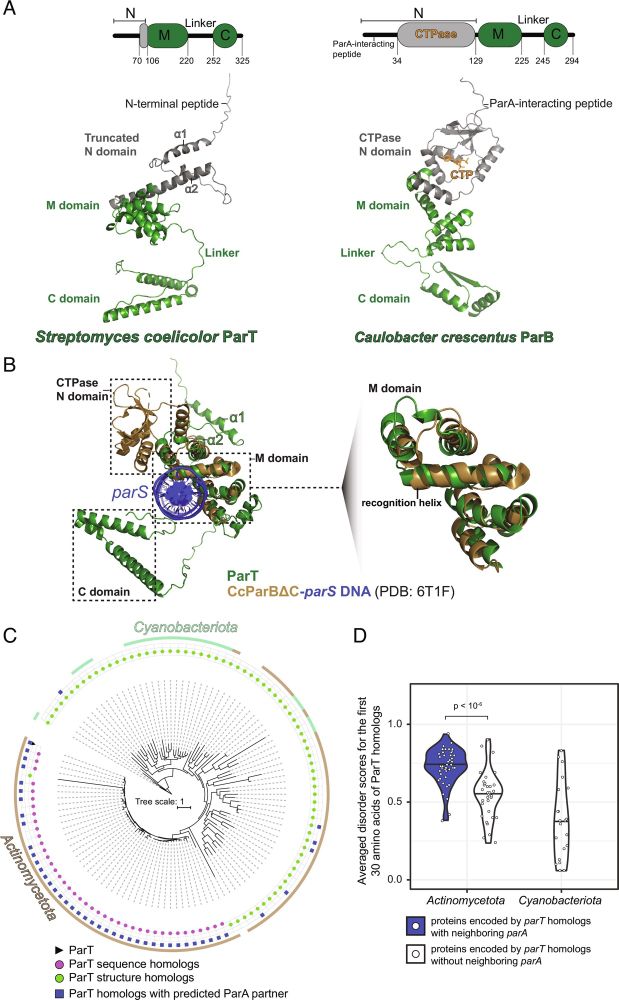
Versatile NTP recognition and domain fusions expand the functional repertoire of the ParB-CTPase fold beyond chromosome segregation | PNAS Nucleotide triphosphate (NTP)-dependent molecular switches regulate essential cellular processes by cycling between active and inactive states thro...

Our preprint is now published in PNAS! This came together thanks to a great collaboration with Antoine Hocher and a strong team effort from the Le Lab. Thank you to the reviewers and to everyone who helped improve it. I hope ParB aficionados will enjoy it.

www.pnas.org/doi/10.1073/...

04.12.2025 20:10 β€” πŸ‘ 35    πŸ” 18    πŸ’¬ 2    πŸ“Œ 1

Bacteriologists - save the date for the next BacNet meeting in September 2026 #BacNet26 organised by @lalouxlab.bsky.social

20.11.2025 08:58 β€” πŸ‘ 22    πŸ” 8    πŸ’¬ 0    πŸ“Œ 0
Preview
Beyond Immunity: Uncovering the Hidden Diversity of Bacterial NLRs (SCHLIMPERT_J26DTP) | Doctoral Training Partnership Join us in exploring the hidden functions of ancient immune proteins in bacteria. Bacteria, like plants and animals, have evolved sophisticated systems to detect and respond to threats.

We have a PhD opportunity available in our group @johninnescentre.bsky.social through the NRP Doctoral Training Partnership. Help us uncover the Hidden Diversity of Bacterial NLRs.

Start date: October 2026. For more information and how to applyπŸ‘‰ biodtp.norwichresearchpark.ac.uk/projects/bey...

13.10.2025 06:46 β€” πŸ‘ 31    πŸ” 40    πŸ’¬ 0    πŸ“Œ 0
Preview
Versatile NTP recognition and domain fusions expand the functional repertoire of the ParB-CTPase fold beyond chromosome segregation Nucleotide triphosphate (NTP)-dependent molecular switches regulate essential cellular processes by cycling between active and inactive states through nucleotide binding and hydrolysis. These mechanis...

new preprint from our group & Antoine Hocher: www.biorxiv.org/content/10.1...
A fantastic collaboration with Antoine, with Jovana Kaljevic' initiated the collaboration and drives the project.

11.10.2025 11:36 β€” πŸ‘ 67    πŸ” 34    πŸ’¬ 3    πŸ“Œ 3
Preview
Expanding the diversity of bacterial DNA partitioning: A CTP-independent ParABS system for plasmid partitioning in Streptomyces | PNAS The ATP- and CTP-dependent ParA-ParB-parS segrosome is a macromolecular complex that segregates chromosomes/plasmids in most bacterial species. CTP...

Finally published! Many thanks to the reviewers and editor whose comments & suggestions improved this work significantly more than the first preprint version!!!

www.pnas.org/doi/10.1073/...

02.07.2025 17:49 β€” πŸ‘ 49    πŸ” 20    πŸ’¬ 1    πŸ“Œ 2
Preview
A bacterial CARD-NLR immune system controls the release of gene transfer agents Bacteria have evolved a wide array of immune systems to detect and defend against external threats including mobile genetic elements (MGEs) such as bacteriophages, plasmids, and transposons. MGEs are ...

1/ Excited to share our latest work on gene transfer agents (GTAs) in Caulobacter crescentus, led by Emma Banks in collaboration with Pavol Bardy and Mai Nguyen from York!!! See a brief thread below.
shorturl.at/o6S1w

09.05.2025 08:08 β€” πŸ‘ 86    πŸ” 38    πŸ’¬ 2    πŸ“Œ 7