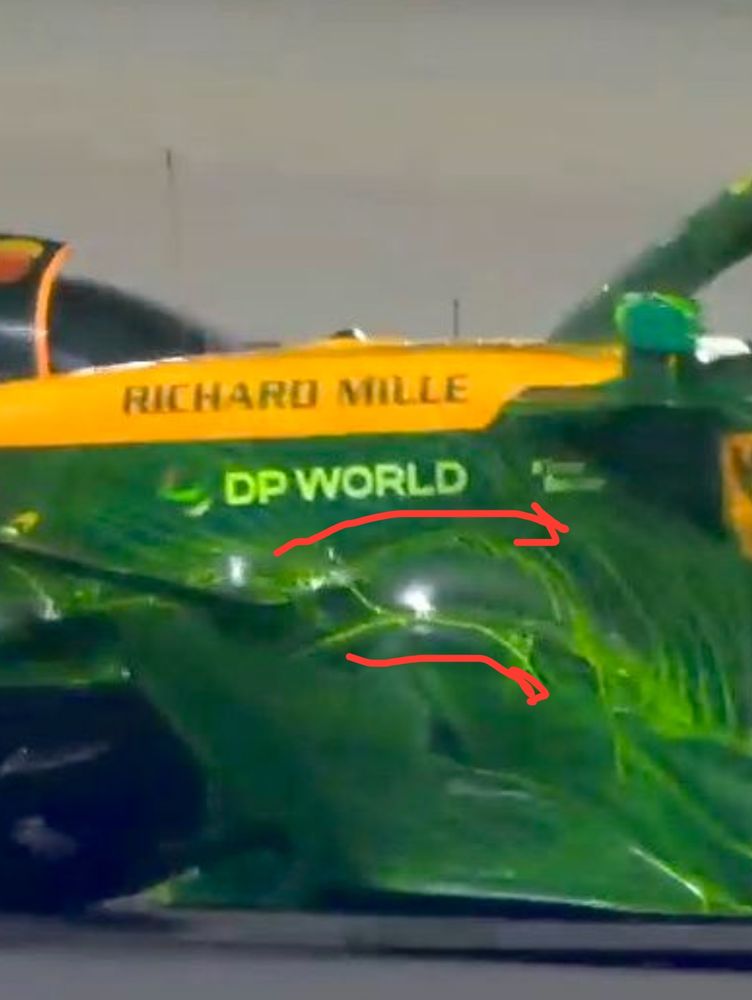
Vortices are hard to see from Flow Vis, but I believe that the below image is showing some swirl or rotation at this exact location of the training edge of the upwashing junction. Theory supported? 🤓
Flow Vis image from Floorent Gooden on instagram.
30.06.2025 14:55 —
👍 4
🔁 1
💬 0
📌 0
In my analysis of the McLaren MCL39 FSUS junction update, I had questioned if the new aggressive upwashing junctions might shed a small vortex that could re-energize the slow moving boundary layer along the nose.
30.06.2025 14:55 —
👍 7
🔁 3
💬 1
📌 0

.. This larger merged vortex stays outboard of the front Tyre and downwashes air onto the outboard Tyre jet which can help to suppress and dissipate it quicker reducing any negative influence it may have on your floor edge downstream.
13.06.2025 20:41 —
👍 8
🔁 1
💬 0
📌 0

McLaren introduced a new front wing with some interesting little end element winglets. IMO, these aren’t really wings generating much load. They are more vortex generators shedding counter-clockwise small vortices that all co-rotate and merge downstream…cont
13.06.2025 20:41 —
👍 12
🔁 1
💬 1
📌 0
Most definitely. Overheating quite often
11.04.2025 02:23 —
👍 1
🔁 0
💬 0
📌 0


Heck of a glow up for McLaren from 2022 to present on the front brakes. From a liability to an advantage. That’s just great engineering folks!
10.04.2025 21:04 —
👍 10
🔁 2
💬 2
📌 0

I think that these vortices will detach and be counter rotating with bulk outwash btwn them. The benefit of this could be creating more outwash using the side pod for the upper front tyre wake. It's a really interesting design, and I wonder if more teams could be looking at this option as well.
27.03.2025 16:39 —
👍 4
🔁 0
💬 0
📌 0
Obv, having the CFD would help, but I think that the inlet pressure is > than the local pressure on either side. The upper edge will have the downwash from the shark inlet, so ⬇️ P. The bottom edge could just be marginally less, even though you will have some forward undercut pressure built up here.
27.03.2025 16:39 —
👍 6
🔁 0
💬 1
📌 0
Both of the extended upper and lower edges look like vortex shedding edges. So it's safe to say that there is some rotation along these edges. But how to resolve the direction?
27.03.2025 16:39 —
👍 1
🔁 0
💬 1
📌 0
Been thinking about this new Sauber Side Pod intake since I first saw it. Pretty cool little design. Here is what I THINK is happening. 🧵
27.03.2025 16:39 —
👍 10
🔁 1
💬 1
📌 0
So tribal. Even creators and analysts arguing with one another
14.03.2025 16:18 —
👍 1
🔁 0
💬 0
📌 0
..while still holding the mid wake of the front tyre outboard. A wonderful example of aero driven packaging.
13.03.2025 18:44 —
👍 4
🔁 0
💬 0
📌 0

The space between the rads and the exhaust headers is where the depression is in the sidepod, with the headers forming the “tail” of the tadpod. This allows Merc to maximize the downwash of the sidepod transition into the rear coke, and slim the shape of outboard sidepod volume maximizing undercut..
13.03.2025 18:44 —
👍 4
🔁 0
💬 1
📌 0
Some are calling the new Mercedes W16 side pod the “tadpod” as it looks like the shape of a tadpole. Pitlane shots from Albert Park now shows how Mercedes did this. You can see the “belly” of the tadpole shape where the rads are located and stacked.
13.03.2025 18:44 —
👍 13
🔁 1
💬 1
📌 0

For the blue arrow, we can also see a bit of the boundary layer as the slower moving air upstream of the suspension junction doesn't have as much paint. The influence of the solid body creates an upstream pressure build up that helps to deflect some of the air around it. @xavigazquez.bsky.social
08.03.2025 09:26 —
👍 4
🔁 0
💬 0
📌 0
LOVE FLOW VIS!! RB21 here...
Red arrow shows that the aero neutral suspension arms aren't as down washing as some might expect. This shows an upwards trajectory after the rear leg from the flow coming off the front wing. We do see some downward deflection from the flow UNDER the trailing arm.
08.03.2025 09:26 —
👍 12
🔁 1
💬 1
📌 0
Just so happens @mollym-o.bsky.social and I just recorded the next episode of the @brakingbiaspod.bsky.social today! We talk exactly about this! Episode will be out soon and we both go into detail on it!
05.03.2025 01:47 —
👍 1
🔁 0
💬 0
📌 0
Also, you would not run a RW flow vis with DRS open. It’s a time averaged flow field visualization, and you wouldn’t change the flow fields this drastically for time averaged results. You would get a jumbled mess. Also validated by F1Talks on X that it was indeed closed.
05.03.2025 00:08 —
👍 4
🔁 0
💬 1
📌 0

So to see these two regions of what looks like high shear, and a clear line of flow pattern difference just sparked my curiosity. Not saying this is 100% mini-DRS, nor do I know for sure what it is. But even speaking with other aero’s it’s very curious.
05.03.2025 00:08 —
👍 4
🔁 0
💬 1
📌 0
When I first saw the flow vis posted by @xaviimages I knew something was a bit off. It’s not typical that you see these types of patterns. Even with the new cut end wings (see MCL from 2023) the junction from where the DRS and end piece meet is usually uniform and neat…
05.03.2025 00:08 —
👍 11
🔁 2
💬 2
📌 0

Hell of a week last week huh? 😂😂
03.03.2025 03:31 —
👍 12
🔁 0
💬 0
📌 0

A good look at how the Mercedes W16 forward floor is working. Pretty standard solutions today using a small forward edge gurney, and integrated curl with VG's on the edge wing. Always a good thing to explain for some that may not have seen this before.
27.02.2025 16:24 —
👍 9
🔁 1
💬 0
📌 0

Really interesting look here at the RB21 G-Line. There seems to be a slight bulge maybe in the floor (Blue) which funnels the floor edge wing inflow into a particular position. Possibly some influence from the forward curl? The mechanics here are fascinating.
27.02.2025 16:23 —
👍 7
🔁 1
💬 0
📌 0

Then along the g-line we can see the outwash of air pulled down into the floor edge wing. More than likely spinning up some structures that load up the floor edge and clean up the diffuser. (Lower arrows)
26.02.2025 18:21 —
👍 6
🔁 0
💬 0
📌 0
Then here we can see the air from alongside the center cooling box migrating down into the water slide where low pressure suction is building as it ramps down. (Top arrow)
26.02.2025 18:21 —
👍 6
🔁 0
💬 1
📌 0
and the higher pressure at the SP inlet and under wing then pushing this air down onto the floor top deck and into the undercut. It’s clear as day.
26.02.2025 18:21 —
👍 2
🔁 0
💬 1
📌 0
A good photo from Mateusz M on X where we can draw a few observations from this. Firstly, we can see the influence of the floor leading edge in helping to upwash some of the inboard air from the nose and FW,
26.02.2025 18:21 —
👍 29
🔁 7
💬 1
📌 0
I used to teach children on Sunday mornings and enjoyed it. I thought about maybe making a kids series as well.
25.02.2025 23:37 —
👍 1
🔁 0
💬 0
📌 0

Williams gave us a nice shot of this with some of their flow vis during testing in 2024. You can see the additional challenge of the push rod front suspension with the quite complex junction geometry. This is the cool stuff we have to look forward to in testing next week!!
23.02.2025 17:34 —
👍 7
🔁 0
💬 0
📌 0

Nice graphic showing the types of vortices that can be formed at the junction of two surfaces. Easy to see this as an example of the a-arm fairing junction with the monocoque. Without junction fairings (gaiters or flexis) the losses could be disruptive to distress aero elements
23.02.2025 17:34 —
👍 10
🔁 1
💬 1
📌 0